

 Explore Worlds
 Find Life
 Defend Earth

Planetary Radio • Apr 15, 2026
Triumph and turmoil: Artemis II and the renewed fight to save NASA science
On This Episode

Jack Kiraly
Chief of Advocacy for The Planetary Society

Ari Koeppel
Policy and Advocacy Fellow for The Planetary Society
Bruce Betts
Chief Scientist / LightSail Program Manager for The Planetary Society

Sarah Al-Ahmed
Planetary Radio Host and Producer for The Planetary Society
Also in this episode:
- Reid Wiseman, Commander, Artemis II
- Victor Glover, Pilot, Artemis II
- Christina Koch, Mission Specialist, Artemis II
- Jeremy Hansen, Mission Specialist, Artemis II
- Jenni Gibbons, Capcom, Artemis II
The Artemis II crew has returned home safely after a historic 10-day journey around the Moon, the first crewed lunar mission in over 50 years. In this episode, we celebrate some of the mission's most extraordinary moments: the record-breaking Flight Day 6 when Commander Reid Wiseman, Pilot Victor Glover, and Mission Specialists Christina Koch and Jeremy Hansen traveled farther from Earth than any humans in history, a breathtaking solar eclipse observed from lunar orbit, meteorite impact flashes spotted on the lunar surface, and a deeply personal crater dedication that moved the world.
But the triumph comes with turbulence. Just days after launch, the White House released a Presidential Budget Request proposing a 47% cut to NASA's science budget — threatening 84 missions and nearly half of NASA's science portfolio. Jack Kiraly, Director of Government Relations at The Planetary Society, and Ari Koeppel, AAAS Science and Technology Policy Fellow, join host Sarah Al-Ahmed to break down what's at stake and what's being done about it. Plus, Chief Scientist Bruce Betts joins for this week's What's Up.


Related Links
- NASA's Artemis II Mission Coverage - YouTube
- Artemis II blasts off, sending humans back to the Moon
- The best images from Artemis II
- Artemis, NASA's Moon landing program
- The Artemis II mission: What to expect
- What's keeping the Artemis astronauts safe?
- Artemis II Science - NASA
- ARCHeR - NASA
- Artemis II Crew Both Subjects and Scientists in NASA Deep Space Research
- Artemis II Crew to Advance Human Spaceflight Research - NASA
- Immune Biomarkers - NASA
- NASA Artemis II Science | AVATAR (A Virtual Astronaut Tissue Analog Response)
- Risk from Inadequate Sleep and Irregular Schedules - NASA
- Risk of behavioral changes and psychiatric disorders - NASA
- Risk of inadequate teamwork - NASA
- Planetary Radio: Artemis II and III: The science that brings us back to the Moon
- Planetary Radio: Artemis update: NASA reshapes the road back to the Moon
- Job opening: Senior Executive Assistant
- 82 NASA missions at risk under new proposal
- What is the skinny budget and what does it mean for NASA?
- Your Guide to NASA's Budget
- Save NASA Science
- Donate to our advocacy efforts
- The Planetary Society shop
- The Night Sky
- The Downlink
Transcript
Sarah Al-Ahmed:
Humans just traveled farther from earth than ever before. Meanwhile, the president's budget request in the United States proposed cutting nearly half of NASA's science budget. We're calling on space advocates everywhere this week on Planetary Radio. I'm Sarah Al-Ahmed of The Planetary Society with more of the human adventure across our solar system and beyond. Four astronauts just made history, traveling farther from earth than any humans ever have. We'll relive some of the most breathtaking moments of the Artemis II mission with Commander Reid Wiseman, Pilot Victor Glover, and mission specialists, Christina Koch and Jeremy Hansen.
They'll share their experiences with the solar eclipse from deep space, meteorite impacts on the lunar surface, and a deeply personal tribute to a loved one memorialized forever on the moon. Then Planetary Society Director of Government Relations, Jack Kiraly, and AAAS Science and Technology Policy Fellow, Ari Koeppel, join us to sound the alarm about the president's fiscal year 2027 budget request. It proposes eliminating nearly half of NASA's science portfolio. And of course, we'll wrap up with what's up with our chief scientist, Dr. Bruce Betts. If you love Planetary Radio and want to stay informed about the latest space discoveries, make sure you hit that subscribe button on your favorite podcasting platform.
By subscribing, you'll never miss an episode filled with new and awe-inspiring ways to know the cosmos and our place within it. Before we get into the main topics of today's show, we have an exciting opportunity to share. The Planetary Society is looking for a senior executive assistant to support our new CEO, Jen Vaughn. It's one of those high trust roles that spans everything from calendar management and board coordination to cross-team project support. If you're an experienced executive assistant who's passionate about our organization's mission and wants to work from our beautiful headquarters in Pasadena, California, we'd love to hear from you.
But the application deadline is coming up quickly on April 22nd. You can find the full job posting details on how to apply at planetary.org/careers. Man, what a week. It's been such an adventure watching the Artemis II crew finally journey around the moon and back to earth. And I could not be happier that they returned safe and sound to our home planet. There's something just so triumphant about it. Not just humanities returned to the moon for the first time in over five decades, but after the disasters of Challenger and Columbia and every other reminder of how unforgiving space can be.
It's just so relieving to have watched them splash down safely off the California coast. I'm so proud of everyone who made this mission possible. For those of you who haven't been following along with this space adventure, Artemis is NASA's program to return humans to the moon. Artemis II is the first crude mission in that program and the most ambitious human space flight in a generation. The mission launched on April 1st, 2026 aboard the Space Launch System Rocket and the Orion Spacecraft. Every Apollo crew before named their spacecraft, and this crew carried on that tradition, they named theirs Integrity.
Commander Reid Wiseman, Pilot Victor Glover, and mission specialists, Christina Koch and Jeremy Hansen weren't just testing hardware. They were reopening a door humanity had left closed for over half a century. And then on April 6th, the crew broke the record for the farthest humans have ever traveled from earth. CAPCOM, Jenni Gibson announced that the crew had broken the record set by the Apollo 13 crew. Commander Reid Wiseman answered for the crew and then passed the moment on to Jeremy Hansen.
Jenni Gibbons: Integrity Crew. On April 15th, 1970, during the Apollo 13 mission, three explorers set the record for the farthest distance humans have ever traveled from our home planet. At that time, over 55 years ago, Lovell, Swigert, and Haise flew 248,655 statute miles away from earth. Today, for all humanity, you're pushing beyond that frontier. Integrity, over to you.
Jeremy Hansen:
Yeah, from the cabin of Integrity here as we surpass the furthest distance humans have ever traveled from planet earth. We do so in honoring the extraordinary efforts and feats of our predecessors in human space exploration. We will continue our journey even further into space before Mother Earth succeeds in pulling us back to everything that we hold dear. But we most importantly choose this moment to challenge this generation and the next to make sure this record is not long-lived. And we have a couple more things we'd like to take this moment for.
Our science team helped us out with a couple of relatively fresh craters on the moon that have not been previously named, and our crew would like to propose a couple of potential names for those items or those areas. And we spent a bit of time this morning looking out the window and we're able to see them now, both with our naked eye and through the long lens. The first one we'd like to suggest is a named crater in honor of our great spacecraft Integrity. And so, if you were to look at Oriental on the far side and then draw a line straight up to Ohm on the far side, relatively in the middle is an unnamed crater and we would like to suggest it be called Integrity in the future.
And the second one, and especially meaningful for this crew, is a number of years ago we started this journey in our close-knit astronaut family, and we lost a loved one. And there's a feature in a really neat place on the moon, and it is on the near side, far side boundary. In fact, it's just on the near side of that boundary, and so at certain times of the moon's transit around earth, we will be able to see this from earth. And so, we lost a loved one, her name was Carol, the spouse of Reed, the mother of Katie and Ellie. And if you want to find this one, you look at Glushko and it's just to the northwest of that at the same latitude as Ohm, and it's a bright spot on the moon. And we would like to call it Carroll, and you spell that C-A-R-R-O-L-L.
Sarah Al-Ahmed:
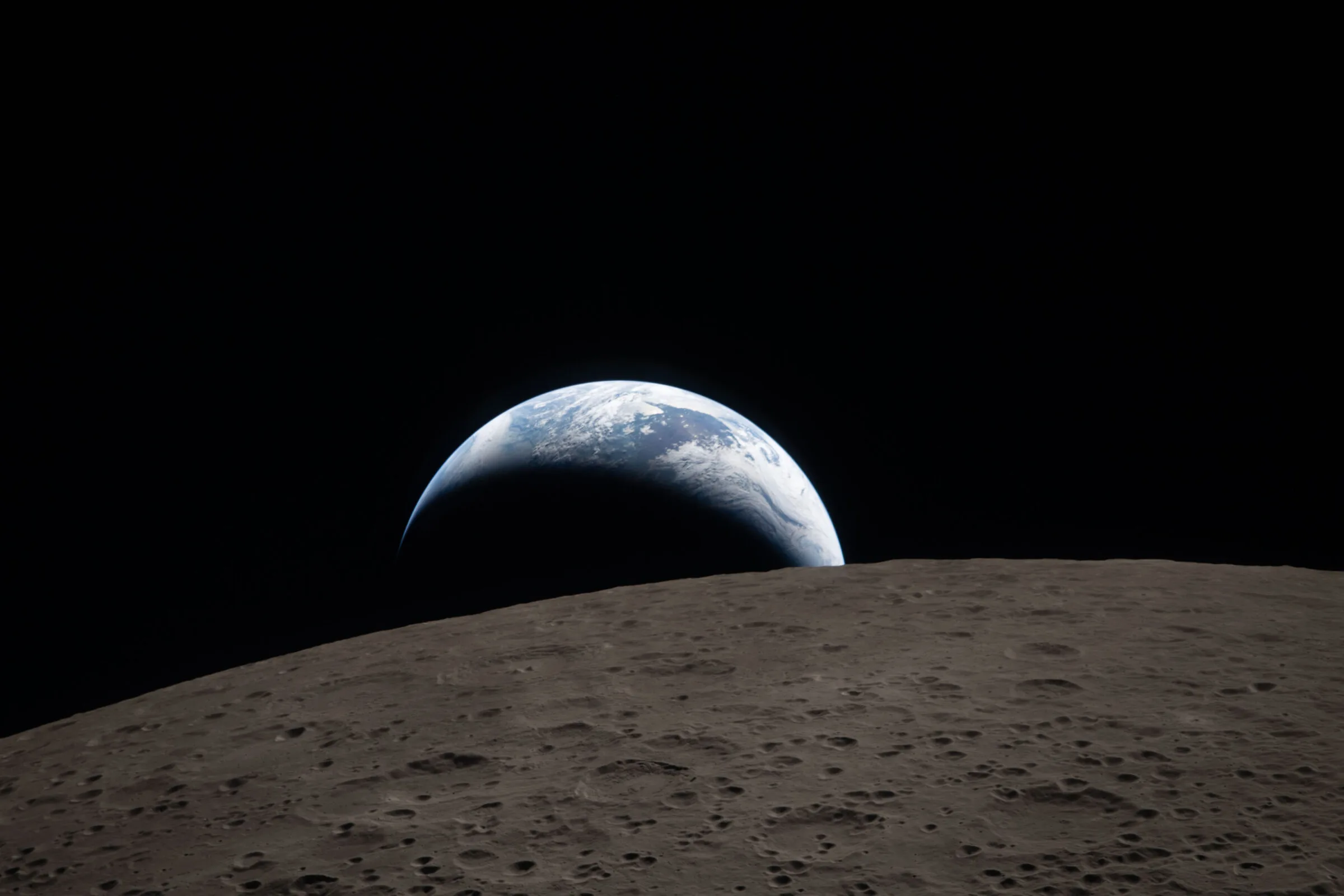
Flight Day number six was a really exciting day for the crew and all of us who are watching back here on earth. Shortly after they broke that distance record, the team found themselves watching something no human had ever seen from that vantage point, a total solar eclipse. The moon covered the sun, setting the solar Corona ablaze around it. And as you'll hear, the crews struggled to find the words to adequately describe the moment. For those of us who have seen a total solar eclipse, we know how spectacular it can be, but seeing it from outer space, from a vantage point that no human ever has in the history of our species has just got to be something really special.
And while they were basking in the shadow of the moon, they actually saw some meteorite impact flashes on the lunar surface, visible with the naked eye. In this clip, you'll hear Pilot Victor Glover describe the eclipse, and then Commander Reed Wiseman report the meteorite impacts as the science team literally jumped for joy back at mission control.
Speaker 4: You're getting a live look from Orion as the crew observes a solar eclipse from the moon.
Victor Glover: Science integrity in the blind, this continues to be unreal. The sun has gone behind the moon and the Corona is still visible and it's bright and it creates a halo almost around the entire moon. But when you get to the earth side, the earth shine has already shown. I mean, almost seconds after the sun set behind the moon, you could see earth shine. The earth is so bright out there and the moon is just hanging in front of us. This black orb out in front of us, in front of now, not the blackness, but the gray that blends and drifts into the blackness. We can see stars and the planets behind it, and it is quite an impressive sight. Wow, it's amazing. We just went sci-fi. It just looks unreal. It is the strangest looking thing that you can see so much on the surface.
Speaker 4: Integrity Science. We were loving your science that reps in the blind and it should come as no surprise that we have a number of follow up questions. First, you mentioned Reid observing meteors. Can you speak to that? Were you referring to comets or impact flashes or something else?
Reid Wiseman: Yeah, there was a little bit of getting this. We have seen three impact flashes so far. I saw two and Jeremy has seen one undoubtedly little ... Jeremy saw two, so that's four total. Undoubtedly quick impact flashes. It was not sun glint off a particulate from the thrusters or the burge tanks. It was definitely impact flashes on the moon and Jeremy just saw another one.
Speaker 4: Amazing news. I literally just looked over at the [inaudible 00:09:57] and they were jumping up and down literally. If you could describe where on the moon you saw them, please.
Reid Wiseman: All right. So, Jeremy has seen them on and south of the equator, spread across the moon and mine were both south of the equator and just a little bit left of center of the moon.
Speaker 4: Incredible news Reid and reminder, we have citizen scientists here on earth looking for impact flashes. So, hearing you saw them on the near side means that people saw them too.
Reid Wiseman: One of the other things I wanted to describe, which was surprising to me, but the entire moon is lit up. It's glowing behind the entire moon. I thought it would look dark against the black sky or deep space, but the sun is lighting up the entire limb of the moon. You can see the entire perimeter of it. And even now with the sun far behind the moon, you can see, you can still make little bits of topography around the entire limb, just bumps as you go around it. Science and Houston integrity, I know this observation won't be of any scientific value, but I'm really glad we launched on April 1st because humans probably have not evolved to see what we're seeing. It is truly hard to describe. It is amazing.
Speaker 4: Victor-
Victor Glover: I'm just doing the best job and I'm not going to try to add onto what he's doing. It's just, it's indescribable. No matter how long we look at this, our brains are not processing this image in front of us. It is absolutely spectacular, surreal, there's no adjectives. I'm going to need to invent some new ones to describe what we are looking at out this window.
Sarah Al-Ahmed: After integrity swung around the far side of the moon, the crew looked back at earth from across that vast distance and sent a message home. Mission specialist Christina Koch spoke directly to the people of earth, reminding all of us why humanity ventures out into the dark in the first place.
Christina Koch: To Asia, Africa, and Oceana, we are looking back at you. We hear you can look up and see the moon right now. We see you too. When we burned this burn towards the moon, I said that we do not leave earth, but we choose it, and that is true. We will explore, we will build, we will build ships, we will visit again. We will construct science outposts, we will drive rovers, we will do radio astronomy. We will found companies, we will boast our industry, we will inspire. But ultimately, we will always choose earth, we will always choose each other.
Speaker 4: Integrity from earth are single system, fragile and interconnected, we copy. Those of us that can are looking back.
Sarah Al-Ahmed: We spent years looking forward to this mission, but every mission has to come to an end. And on April 10th, 2026, after 10 days and many moments that will live forever in the history books, it was time for integrity and her crew to return home. They had one last challenge ahead of them though. A 24,661 mile per hour, that's 39,689 kilometers per hour, plunge through earth's atmosphere. It's not the fastest that humans have ever traveled, but it was really close. Ultimately, the parachutes deployed and they were gently delivered to the Pacific Ocean off the coast of San Diego, California.
Speaker 8: Splashdown confirmed.
Speaker 9: Copy Splashdown, waiting on VLDR.
Speaker 8: Splashdown confirmed at 7:07 PM Central Time, 5:07 PM Pacific Time. From the pages of Jules Vern to a modern-day mission to the moon, a new chapter of the exploration of our celestial neighbor is complete. Integrity's astronauts back on earth.
Speaker 9: Integrity, Houston, comm check on VLDR.
Speaker 10: Houston, we have you loud and clear on VLAR. How us?
Speaker 9: We have you the same. We'll meet you over in post landing.
Speaker 8: Perfect communications established.
Speaker 10: What a journey. We are stable one, four green crew members.
Sarah Al-Ahmed:
There is so much from this mission that we didn't have time to cover in this episode. So, I'm going to label link to NASA's YouTube playlist that includes all of the live streams, but also their compilations of the key moments. You'll be able to find that on the website for this episode of Planetary Radio. But while the crew of integrity was out there sharing all these breathtaking moments with the world, something else was happening back down on earth. On April 3rd, the White House released its presidential budget request for fiscal year 2027, and spoiler alert, it was not good for NASA.
The proposal calls for a 47% cut to NASA's science budget. That's $3.4 billion slashed, 53 missions fully canceled, and another 31 that are at risk. That totals 84 missions under threat. That's essentially half of NASA's entire science portfolio. We're talking about spacecraft that have already been built, already launched, and already making discoveries. For example, new horizons that's still out at the edge of our solar system. The Juno mission that's orbiting Jupiter, and OSIRIS-APEX, which is on its way to intercept the asteroid Apophis. That thing is coming closer to earth than our geostationary satellites, and I'd really like to get a closer look at it.
We got to make sure that's not going to hit earth in another several hundred years. And then of course, the James Webb Space Telescope. It took decades to build and has a limited lifetime in space, yet they're proposing a cut of one third of its entire research budget. And what about the Perseverance Rover on Mars? That Rover found what NASA called the closest we've ever come to discovering life on Mars, and now that Rover is facing a 50% cut. And even more striking is that in response to this budget dropping, 13 astronauts signed a letter to the House and Senate Appropriations Committees opposing these cuts.
I think almost any astronaut will tell you that science and human exploration aren't separate things. You can't really do one without the other. But here's the thing, we've seen all of this before. Last year, the White House proposed almost exactly the same cuts, and The Planetary Society, along with all of our partner organizations, helped people around the world to raise their voices. Ultimately, Congress listened, they rejected those cuts decisively and on a bipartisan basis, 397 to 28 in the House, and 82 to 15 in the Senate.
Do you know how rare it is to see something rejected that resoundly in the United States government? Together, all of us fought to save NASA science and we won, and we're prepared to do it again. In fact, next week we're headed to Washington D.C. for our annual day of action, more prepared than we ever have been to re-join this fight. I'm really looking forward to going on the journey myself, and I want to thank everyone who's going to be helping us there in Washington D.C. and at home. To help us understand exactly what's at stake and what we can do about these proposed cuts, I'm joined by Jack Kiraly, our director of government relations.
And Dr. Ari Koeppel, our AAAS Science and Technology Policy Fellow. Hey, Jack and Ari. Thanks for joining me again.
Ari Koeppel: Hey, Sarah. Good to be here.
Jack Kiraly: Hey, Sarah. Nice to be back with you.
Sarah Al-Ahmed: So, deja vu, right? The band is getting back together. Campaign is back on, and somehow, I feel like none of us are surprised.
Jack Kiraly: No. We had heard rumors that the budget request was going to be a repeat of last year. I just don't think I fully anticipated it to be quite literally copy paste. It seems a little lazy on OMB's part, but we at least have the infrastructure in place this year than trying to spool something up like we had to do last year.
Sarah Al-Ahmed: What are some of the indicators that this is a copy pasted budget? Because I think that was really revelatory for me when Casey started breaking this down in one of our team meetings. I was like, that is quite remarkable.
Jack Kiraly:
Yeah. And Ari's been doing a lot of diving into this budget. I've read it cover to cover once, or you've probably done it three or four times at this point. There's a few markers in there. One of them is just the fact that there are typos riddled throughout where it mentions fiscal year 2026 as the year they're requesting for. Hello, it's fiscal year 2027 that this is the budget request for. And so, throughout the document, there's just instances in which they reference the wrong year. They provide inadequate funding numbers, exact same funding numbers as they provided last year.
Their justifications are almost word for word, though they have removed things, but by and large, there's whole sections of this that were lifted from last year's budget document, which as we all know, was crafted between January and April of last year, just lifted input right on the 2027 letterhead.
Ari Koeppel: And I think it's also worth noting that it's actually a worse version. Its copy pasted, but what we see in this version, rather than explicitly justifying or at least giving a nod to the missions that are going to be canceled potentially by this budget, they're just omitted entirely. We just don't see any mention of those missions at all. And so, it seems like what happened in this budget request is they took all the information from last year and then they just removed the things that we had complained about last year and didn't allow us to complain about them in the same way because they're not actually explicitly mentioned.
Jack Kiraly:
Cancellation by omission, which for those that have not been following the budgeting process in the US, not typical. Typically, the president's budget request, though often different than what Congress ultimately passes and becomes law, typically acknowledges what Congress has done, which was a wholesale rebuke of this proposal last year. And they've had two months since that law was signed, HR 6938, which was the compromise bill that fully funded NASA, NASA Science, National Science Foundation, Office of STEM Engagement, and they've had two months to update this document to reflect those changes as were implemented by the Congress and they didn't.
And it just omits information about key missions that are high priorities for decadal surveys, everything from the Veritas and DaVinci missions just across the board, just a geospace dynamics constellation, the flagship mission for the Heliophysics Division, just not even mentioned as if it was unimportant enough to mention it, even though the top lines are lower for the budget, for each division. And so, it's not like you can say, "Well, the money could potentially be in there." It's like, no, it's just not there. No mention of it, no explanation. They have these whole sections called summary of major changes for each budget line, which is very useful typically.
They're shortened, they're less than a paragraph in some cases. For projects that are very high priority for the science community, things where hardware is actually being built and you're giving no guidance to the agency, you're giving no guidance to Congress and there's no transparency with the public. And so, this is probably, and if Casey were here, he would say this is the most untransparent, I'll say the most opaque budget request that OMB has put out. End of that sentence, period, like in NASA history.
Ari Koeppel:
It's also worth taking just a step back to understand why maybe this happened. And we can't, as analysts and advocates, we can't fully explain all the decisions being made behind the scenes, but we do know that the process of drafting the budget was likely taking place in the fall and into December. Now, if you remember, the congressional budget that ultimately passed for NASA, it didn't pass until January. So, it's likely that this document, as we see it, largely was already completed by the time Congress ultimately rejected the FY26 version. And I point that out not to defend OMB in any way, because as Jack mentioned, they did have two months to revise and modify it, but whether they were willing to actually go back and do that effort is another story.
And as we know, federal agencies right now are facing large workforce shortages. And so, maybe some of that could have played in to the fact that they just went essentially with the budget that they had put in place last year.
Sarah Al-Ahmed: And this was something that Casey and I were speculating on recently. We were talking about Jared Isaacman's announcements about Ignition Day, this very broadened vision of what we're going to be doing on the moon, building a nuclear-powered base up there and sending a bunch of ingenuity like helicopters to Mars. They announced so much all at once and I basically asked him like, "Do you think this is going to be reflected in the budget?" And he said, "No, I'm pretty sure the budget was finished before that." And I'm wondering whether or not the NASA administrator and NASA more broadly thinks maybe they can force this issue a little bit by making these big announcements and then maybe that'll get factored into the budget because they assume that Congress is going to smack this down all over again. It's very difficult to reconcile all of this.
Jack Kiraly:
It is. And I'll say this too, the Ignition Day announcements and announcements made at the end of February by Administrator Isaacman for accelerating the Artemis' timeline included mentions of what will be happening for Artemis VI onward. The president's budget request, this OMB drafted document, basically says Artemis ends at V. And anything beyond that is going to be this kind of vague, maybe commercial procured, maybe government supported. It's this very open-ended plan for a sustainable presence on the moon, which as we've experienced with Apollo, once you stop planning, it doesn't happen. There needs to be intention behind it, these are things that take years to develop. And if we are talking about building a lunar installation, which is really exciting, right?
I don't want to gloss over the fact that that is an excellent step in developing a sustainable presence on the moon, opens up doors for any number of science and engineering disciplines, but without proper planning, that doesn't happen. And I will say that the PBR doesn't really mention any of the ignition day events. It mentions a lunar base camp. Again, it doesn't call it the moon base, it calls it lunar based camp. So again, there's maybe a nomenclature difference too in some of the things that the budget proposes, but doesn't allocate really any resources to it. It's just a vague mention of, "Oh, we'll eventually go do this thing."
The SR1 freedom, the nuclear-powered demonstration mission that would carry the Skyfall mission concept, which is those four ingenuity style helicopters, not mentioned once. Moonfall, again, everything has got to be something fall, I guess, right now. Moonfall, which is supposedly part of this new ignition architecture for Artemis is also not mentioned. Whole swaths of the ignition day plans are just not mentioned at all, which I think goes to show just how out of the loop OMB is on this. And I will say they have lost a lot of credibility both within the administration and with Congress for the way that they've approached cuts to NASA, other federal priorities and just the lack of transparency is not something ... This is not a partisan issue.
Republicans, Democrats, independents on the Hill are frustrated, I think rightfully so, with the lack of transparency. NASA's not submitted a formal budget plan, what they call a spend plan for fiscal year 2026. They needed to do that 45 days, within 45 days of the budget passing. We're well beyond that point. The 2025 spend plan was only submitted three months into fiscal year 2026, so there was no accountability there on the FY 2025 plan. And so, time after time, OMB is demonstrating both a lack of credibility, a lack of transparency, and a general ineptitude that is quite shocking for the federal government.
And so maybe that's part of the plan. It is really shocking for those of us who have followed the budgeting process and understand how it has historically worked, even in times when there's been a contentious relationship between the White House and Congress.
Ari Koeppel:
So, Jack, you mentioned the Ignition event and one thing I found interesting in comparing the overarching themes of the president's budget request and the Ignition event are they both attempt to address an executive order that came out in December, December 18th of last year. And in that executive order, there are highlighted calls for astronauts on the moon before the end of this administration for a refocus on a lunar base, for nuclear power in space, for subsidizing companies that are aiming to test new business models in space. And I think the Ignition event gives us a really exciting vision for addressing those things.
The OMB budget gives us a minimalist dud for addressing those things. And one of the stark elements that was in the executive order that's actually missing from the OMB budget is a goal centered around science, which actually appears in that executive order. And I'll just read the quote here, "In the executive order, one of the major goals is optimizing space research and development investments, using emerging technologies and scientific discoveries to advance mission capabilities. And then thirdly, enabling scientific discovery for America's long-term science and technology leadership. What we're seeing is a budget that is incompatible with those stated objectives.
A budget that cuts science by nearly 50% is not going to achieve any of those three things that I just said, which appear in the executive order. Whereas I think what we were hearing on Ignition Day was leaving the door open to be able to implement the science objectives that appear to be what the president actually wants for this country to be a leader in science technology.
Sarah Al-Ahmed: We'll be right back after the short break.
Bill Nye: Greetings, Bill Nye here, chief ambassador of The Planetary Society. Last year you showed up and it made all the difference. Tens of thousands of you sent messages to Congress, you traveled to Washington, you made your voices heard, and together we stopped nearly 50% in cuts to NASA's science. That victory, that was you. But the fight isn't over, new challenges are here. Your gift today keeps our advocacy efforts going strong so that next time we can act fast, fight hard, and win again. Together, we're not just saving NASA's science, we're protecting humanity's greatest adventure. So please check out planetary.org/takeaction, and together we can carry on, keep exploring, and change the world. Thank you.
Sarah Al-Ahmed: Since they're canceling things by omission, do we have a real understanding of how many missions are getting canceled or which ones specifically?
Ari Koeppel:
Yes, we do. So, as you said, it's a little tricky because the specific mission cancellations aren't actually discussed in the PBR. So, we actually have to go in, see all the missions that are currently receiving funding and are expected to continue receiving funding, and then see which ones of those are not named. And what it comes out to is 53 missions that are canceled across all of NASA's major mission-driven divisions, that's planetary science, earth science, astrophysics, and heliophysics. And then we see an additional 31 missions that are at risk.
And at risk can mean a couple different things, it can mean that it's actually called out in the PBR, but in the out years, meaning not FY27, but in years beyond FY27, that mission is going to lose funding under this proposal. So, it would basically be a drawdown. Or it also means there's several missions that are called out in the PBR as needing programmatic review and potentially being canceled after programmatic review. So, it's a halfway point for OMB to wiggle out of missions without saying that they're canceling them outright. When the reality is by calling out these missions as needing programmatic review, it leaves the door open for someone potentially from OMB to later go in and say, "No, actually all the missions need to be canceled."
So, in sum, there's 84 missions under threat with this model. And I should just say that is essentially 50% of NASA's portfolio.
Jack Kiraly:
Which would be a shock to the US science community, if that were to take place. I'll add another layer here. So, we talk about programmatic review. One of the major changes that has been happening at NASA and federal agencies across the government is that major reviews, both of grants, of programmatic decisions, are now being made instead of by civil servants who are trained in the topic, who are subject matter experts in whatever discipline or activity that is, decisions are being made by folks who are political appointees of the administration. And so, that also slows down the process.
There's NASA's 18, well, at its high point was 18,000 civil servants. Right now, we're hovering around 14,000. I will note the budget request does pretty obliquely say we are going to reduce the NASA workforce by another 2,000 people, bringing it down to just under 12,000. But so, of all those people, right, there's only a handful of political appointees, right? There's a few that require Senate confirmation that you're NASA administrator and deputy administrator, but there's a lot of folks who are non-Senate confirmed. They don't need to go through that process, but our taxpayers have spent millions, if not billions of dollars producing.
The decision to continue that or not should be made by an informed group of people. And this is how it's been for 60 years by an informed group of people who are experts in the subject, not by political appointees. The shift that has happened towards that process has made it more difficult and less transparent. And then yeah, we have the workforce piece of this as well, which is also contradictory to what Administrator Isaacman has said is we want to hire 2,000 more people because we lost so much expertise during the cuts last year or the proposed cuts last year, which incentivized people, made them feel as if it was inevitable that they would lose their job.
And so, they took what they call the deferred resignation program or retired early and then we're now trying to get those people back. But this budget now does not help Administrator Isaacman's case that we need those people in the civil service doing the science and engineering and technical work to keep America's place in first when it comes to space science.
Sarah Al-Ahmed: Yeah. It just seems like all of the stated goals of the people at NASA is clearly just completely at odds with this budget request. And I'm wondering how the people in Congress are reacting to this. After clearly stating very recently that they want to maintain the funding for NASA, do you feel like this is just dead-on arrival or are you hearing any frustration from people in Congress as they look at this?
Jack Kiraly:
You stole the words out of my mouth. I have heard the words, "This is dead on arrival," from Democrats, Republicans across the board. This thing is deeply unserious and Congress sees it, right? They see what Administrator Isaacman is proposing. Obviously, the details of these ignition plans are still a little fuzzy around the edges and it's a big shift in terms of national space policy. So, it hasn't gone through the typical ringer going through NASA authorization and through budget hearings to understand because it's so new. And then this budget coming out, basically undoing that and then sending us back to the same budget crisis we faced last year, Congress is very frustrated with this.
And so, I've seen a handful of statements out. I do want to put a plug in for two in particular that I've seen Congresswoman Chu and Congressman Bacon, the co-chairs of the Bipartisan Planetary Science Caucus released a statement saying that they will do everything in their power to defeat these cuts. And Congressman George Whitesides, I believe, was the first one to release a statement and said exactly that, that this is dead on arrival. And there's been a number of statements out ranking member Valerie Foushee from North Carolina who's the highest-ranking Democrat on the House Space Subcommittee has come out against this.
And we haven't really seen a lot of support from anybody. I don't think there's anybody pushing these cuts. And so, the next part of this process is Congress is going to invite Administrator Isaacman to testify on these proposed budget cuts and put him in the position of defending them. Unfortunately, he is a representative of the administration, and so that means he is going to have to, and we've seen it in his recent statements that he supports the budget, even though it is completely contradictory to what he has proposed otherwise for the agency.
And so, there's a difficult political line that he will have to walk, but that is going to be something that we'll be tuning into. And from everything we can tell, Congress seems to be moving pretty fast when it comes to the appropriations process. Typically, by this point with the PBR out, we haven't even gone through what they call the appropriations request process, we've talked about this before, where members of Congress can submit their priorities to the appropriations committee. That typically kicks off with the PBR coming out. That has already ended in both the House and the Senate.
And so, we're already this major step into the process. Next step is these budget hearings and then markup, which at the current rate, we could be seeing that at a pretty early time. In the last few years, that typically takes place in July, I wouldn't be surprised if we start seeing bill text in May or June.
Sarah Al-Ahmed: And the timing on all of this seems a little interesting to me. So, A, we're in the middle of the Artemis II mission right now. So, it's already a really hard thing to defend a budget trying to scale back on this in the middle of one of the most inspiring space moments in human history. But also, we had this situation happen where the skinny budget dropped and then literally just a few hours later, the entire presidential budget request came out. How common is that? And what causes those two things to happen so close in time? As far as I know, that's never happened before.
Jack Kiraly:
It typically does not happen. There's typically some period of time. It could be as it has in the past, and I probably will need to eat my hat because I probably said a couple of weeks ago that we would have a couple weeks maybe between skinny budget and the full budget coming out. Typically, it's within as short as a week, as long as two months, right? Between the skinny budget coming out and the full budget request being released. This was a matter of hours, which again, given the fact that this is copy paste, I don't think there was much updating they were going to be doing between the skinny budget and the full budget coming out.
So maybe part of it is that, and they dropped it on a Friday too, which it's trash day here in D.C. So, you got to take out the trash on Fridays. You just don't want people to look at it, it's not something that is important and so you release it on a Friday or you want to really ruin me, Ari and Casey's weekend, is why you would do that. And so, I think there's a part of this that they know that this has no political future, right? And so, they're like, let's just get this out the door as quickly as possible and I guess rip the band aid off and start to plan for the next fiscal year.
Until Congress responds with their own budget proposal, could be as soon as May that we see that, and please don't make me eat my head again on that one. Until that is out, NASA will have to start planning to implement the PBR starting on October 1st. And so, that is, we saw a big problem with that last year where teams were taken off of doing science and forced to make termination plans for healthy missions. So, that's going to go through that process again. So, the sooner that Congress can respond, the sooner that the agency can be instructed not to plan to the PBR, but to instead plan for a congressional budget.
Ari Koeppel:
And Sarah, to your point about this also taking place during Artemis, while astronauts are currently in space, risking their lives for the mission of exploring another world, our moon, this budget request coming out is unconscionable. It makes absolutely no sense and is frankly insulting to these highly trained individuals who have a very important purpose in space, which is representing humanity and uncovering the mysteries of the universe that the budgets that support them would be proposed to be slashed as they're carrying out their mission around the moon.
And now you might say, going through the president's budget request, you might say, "Well, the human exploration program is not being cut as intensively as science, so we can still do Artemis." Well, I actually think the astronauts would be the first to tell you that science and human exploration are intimately intertwined at NASA. This is something that has always been an essential component of NASA. You can't do human exploration without the science, at least you can't do it safely, and you also can't derive as much meaning from it without carrying out science and understanding the things that the astronauts are seeing out there.
And vice versa, having the human's perspective, being able to see the eclipsing sun from behind the moon gives you a emotional reality that you can't pick up from probes alone.
Jack Kiraly:
And you don't have to wait to ask an astronaut. 13 astronauts signed a letter immediately after this budget came out and just as the Artemis II astronauts were at the furthest point that humans have ever traveled in space, sent a letter to the House and Senate Appropriations Committee opposing these cuts. The collective flight time experience of these astronauts is more than 647 days in space. It's almost two years in space of collective experience in space, not counting the years and years of training and terrestrial flight time in Earth's atmosphere and all of the academic work that they've all individually done.
And so, astronauts have already come out and said that this budget proposal should not stand and that these programs are intimately intertwined, as Ari points out. And so, this budget has no friends, maybe one at OMB, but it's overall just such a terrible proposal. And so, that's why we've spun up our save NASA science campaign again, because even though this budget faces a much steeper political climb, not that the one last year had an easy path forward, that one also faced huge political headwinds when it first came out. This one is facing those same and amplified political headwinds, but it's still the official budget request, right?
At the end of the day, as poorly written as it is, as riddled with typos and errors as it is, as non-transparent as it is, it is still the official budget request as defined by the Budget and Impoundment Control Act of 1974. This is the document that the administration's putting out to comply with that law to say, "This is the president's budget." And so, it's now on us to spin up that save NASA science campaign and that we've done. So, if you go to planetary.org/savenasascience, you'll see our action hub is up and live just a few days from now. We will be in D.C. for our day of action. We had actually already scheduled this prior to knowing when the budget was going to come out.
So, we're going to have more than a hundred people here in D.C. taking to the halls of Congress to oppose this budget and support robust funding and policy direction for NASA that aligns with our deepest ambitions and with the priorities of the science community at heart.
Sarah Al-Ahmed:
I think last year when we faced this situation, I really did have this very forlorn moment. And I think it's because we hadn't seen a slashing of NASA science budget like this ever, but now I feel very differently about it because we've fought this fight before and we won. So, I'm less in a space of feeling like we're in serious trouble, although this could be very problematic if it passes, but it sounds like we still have Congress on our side. All of the advocates are already mobilized and we have all of these other institutions that are partnered with us in order to do this fight.
So, what do you think you're taking from last year's experience that you're taking into this fight this year going into the day of action? And is there anything that you want to change this next time around?
Jack Kiraly:
Well, I think the big thing I wanted to change was have more prepared for when this inevitably dropped and we did. I think we were the first organization to put out a statement. For what a statement is worth, it at least is us planting the flag and saying, "This is where we stand," within an hour and a half of the budget coming out. So, we were prepared and we're more prepared now than we were when we were facing this last year, but everything else about this is going to have to be the same, if not redoubling those efforts. And so, our day of action already is hitting for a non-save NASA science, I guess when we were planning most of this, we weren't yet in the campaign.
It now is part of the campaign is already breaking every other record except for the one from last October. We've already launched a number of advocacy actions. We hit a high watermark, members of the House of Representatives, 103 of them. It's a bipartisan group, sent a letter to the appropriations committee urging full funding for NASA science before this budget even came out. So, that was already where we were at when we restarted this campaign. And so, we have the wind at our backs. We have the public support, we have the congressional support, we have support from our stakeholders, from partner organizations, and we even have support in the administration, right?
We have folks in the administration who see the value of science, that see the value of an ambitious program for space exploration. And so, we have more than what we had last year. We just have to do it again, redouble some of those efforts because this year is going to be a long and intense one. We all know it's an election year here in the US, and so that is going to take up a lot of the airwaves. And so, the sooner that Congress can respond to this budget, the sooner we can pass a budget that fully funds science, the sooner we can save NASA science.
Sarah Al-Ahmed: We did see last year though that even though we did accomplish this fight, we managed to turn it around. There was a lot of damage in the interim. Many, many people lost their jobs, a lot of grant funding was pulled, a lot of people in the scientific community suffered. And I'm sure that might be the case again this year, despite all of our efforts, things might be very dire for people for a long time. So, what message would you give to them knowing how difficult this year might be just to let them know we're going to be doing our best to fight for them?
Ari Koeppel:
I can jump in. As a scientist myself, someone who was funded by federal grants and felt the uncertainty and frustration and sense of a lack of a future in the field. There's always going to be exploration, there's always going to be science and as long as we have a passionate and curious and creative group of people pushing the boundaries of knowledge, we'll always have that voice keeping things on track, so to speak, in the government. And I just encourage everyone to continue expressing their joy for the universe and their joy for NASA missions and their joy for exploration, whether it's in the US or abroad.
I think that having a organized and ambitious and creative community is going to go a long way, even if we are experiencing a period of drought and ultimately we'll find our way back to some of the stability that we had in the last decade and we'll be able to push the boundaries of space exploration and develop new projects that would have been unthinkable in the last decade. So, perhaps it could be an opportunity for rebuilding a system that's even better than it was previously.
Sarah Al-Ahmed: Well, we just have a few days until the day of action. So, there's a lot to get accomplished in the meantime, there's a lot of training that's going to be happening, but I'm glad this came out before we were in Washington D.C. because we've got everyone at our backs, even more people are joining and I'm looking forward to seeing you guys in Washington D.C. This is going to be an intense few days.
Jack Kiraly: Indeed, it will, but for everyone listening, if you can't be here in D.C., don't worry about it. Go to planetary.org/savenasascience and find ways. We have three easy ways at the top of the page for you to get involved. And this is going to take a monumental effort building on the movement we built last year. And so, we're standing together with the science community, with our partner organizations. So please just know that you always have a friend in the planetary society. We will keep fighting until this battle is won and we continue to explore the cosmos.
Sarah Al-Ahmed: We've got this, you guys. Let's save NASA science again.
Ari Koeppel: Thanks, Sarah.
Jack Kiraly: Thanks, Sarah.
Sarah Al-Ahmed:
It's really strange seeing these two things happen at the same time. Humanity returning to the moon for the first time in half a century. Meanwhile, NASA science is facing one of the largest proposed cuts in its history. But after watching what the Artemis II crew and everyone supporting them pulled off and knowing what happened last year, with how many people stood up and poured their hearts into supporting NASA science, I feel like there's genuinely nothing we can't do when we work together on this quest toward the scientific exploration of space.
It's going to be a hard year, but I have hope that we're going to accomplish it. Now it's time for what's up with our chief scientist, Dr. Bruce Betts. Hey, Bruce.
Bruce Betts: Hi, Sarah.
Sarah Al-Ahmed: Dude, did you watch that splashdown? We actually did it.
Bruce Betts: What splashdown?
Sarah Al-Ahmed: But it is so wild that in the midst of one is one of the coolest bits of human exploration that's ever happened, let alone in my lifetime, we get this presidential budget request that once more is trying to cut NASA's budget by about a quarter and NASA science by half again. So, here we are, but hey, I mean, it really helps in our favor that this is happening in a moment where everyone can look to this moment of exploration and really see the value that's there.
Bruce Betts: I hope so.
Sarah Al-Ahmed: I hope so.
Bruce Betts: Yes. No, we and our members and other groups and people fought last year when they did basically the same thing and Congress undid a lot of it. Although not until after there were plenty of firings and we'll do it again, we'll get it back. It'll be a pain and it certainly shows a gross inconsistency having those two things occurring at the same time.
Sarah Al-Ahmed:
It's all right. We're just going to round two, fight. Oh man, there were so many good moments during this mission and I had a really hard time trying to put together like a short compilation of these moments. But I have to admit, during 10 days of basically crying on and off about my emotions, about seeing humans back in space, the one that really broke me was that moment where they named that creator Carroll after Reid Wiseman's late wife who passed away. And I feel like I have to be careful listening to it too much because you can hear the emotion in the voices of everyone who speaks about it in that clip.
And I wanted to give people a chance if it's possible for them to find this crater to find it, but it turns out clearly, it's complicated to figure out where this thing is. So, I wanted to get a little bit of your help for the observers at home to see if they can actually see this thing, because then they can look through the telescope and cry while looking at it.
Bruce Betts: Well, there's something to look forward to. No, you're not supposed to ... There's no crying in astronomy.
Sarah Al-Ahmed: I'm doing it wrong.
Bruce Betts:
You can't see what you're looking at. No, usually we talk about very simple observations. This one is a little tougher to find this one because if you think about it, all the good stuff on the near side, and I don't mean good stuff, what I really mean is that all the large craters, all the distinctive craters are already named, and those are the ones that are easier to see. So, Carroll, which to be formal is an unofficial name at the moment, although clearly for NASA and people who watch that, that will be the name for now, but it needs to be approved by the International Astronomical Union, which I'm guessing will happen to be an official name.
Back to our story, it's on the edge of the moon, to use the non-technical term, and as seen from Earth, Moon, of course, points one side towards Earth, in which case we'd have more trouble seeing it. But the moon wobbles a little bit, which we usually don't mention because it's not a huge factor, but there is a wobble back and forth, a vibration while it does go around. So, you can see a little bit more than 180 degrees of the moon's longitude. So, if you do try to look for it, you're going to want to look up a map of the moon, which you can find pretty easily.
If you just look it up, you can head straight to Goushko, which I'm sure I'm pronouncing wrong, G-O-U-S-H-K-O, which is at 8.4 degrees north, 77.6 degrees west, and then you'll head northwest from there. And so, this will be the left side of the moon if you're in the Northern Hemisphere, right if you're in the Southern Hemisphere. So, then there will be a small bright spot. So, even when they named it, they basically, they named it with the emotional connection that it's a bright spot on the moon. And there is a relatively small, I'm guessing, few kilometer crater that was unnamed in that spot that'll get you there.
They also named another crater, by the way, which is between Orientale and Ohm and going to be impossible to see and that they've named Integrity after their spacecraft.
Sarah Al-Ahmed: But that's clearly on far side, we won't be able to see it.
Bruce Betts: Yeah, that's far side, yeah. Well, those of you who go and observe the far side from a spacecraft, you'll be able to see it. Or if you pull up data from Lunar Reconnaissance Orbiter or others, you'll see all sorts of stuff or USGS Maps, US Geological Survey.
Sarah Al-Ahmed: Honestly, there's just been so many beautiful moments from this. And the one I didn't get to include in this show, which I wish I could have, was the video of Christina Koch returning to her happy dog. Have you seen that?
Bruce Betts: Yes, I did. Not surprisingly, it was very cute, very fun.
Sarah Al-Ahmed: I think the whole world is happy to see them back home safely, but I think it's time for something random.
Bruce Betts: If the moon, you've heard of that, right? The moon were the size of a tennis ball, then Mercury would be about the size of a softball. Mars a little bigger than a shotput. Venus, the size of a basketball and earth slightly bigger than a basketball. So, in the end, moon, tennis ball, earth, slightly bigger than a basketball, there's your scale. That puts Jupiter, as I recall, roughly the size of one of those big exercise balls that were like half the height of a human. Maybe not that, but yeah, I believe that that's where Jupiter falls. So yeah, that's about right.
Sarah Al-Ahmed: That's wild. I don't know. I just keep thinking about everything they said on that journey about how weird it was to see the earth recede behind them. And then as they were approaching how fast it grew and their vision, and even then it's just so tiny compared to some of these other worlds out there. We're so lucky to live here.
Bruce Betts: All right, everybody. Go out there, look up the night sky and think about what you would name a crater on the moon and go two different ways, serious and what would be funny for a creator on the moon. Thank you and goodnight.
Sarah Al-Ahmed:
We've reached the end of this week's episode of Planetary Radio, but we'll be back next week with even more space science and exploration. We're going to be discussing the new Project Hail Mary movie based on the book by Andy Weir. So, you might consider watching that before I accidentally spoiler anything for you. If you love this show, you can get Planetary Radio T-shirts at planetary.org/shop, along with lots of other cool spacey merchandise. Help others discover the passion, beauty, and joy of space science and exploration by leaving a review or a rating on platforms like Apple Podcasts and Spotify.
Your feedback not only brightens our day, but helps other curious minds find their place and space through Planetary Radio. You can also send us your space thoughts, questions, and poetry at our email, [email protected]. Or if you're a Planetary Society member, leave a comment in the Planetary Radio Space and our member community app. Planetary Radio is produced by The Planetary Society in Pasadena, California, and is made possible by our members from all around the world.
You can join us as we fight that good fight to save NASA's science and share the joy of space exploration with people all over our planet at planetary.org/join. Mark Hilverda and Rae Paoletta are our associate producers. Casey Dreyer is the host of our monthly space policy edition, and Mat Kaplan hosts our monthly book club edition. Andrew Lucas is our audio editor. Josh Doyle composed our theme, which is arranged and performed by Pieter Schlosser. I'm Sarah Al-Ahmed, the host and producer of Planetary Radio. And until next week, ad astra.