

 Explore Worlds
 Find Life
 Defend Earth


The Artemis II mission
Humanity's return to the Moon


NASA's Artemis II mission sent the first humans back to the Moon in over 50 years. A crew of four astronauts undertook a 10-day mission around the Moon and back, kicking off the first crewed mission of the agency's Artemis program, which aims to land people on the Moon in 2028 and eventually set up a base there.
The mission concluded on April 10, 2026, with a successful splashdown in the Pacific Ocean off the coast of San Diego. See our favorite images from throughout the mission.
Latest Updates
The Artemis II crew has left the Orion Capsule

By Rae Paoletta
Director of Content & Engagement
After completing medical assessments, all four Artemis II crew members exited the Orion Capsule, with assistance from U.S. Navy personnel.
Splashdown successful!
By Rae Paoletta
Director of Content & Engagement

The Orion capsule carrying the Artemis II crew successfully splashed down in the Pacific Ocean off the coast of San Diego, California.


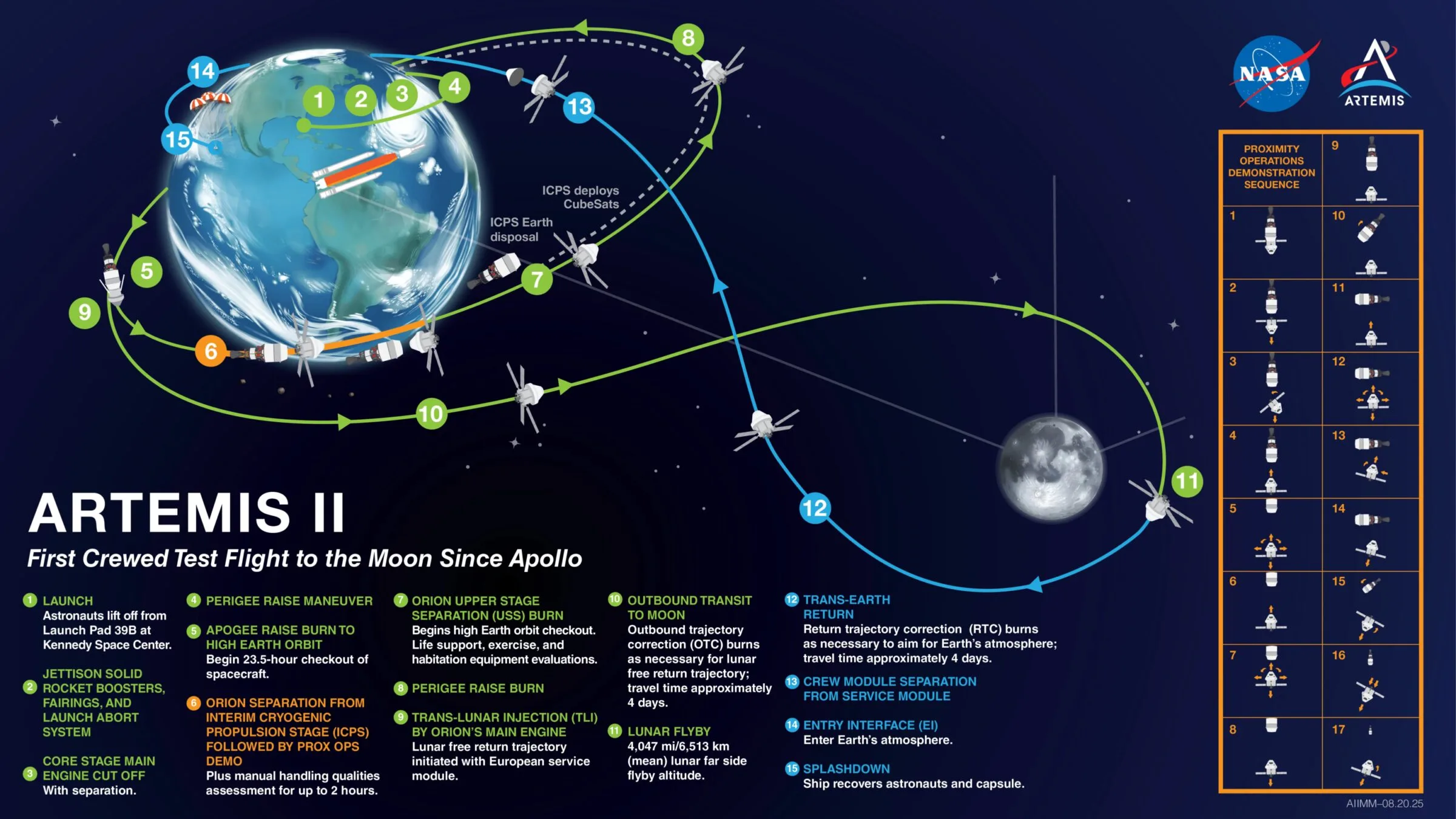
Artemis II was a test flight, meaning that its primary objective was to demonstrate key systems that would be needed for a crewed mission to land on the Moon. That includes Artemis II's launch vehicle, the Space Launch System (SLS) rocket, and its crew capsule, Orion.
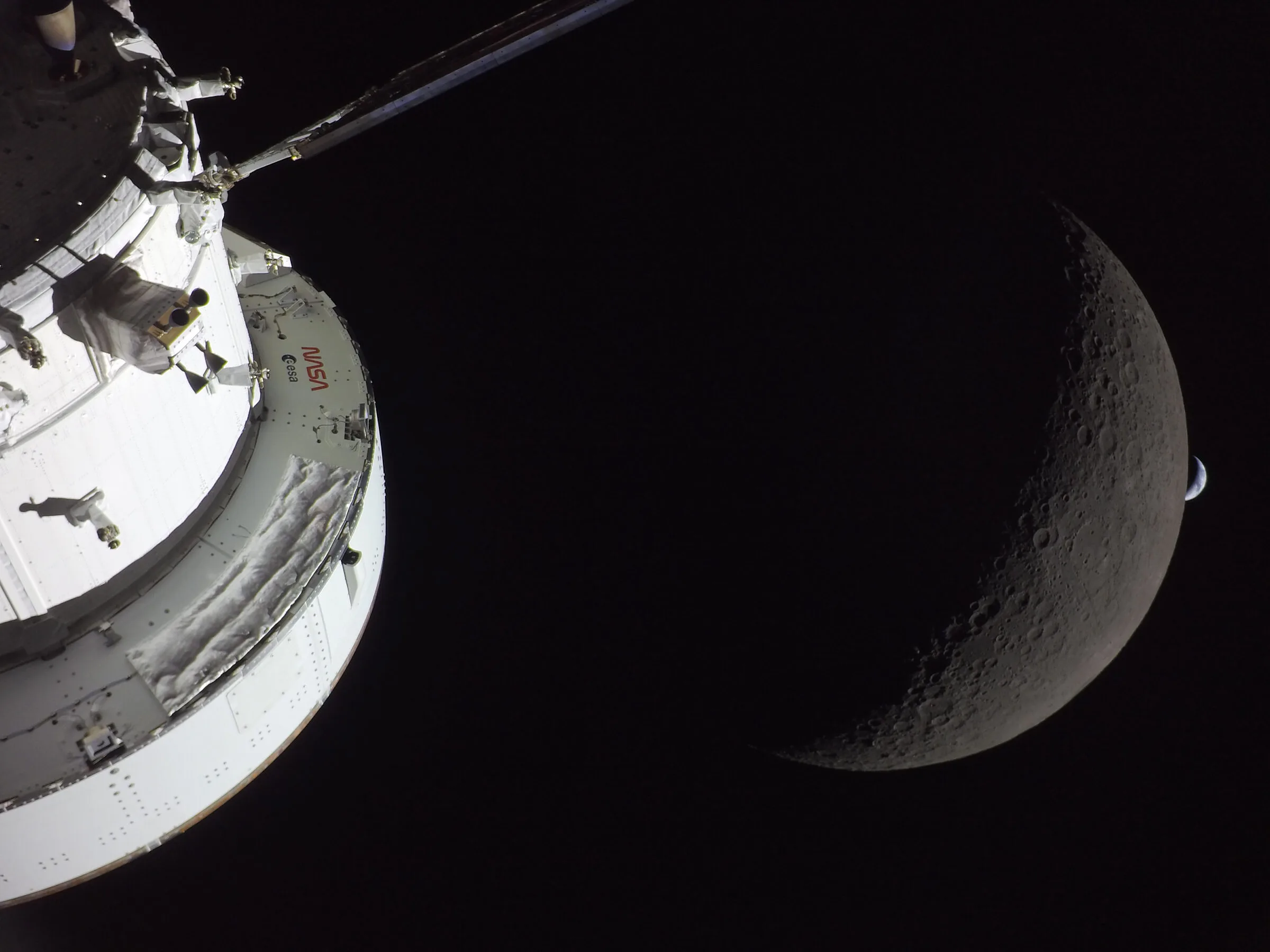
The mission took about 10 days to complete. The mission launched from NASA’s Kennedy Space Center in Florida on April 1, using Launch Complex 39B — the same historic pad used for Apollo and Space Shuttle missions. Orion orbited Earth twice while the crew tested out its systems, then the mission headed for the Moon, flying as close as 8,000 kilometers (5,000 miles) from its surface on April 6. After traveling back to Earth, the crew reentered the atmosphere, descended under parachutes, and splashed down in the Pacific Ocean on April 10.
The crew
Four astronauts were selected for NASA’s Artemis II mission: Commander Reid Wiseman (NASA), pilot Victor Glover (NASA), mission specialist Christina Koch (NASA), and mission specialist Jeremy Hansen (Canadian Space Agency).
Reid Wiseman is a native of Cockeysville, Maryland. He first gained an interest in spaceflight seeing fighters jets fly overhead and, one time, the Space Shuttle on the back of its 747 transport plane. After earning his Master's degree in systems engineering from Johns Hopkins University, Wiseman became a Navy test pilot and ultimately a captain in the navy. He was selected as a NASA astronaut in 2009, flew on an expedition to the International Space Station in 2014, and served as chief of NASA's Astronaut Office from 2020-2022.
Christina Koch is a native of Grand Rapids, Michigan, and has wanted to be an astronaut since she was five years old. After earning a bachelors and a master's degree in electrical engineering from North Carolina State University, she worked as an electrical engineer at NASA Goddard Space Flight Center. There, she contributed to science instruments on multiple NASA missions. Around this time, she served as a research associate for the U.S. Antarctic Program. Later, as an engineer at the Applied Physics Laboratory, she worked on missions including NASA's Juno spacecraft, which is currently orbiting Jupiter. She was selected as a NASA astronaut in 2013. In her expedition to the ISS in 2019, she was part of the first all-female spacewalk in history, and also set the record for the longest continuous stay in space for a woman.

Victor Glover was born in Pomona, California. He earned his bachelors degree in general engineering from California Polytechnic State University, then became a test pilot for the U.S. Navy, where he was given the callsign "Ike" — short for "I know everything." While serving in the Navy, he earned three Master's degrees (in flight test engineering, systems engineering, and military operational art and science) from Air University and the Naval Postgraduate School. Glover was selected as a NASA astronaut in 2013. In his expedition to the ISS in 2020, Glover became the first African American crewmember to live long-term on the space station, as opposed to staying for a brief period as Shuttle or ISS assembly crew did.
Jeremy Hansen, From London, Ontario, earned his bachelors in space science and master's degree in physics from the Royal Military College. He served as a pilot in the Canadian Air Force and was selected by the Canadian Space Agency (CSA) as an astronaut in 2009. He has also served as CAPCOM, the Capsule Communicator, between Mission Control and the ISS.
The next mission will be Artemis III, a crewed test where Orion will dock with a lunar lander in low-Earth orbit. After that, Artemis IV intends to mark the first crewed Moon landing mission since the Apollo era. NASA is aiming to conduct this roughly 30-day mission to land astronauts on the lunar south pole by 2028. Artemis IV will use the SLS rocket to launch the Orion capsule into orbit around the Moon. Once there, two of the crew’s four astronauts (not yet chosen) will descend to the lunar surface on another spacecraft, possibly SpaceX’s Starship Human Landing System. Those two astronauts will spend about a week near the lunar south pole. They will explore the Moon's surface and perform science experiments before returning to lunar orbit to join the rest of their crew for the journey back to Earth.
What the Artemis II astronauts did
During the mission, the Artemis II crew tested Orion’s various capabilities in deep space. That includes life-support and environmental systems, manual piloting and proximity operations, and communications and navigation systems.
The crew also contributed to studies of human physiology, sleep, motion, and other biological responses to space travel. For example, the AVATAR (A Virtual Astronaut Tissue Analog Response) project used organ-on-a-chip devices to study the effects of increased radiation and microgravity on human health. While in the vicinity of the Moon, the crew also made geological observations that could help scientists refine planning for the Artemis III mission.
Why are we going back to the Moon?
Although humans have been to the Moon before, we’ve spent only about 12 days there total. In such a short time, we have accomplished just a small fraction of the science that awaits us. Although robotic missions have explored the Moon since the Apollo era, it’s still worth sending astronauts back. Humans can do science more quickly, flexibly, and intuitively than robots alone, especially when exploring complex terrain and trying to select meaningful samples. The Moon also serves as a testing ground for technologies and skills that are needed for future deep-space missions, including eventual human trips to Mars.
Related pages

Artemis II blasts off, sending humans back to the Moon
NASA's Artemis II mission has just launched people to the Moon for the first time in over 50 years.

Artemis, NASA's Moon landing program
Artemis is NASA's effort to send astronauts back to the Moon for the first time since the Apollo program.

Why send people back to the Moon?
What can an astronaut do on the Moon that a robot can’t?

Principles for Human Spaceflight
These principles lay out how The Planetary Society will evaluate, support, and critique proposed plans for human spaceflight.
You Power the Next Great Discovery!
Fund future scientific research that advances space science and exploration with your gift today.
Donate