

 Explore Worlds
 Find Life
 Defend Earth


Planetary Radio • Dec 17, 2025
Galileo at 30: How a mission transformed our understanding of Jupiter
On This Episode
Geoffrey Collins
Planetary Scientist for Wheaton College
Elizabeth "Zibi" Turtle
Planetary Scientist at Johns Hopkins Applied Physics Lab and Dragonfly Principal Investigator

Jonathan Lunine
Chair, Department of Astronomy for Cornell University

Margaret Kivelson
Distinguished Professor of Space Physics, Emerita in the Department of Earth and Space Sciences at the University of California, Los Angeles

Ashley Davies
Volcanologist and member of the Europa Clipper science team for Jet Propulsion Laboratory
Bob Pappalardo
Europa Clipper Mission Project Scientist for Jet Propulsion Laboratory
Louis D. Friedman
Co-Founder and Executive Director Emeritus for The Planetary Society
Bruce Betts
Chief Scientist / LightSail Program Manager for The Planetary Society
Sarah Al-Ahmed
Planetary Radio Host and Producer for The Planetary Society
Also in this episode:
- Erik Conway, Historian of Science and Technology, Purdue University
- Bill O’Neil, former Galileo Project Manager, NASA Jet Propulsion Laboratory
- Les Deutsch, former Deputy Director of the Interplanetary Network, NASA Jet Propulsion Laboratory
- Jeff Moore, Planetary Geologist, NASA Ames Research Center
Thirty years ago, NASA’s Galileo spacecraft became the first mission to orbit Jupiter, opening a new chapter in our exploration of the outer Solar System. Over eight years around Jupiter, Galileo transformed how we understand Jupiter and its moons, revealing a powerful and dynamic planetary system, uncovering evidence for oceans hidden beneath icy worlds, and reshaping the search for life beyond Earth.
To mark the 30th anniversary of Galileo’s orbital insertion, scientists, engineers, historians, and advocates gathered at the California Institute of Technology for a special symposium: Galileo at 30. In this episode of Planetary Radio, host Sarah Al-Ahmed takes you inside that celebration. You’ll hear how Galileo survived seemingly impossible challenges, how its team adapted when things went wrong, and how its discoveries reshaped planetary science.
You’ll hear from key voices in Galileo’s story, including historian Erik Conway, project manager Bill O’Neil, magnetometer principal investigator Margaret Kivelson, Europa Clipper Project Scientist Bob Pappalardo, and Dragonfly mission Principal Investigator Elizabeth “Zibi” Turtle, along with reflections from many others whose lives and careers were shaped by this remarkable mission.
Together, they tell the story of Galileo not just as a spacecraft, but as a shared human effort, one whose legacy continues to guide exploration today.



Related Links
- Jupiter, the planet with a planetary system of its own
- What are Jupiter’s Galilean moons?
- A serendipitous observation of tiny rocks in Jupiter's orbit by Galileo
- Galileo's still producing discoveries: A magma ocean within Io!
- Blast from the past: The Galileo Messenger
- Galileo Messenger Archive
- Galileo Messengers: Cruise to Venus, Earth, Gaspra, Earth, Ida, and almost to Jupiter
- Juno, NASA's Jupiter probe
- Europa Clipper, a mission to Jupiter's icy moon
- Dragonfly, NASA's mission to Saturn's moon Titan
- Planetary Radio: Legendary space physics pioneer Margaret Kivelson
- Planetary Radio: Claudia Alexander, the Final Galileo Project Manager
- Planetary Radio: An Earthling’s guide to the "Moons Symphony"
- Planetary Radio Live in London: The Moons Symphony
- Planetary Radio: Bob Pappalardo and the Mysteries of Europa
- Planetary Radio: Europa in reflection: A compilation of two decades
- Planetary Radio: Europa Clipper’s message in a bottle
- Europa Clipper blasts off: How the mission team weathered Hurricane Milton
- Planetary Radio: Europa in reflection: A compilation of two decades
- Planetary Radio: Space Policy Edition: Should a (potential) biosignature revive Mars Sample Return?
- Planetary Radio: Alone but not lonely with Louis Friedman
- Planetary Radio: Zibi Turtle and a Mission to the Ice Giants
- Planetary Radio: Flying the Skies of Saturn’s Moon Titan
- Planetary Radio: We’re Sending a Flying Machine to Titan
- Buy a Planetary Radio T-Shirt
- The Planetary Society shop
- The Night Sky
- The Downlink
Transcript
Sarah Al-Ahmed:
We're celebrating the 30th anniversary of the Galileo Mission's orbital insertion around Jupiter this week on Planetary Radio. I'm Sarah Al-Ahmed of The Planetary Society with more of the human adventure across our solar system and beyond. On December 7th, 1995, a spacecraft named Galileo fired its engines and slipped into orbit around Jupiter, becoming the first mission to do so. Over the next eight years, Galileo transformed our understanding of the largest planet in our solar system and its moons. It revealed oceans hidden beneath ice, worlds shaped by extreme volcanism, and a planetary system far more dynamic and interconnected than anyone had imagined.
Thirty years later, scientists, engineers, historians, and advocates gathered at the California Institute of Technology to mark the moment. The 30th anniversary of Galileo's orbital insertion. The event known as the Galileo at 30 Symposium brought together generations of people whose lives and careers were shaped by the mission. Many of them hadn't seen each other in years. Some were babies when Galileo flew. Others had shepherded the mission through launch delays, engineering crises, and political battles that nearly ended it before it ever began. It felt less like a conference and more like a family reunion. In this episode of Planetary Radio, we're taking you inside that gathering.
You'll hear how Galileo survived seemingly impossible challenges, how its team adapted when things went wrong, and how the mission's discoveries reshaped planetary science from Jupiter's atmosphere and its magnetic field to ocean worlds like Europa. You'll hear from some of the people who shaped Galileo's story. Historian Erik Conway, who helps place the mission in the broader context. Bill O'Neill, Galileo's project manager who guided the spacecraft through years of challenges. And Margaret Kivelson, whose work on Galileo's magnetometer led to one of the mission's most profound discoveries, a potential liquid water ocean beneath the icy crust of Europa.
You'll also hear from Bob Pappalardo, now the project scientist for Europa Clipper, whose career grew out of Galileo's discoveries, and from Elizabeth Zibi Turtle, who joined the mission as a graduate student and now leads NASA's Dragonfly mission to Titan. And you'll hear from many others, scientists, engineers, and advocates, all of whom had lives and careers that were shaped by this extraordinary mission. We begin with Dr. Erik Conway, a historian of science and technology at Purdue University. He served for more than 20 years as the historian at NASA's Jet Propulsion Laboratory.
At the Galileo at 30 Symposium, he helped frame the mission, not just as a spacecraft, but as a long, complicated human endeavor, one that began in the early days after Voyager and unfolded across shifting political realities, engineering challenges, and generations of researchers.
Erik Conway:
I'm Eric Conway. I'm currently at Purdue University. I'm a history of historian of science and technology, but I was the jet propulsion lab historian for about 20 years until late 2024. And I'm also here to set the stage for you. The Galileo Mission concept dates all the way back to the early 1970s, and a whole series of design studies around the idea of what do we do after the Voyager Grand Tour mission that, and I hope some of you know something about, but gave us a number of two flybys of Jupiter after parasimilar missions earlier, the pioneers. The mission is assigned to JPL finally by NASA headquarters in 1975.
After a bit of a political battle, it's approved by Congress in the fiscal year 1978 budget and thereafter, encounters a number of engineering challenges that our first speaker will talk to us about in a little bit. It's supposed to have launched in 1982, and then it was 1986, and it finally was actually launched in 1989 on a voyage of adventure that then lasted until 2003. Galileo gave us the first closer uplick reviews of Jupiter's icy moons, taught us a great deal about the series of Jupiter, the atmosphere of Jupiter. What am I thinking? In part because it carried an atmospheric probe that was deposited by Galileo before its own entry into orbit around Jupiter.
Sarah Al-Ahmed: Galileo's story wasn't just shaped by science goals and bold ideas. The team contended with many funding, political and launch vehicle setbacks. It took a lot to get Galileo off the ground. Dr. Bill O'Neill was the Galileo project manager, overseeing the mission through some of its most turbulent years. He joined the project early on as mission design and science manager, and later took on responsibility for guiding Galileo through launch delays, redesigns, and a constantly shifting technological landscape. Space exploration is never a straight line, but Galileo only succeeded because its team refused to give up.
Bill O’Neil:
I dedicate my talk this evening to our Galileo leader, John Casani. John passed away in June at age 92. Without John's brilliance and tenacity, Galileo would never have been launched. The story of getting here is nothing short of unbelievable. Here's the way we flew to outer planets before Galileo. Home and transfer, add speeded earth to achieve a big enough orbit around the sun to just reach the outer planet, and the planet would basically catch us going faster than we were. Yep, that's how we were supposed to get to Jupiter. New congressional start, October 77, launched in '82 using special NASA three stage universal upper stage arrive in '85.
We cheated home in a little by planting our gravity assist from Mars. Whoops. Shuttle won't be ready by 82, let's do '84. Much poorer opportunity. So, gosh, we have to launch the orbit and the probe separately to build another spacecraft to carry the probe and oh, build a special propulsion module to attach the orbiter to fire at Mars. Enter general dynamics congressional lobby. We can fill the cargo bay with a huge centaur that can propel orbiter and probe attached directly to Jupiter. We'll be ready in '85. Oh, no. NASA says we can't afford shuttle, Centaur shuttle. Forget about it. We scrambled like hell to avoid consolation. We fell to our forever backup a Delta Vega transfer.
Then Congress tells NASA, "You were not to cancel Centaur. Do Centaur and Shuttle like we told you." A year loss, go for '86. The huge Centaur and Galileo were in final preparation for launch at Kennedy when Challenger exploded. End of Centaur and Shuttle. We chased Jupiter halfway around the solar system with our reprogrammings. We struggled cobbling things together, but shuttle always refused our plan. In desperation in August '86, we again proposed two launches, almost certainly DOA. But we had to ace up our sleeve. Four days earlier, trying to get to sleep. Roger Deal had an epiphany. Could Galileo get to Jupiter with two earth flybys after going to Venus?
Venus Earth assist was well-known, but a second earth encounter was never thought of. Next morning, Roger tried it on his computer. It worked. Oh my God, we immediately created Vega proposal to NASA. The rest is history. Greenpeace took us to court to cancel the first earth assist for further the Galileo would crash and spew its plutonium all over the earth and wipe out civilization. The judge dismissed with prejudice. Well, Galileo the man was sentenced to house arrest for proving the earth is not the center of the universe. Our esteemed project scientist, Torrence Johnson, demanded we not repeat Galileo's mistake. Torrence insisted we not mess with the middlemen, but go directly to the top.
And here we are briefing John Paul, January '87. But even the Pope could not save us. Galileo's greatest discovery that there could be past or present life on Europa got Galileo the death sentence, and we were ordered to crash it into Jupiter. The project faced and surmounted more challenging development and flight than any other planetary project.
Sarah Al-Ahmed:
Soon after launch, the mission faced what many thought would be a fatal blow. Galileo's high gain antenna. The dish designed to beam back most of the spacecraft's data failed to fully deploy. Instead of opening beautifully like an umbrella, it remained partially stuck, leaving the spacecraft with only its much smaller, low gain antennas to communicate back to earth. For many missions, that would've been the end of the story, but Galileo's team refused to accept that outcome. Dr. Les Deutsch is the retired deputy director of JPL's interplanetary network and co-led the effort to save the mission after the antenna failure.
Their team re-engineered Galileo's communications on the fly, rewriting software, upgrading the deep space network, and inventing techniques that not only salvaged Galileo's science returns, but permanently changed how we communicate with spacecraft across the solar system.
Les Deutsch:
What people don't realize is even before any problem with the antenna, that trajectory presented a problem for Galileo, and that is it was going to take us a lot longer to get to Jupiter and our power source, the RTG, the radioisotopic thermal generator, was going to be depleted more than planned. And so, we were already looking at operating at something like 80% of planned power. And my program had already designed a more complex communications encoder, which was built and installed on the spacecraft before launch to compensate for that degradation. We were already thinking in terms of how to save Galileo before it really needed saving.
The new trajectory had these additional flybys and because of that, we had to add a radiation shield behind the high gain antenna and couldn't open it until after it had gone by Venus at least. And when we did and only partially deployed, and you've heard that story, Galileo continued to operate at that time using its two smaller low gain antennas. It was operating just fine because it wasn't that far from the earth yet. The LGAs were only capable of transmitting an S band. Don't worry too much about what those things mean. These communication bands remain originally by the military to confuse the enemy. It still confuses the enemy. It confuses me.
These letters mean absolutely nothing, but the higher that frequency, the narrower the cone of energy that comes out of the parabolic antenna and the more of it reaches the earth. You want to be at higher frequencies. The combination of the frequency and gain difference between SBAN and XBAN between the large antenna and the small antenna meant we were operating at a factor of 10,000 disadvantage. So, Galileo was otherwise completely healthy from an engineering standpoint. The problem is as Galileo got closer to Jupiter, which means further from the earth, the data would become unreasonably low.
If we didn't make changes, we'd be operating at less than five bits per second from Jupiter, and that's not a great data rate. My office was already working on solutions to this, and so we conducted an internal 30-day study and just starting days after the high gain antenna failed to deploy. We didn't use people from the Galileo project because they were all busy working the mainstream fix, which was fixing the high gain antenna, and that was the right thing for them to do. We had our own technologists and our own spacecraft systems people from other technology programs, and we evaluated various solutions. We concluded that there was a good Jupiter orbital mission possible using the low gain antennas.
And based on it, we went to the flight project office, read that as John Casani. We'd have to add a whole bunch of new software to the spacecraft and as well as several ground enhancements to the deep space network. We added advanced error correcting coding. Remember I said that our program had already implemented a new error correcting code? We couldn't use it because the switch to turn it on was tied to being at the highest data rates. We arrayed ground antennas together for the first time for real time and routine use to get approximately the performance of one giant antenna with the combined area of all the individual antennas.
We installed an optimized SBAN signal detector at the biggest antenna at the place that had the most return from the Galileo orbital mission, which turned out to be in Australia. We used a packet-based scheme for loading the bitstream. I'll come back to all these in a little bit more detail, but together these resulted in a 10 folder, 10DB increase in the return bits for Galileos. We're up to a physical data rate of 50 or so bits per second, and all the items in green have been continued to be used by all subsequent deep space missions. That's like a factor of 10 that Galileo has given to all subsequent missions.
It was a hard thing to do in real time at the time, but the fact that we were at a low data rate made it easier to do. Now we do it at all data rates in the DSM.
Sarah Al-Ahmed: By the time Galileo actually reached Jupiter, it was a spacecraft that had already survived more than its share of near disasters. But even after the mission was saved, the team still had to learn how to work with a spacecraft unlike anything that they'd ever flown before. Early on, nothing was routine, not the instruments, not the data flow, and certainly not the images. Dr. Geoff Collins was a member of the Galileo imaging team and is now part of the camera team for NASA's Europa Clipper mission. At the symposium, Jeff took us back to the very first high resolution images Galileo returned from Ganymede and the confusion, improvisation and eventual breakthrough that followed.
Geoff Collins:
I want to start off with a little story about the very first high resolution images that we got back from Galileo of any of the satellites. And this was because the first close encounter was the G1 encounter, right? Ganymede one, and it was the first time that we were going to exercise the camera and many of the other instruments in one of the closeup satellite encounters. And of course, there was going to be a big press hoopla about what did Galileo find during the very first encounter. This encapsulates a lot of the early days of learning how to use the spacecraft and how we're going to work together. But the first G1 SSI target was going to be Uruk Sulcus, right?
This place that had originally fascinated me. And so, I was really excited to see what were those grooves going to look like close up, right? And we were going to be zooming in toward this corner of the sulcus here, zooming in even farther. We knew the images were going to fall somewhere around here. Now there's some uncertainty in the pointing of where the camera was actually going to, where the images were going to land. And so, my first job during that G1 encounter was figure out where the images landed, right? We have these blurry voyager images and we're going to get these high-res Galileo images. That first box that we give is going to be somewhere in here, like where is it going to be?
Jim and Bob flew out a couple days before me. I flew out to LA. They picked me up at the airport. It was actually my first time in Los Angeles and it was middle of July 1990s. It was a smoggy day. I got off the plane, my eyes were like watering from the smog and they hand me this picture and I can like barely see it through my watering eyes. And I'm looking at the picture and I'm like, "Oh, you have it upside down." I turned it over like, "This makes more sense." And they're like, "No, no, no. The other side is up. The light's coming from that way." I'm like, "Really? Okay." I'm staring at it trying to make any sense of what I'm looking at.
It didn't look like those like smoothly undulating grooves like we had seen in the voyager images. And as somebody into structural geology, I'm like, "Wow, there's fractures and faults everywhere. This is exciting." Except the faults seemed weird to me. They were curved the wrong way, given the way that the lighting was. And we kept looking around at like, "Where in this picture does it fit?" And we couldn't figure out where this was. It didn't match anything. We got a few more pictures. Jim was mosaicing the pictures together with scotch tape because the computers weren't working very fast.
And one of the engineers came by, I think his name was also Jim, and said, "Don't you have it upside down?" And we're like, "No, no. We were told it comes in this way." And it's like, "Let me look into that." And then we learned a few hours later that when the scan platform was beyond a certain angle, then all the images came in upside down and they hadn't put that into the software that we were using to analyze the images. We took that image, we flipped it over and suddenly, it made way more sense. And we had just spent two days spinning our wheels, trying to figure out where we were, when in fact it fit right in the middle of where we were looking right there, so mystery solved.
Sarah Al-Ahmed:
I think one of the most striking things about this mission was how many careers began with Galileo. Graduate students who cut their scientific teeth on its data are now leading some of NASA's most ambitious missions to the outer solar system. Dr. Elizabeth or Zibi Turtle is definitely one of them. Zibi is a planetary scientist at the Johns Hopkins Applied Physics Laboratory. She joined Galileo as a graduate student working on the imaging team, but today she's the principal investigator of NASA's Dragonfly Mission, a nuclear-powered rotorcraft that's going to explore Saturn's moon titan.
She's also a key member of the Europa Clipper Imaging Team. Zibi reflected on what Galileo taught her, not just about icy moons, but about how space missions survive the unexpected.
Elizabeth Turtle:
I came onto Galileo as a grad student, as others have said. I was an associate of the imaging team and got to do scientific research into the impact craters on Europa and the ridges, all these enigmatic features on Europa, as well as Rosalie alluded to the mountains on IO. And it was an absolutely thrilling time to get to explore these moons and to be part of the team that was planning the observations as well.
And Galileo really informed not only the scientific discoveries that we all associate with the mission and how much we learned about the Galilean moons and other aspects of the Jovian system, but it also informed the future exploration and Europa Clipper and the Europe Imaging System, which I work with, not only in terms of responding to scientific questions and how to build off of the discoveries of previous missions to design aspects of the investigations and the instruments, but also in terms of the teamwork, getting to be part of that team, getting to see the resilience and the perseverance and how teams manage things when they don't go as planned.
And also fostering an environment where a team can respond to hardware issues or turnaround science and technical trades and innovate solutions to issues that no one ever foresaw while working within the available resources. And what I learned from Galileo observations translated into the opportunity to work with the Cassini mission, planning observations of Titan with the Cassini imaging science subsystem team of which I was an associate. And as Galileo informed Europa Clipper exploration and really taught us the next questions to look for answers to, Cassini-Huygens laid the groundwork for the exploration by the Dragonfly mission at Titan to take the next steps or flights in this case in terms of exploration and discovery at Saturn's Moon Titan.
It has been a privilege to be able to be part of these teams as we grow our understanding of the bodies in the outer solar system.
Sarah Al-Ahmed:
When people think about the Galileo mission, they often picture the spacecraft orbiting Jupiter and flying past its moons, but part of the mission took a far more dangerous path. Before Galileo ever entered orbit, it released a probe, a one-way spacecraft designed to plunge directly into Jupiter's atmosphere. It was protected by a heat shield that itself dealt with some ablation issues, but the probe survived extreme temperatures and pressures and returned the first direct measurements from inside the atmosphere of a giant planet. Those measurements changed how we understand Jupiter and how we compare it to giant planets throughout the solar system and far beyond.
Dr. Jonathan Lunine is a planetary scientist whose work focuses on the formation and composition of planets. At the symposium, he talked about the legacy of the Galileo probe and why its measurements of Jupiter's atmospheric composition are still used as a benchmark today, including for NASA's Juno spacecraft.
Jonathan Lunine:
I did also want to give a shout-out to the probe and the probe investigators. The Galileo probe had its own set of very exciting technical challenges and near disasters as well in terms of how far the heat shield ablated and so forth. But most importantly, it gave us a series of measurements of the abundances of elements thanks to the Galileo mass spectrometer and also the helium abundance detector, which we still use today and were very important as being the reference point for measurements of Jupiter's atmospheric composition that have been made by Juno. And that was mass spectrometry done by the team led by Hasso Niemann at Goddard Space Flight Center.
There's a tremendous amount of calibration work that Hasso and his team did afterwards. He's not with us anymore. Paul Mahaffy has took the lead. And then of course now with Dragonfly, there's a new generation as well. Those measurements were extraordinary and they're still of great utility today. that's another great contribution that the Galileo mission has made to our understanding of the solar system.
Sarah Al-Ahmed:
Among all of Galileo's discoveries, one stands out as truly, truly transformative. Galileo revealed that Europa, a small icy moon of Jupiter, likely hides a global salty ocean beneath its frozen crust. That insight reshaped planetary science. It redefined where we might find habitable environments in our solar system, and this breakthrough didn't come from images alone. It came from magnetism. Dr. Margaret Kivelson was the principal investigator for Galileo's magnetometer, the instrument that measured Jupiter's powerful magnetic field and how Europa moved through it.
By analyzing those data, Kivelson and her team detected the signature of an electrically conducting layer just beneath Europa's ice, evidence that's best explained by a liquid water ocean.
Margaret Kivelson:
Before Galileo got to Jupiter, we did know something about Jupiter's magnetic properties. There were ground-based observations both in decametric and decimetric frequencies that showed that something interesting was going on and Pioneer 10 and 11 were the first spacecraft to fly by Jupiter followed quickly by Voyager one and two, and they discovered that not only did Jupiter have a magnetic sheath around it, but that it had flapping current sheaths that were moving again at Jupiter's rotation period. The data from these spacecraft also showed that the scale of the magnetosphere can change by a factor of two, that the outer magnetosphere occurrence sheet stretches the field.
Galileo came along and characterized significant departures from local time symmetry and showed that Io was the source of a heavy ion plasma that greatly modifies the structure and dynamics of the magnetosphere, and Fran's going to talk about that. Finally, Galileo came along and as we heard, launch was delayed and delayed, but of last John Casani led us into the outer solar system. John had to deal with not only technical and political problems, but the resistance to having something with plutonium on the spacecraft led to a lot of resistance against launch, but John managed to get us out anyhow. We got to the Cape.
There were two days when launches were possible and were missed, but the third day we sat there in the bleachers and we watched a perfect launch celebrated afterward with parties. We learned a great deal about the magnetosphere despite the loss of our antenna and I'm always credit Tal Brady and his crew for finding a way to make the most important scientific data available for transmission down to earth. It's really remarkable that with a factor of 50 decrease in data rate, I would say we probably lost only a factor of two in science. Galileo confirmed IO's role as the engine of much of magnetospheric dynamics and set the stage for further exploration.
Let me talk a little bit about the near equatorial boundary structure. This work was led by Steve Joy, and what he found that was quite interesting was that the magnetopause, which gives the scale of the magnetosphere, can move in and out by a factor of two, but there seemed to be two peaks in position, one near 60 and one near 90 JOVE and Radii. I don't think we still really understand why that's true. We learned about the near equatorial boundary structure. We learned that the low energy ions are dominated by sulfur and oxygen ions and the energetic particles have a different composition with protons dominating the density and pressure beyond seven JOVE and radii.
Sarah Al-Ahmed: We'll be right back with the rest of the Galileo at 30 Symposium after the short break.
Bill Nye: Greetings, Bill Nye here, CEO of The Planetary Society. We are a community of people dedicated to the scientific exploration of space. We're explorers dedicated to making the future better for all humankind. Now, as the world's largest independent space organization, we are rallying public support for space exploration, making sure that there is real funding, especially for NASA science. Now, we've had some success during this challenging year. But along with advocacy, we have our step initiative and our NEAR Shoemaker grants. Please support us. We want to finish 2025 strong and keep that momentum going into 2026. check us out at planetary.org/planetaryfund today. Thank you.
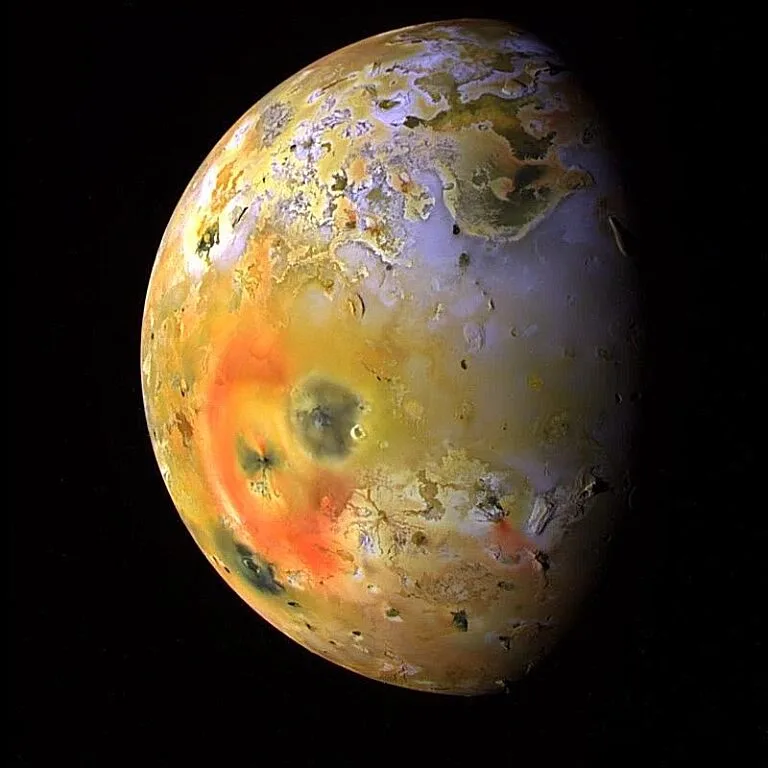
Sarah Al-Ahmed: IO, which is the innermost of Jupiter's large moons, is the most volcanically active world in our solar system. While Voyager first hinted at that activity, it was Galileo that transformed IO from a curiosity into a laboratory for understanding how tidal forces shape entire worlds. Dr. Ashley Davies is a planetary volcanologist at NASA's Jet Propulsion Laboratory and served as the IO lead for Galileo's near infrared mapping spectrometer. His work helped uncover just how extreme IO's volcanism really is.
Ashley Davies:
I am a volcanologist and I like studying volcanic eruptions on earth to better understand volcanic eruptions out there on IO. We now know there are hundreds of active volcanoes at hundreds of locations, high temperature silicate volcanism, so it looks like hail, but it's paradise to a volcanologist. Voyager discovered IO's active volcanism in 1979, leading to a completely new paradigm of how the solar system works and how it evolved, and by extension where life could be supported. Voyager saw volcanic plumes laying down extensive deposits, mountains up to tens of kilometers high, extensive lava flows, volcanic structures, and in Iris data, hints of high temperatures in excess of about 600 kelvin.
In the wake of Galileo, about 250 hotspots and thermal sources were identified on IO. Coverage was not quite complete, especially in the polar regions and in some areas of the sub-Jovian hemisphere, but these gaps have subsequently been filled. A Galileo view of IO, we saw numerous changes, but not perhaps as many as we expected. Silicate volcanism which dominates everything, but sulfur and sulfur dioxide play an important role, especially as volatiles in magma. Heat pipe volcanism most likely drives volcanic evection.
IO's eruptions and products are recognizable and familiar, similar to Basaltic type volcanism on earth, except for the larger scale of activity on IO and magnetometers data that suggested that there might even be a global magma ocean. Much volcanic activity takes place within Bertera and there's a preference for activity adjacent to mountains exploiting faults and tectonic ruptures and lithospheric fractures and the distribution of vulcanism and heat flow generally agree with the patterns predicted from asthenospheric heat flow models. But in terms of heat flow, the patterns are shifted 30 to 60 degrees to the east.
This is basically our current understanding of the heat flow distribution and we still haven't mapped about 45% of IO's total heat flow and equivalent amount to Earth's entire endogenic heat flow. Iowa is an extraordinary world and it and its volcanoes got me into pantry science, got me into the game in the first place, and it continues to fascinate as a unique volcanological laboratory and even a window into earth's distant past. Most of what we currently know about IO is the result of Galileo and that the Galileo observations were so successful.
It's a testament to the ruggedness of the spacecraft, the skill of its builders, the ingenuity of its mission planners, the tenacity and innovation of its controllers on earth. And this is in turn due to the leadership of Torrence and Bill to whom I'll be eternally grateful.
Sarah Al-Ahmed: Callisto is Jupiter's outermost large moon, and it's often described as ancient and quiet, a place that's shaped more by impacts than internal activity. But that simplicity is exactly what makes it scientifically valuable. Dr. Jeff Moore is a planetary geologist at NASA Aims Research Center and was a member of the Galileo imaging team. At the symposium, he reflected on what Galileo taught us about Callisto, a world that preserves a record of the early solar system largely unchanged for billions of years.
Jeff Moore:
From Voyager, we saw that it was this very large rules, one of the largest natural satellites in the solar system. We saw wall to wall craters, we saw several multi-ring basins, fractures, scarfs to robin or grooves. And these things were all very intriguing. We could see curious things like these little catena, which we later tried to take images of. And also to John Spencer's great credit, John recognized that in fact, the rims of many of the craters were bright and he suggested it was due to a process which he called cross segregation.
None of us really understood how thick it would be or what it would look like in detail, but at least it was an intriguing proposal, particularly for Callisto and he made some suggestions we might also see it on Ganymede. And once the compression artifacts have been cleared up, we came to realize that there really were these vast areas of extremely smooth dark material and as well as peaks, which had albedos of around 0.8, which is ridiculously bright.
That's almost like new fallen snow. And so, we continued to look at the data and we realized that when you compare the craters on Callisto with the craters on Ganymede, that the craters on Callisto are actually undergoing some kind of weird degradation or decomposition relative to the craters you see on Galileo, which are simply coming degraded as a consequence of the incisive reign of ever smaller micro impacts softening their slopes. Something was going on more than just small micrometeorite erosion, which is what you otherwise see most of the bodies in the solar system.
Sarah Al-Ahmed:
In the end, Galileo didn't just transform our understanding of Jupiter. It shaped the missions that followed and the people who went on to lead them. Dr. Bob Pappalardo is at the center of that legacy. Bob is a planetary scientist at NASA's Propulsion Laboratory and the project scientist for NASA's Europa Clipper mission. Early in his career, he worked with Galileo data as part of the imaging team, helping to plan observations of Europa, but also Galileo, which is the largest moon, not just at Jupiter, but in our entire solar system. He was also the organizer for this Galileo at 30 celebration.
He was the one that brought together so many generations of the Galileo family in one room, and the person who invited me to be there and share this moment with all of you. Bob reflected on his time with Galileo, how that experience helped shape Europa Clipper and why the mission's legacy lives on, not just in data, but in the people who carry its lessons forward.
Bob Pappalardo:
So, what did we find? It's hard to summarize all of Europa and Ganymede in a few moments, but I'll try. Europa is an incredible place, this beautiful image mosaic by Cynthia Phillips here, on the bottom left shows it's a bizarre place crosscut by ridges and grooves. On the top there, you can see these cross-cutting ridges. The bright areas are just a maze of lineaments. And then there are places that are aptly called chaos terrain, where that material has broken up into plates. Something below the surface caused heating, which broke up the surface and disintegrated some of these blocks.
We think that Europa has an ice shell, something like 20 kilometers thick above a global subsurface ocean. There were ideas that there could be an ocean, the geology's consistent with an ocean, and Margie Kivelson and her team on the magnetometer team determined that Europa was behaving as a conductor and creating this little mini magnetic field as it moved through Jupiter's magnetic field and what could be conductive within the shallow surface of Europa, but a salty ocean, confirming that that ocean is almost certainly there today and explains a lot of the geology as well. And the upper right, you see Galileo unlike Europa is all bright with these weird lineaments on it.
Ganymede we almost get and it has dark terrain and brighter terrain and that dark terrain is Callisto-like cratered neighbor of Galileo on the other side and it's somewhat Europa-like in having ridges and grooves and some smooth bands and studying Europa can help us understand maybe the transition from a cratered ancient body like Callisto to a more modern one that has been repaved more recently like Europa. Europa's surface has something like 20 craters. We think large craters on it, 10 or 20 kilometers in size, such that that tells us its surface age. That surface has been sitting out there for about 60 million years.
Europa's been resurfaced since dinosaurs roamed the earth, whereas for Galileo, that surface, the dark terrain is probably four billion years old and the bright terrain is probably maybe two billion years old, plus or minus two billion years. We don't know very well. And Galileo also tells us about the cratering process and what's going on inside Europa Clipper. It was years in the making, literally about, I think 18, 17, 18 years in the making from concept of a Europa orbiting mission to one that became more Juno-like in orbiting and more Galileo-like in orbiting Jupiter and flying by Europa. We're going to fly by Europa nearly 50 times with an incredible suite of instruments.
Unlike Galileo, these instruments are designed to test for hypotheses related to water below the surface and what creates this bizarre surface. And there we are celebrating the launch just over a year ago as me with a ponytail and I have to give credit to the entire amazing team. It takes people and ingenuity and persistence to get to a place where you can have a large flagship mission like Galileo, like Europa Clipper. And we're really here to talk about the legacy of Galileo, which allowed us to create and design the Europa Clipper mission.
Sarah Al-Ahmed:
Galileo overcame an extraordinary number of challenges, but what carried it through wasn't just engineering or persistence. It was people, the camaraderie of the team and the wider community of space fans who believed in the mission. All of these people working together helped Galileo survive its hardest moments. I've been reflecting a lot about this as we come to the end of The Planetary Society's 45th anniversary celebration year. Our organization was founded just 10 years before Galileo launched with a mission to advocate for ambitious exploration and to share what these missions teach us. In many ways, our organization grew up alongside Galileo.
Our resolve strengthened by watching this team fight for their mission against all odds and triumph with science that changed everything that was to come. I caught up with Geoff Collins, who you heard from earlier speaking about that image flipping situation. He shared a story from the Galileo era involving an astronaut, a chance encounter, and a Planetary Society T-shirt.
Geoff Collins:
I was a graduate student working during the first encounter of Galileo with Jupiter's Moon Ganymede, and this were the first high resolution pictures that we got back of any of the Galilean satellites, so very exciting time. And these images had only been down on the ground for a few days. Only a couple of dozen humans had seen these first pictures from Ganymede so far. And my advisor, Jim Head, had the idea, "We should go out to dinner with Dave Scott, the commander of Apollo 15, because he knows him. He lives in the LA area. Let's show him the pictures. We'll have dinner, we'll have a good time."
So, we meet up at a Mexican restaurant, we're waiting for our table, and I've got this big folder with all of the new pictures from Jupiter under my arm. I'm chatting and also fanboying Dave Scott, who's standing right there like, "Oh my God, an Apollo astronaut." And I'm also wearing a T-shirt that The Planetary Society put out that said, "Go Galileo," and it said The Planetary Society across the bottom. We're standing there chatting, waiting for a table, and this guy sitting at the bar swivels around, looks at us, his face lights up and he starts heading straight toward us. And Jim and Dave were like, "Oh no, he's been recognized.
We're going to have some celebrity moment, like what's going to happen?" And the guy goes right past Dave Scott and starts shaking my hand and says, "You remember The Planetary Society. That's so great. I love everything about space." And I'm like, "Yeah, great. Nice to meet you too." Thinking to myself like, "Wow, I'm not going to say anything about all the things that he's missing right now."
Sarah Al-Ahmed: I was also delighted to bump into Planetary Society co-founder, Dr. Lou Friedman. He shared a few reflections about what Galileo meant to him.
Lou Friedman:
Personally, it's one of the most exciting things I ever worked on because we were discovering new ways of doing orbit tours. It was the first time ever that orbit tours had ever been thought of and the idea that you could go to Callisto and then on to Io and then back to Europe and all that. That was all new stuff. And there's another part of it, which is sometimes neglected now, which is you could change the orientation of the orbit. For example, James Van Allen very much wanted the aphelion of the orbit, the Apophis of the orbit to move around 360 degrees in longitude in the magneto sphere.
Well, that's a design challenge that an engineer loves. We designed orbit tours that did that. They called it the flower orbit when we were done.
Sarah Al-Ahmed: Galileo's story was never just about science. It was also about whether we're willing to fight for it. The mission survived years of budget pressure, political resistance, and skepticism about whether it was worth the cost. It flew because people believed in its value and because they refused to let it quietly disappear. Today, as we face renewed threats to NASA science funding, that history feels especially close. Our co-founder, Lou Friedman, has lived through moments like this before, and he carried a message from the Galileo era that still matters now.
Lou Friedman: Galileo was followed by a wonderful couple of decades of exploration afterwards with Cassini and New Horizons and the Mars program and the several Mars missions. And so, I guess I want to say that as bleak as things look now, maybe one lesson from Galileo is that it'll get better.
Sarah Al-Ahmed: I wanted to close with something that I found particularly meaningful. Throughout the day, participants were invited to take part, sharing reflections and responding to group polls. They were asked to imagine speaking directly to the mission team in the midst of the mission and to reflect on what Galileo would come to mean to them, both personally and professionally. Those responses became a collective memory, voices from across generations. Dr. Cynthia Phillips, a planetary scientist and longtime member of the Galileo Imaging Team, helped gather and read many of those reflections aloud at the end of the symposium.
Cynthia Philips:
If you could send a message to the Galileo team 30 years ago, what would you say? It will all work out if you keep going and take time to enjoy things, you're going to have a wild, wonderful ride. Future missions will look to your achievements for inspiration. You'll face unexpected challenges that could be devastating and overcome them because of your knowledge and creativity. The Galileo mission is what made me decide to pursue a career in planetary science. You are part of history and then watch out your AI8 mode images that I were going to get scrambled. Boy, was that the case? They were a mess. Don't know if we could have done anything, but it would have been nice to know that.
And really the biggest message that we got was thank you. And so, thank you to all of you who joined us today, who came together to share such amazing memories of the Galileo Mission. For me, who was a graduate student on the mission, it was fantastic learning more about the history, the long road that happened so that I could just sail in. like Jeff, we could just sail in grad school and, "Hey, there's this mission entering orbit." And we got to do in some ways a lot of the fun stuff because we had data coming in. And so, thinking about the decades of work that went into bringing us as a community to that point was just awe-inspiring.
And so, thanks to everyone who shared their stories today and really thank you to Bob for putting this all together. I think Bob deserves six rounds of applause here.
Sarah Al-Ahmed:
I want to say thank you to the Galileo team whose perseverance and ingenuity carried this mission through its hardest moments. To the organizers of the Galileo 30 Symposium who brought this remarkable community together and to everyone who worked on the mission and advocated for it, I wish I had the time to share each and every one of their voices in this episode, but in the coming days, I'll be posting all of my recordings from the entire Galileo at 30 Symposium. You'll be able to find those on The Planetary Society website and I'll link to them on this episode page. Thank you for your patience as I get this done during the holiday rush.
And if you'd like a way to mark this anniversary at home, you can do what Galileo himself did more than four centuries ago. Step outside, look up, and turn your eyes toward Jupiter. Here's what you can look for, and this week's what's up with our chief scientist, Dr. Bruce Betts. Hey, Bruce.
Bruce Betts: Hello, Sarah.
Sarah Al-Ahmed: Another great day for celebrating Jupiter missions.
Bruce Betts: Yeah. Way to go, Jupiter missions and all those moons. I love the moons.
Sarah Al-Ahmed: I mean, really though, there's so much going on with so many of these planetary systems, but the fact that anybody with a small telescope can just do what Galileo, not the spacecraft, the human did, and just look up at Jupiter and even over a little bit of time, just see the moons moving. It's such a powerful way to explore space from home.
Bruce Betts:
It is. It is. Along with Saturn's rings, it's probably the other thing that people can see and really go, "Oh, wow, I can actually see that." So, hey, if you haven't tried it, and if you can hold this binocular steady, you can actually do it just with binoculars. But otherwise, if you have a small telescope, take a look at Jupiter, which right now is coming up in the east in the mid-evening. It's super bright. It's the brightest object there. And take a look at it and you'll see some number of dots roughly in a line next to Jupiter. Those are the four moons, but one of them may be behind or in front of Jupiter.
If you've got a bigger telescope, you might be able to actually see the shadow on the planet or watch them disappear or do fun things like that. But just generally, you can watch them. And because their periods are short, measured in days and only like a day and a half for IO, you can actually watch the move from night to night. You can look up online and help you identify which one's which. you actually see the motion and you're recreating one of the most important observations in the history of the world when Galileo, the dude, the man, the myth, the legend, used one of the first telescopes to look at Jupiter and saw these things moving and thought, "Hey, they must orbit Jupiter." Oh, blasphemy.
Sarah Al-Ahmed: Dangerous thought.
Bruce Betts: Dangerous thought. it led to the whole Copernican revolution and the thoughts. And anyway, it's fun to do. You can also, often with even a small telescope or maybe binoculars and a nice clear, dark skies, you can see at least a couple of the cloud belts or zones, the bright, dark, linear features. And that's also very cool because it's not just a disc, it's a disc with cloud features and you can see them. Give it a try if you haven't, or even if you have, go reacquaint yourself with Jupiter and the Galilean moons.
Sarah Al-Ahmed: And maybe if you're lucky, a red spot.
Bruce Betts: Well, you can have those removed, but oh, the great red spot. Yes. No, I missed something there. Again, if probably not with the small telescope, but a little bit bigger amateur telescope, you can actually see the great red spot if it's on the half of Jupiter that you're looking at. But wait a few hours and if you don't see it, it'll come around. How do you like to hear a not so random space vac rewind?
Sarah Al-Ahmed: Is it not so random because it is Jupiter related?
Bruce Betts: Yes, it is. Jupiter is more massive than all the other planets in the solar system combined, but wait, plus their satellites, the asteroids, all the comets add them all up still less than the massive Jupiter. And of course, it pales compared to the sun, but don't tell Jupiter that.
Sarah Al-Ahmed: It's just so, so big and so interesting that that's the way that the mass distribution in our solar system turned out.
Bruce Betts: Yep. That was what I said to do.
Sarah Al-Ahmed: It just the other day, I was playing Destiny Too, running around on Europa with a lightsaber. Nice. Look up in the sky, big old Jupiter. Absolutely terrifying.
Bruce Betts: You had a lightsaber on Europa.
Sarah Al-Ahmed: Yep, I did. Just fighting for the solar system, Bruce.
Bruce Betts: Hmm, on the good side?
Sarah Al-Ahmed: Of course.
Bruce Betts: Of course. It's Sarah. All right, everybody. Go out there and look in the night sky. Don't hurt yourself, but think about your destiny too. Thank you and goodnight.
Sarah Al-Ahmed:
We've reached the end of this week's episode of Planetary Radio, but we'll be back next week with more space science and exploration. If you love the show, you can get Planetary Radio T-shirts at planetary.org/shop, along with lots of other cool spacey merchandise. Help others discover the passion, beauty, and joy of space science and exploration by leaving a review or a rating on platforms like Apple Podcasts and Spotify. Your feedback not only brightens our day, but helps other curious minds find their place and space through Planetary Radio. You can also send us your space thoughts, questions, and poetry at our email, [email protected].
Or if you're a Planetary Society member, feel free to leave a comment in our Planetary radio space and our member community app. I would love to hear your memories of the Galileo Mission. Planetary Radio is produced by The Planetary Society in Pasadena, California and is made possible by space fans all around the world. You can join us as we work to share the amazing stories of missions like Galileo at planetary.org/join. Mark Hilverda and Rae Paoletta are our associate producers. Casey Dreyer is the host of our monthly space policy edition, and Matt Kaplan hosts our monthly book club edition.
Andrew Lucas is our audio editor. Josh Doyle composed our theme, which is arranged and performed by Peter Schlosser. I'm Sarah Al-Ahmed, the host and producer of Planetary Radio. And until next week, ad astra.