

 Explore Worlds
 Find Life
 Defend Earth
Planetary Radio • Jan 07, 2026
Voyager and the heliopause: Exploring where the Sun gives way to the stars
On This Episode

Linda Spilker
Voyager Mission Project Scientist at NASA's Jet Propulsion Laboratory
Bruce Betts
Chief Scientist / LightSail Program Manager for The Planetary Society
Sarah Al-Ahmed
Planetary Radio Host and Producer for The Planetary Society
What does it really mean to enter interstellar space, and what have we learned since humanity first crossed the invisible boundary between our Sun and the stars?
In this episode of Planetary Radio, we explore the science of the heliosphere and the realm beyond with Linda Spilker, project scientist for the Voyager mission at NASA Jet Propulsion Laboratory. Drawing on decades of experience with the twin spacecraft, Spilker shares how Voyager reshaped our view of the Solar System’s outer frontier, from the nature of the heliopause to the unexpectedly rich structure of the local interstellar medium.
We unpack what Voyager 1 and Voyager 2 have taught us about charged particles, magnetic fields, and cosmic rays beyond the Sun’s protective bubble, and why those measurements have upended earlier ideas about where the Solar System truly ends. Spilker also reflects on the mission’s extraordinary longevity, the ingenuity required to keep the spacecraft communicating across the vastness of space, and what Voyager’s legacy means for future journeys between the stars.
Then, in What’s Up, Bruce Betts, chief scientist at The Planetary Society, places Voyager in context, showing how long-lived missions shape the bigger picture of space science and why observing longer can lead to some of our most profound discoveries.


The best space pictures from the Voyager missions NASA’s Voyager 1 and 2 missions Launched in 1977 and provided an unprecedented glimpse into the outer solar system — a liminal space once left largely to the imagination. The spacecraft provided views of worlds we’d never seen before, and in some cases, haven’t seen much of since.
Related Links
- The Voyager missions
- The best space pictures from the Voyager 1 and 2 missions
- The Voyager Golden Records: A cosmic love letter
- Planetary Radio: The Edward Stone Voyager Exploration Trail
- Planetary Radio: Io and Voyager 2: Lost oceans and found signals
- Planetary Radio: Voyager Mission Project Scientist Linda Spilker
- Planetary Radio: Cassini, Voyager and beyond with Linda Spilker
- Planetary Radio: Cassini Project Scientist Linda Spilker’s Last Appearance Before the Grand Finale
- Planetary Radio: More From JPL's Linda and Tom Spilker
- Planetary Radio: Back to Saturn for Brand New Cassini Science
- Planetary Radio: Cassini Project Scientist Linda Spilker’s Last Appearance Before the Grand Finale
- After crisis in interstellar space, stream of Voyager 1 data resumes
- Galactic Cosmic-Ray Anisotropies: Voyager 1 in the Local Interstellar Medium
- Interstellar space even weirder than expected, NASA's Voyager 2 reveals
- NASA Turns Off 2 Voyager Science Instruments to Extend Mission
- NASA’s Cassini, Voyager Missions Suggest New Picture of Sun’s Interaction with Galaxy
- NASA's Cassini, Voyager missions suggest new picture of sun's interaction with galaxy
- NASA’s Voyager Probes Find Puzzles beyond the Solar System
- NASA's Voyager Spacecraft Found A "Wall" At The Edge Of Our Solar System
- Why Some People Call The Solar System’s Edge “The Wall Of Fire”
- News brief: Voyager 2 has passed beyond the heliopause
- Voyager 2 Illuminates Boundary of Interstellar Space
- News brief: Voyager 2 has passed beyond the heliopause
- Voyager still breaking barriers decades after launch
- How EELS could change the future of robotic exploration
- Planetary Radio: EELS: AI-enabled snake robots and the search for life on Enceladus
- Pale Blue Dot
- Buy a Planetary Radio T-Shirt
- The Planetary Society shop
- The Night Sky
- The Downlink
Transcript
Sarah Al-Ahmed:
We're exploring where the Sun gives way to the stars, this week on Planetary Radio. I'm Sarah Al-Ahmed of The Planetary Society with more of the human adventure across our solar system and beyond.
Nearly 50 years after launch, the twin Voyager spacecraft are still out there exploring beyond the sun's protective electromagnetic bubble. After crossing the heliopause, Voyager became the first mission to explore interstellar space and it's still sending data home.
This week I'm joined by Linda Spilker, project scientist for the Voyager Mission at NASA's Jet Propulsion Laboratory. We talk about what Voyager has taught us about the heliopause, how the spacecraft revealed the structure of the space beyond the sun's primary influence, and why a mission launched nearly half a century ago is still reshaping our understanding of the solar system. Then in What's Up, Bruce Betts, our chief scientist, places Voyager in the broader context, explaining how long-lived missions continue to change the way we do space science.
If you love Planetary Radio and want to stay informed about the latest discoveries, make sure you hit that subscribe button on your favorite podcasting platform. By subscribing, you'll never miss an episode filled with new and awe-inspiring ways to know the cosmos and our place within it.
The twin Voyager spacecraft launched in 1977. It was during a rare planetary alignment that let a single mission visit the outer planets in one sweeping journey. At the time, the goal was ambitious, but finite. First, visit Jupiter and Saturn. And in the case of Voyager 2, go on to Uranus and Neptune.
No one expected these spacecraft to still be working nearly 50 years later, let alone rewriting our understanding of the boundary between our solar system and interstellar space. The sun's influence stretches far beyond the worlds that orbit it, carried outward by a consistent flow of charged particles called the solar wind and its magnetic field. Together, they formed the heliosphere, a vast dynamic bubble that surrounds the planets and extends far beyond Pluto. In doing so, it helps shield much of our solar system from high energy radiation that's arriving from the wider galaxy and even beyond.
At the outer edge of the heliosphere is the heliopause. It isn't a solid wall, but it's a boundary where the outward pressure from the solar wind balances the inward pressure from the interstellar medium. Crossing the heliopause marks the point where the Sun is no longer the dominant influence and the environment around a spacecraft becomes truly interstellar.
Voyager 1 crossed the heliopause in 2012, becoming the first spacecraft to directly sample interstellar space. Voyager 2 followed in 2018, because it took a totally different trajectory, crossing at a different location and revealing that the heliosphere isn't smooth or symmetrical. It's shaped by solar cycles and space weather and its interaction with the surrounding galaxy.
In recent months, I've seen a few headlines describing this heliopause region as a wall of fire. That's not the most accurate phrasing, but it does catch attention. That phrase refers to the incredibly high temperatures associated with the particle energy in that boundary region. It's not a literal wall or something a spacecraft could burn through. In reality, the space there is extraordinarily sparse, emptier than any vacuum we could actually create on Earth, but rich in information carried by particles and magnetic fields.
To help us make sense of what Voyager actually observed in this region and why it matters, I'm joined by Dr. Linda Spilker. She's a senior research scientist and planetary scientist at NASA's Jet Propulsion Laboratory. She's worked on planetary missions for over 45 years, so you may have heard her voice on this show many, many times.
She's currently the Voyager project scientist, but her connection to Voyager stretches back to the early years of the mission when she worked on its science team during the historic outer planet encounters. She later spent decades helping guide the Cassini mission at Saturn, including serving as Cassini's project scientist before returning to Voyager to lead its science as the spacecraft entered interstellar space. Hi, Linda. It's wonderful to see you again.
Linda Spilker: Hi, great to see you too. It's wonderful to be here. Wonderful to be back.
Sarah Al-Ahmed:
So we were both recently at the Galileo at 30 Symposium at Caltech, which was a celebration of the 30th anniversary of orbital insertion for the Galileo mission. And one of the people who was introducing one of the speakers there, who was Gentry Lee, who used to be the chief engineer on Galileo before it actually launched, said something that's really been just reverberating in my head for the last few days, which is that the people that worked on these early missions were the first and only generation that got to explore the solar system and that we're not going to see another generation like that for years and years to come, because to do anything similar would mean going to the next star system over and that's so far beyond the bounds of what we can accomplish now.
And as I've been thinking about that, that anniversary and about all these other things, I just wanted to say that of all the different missions and all of the different mission teams, I think the Voyager team is going to go down in history as one of the most important missions in the history of space exploration, so I just wanted to share that.
Linda Spilker: Oh, well, I agree with you completely. And I just feel very fortunate that I was graduating from college and my very first job was to come to JPL, work on Voyager, go to the launch and be there for all the planetary flybys. So it doesn't get much better than that.
Sarah Al-Ahmed: That must just be such an experience. I mean, after all the years that you've been working on this mission, are there any moments that just really stick out to you in history that were just so important to you that you wish you could share them with other people?
Linda Spilker:
Yeah, I think just in a general sense, the fact that in the planetary flybys, Voyager got a closeup look at so many moons at Jupiter, Saturn, Uranus, and Neptune and really changed the way that we looked at these moons, because they were so different from our own moon, from the volcanoes on Io to subsurface ocean. We saw hints of it on Europa and Enceladus from Voyager data. And then to watch the follow-up missions that come with that, there might be ocean worlds perhaps with life in them. And that was all started with what Voyager ultimately discovered.
And, of course, there's favorite moments from every single flyby that we had. And it was so exciting that there were times when I would just bring my sleeping bag into work and I'd sleep under my desk and I had my little timeline of what was happening. And I'd set my alarm, so I'd wake up to see the pictures, the first pictures ever of this moon or the rings or something. And it was just a wonderful, very exciting time.
Sarah Al-Ahmed: Well, I know I speak for so many people in my generation of space scientists, but I know that I wouldn't be here without the images from Voyager. And even when I was a little kid, I literally, I still have it, an old book of just all the first images of these worlds. It was a kid's book that my mom gave me. So I can't even imagine what it was like to actually understand what was going on there. Because as a kid, I was just like, "These are cool images of other planets." It didn't even really occur to me how important that was that we'd never seen these things before.
Linda Spilker: Yeah. I think if I had to pick one kind of favorite overall moment for Voyager, it was when the time when these pictures would come back and you'd watch them come back line by line on a TV screen and you'd see something new and exciting and someone would be jumping up, pointing at the screen and say, "What do you think this is?" And then you'd wait for the next image and so on. And it was just to sort of see science happening in real time.
Sarah Al-Ahmed: Well, the two Voyager spacecraft had been traveling so long that they were not only the first to see all of these worlds, but they now transcended the boundary of our sun's influence and gone into interstellar space. So where are the two Voyagers now?
Linda Spilker: Voyager 1 is roughly 15.8 billion miles away and Voyager 2 is around 13.1 billion miles and getting further away from the Earth every day.
Sarah Al-Ahmed: Relative to each other, how are they exiting the solar system?
Linda Spilker:
Well, their paths for exiting the solar system were determined by the last planetary flybys that they had. For Voyager 1, it was flying by Saturn's moon, Titan, and that swept us up out of the solar system going toward the north, leaving about 35 degrees above the ecliptic plane at that angle. And then Voyager 2 with its flybys of Jupiter, Saturn, Uranus and Neptune. At Neptune, we went up and over Neptune's north pole, and then we went down southward out of the solar system about the same angle, about 35 degrees.
And so now, each one is traveling in different directions, but just fortuitously because Voyager was never planned to go all the way out to the heliopause, much less cross it. We happened to be headed toward the nose of heliopause or the closest point the heliopause is moving through interstellar space. You think of it like the nose of a comet, and so we crossed in that direction, which made it easier to cross compared to going all the way down the tail. We probably would not have crossed the heliopause.
Sarah Al-Ahmed: Oh man, it would take so long to reach that distance. I can't even imagine. But unfortunately, it hasn't been absolutely smooth sailing for the last few years. It's been pretty dramatic for the Voyager team in recent years. And I think when last we had you on the show to speak about what was going on with Voyager, it was 2024, and Voyager 1 had just recently recovered from this severe six-month communication blackout. So how were the two spacecraft doing now health-wise?
Linda Spilker:
Health-wise, the two spacecraft are in great shape. We're communicating with them daily. We get four to six hours per day communication with them and they send back data. Voyager is unique in that the high-gain antenna always points toward the Earth. And so it's just whenever we can get a DSN, deep space network station to go over there and look at them, we can get data back. And fortunately, we haven't had any major, what we call anomalies or problems with either of the spacecraft, but we have our challenges as each year we have about four watts less power. We're fueled by the power comes from radioisotope through electric generators, those decay a little bit each year, and so we're having to get creative on how to keep enough power to keep the spacecraft warm and keep the key systems operating.
We're essentially single string. Anything that was redundant has been turned off, and so we're carefully managing our power and thermal. And then our tiny little thrusters are very slowly clogging. We have three different sets of them and we sort of go between one set and the other, but we still are steadily pointed at the Earth and returning data and still finding surprises with Voyager.
Sarah Al-Ahmed: In a best case scenario, how long are those RTGs going to be able to power the spacecraft?
Linda Spilker: Well, we have timelines now that show that it is possible, but taking more and more risk each year as you start turning off more critical subsystems that perhaps we could last until the 2030s. Our goal is to last through the 50th anniversary with the two spacecrafts, so that would be in the fall of 2027. So we think that's a very realistic goal, but with a little bit of luck, perhaps we'll go out into the early 2030s.
Sarah Al-Ahmed: Well, speaking of which, you've got a number of milestones that are coming up for the spacecraft, and particularly Voyager 1, next year is about to cross a boundary that no spacecraft has ever done before. You're going to reach one light day away from Earth. What are you personally planning to do to mark this moment?
Linda Spilker: Well, one light day, it's really a distance. It's the distance at which between the Earth and voyager is exactly the time it would take for light to travel in 24 hours. And so we're looking at what kinds of activities we might have or even a celebration of this, you're right, unique milestone for Voyager. It's going to happen on November 18th around 2:00 AM. That will be the moment where the Earth and Voyager 1 are exactly one light day apart. And so we'll have to see if there are some public events. There's nothing that we've planned quite yet, but we're discussing and talking about it.
Sarah Al-Ahmed: Is that 2:00 AM Pacific Time?
Linda Spilker: Yes, it'd be 2:00 AM Pacific Time, but you think about the speed of light. Voyager is traveling at much more slowly than the speed of light, and it's close to five hours between light seconds. So we could think of very leisurely approach to this one light day as we get to that particular milestone. And at that point, Voyager 2 will be about 0.84 light days away, and it will have its one light day crossing out somewhere in 2035.
Sarah Al-Ahmed: I imagine though that, that distance has to make it very difficult to troubleshoot issues, because anytime you send a signal to the spacecraft, it's going to take about a day to get to Voyager 1 and then another day to communicate back. So how has that been impacting the team's ability to troubleshoot issues on the spacecraft?
Linda Spilker:
Well, you have to trust the spacecraft that it has routines embedded in it, that if it encounters problems, it can take care of itself up to a certain point and give us time then to see what's wrong and respond. It has happened with the failure in one of the computer chips failing and that we were able to correct that, but it makes it very challenging.
And I was thinking about it, for one light day, to give you an example of just how far away that is or what amount of time it is, for a signal to go from the Earth to the Moon is about 1.3 seconds. And for a signal at the speed of light to go from the Sun to the Earth or the Earth to the Sun is 8.3 minutes. And so that sort of gives you the scale of just how far away, about 16 billion miles that voyager will be at that one light day milestone.
Sarah Al-Ahmed: This is the first time it's ever happened, and we're never going to have another moment like this as humanity that we can look up at the sky and think, "Hey, for the first time ever, something we created reached that distance."
Linda Spilker:
Right, right. And basically, the Voyager is the kind of mission that sort of reinvents itself. You had the planetary phase, then the phase where you're exploring basically inside our heliosphere. And then finally crossing that boundary, the heliopause where the pressure from the solar wind is balanced by the pressure from the interstellar wind and finally breaking free really of the influence of the Sun and being able to make measurements that are completely unique.
And I could just name a couple of those. One of them is that the cosmic ray abundance jumped up by a factor of three crossing out into the heliopause. You can think of the high energy cosmic rays like radiation. And so we found that, that heliopause is really like a shield protecting the solar system from those very, very high energy cosmic rays.
We crossed in the interstellar space and expected the magnetic field direction to change from the solar direction into the interstellar direction. And yet with all things, we're still waiting for that rotation to occur. And so it appears that the influence of the Sun in many ways continues out past the heliopause. We see, for instance, these effects called shocks. There might be a big coronal mass ejection that makes it all the way outward to the heliopause, and then its energy is transferred into these shockwaves that we can measure. And these shockwaves last weeks to months. Whereas if you had a shock in the vicinity of Earth, it might be only days that they last. So we're seeing some interesting differences that we can use to compare and to understand what's going on in these two very different environments. Let's see.
We found a very interesting feature called pressure front two. Voyager 1 in 2020 crossed pretty abruptly this region where both the plasma density and the magnetic field increased by about 30% and we thought, "Okay, it's another shock. It's something coming from the Sun." And so we're still waiting. It's been over five years now, and yet still this enhanced density is still persisting.
And so it's now getting around half a solar cycle. So we're starting to think, "Maybe this isn't so much a solar-driven effect. Maybe there's some other phenomena that we're trying to understand. Could it be something from interstellar space creating this increase in plasma density? Is it just something new in the interaction we don't understand?" And so it's great. The modelers are busy at work trying to see if they can find a way to create and maintain this pressure front two feature. And so that's just one of the many, many interesting things that Voyager keeps finding.
Sarah Al-Ahmed: I wanted to ask a little bit about the shocks, because Voyager has been out in space for quite a long time, but only within this region for a limited amount of time. And it takes quite a while for the material from the Sun to reach that point. So do we have any understanding of what solar events are causing these shocks or any way to connect them?
Linda Spilker:
We're trying to do that. It turns out that there are these coronal mass ejections coming out and maybe it could be several effects from several of them might combine. They travel at different speeds. And so it's possible they combine into a grand effect and that's what we're seeing. And so it's difficult to trace back to a single one, but we can definitely see the effects of the solar cycle that when the active solar cycle is then getting out to the distance of Voyager 1 or 2, that's the time when you're more likely to see shocks.
And then when you get into that solar minimum, you're going to run into a period when you don't see those shocks. And so, one of the questions for Voyager is, when will we stop seeing these shocks altogether and sort of transitioning maybe there's sort of an intermediate region that after the heliopause where these solar effects are present and then they go away when we get further out into interstellar space. So that's another effect we're looking for with both voyagers. And the longer we keep going, the more likely it is we can answer that question too.
Sarah Al-Ahmed: Yeah, I think there are a lot of misconceptions about what it means that Voyager has reached interstellar space because I've heard people say things like it's exited our solar system or it's left the influence of our sun, but all of those boundaries are different places and it's very confusing for people, I think.
Linda Spilker: That's right. Yeah. The heliopause is really the boundary where the solar wind pressure is balanced by the interstellar medium pressure. If you ask where is that gravitationally, it's much further away at a distance that Voyager won't cross. It's out in the Oort cloud. You have to go to the place where the distance between the Sun and the nearest star are gravitationally balanced so the Sun can no longer capture these objects to come into the Sun's influence gravitationally. So that's much, much, much further away. We're not anywhere near the Oort cloud with Voyager.
Sarah Al-Ahmed: When you're talking about the magnetic field as we're going out into this region and how it aligns with the boundary that we see within the heliopause versus outside of that space, do we actually think that's an effect of that the sun's electromagnetic field really influencing much further than that? Or is there something that's causing these fields to align with each other?
Linda Spilker:
That's a very good question. And the thinking is that probably the effects from the solar magnetic field are persisting, but exactly why, especially for so long. Voyager 1 crossed the heliopause back in 2012 and Voyager 2 crossed in 2018. So it's now been, for voyager 1, well over a decade, and yet we're still watching to see when this rotation might occur.
We know the direction of the intercellular magnetic field from other missions like IBEX, and that now we've recently launched IMAP. Yeah, they're seeing, but they're seeing much further out too, and so we're just waiting to see where that transition. Maybe it's sort of an intermediate region between the heliopause and where you're in true pristine interstellar space, and maybe that's part of what Voyager is probing.
Sarah Al-Ahmed: I'm going to be speaking with the IMAP team in just a couple of days, so we'll hear a little more about how they're hoping to answer some of these questions from Voyager because honestly, I think the best missions are the ones where you never expect they're going to last that long. And they discover all these things that just open up new questions that are so baffling that it takes decades later that we answer them.
Linda Spilker: Right, right. And Voyager is leaving a list of questions of its own for a future interstellar probe or a future mission that would go out into this region and beyond. And so that's part of the fun of these missions. You answer some questions, but you pose a lot more questions for future missions and future modelers too. Some of this perhaps future modeling might happen to answer some of the questions.
Sarah Al-Ahmed: Well, we're talking a little bit about the heliopause and what's happening right outside of that. But in order to get there, the Voyagers had to cross through these several layers at the edge of the sun's influence, starting with this kind of termination shock area. And I remember during that time, especially Voyager 1 crossing through this space, essentially it reached this boundary several times over. We kept getting these readings, it's hit the edge of the termination shock and then it hit it again. Is that because there's layers to it or is it that the entire system, all of these boundaries that we're measuring are continuously fluctuating?
Linda Spilker:
There's definitely some fluctuation with the change in the solar cycle. At solar maximum, the solar wind is blowing at its maximum rate, and so it's inflating the heliosphere, and then at solar minimum, it kind of moves back inward. And then it's a very complex region. The termination shock is where the solar wind goes from supersonic to subsonic. And then you're in this region called the heliosheath between the termination shock and the heliopause where there's a lot of activity going on, a lot of turbulence.
And then you hit the heliopause and you have exchange between what's inside the heliopause and outside through these neutrals that might be neutral passing through the heliopause, and then they might get charged. And so there's a lot of very interesting effects going on. And these particles that transition through the heliopause actually heat the interstellar medium to very, very high temperatures, but the densities are so low. It's like 0.1 particles per cubic centimeter there that it's basically like a vacuum and Voyager is cooling just as though we're in a vacuum. And so there's this very large difference.
For instance, if you looked at the Moon and said, "Okay, what's the typical atmosphere like on the Moon?" It's something like 1,000 to 10,000 particles per cubic centimeter, and yet we consider the surface of the Moon like a vacuum. And here, Voyager is out into an even more tenuous region of space.
Sarah Al-Ahmed: This is actually part of why I wanted to bring you on, because as someone who loves space, I'm continuously scrolling through the internet and I think there's a lot of misinformation out there. And I keep getting these social media posts and sometimes even articles about this idea that Voyager has passed through a "wall of fire." And they're referencing this temperature range, which is like between 30,000 and 50,000 kelvin. I think it's very high, but all the comments are like, "If that's the case, then why didn't the spacecraft melt or bake into pieces?" So what would you say to people that are so alarmed by that temperature?
Linda Spilker: Oh, I would say it's just that Voyager is essentially in a vacuum and that the particles are so far apart. Yes, they were given energy in part from their interaction with the heliopause and just sped up. It's the velocity that you're measuring of these particles and then you turn that velocity into a temperature, but that number of temperature doesn't tell you anything about the density, and so that's really the key. If there's such a small density of particles, much, much, much smaller say than the lunar surface. And it's very cold, we know, on the lunar surface that explains why there's nothing really equivalent, nothing hot that Voyager passed through because those particles are just so far apart.
Sarah Al-Ahmed: I think a lot of people were very alarmed at this idea that that means, well, as the human species, maybe we'll never be able to travel to other star systems because we'll get to this edge and we'll all just bake alive, which isn't the case, but there is something really interesting here, which is that you get to this point and these particles are so high energy that it's not to say that we're all going to burst into flames, but it does mean that we have to consider that not just for future human travel, hundreds of years in the future, but for the longevity of our spacecraft. And even as I say that, I'm thinking about the fact that the Voyager spacecraft are still surviving out there without us knowing that was going to happen 50 years later almost and on 1970s technology. So maybe it's not as much of a problem as people think it might be.
Linda Spilker: Well, another way to look at it is that the Voyagers have both been flying through this same high energy plasma, but very, very low density in case of Voyager 1 for well over a decade, and they're fine. In fact, they're cooling, like I said, just as though they were in a vacuum.
Sarah Al-Ahmed: What are our readings of the actual energy of these particles that are outside in the interstellar medium once we get past this point?
Linda Spilker: Well, at some point, again, the heating is coming from the interaction with the solar wind particles that can go through the heliopause, and there are a variety of effects, things like magnetic reconnection, shocks, et cetera, that provide heating to this material. And at some point, that influence between what the Sun is doing and pristine interstellar space will start to decrease. And then we'll get a chance to make that perhaps Voyager or perhaps a future mission that can go out to say 500 AU or something that might be able to answer that question.
Sarah Al-Ahmed: Well, we're only studying this system from two points, these two spacecrafts, but is that enough to give us a better idea of the actual shape of the heliosphere? Because I know you described it a bit like a comet with this head on one side and a tail. And I think that's been the predominant hypothesis for a long time, but there are also these other indications that maybe there are things that are kind of squashing the tail down. And in some cases people say it's shaped like a croissant. So how is the Voyager data feeding into this debate?
Linda Spilker:
Well, the Voyagers, as I said, are traveling toward the nose or crossed at the nose of the heliopause, which is pretty far away from the tail, sort of in the opposite direction of the tail. And so what we just really have is models taking data from other spacecraft that are not the voyagers. As you said, there are ideas it was common like, and that's been a longstanding concept that we've had for what the shape of the heliosphere looks like.
There's also from Cassini data, the thought that perhaps it is spherical, more like it's a spherical shape. And then of course, a more recent modeling that perhaps the magnetic field lines get really twisted and it makes some kind of croissant shape. And then there's the hybrid models of maybe depending on what the solar cycle is doing and where exactly you are in the tail, it might be a mixed mode. Maybe it looks croissant-like, but then it stretches out as you go further along. I mean, there's all kinds of ideas. And so the modelers are really having a lot of fun, I think, an interesting time trying to explain these measurements, but Voyager is not really contributing any direct measurements at all to the shape of the tail.
Sarah Al-Ahmed: If it is kind of croissant shaped, are the two kind of sides of the croissant oriented with the poles of the Sun's magnetic field? Or is it all twisted up? Do we have any idea?
Linda Spilker: I think there's some idea. The question is just how twisted up is it? And do they come straight back like a croissant, or are they literally twisted around each other, and how does that interaction work? So like I said, a lot of it is model based, but based on data that we have from other spacecraft.
Sarah Al-Ahmed: Well, you mentioned earlier that we're kind of single threading it at this point. You've turned off a lot of the instruments aboard these spacecraft. What is still functioning that we're using to take these measurements?
Linda Spilker:
Well, on each spacecraft as the power decreases, we've had to turn off at least one instrument, one science instrument. And so on Voyager 1, we have one particle instrument, the low energy charged particle instruments still operating, as well as the plasma wave spectrometer. It can pick up shocks. And on Voyager 1 also measure the plasma density because our tape recorder is still working and we can record these really high rate frames with the plasma wave spectrometer. And from those, they found a way to process it and get the electron density. So we have an instrument that can actually get a density measurement and then the magnetometer. And so we have both particles and fields as well as the radio waves from the plasma wave spectrometer on Voyager 1.
On Voyager 2, right now we have the cosmic ray spectrometer, the high energy cosmic rays are what it measures. We had to turn off the low energy charge particle instrument, and then we have the plasma wave spectrometer and the magnetometer. Turns out those last two instruments, magnetometer, plasma wave spectrometer take amongst the least amount of power and a lot of their electronics is inside what we call the bus, the central core of Voyager where the computers are and the thruster lines. We don't want the hydrazine to freeze. And so they're low power in helping keep those other parts of the spacecraft a little bit warm.
And so we're hoping that with Voyager 2, perhaps we can get out past the 50th. Maybe we can keep all the instruments on, but we're watching. The power degrades and there are other effects. We've got to keep the thrusters warm. So we could perhaps have to turn off one more instrument on Voyager 2 or we might just make it to the 50th.
Voyager 1, we'll probably have to turn off the low energy charged particle instrument on Voyager 1, but we're watching it. This is a spacecraft that we don't know exactly what to expect. We have models. And so we see how closely our models follow what we're observing daily with this data that we get back from Voyager. And then we'll make the decisions based on that.
Sarah Al-Ahmed: We'll be all right back with the rest of my interview with Linda Spilker after the short break.
LeVar Burton:
Hi, y'all. LaVar Burton here. Through my roles on Star Trek and Reading Rainbow, I have seen generations of curious minds inspired by the strange new worlds explored in books and on television. I know how important it is to encourage that curiosity in a young explorer's life. That's why I'm excited to share with you a new program from my friends at The Planetary Society. It's called The Planetary Academy and anyone can join.
Designed for ages five through nine by Bill Nye and the curriculum experts at The Planetary Society, The Planetary Academy is a special membership subscription for kids and families who love space. Members get quarterly mailed packages that take them on learning adventures through the many worlds of our solar system and beyond.
Each package includes images and factoids, hands-on activities, experiments and games and special surprises. A lifelong passion for space, science, and discovery starts when we're young. Give the gift of the cosmos to the explorer in your life.
Sarah Al-Ahmed: Well, you've brought this up a few times that we're close to the 50th anniversary of the launch of these missions in 2027. That's an absolutely mind-boggling thing that these spacecraft are still working at that point. Did you ever imagine when you started working on this mission that this would be a milestone that you would live to see? I don't think I would've expected it.
Linda Spilker:
Oh no, I think, well, after the Neptune flyby, I was working with one of the instruments on the scan platform, the inference spectrometer. And so I had an opportunity to go onto this new mission called Cassini, because after the Neptune flyby and after we took that image of the Pill Blue Dot, that image of the Earth and the solar system from Voyager 1, then they turned off those instruments. And so I went on to this new mission called Cassini. And I thought, well, and then Cassini got started and launched in 1997 and then ended in 2017.
And I never thought that Cassini would end before Voyager, and that I would basically be able to come back around, circle around, and come back to Voyager. After Cassini had ended and end my career where I started back on the mission where I actually saw the launch. So completely surprised, delighted that it could actually last for this long. Just been an incredible mission and it's wonderful to be a part of it.
Sarah Al-Ahmed: I don't know if I've ever told this story on the show, but we spoke very briefly. The first time I ever met you was actually at Griffith Observatory during the Cassini End of Mission Party. They threw a gathering there.
Linda Spilker: Oh, right.
Sarah Al-Ahmed: And I remember you were there and thinking, "Oh my gosh, that's Linda Spilker." And actually, I woke up early in the morning to watch the end of the Cassini mission, and I remember seeing you on that broadcast. And just thinking about what that must have meant to you. That was such an emotional day for everyone, and I think that's going to be so much more intense when Voyager finally ends, but it's not a moment we'll be able to anticipate necessarily like with Cassini. So it might be very different.
Linda Spilker:
You're exactly right. Cassini, we knew to within probably a minute or so when the density of Saturn's atmosphere would grow so great that the spacecraft could no longer point at the Earth and then it would very shortly be ripped apart and basically burn up in Saturn's atmosphere. And so we knew the day, the hour, basically to about the minute it would happen.
And Voyager is very different because it could be just one day Voyager will stop communicating with us. And of course, we will try everything we can just as we've done with past anomalies to try and figure out what's wrong and to get the spacecraft back. And if we're lucky, we'll be able to get it back again. And if not, we'll just have to accept, hey, that was the end of the Voyager mission. And that's going to be really hard because 50 years is a long time.
I remember I'd go to the American Geophysical Union meetings and I'd talk to Ed Stone and I'd always ask, "How's Voyager doing?" And it's kind of like that's where I got my start and I really care about these two spacecraft. And he would give me ... He'd smile and give me an update. And I'd say, "Well, when are we going to cross the heliopause?" And his answer was always, "Oh, sometime in the next three to five years."
Because the way the modelers worked is that we'd cross the distance where the modelers thought the heliopause would be. And they'd go, "Hmm, maybe we need to include something else in the model." And before you knew it would move out another 5, 10 AU and then Voyager would go out to that distance and it would not cross the heliopause and the modelers would start over again. And so the boundary kept moving out every three to five years. And so he could confidently say, "Well, three to five years." That's kind of the uncertainty in our latest models that we have for the heliopause.
And I know when they first crossed the heliopause in 2012, there was a lot of discussion and debate amongst the science teams, because first they weren't sure exactly what to see and what to expect. Second, it wasn't just this smooth single crossing. It was kind of like dipping your toe in and out of the edge of those waves at the edge of the ocean and having to sort that out. But I think the fact that the cosmic ray abundance jumped up by a factor of three, the plasma density changed, so many things pointed to it, but they were very careful in double and triple checking the data before finally announcing, "Okay, Voyager 1 has crossed the heliopause."
Sarah Al-Ahmed:
Well, I'm sure the mission is going to continue to throw us for a loop with new discoveries as it keeps going, because these things are all moving. They're worth debating. No one has ever done anything like this before. And I'm hoping that one of these days, we'll be able to send out multiple probes in multiple directions to really get more of an idea of how the system works over time, but also its shape and how that shape changes based on the solar cycle and its interaction with nearby interstellar medium and all kinds of things.
It's such a complex system and understanding it I think is going to be really key, not necessarily for us surviving here on Earth presently, but as humanity looks to send things to other star systems or we still have a lot to do in the future, but there's a lot there we need to figure out. And we can't anticipate when the mission is going to end, but we can anticipate that 50th anniversary coming up in 2027. Do you and the mission team have any idea of things that you want to do to celebrate that moment?
Linda Spilker:
Well, we're in the midst of planning those activities now, but certainly yeah. The Galileo event was so wonderful to go and hear basically summaries of what Galileo discovered in the context of other missions. I got to see a lot of Voyager data because often, Galileo was building on the results from Voyager that Voyager had found. And so we'll probably do something similar and have a one or two-day event possibly at Caltech where some of the summaries of both the planetary and the interstellar mission phases probably do some public events also, maybe a panel discussion or a talk or something for a public event, and then hopefully some kind of big celebration, because this is truly an amazing milestone that the two spacecrafts have lasted this long, much longer.
The original mission was four years long, and the expectation was we get through the Jupiter and Saturn flybys. And then if the spacecraft were still working, we could send Voyager 2 onto Uranus and Neptune. And so by Neptune, I remember reading in the newspaper of just how old Voyager was, both of them at that point. And it was probably just a few years until we would lose those spacecraft because we hadn't flown hardware for that long in these kinds of environments. And to see now they're off by just a few decades from the end of Neptune. And to be continuing on, it's just very, very special, and very exciting. So the 50th, I sort of see that as a milestone, and yet I think there's this possibility of perhaps going out into the 2030s. So we reach a milestone and we keep going.
Sarah Al-Ahmed: The Voyager mission is in the Guinness Book of World Records for several firsts, as is totally deserved. But I wanted to ask you what kind of records this spacecraft actually holds other than the obvious ones that we've mentioned so far.
Linda Spilker:
Yeah, there's quite a few records, and I'll just share some of them with you. Most remote human-made object, longest period of continual operation for a computer. And you think about the age of those computers and the size, how tiny they are compared to the technology today. Longest communications distance. Here we're coming up on the one light day for Voyager 1. Most durable nuclear-powered interplanetary spacecraft. Those RTGs, their power curves, we're following them very closely from what was predicted at launch.
Most distant image of the Earth. That's the Pale Blue Dot image that Carl Sagan talked about, that very special planet on which we live. First probe to leave our solar system. First observation of the solar systems, what plasma shield are heliopause essentially, and crossing the heliopause.
And on the science side, most planets visited by one spacecraft. You've got Voyager 2 with Jupiter, Saturn, Uranus, and Neptune. First flyby of Uranus today, still today, the first flyby. First and only flyby of Uranus. First flyby of Neptune. First observations of Jupiter's ring. Oh, I remember that. We were so sure Jupiter didn't have a ring, but we thought with Voyager 1, we'll just take a long exposure image about where we think the ring will be just in case, we want to be able to check off that box, no ring.
And so here was this very peculiar image of this stairstep, little lines because the spacecraft was moving back and forth and you could see the streaks of the stars. And sure enough, we found a ring. And Voyager 2 later went on to image it that much more completely. But we make these assumptions and it's really a lot of fun when it's not quite what you expect.
Oh, also this is a really good one. The longest career as a space exploration project scientist, and that was Ed Stone, that he started working on Voyager in 1972 and retired in 2019, I guess, right? Does that add up?
Sarah Al-Ahmed: I think so.
Linda Spilker:
Yeah. So longest careers of space exploration project scientist, Ed Stone, project scientist for 50 years. Most distant sound recorded from the Earth that you can turn some of these plasma wave radio data into a sound. And think of it as a sound recorded at the Earth. First image of the Earth and the Moon in a single frame that we got that after launch, we got that and took that picture as we were flying out past the Moon. Farthest recorded music from Earth, what we have on the golden record. And furthest camera from the Earth too, and that would be true of any of the instruments onboard Voyager. So that's just some of the many records that Voyager helped with.
Also, just some more records more on the science side. Fastest winds in the solar system. We found those at Neptune as measured by Voyager 2. Tallest nitrogen geysers from Neptune, a flyby of Neptune. First discovery of extraterrestrial volcanism, and that was Jupiter's moon, Io by Voyager 1. And then the most spacecraft to visit an outer planet, that's Voyager holds the record with two of the nine visits to Jupiter coming from Voyager.
Sarah Al-Ahmed: It's absolutely incredible. And it's going to be a long time before we can get a spacecraft of that many worlds all at once. I mean, maybe we could do something Dawn-like and put an ion propulsion system on it to correct for it, but it was a very specific planetary alignment that allowed the team to do anything close to this, so it's going to be a while.
Linda Spilker:
Yeah, that's right. It was the grand tour that really motivated sending the two Voyagers spacecraft out in 1977. And then they started building the spacecraft in 1972. And if you think about it, it's not that long. After we had first landed a human on the Moon, landed a man on the Moon. And we had technology from Viking because we'd sent the Viking spacecraft to Mars, but it really was an incredible feat.
And I think the engineers wanting it to last at least those four years for Jupiter and Saturn, if they could find and use better parts, they did. And they very carefully tried to give it as much margin as they possibly could and shielded it well because we knew that Jupiter had a very harsh radiation environment and that has served Voyager well and getting out into interstellar space with the cosmic rays jumping up a factor of three that has helped protect the spacecraft.
We have some, we call single event upsets. You get a cosmic ray hit on a chip, it might flip a bit and you have to go back in and correct it. But just some of the things they did early on are serving us well in the interstellar medium as well.
Sarah Al-Ahmed: I think too that it's just a testament to how important it is to have this intergenerational knowledge and teams that can work together for long periods of time. So many of the people that worked on Voyager and Cassini went on to work on other missions as well, but I think it's really important to retain these teams and the connections between them because I don't know how people would be able to, say, correct an issue on a spacecraft that was launched almost 50 years ago if no one was still there who knew about the original systems on which it was built, right?
Linda Spilker:
That's right. In fact, some of our key people that we depend on are retirees that have come back to share their knowledge and to work on Voyager that maybe built some of the original computers or subsystems on Voyager. And so they've been very helpful in helping us keep Voyager going.
And yet on the other end of it is that the younger people that are so fascinated and interested in coming and working on the project and learning about this spacecraft and how it works and sort of transferring the knowledge and the lessons learned that we have from Voyager to these, whether it's younger scientists or younger engineers.
Oh, what's really great is there's a possibility of a Uranus orbiter with probe mission. And so a lot of the younger scientists now are going back to the Voyager datasets, looking carefully at the data, reanalyzing the data with the compute power we have today and looking at it with a fresh set of eyes and helping use that to plan what kind of instruments you would want to take back with you for an orbiter for Uranus.
And so I think that's wonderful, because every once in a while, I get a little email with a question that'll pop up. "Do you remember what we did on such and such part of the Uranus flyby?" And Uranus was sort of like a giant bullseye and we had to fly. We flew through the system very quickly because of the orientation of Uranus and we were really taking as much information, as much data as we could during that time. But I'm sure when we have a Neptune mission, they'll go back and look at Voyager Neptune data.
Sarah Al-Ahmed: Absolutely. No, I think a lot of the mission priorities for the next, who knows how many decades of decadal survey are going to be dictated by the discoveries that Voyager first made that we still to this day haven't had the opportunity to go back and look at. So it might take us who knows how many more generations to piece together everything that this mission started.
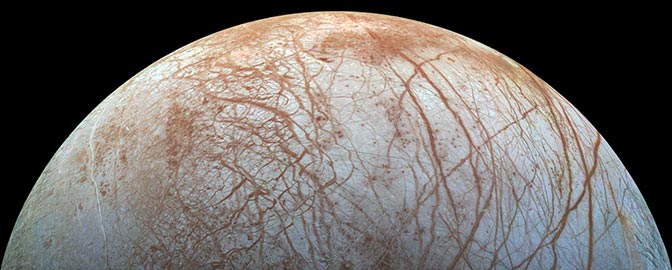
Linda Spilker: Right. I mean, a good example is Europa Clipper. It was Voyager that really saw that Europa was such an interesting world with places. Basically, it wasn't heavily created. It was bright, white and icy. It had these what looked like tectonic fractures and maybe even at the pole like little floating ice flows. And so it was just sort of the key voyager data that led to this mission to go back and to study Europa in more detail. Maybe Europa has geysers like Enceladus. Who knows? And trying to figure out the processes that go on and something about the ocean as well.
Sarah Al-Ahmed: Oh, I hope it has geysers.
Linda Spilker: That'd be exciting. Yeah, it's a possibility.
Sarah Al-Ahmed: It'd be amazing. Otherwise, how are we going to get beneath all that ice to really get at what's going on in that ocean? What happened with Cassini flying through those geysers around Enceladus was just so absolutely pivotal. So I have my fingers crossed for that one when we get there again.
Linda Spilker: Right. And it's part of the decadal surveys to have some kind of a mission to go back to Enceladus perhaps with a lander, to actually land perhaps near those tiger striped fractures and take samples and carry the instrumentation to address the question of whether or not Enceladus may be habitable.
Sarah Al-Ahmed: I've heard so many interesting ideas from the NASA's Innovative Advanced Concepts program, specifically about how we can try to get down in the cracks or make little leaping robots that can jump through those geysers to test more. Even if it's going to take us a while to get back with something like a lander, it's already sparking so many new forms of technology that we'll be able to use for other things, I'm sure. There's a whole group of people over at UC Berkeley making little hopping robots just for this reason. It's amazing.
Linda Spilker: I worked with a group who designed what looked like a giant snake-like robot.
Sarah Al-Ahmed: Oh, eels?
Linda Spilker: The eels, yes, could go down into the fracture and make scientific measurements and had a way to go down there. And I thought what a clever concept. What a clever idea.
Sarah Al-Ahmed: Oh, it's genius. And even if we don't use it for the cracks in one of these icy moons, that technology could help us survey all kinds of caves here on Earth or even the lunar lava caves, that would be so useful.
Linda Spilker: Yeah. Lots of fun. Lots of fun to think about what might be ahead in the future.
Sarah Al-Ahmed: Well, I want to wish you and the entire team good luck keeping these spacecraft alive until that 50th anniversary.
Linda Spilker: Well, thank you.
Sarah Al-Ahmed: I think the whole lot of us want to have that moment celebrating together, but it's going to be so much more meaningful if those spacecraft are still alive out there in space. And I know we can't necessarily turn it back on and point it back toward Earth and take a new Pale Blue Dot image at that moment. But in my brain, I'm going to be thinking about it.
Linda Spilker: Right, right, right. And maybe at that one light day milestone, go out and wave at Voyager and think about Voyager and your favorite memory of Voyager.
Sarah Al-Ahmed: Right. I love it. Thank you so much, Linda, and good luck with the next two years of amazing milestones.
Linda Spilker: Well, thank you very much. And it's been a pleasure to be here.
Sarah Al-Ahmed:
Voyager gave us our first direct measurements of that boundary between the Sun and interstellar space. And next week on Planetary Radio, we'll look ahead to what comes next in this research with a conversation with the team behind the Interstellar Mapping and Acceleration Probe or IMAP. It's a mission designed to not only study that boundary in more detail and help us understand the heliosphere, but also to help protect our own world from space weather with a little more warning.
But Voyager's story also raises a bigger question about space exploration. What happens when missions last far longer than anyone expected and keep returning new science decades after launch? To put Voyager in a broader perspective, it's time for What's Up with Dr. Bruce Betts, Chief Scientist at The Planetary Society. We'll talk about the missions that survived well past their planned lifetime and why listening longer can absolutely change the way we learn about the universe.
Hey, Bruce.
Bruce Betts: Hello. Happy 2026.
Sarah Al-Ahmed: Happy 2026. Air horns. Oh, we finally made it. Oh my gosh. 2025 couldn't get out of here fast enough.
Bruce Betts: Yeah. They tend to take the same amount of time though every year. Well, anyway, happy 2026. Hey, what are we talking about?
Sarah Al-Ahmed: Well, okay. So I was actually really excited for this conversation. I got to talk with Linda Spilker about Voyager. A topic that is near and dear to so many of our hearts in the space community, but we specifically talked about Voyager and what it encountered as it left this boundary of the heliosphere and went past the heliopause into interstellar space. So we talked all about the physics there, about the temperature. And, yeah, I don't know. Voyager is just the gift that keeps on giving. Voyager is going to be going so far away, it's finally going to reach one light day away from Earth in November. So that's something I'm looking forward to.
Bruce Betts: I know. It's really far away, and that's not roundtrip light time, that's one way light time.
Sarah Al-Ahmed: Yeah.
Bruce Betts: Send a message, it's two days later before it can get back to you even if it immediately responds. It's out there.
Sarah Al-Ahmed: They're out there.
Bruce Betts: Just like you, Sarah.
Sarah Al-Ahmed: Far out, man. But also in 2027, it's going to be hitting the 50-year anniversary of the launch of the Voyager missions, which just really impresses me because we did not expect them to survive that long. And every time there's a spacecraft that far outlives it's expected shelf life, I'm just so impressed and it's just such a testament to the engineering. So I figured we should take a moment to celebrate some of the missions that just completely outlived their expectations.
Bruce Betts: I think that's a great idea. And a lot of them are still going. I mean, I'll lead off with Mars Odyssey.
Sarah Al-Ahmed: Oh, yeah.
Bruce Betts: Dang. It was called Mars Odyssey because it was in 2001, Space Odyssey. It's still taking data. It's still happily at Mars orbiting, taking data, doing its thing.
Sarah Al-Ahmed: That's so long.
Bruce Betts: That's impressive. Now, admittedly, most of the danger and risk and stuff for a lot of these missions is early on. It's getting launched, it's making sure everything works. It's getting into orbit, but still, oh my gosh, that's a long time. LRO, Lunar Reconnaissance Orbiter, similar. Hanging out at the Moon. I think technically was a one-year planned mission, and that I believe launched in 2008.
Sarah Al-Ahmed: 2009.
Bruce Betts:
Like Odyssey, great stuff, great instruments. Hubble. Hubble, now it cheated because it had people come play with it. But still, oh my gosh, it launched in 1990 and it's still carrying out amazing science and they upgraded it along the way by sticking new instruments into it, so wow. You can go on, you can go to surface there. I mean, the surface rovers. Opportunity, they promised 90 days. Well, they planned for 90 days. It lasted nearly 15 years on the surface. You have various spacecraft that found new lifetimes with new missions essentially.
So WISE, the infrared telescope studying the broader universe became NEOWISE and studied near Earth objects for several years. You have the ones that completed their primary mission, but still had nice, happy working spacecraft. So fortunately, we're looking like we still have OSIRIS-APEX, which is taken from OSIRIS-REx.
You had Deep Impact that modified into going and flying by another place after it dropped a giant ball of copper into a comet. Stardust dropped off sample return capsule at Earth and then went off to check out Deep Impact's playground. And Cassini, geez, you talked about Cassini. I mean, it took seven years to get to Saturn the way they went. And then it lasted for, what, 13 years?
Sarah Al-Ahmed: That was a long time.
Bruce Betts: And it was basically, it was running out of fuel. So not wanting to contaminate with dirty Earth germs, they burned it up in the atmosphere of Saturn. I mean, it will still be flying and popping around if we hadn't done that.
Sarah Al-Ahmed: Oh man, that's actually the first time I met Linda Spilker was for the Cassini Grand Finale Party. And I still have the Grand Finale Mission pin. It's one of my most treasured space objects.
Bruce Betts: Aw, that's nice.
Sarah Al-Ahmed: Of course, back then, I wasn't a Planetary Society worker. I was just some rando at an observatory for their party.
Bruce Betts: Well, that was exciting. How about a ...
Voiceover: Random space facts.
Bruce Betts: If you lived on Mercury, which by the way, I do not recommend, one mercury day would last two mercury years. Let that fry your brain, just like living on mercury.
Sarah Al-Ahmed: Fry your brain. Unless you're in one of those permanently shadowed craters with the water ice of the poles, then you'd freeze and then stick one arm. You know when you're sleeping in bed and you're too hot, so you stick one leg out and the leg gets cold? You could just do one of those things with the permanently shadowed craters.
Bruce Betts: Wow. You think outside the crater, you really do.
Sarah Al-Ahmed: Yep.
Bruce Betts: All right, everybody. Go out there and look up in the night sky and think about all the fun you're going to have in 2026, including with Planetary Radio. Thank you. Goodnight.
Sarah Al-Ahmed:
We've reached the end of this week's episode of Planetary Radio, but we'll be back next week with more space science and exploration. If you love the show, you can get Planetary Radio T-shirts at Planetary.org/shop, along with lots of other cool spacey merchandise.
Help others discover the passion, beauty, and joy of space science and exploration by leaving a review or a rating on platforms like Apple Podcasts and Spotify. Your feedback not only brightens our day, but helps other curious minds find their place and space through Planetary Radio.
You can also send us your space thoughts, questions, and poetry at our email, [email protected]. Or if you're a Planetary Society member, leave a comment in the Planetary Radio Space in our member community app. It's a new year, so I'd love to hear your ideas of what shows you want to see come out in 2026.
Planetary Radio is produced by The Planetary Society in Pasadena, California, and is made possible by our members all over this beautiful planet. You can join us at Planetary.org/join.
Mark Hilverda and Rae Paoletta are our associate producers. Casey Dreier is the host of our Monthly Space Policy Edition, and Matt Kaplan hosts our Monthly Book Club Edition. Andrew Lucas is our audio editor. Josh Doyle composed our theme, which is arranged and performed by Pieter Schlosser. I'm Sarah Al-Ahmed, the host and producer of Planetary Radio. And until next week, ad astra.