

 Explore Worlds
 Find Life
 Defend Earth


The Downlink • May 08, 2026
Nurseries, names, and nominations
Space Snapshot

Tens of thousands of stars are “blowing bubbles” in this spiral arm of the Whirlpool Galaxy. The clumps of blue and white you see here are knots of massive newborn stars, carving shapes out of the surrounding gas and dust with their radiation. This image, which was taken by the James Webb Space Telescope, is helping astronomers uncover how quickly stars strip away that gas. The faster that material goes, the less is left over to make planets and new stars. Image credit: ESA/Webb, NASA & CSA, A. Pedrini, A. Adamo (Stockholm University) and the FEAST JWST team.
Fact Worth Sharing
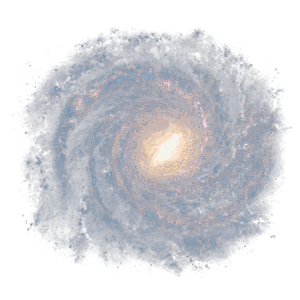
Most of the gas in a galaxy never becomes a star. As soon as massive young stars ignite, they begin to blast their birth clouds apart. This process helps shape galaxies on some of the largest scales.
Mission Briefings


NASA has released more than 12,000 photos from Artemis II. The collection contains the first images taken by humans beyond low Earth orbit in more than 50 years, including views of Earth setting behind the Moon, a solar eclipse from the Moon’s far side, and star trails captured as the crew capsule rotated. Note: the images are not yet accessible via the archive's regular search function. Image credit: NASA.

Congress is pushing back on proposed cuts to NASA science. A House Appropriations subcommittee approved a bill that would fund the agency at similar levels to last fiscal year. Instead of the White House’s plan of a 46% cut to NASA science, the House bill cut it by roughly 18%. At the same time, members of the corresponding subcommittee in the Senate said that the NASA budget request was “shortsighted” and “a disaster for the NASA mission.” The House introduced a bill with similar cuts to NASA science last year, but instead, NASA’s budget was fully restored.

Cracks in the International Space Station remain a problem. Though astronauts have largely sealed the air leaks in a Russian module of the space station, the chairman of the station’s Advisory Council recently said that NASA and Roscosmos have yet to agree on exactly what is causing them or how dangerous they are. The leaks, which have raised concerns for years, are still under investigation.
From The Planetary Society


Two of our leaders have won a major award. The American Astronomical Society's Division for Planetary Sciences has named Casey Dreier, our chief of space policy, and Jack Kiraly, our director of government relations, as recipients of the 2026 Harold Masursky Award for exceptional service to planetary science and space exploration. The recognition comes on the heels of one of the largest Days of Action in the Society's history, which you can get a front row seat to in this week’s episode of Planetary Radio. The Masursky Award was first given to Carl Sagan in 1991; now, it goes to two of the people carrying his work forward. Image credit: The Planetary Society.
What does Artemis II actually mean? On this month's Planetary Radio: Space Policy Edition, host Casey Dreier sits down with Rebecca Lowe, philosophy senior research fellow at the Mercatus Center at George Mason University, to unpack why human presence in space feels different from even the most sophisticated robotic mission.
Catch up on a stellar book club conversation. Last month, the Society's book club met with Hugo Award-winning author Becky Chambers to discuss her novella "To Be Taught, If Fortunate." The story follows four astronaut-scientists as they explore four extraordinary worlds in a distant star system. Members can join book club events live in our digital community and participate in discussions with the authors. Not a member yet? Join today.
Why is Mercury named after a Roman god, but asteroids get named things like “Potato” and “Tomhanks”? From myth and fictional characters to nine-year-olds with naming contests, our latest article explores the long history of how things in space get their names.
What's Up

This week, look for bright Venus to the west in the early evening, with Jupiter above it and getting lower and closer to Venus as the week goes on. To the east, before dawn, be on the lookout for Saturn and Mars low above the horizon. Learn more about what to look for in May’s night skies.
LAST CHANCE to win a once-in-a-lifetime stargazing experience

You could win a once-in-a-lifetime stargazing experience atop Mauna Kea, including rare behind-the-scenes access to the world-famous Keck Observatory, an experience not open to the public, a five-night luxury stay for two at The Westin Hapuna Beach Resort, and a private Zoom Q&A session with our Chief Ambassador, Bill Nye. Use code ENTER25 for 25% extra entries before this sweepstakes closes on May 21!
Wow of the Week

When the Artemis II astronauts flew around the Moon last month, they named a lunar crater after mission commander Reid Wiseman’s late wife, Carroll. The name hasn't been formally approved by the International Astronomical Union yet, but it probably will be: during Apollo 8, astronaut Jim Lovell named a lunar peak Mount Marilyn after his wife back on Earth, and the name later became official.
Send us your artwork!
We love to feature space artwork in the Downlink. If you create any kind of space-related art, we invite you to send it to us by replying to any Downlink email or writing to [email protected]. Please let us know in your email if you’re a Planetary Society member!