

 Explore Worlds
 Find Life
 Defend Earth

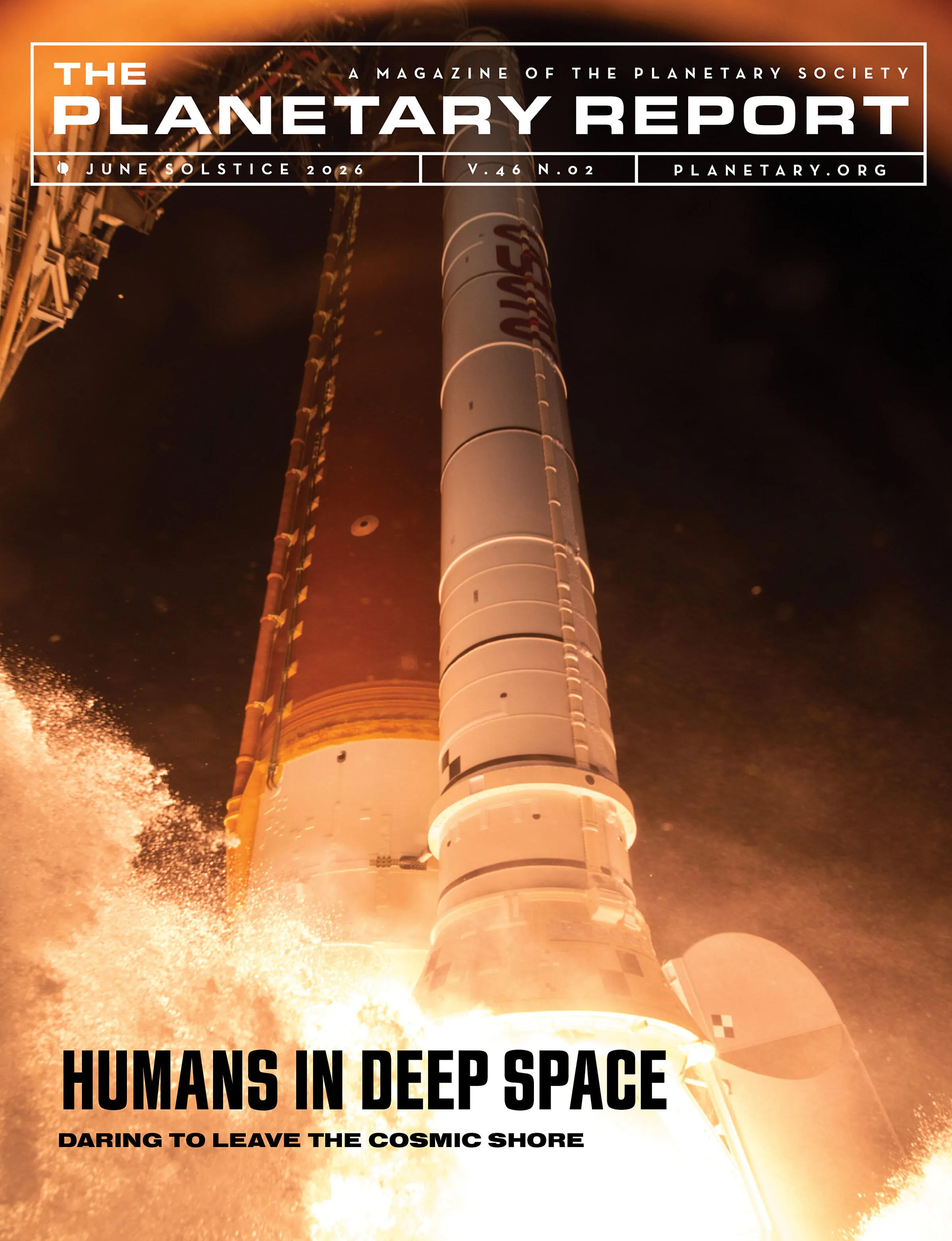
On the Cover: This view shows the Space Launch System rocket lifting off from Cape Canaveral, Florida, in November 2022. It was the precursor to the Artemis II mission, which sent a four-person crew around the Moon in April 2026.
Download PDF
Features
June Solstice 2026

What's actually new about NASA's Artemis missions?
How the technology of Artemis II builds on the past and relies on the new.

Are we ready to send humans to Mars?
The physiological challenges of a mission to the red planet

The consensus problem
Why space science has goals and human exploration has funding but neither has both
Your place in space
Ambassadors of Earth: Celebrating the spirit of exploration
By Jennifer Vaughn, Planetary Society CEO
Humans explore. We are curious. We ask questions about what lies beyond our immediate reach. We build strategies and tools, and we take risks to help us answer them.
Humans have the key attributes that make exploration possible: curiosity, ingenuity, and perseverance. You’ll probably notice that those are also the names of three NASA spacecraft that are on Mars. That’s no coincidence. When we send robotic missions into the Solar System, we are extending some of our best qualities outward. These spacecraft are our surrogates — doing work we cannot yet do directly and expanding human knowledge in places too distant or dangerous for us to go.
When humans leave Earth to explore space, they are also exploring for all of us. They embody the hopes and dreams of so many of us who are bound to Earth. Unlike our robotic emissaries, they bring judgment, adaptability, and the uniquely human capacity to observe, decide, and respond in real time. They also bring something else: human perspective. When humans leave Earth, they carry our stories with them and return with new ones. This exchange has shaped how generations think about our planet and our place in the Cosmos.

Artemis II marks more than a technical milestone. It is part of a broader effort to extend human presence beyond low Earth orbit for the first time in more than 50 years. For a generation that did not experience Apollo firsthand, Artemis offers a new chapter in our story of exploration.
While humans have orbited the Moon before, the success of Artemis II is extraordinary. The capability to send people safely beyond low Earth orbit does not simply lie dormant over decades. Rebuilding that capacity requires sustained investment, engineering rigor, and hard-earned experience. Artemis II’s success is an important step in that work — one that echoes Apollo 8’s first journey into lunar orbit in 1968.
In this issue of The Planetary Report, we examine the context in which the Artemis II mission took place: the policy drivers of human space exploration, the challenges that humans must overcome to extend our reach farther into the Solar System, and the technological advances that will get us there.
Let’s keep exploring.
Your Planetary Society
A STEP Grant update

Growing our understanding of deep-space agriculture
The 2023 round of The Planetary Society’s Science and Technology Empowered by the Public (STEP) Grants awarded $50,000 USD to a team led by Dr. Andrew Palmer of the Florida Institute of Technology to study deep-space agriculture to address the challenge of feeding astronauts on long-duration missions.
Members on deck
Community comments: Members’ reactions to major milestones for The Planetary Society
In January, we announced that the United States Congress had unambiguously rejected extreme cuts to NASA’s science program that were proposed by the White House. This represents a major victory for space advocates like you. Here are some comments shared by Planetary Society members in reaction to that news.
"Hopefully it continues. We all gotta keep writing and advocating. And sharing. The more knowledge that’s spread is net positive in every way, even if it’s a simple astrophotography photo! We live in scary times. But when voices band together, whispers become shouts. And this is immense in its importance." — Jeremiah, USA
"Fantastic news and congratulations. As an Australian who has been a member for many decades, I firmly believe that the U.S. must continue to lead in science and space exploration for the good of everyone. Looks like you will now be able to do so again." — Richard, Australia
"Absolutely delighted and relieved that common sense has prevailed. Congratulations to Casey [Dreier, head of The Planetary Society’s Space Policy & Advocacy program], The Planetary Society policy team, and everyone who supported and kept the pressure on the U.S. Senate and Congress. Thank you from this international Planetary Society member!" — Catherine, U.K.
That same month, we announced that after 15 years at the helm, Bill Nye would be retiring from the role of CEO and stepping into the positions of chief ambassador and vice chair of the board of directors. Jennifer Vaughn was announced as the new CEO. Members shared these reactions to the announcement.
"I have retired after 40 years of teaching elementary school in Canada and frequently showed Bill Nye the Science Guy to my students. They loved every episode and often asked to see more. Bill’s impact on children, many of whom have already grown into adults, is immeasurable. As N.D. Tyson would say, 'Keep looking up!' Thank you, Bill! Good luck in your new role!" — Michèle, Canada
"Congrats, Bill! What a legacy of leadership you leave, and it’s great you’ll remain engaged. I can’t wait to see how you’ll use the extra time. And congrats to Jennifer! TPS is in great hands." — Bill, USA
"As a retired middle school science teacher and Planetary Society member who utilized Mr. Nye’s teaching tools on a regular basis, I cannot express enough appreciation for his skills and passion. I’m ready and willing to assist in any new efforts Bill Nye has in store for the organization. Thank you, Mr. Nye!" — Thea, USA
"I’m so grateful for all of Bill Nye’s contributions and the impact he has had on my life. I’m also SO EXCITED to see Jennifer take on this role. It has been so great to meet her and talk with her at several TPS events!" — Jeffrey, USA
These comments were all shared in The Planetary Society’s members-only online community. Members can log in at community.planetary.org.
Space art
Keeping the future front of mind

Do you want to see your artwork here? We love to feature our members throughout this magazine. Send your original, space-related artwork to [email protected].
From the chief scientist
A cosmic roundup from The Planetary Society’s chief scientist
By Bruce Betts, Planetary Society Chief Scientist
In the sky
Super-bright Venus dominates the evening west for months. Very bright Jupiter will rise in the predawn east starting in July and rise earlier as the weeks pass. Reddish Mars is in the east before dawn. Yellowish Saturn rises in the middle of the night in June, then rises earlier until September, when it begins rising around sunset. In early July, Mercury will be low in the west at dusk. The Perseid meteor shower, usually one of the top meteor showers of the year, peaks Aug. 12-13, with increased activity several days before and after. Viewing will be ideal this year with a new Moon, which will not interfere with visibility. From a very dark site, there are typically 50 to 75 meteors per hour at the peak. On Aug. 12, a total solar eclipse will be visible from portions of Greenland, Iceland, Portugal, and Spain. Much of Europe will see a partial eclipse (wear safety glasses!). On Aug. 28, a partial lunar eclipse with 96% of the Moon in Earth’s umbral shadow will be visible from North and South America, with some of the eclipse visible in Africa, Europe, and the Middle East. For more night sky tips, you can always check out planetary.org/night-sky.

Random space fact
The Trojan asteroids, which orbit ahead of and behind Jupiter in its orbit, are named after characters from Homer’s “Iliad,” a tale of the Trojan War. With only a few exceptions, those ahead of Jupiter are named after Greek characters and those behind are named after Trojan characters.
Trivia contest
Our December Solstice contest winner is Chris Larkner of Pekin, Illinois, USA. Congratulations!
The question was: Three astronauts traveled to the Moon twice. One of those did not land on the Moon either time. Who was it?
The answer: Jim Lovell (on Apollo 8 and Apollo 13).
Try to win a copy of the book “Saturn: The Ringed Planet with The Planetary Society” by Bruce Betts and a Planetary Radio T-shirt by answering this question: What is the largest moon in the Solar System to orbit retrograde — in other words, opposite the direction of its planet’s spin?
Email your answer to planetaryreport@ planetary.org or mail your answer to The Planetary Report, 60 S. Los Robles Ave., Pasadena, CA 91101. Make sure you include the answer and your name, mailing address, and email address (if you have one). By entering this contest, you are authorizing The Planetary Report to publish your name and hometown. Submissions must be received by Oct. 15, 2026. One entry per person. The winner will be chosen in a random drawing from among all the correct entries received.
Advocacy
The 2026 Day of Action: Save NASA Science returns to Capitol Hill
By Jack Kiraly, Director of Government Relations
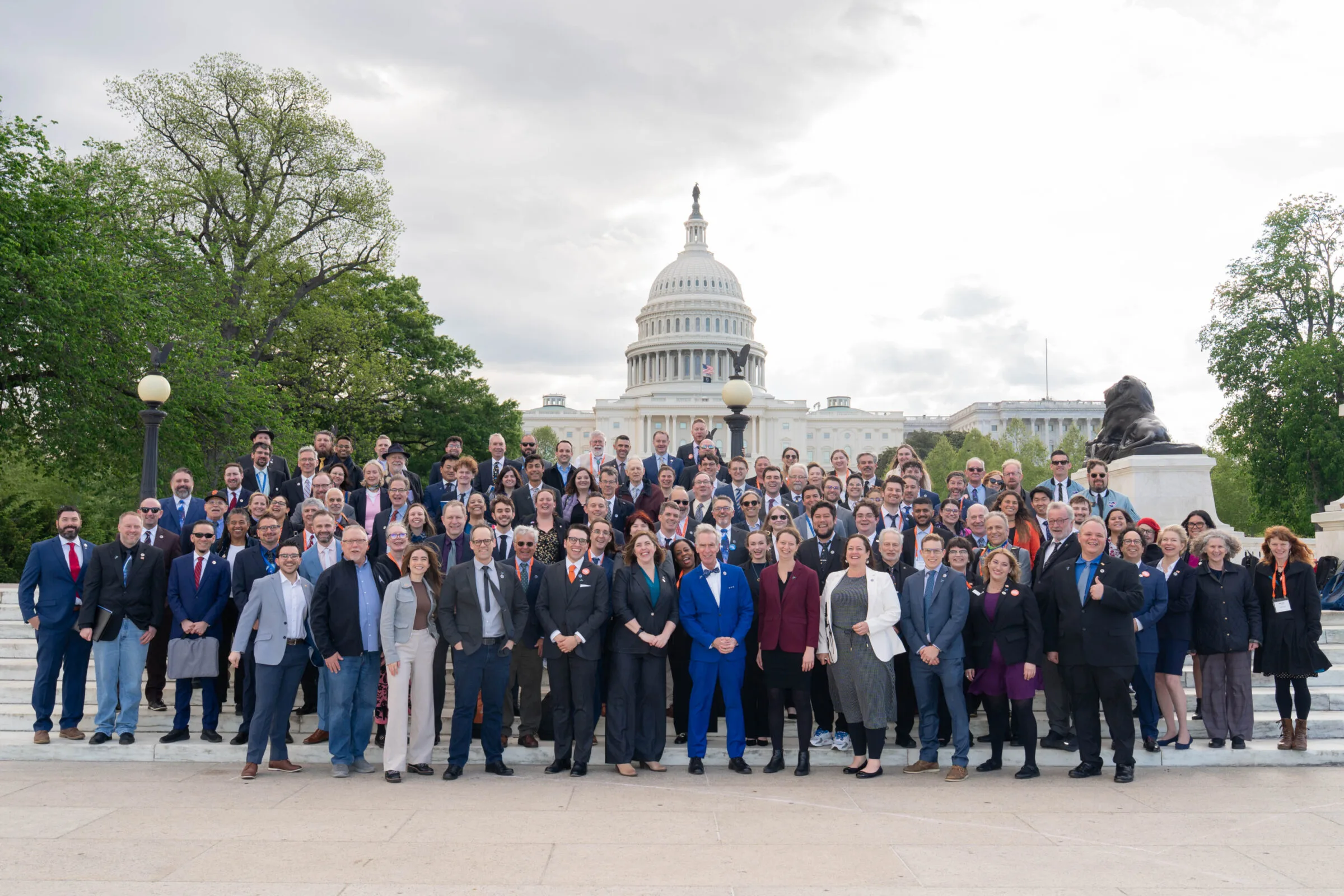
On Monday, April 20, 2026, more than 130 space advocates from 34 states and the District of Columbia came to the nation’s capital for The Planetary Society’s annual Day of Action. Over the course of the day, these volunteer advocates held 280 meetings with House and Senate offices to deliver a simple message: Save NASA Science, again.
And this time, we are confident that Congress will act swiftly to reject the White House’s proposed 46% cut to NASA’s Science Mission Directorate (SMD). The House and Senate rejected a carbon-copy budget proposal in January, and all signs point to a repeat as soon as this summer. And so our message for this Day of Action wasn’t a plea for help but instead an expression of gratitude and a call to keep moving. Our topline ask, beyond rejecting the White House’s proposal, was to grow NASA’s topline budget and increase the SMD budget to its inflation-adjusted peak of $9 billion.
We’re not alone in pushing for this increase. In March and April, a bipartisan group of 125 congressional lawmakers, led by the Planetary Science Caucus, called on appropriators to protect and embrace an ambitious, balanced, and fully funded space science program.
Our momentum is real, and we have our members to thank for that. For the latest updates on this campaign and how you can help, visit planetary.org/save-nasa-science.
The Planetary Report • June Solstice 2026
Help advance space science and exploration! Become a member of The Planetary Society and you'll receive the full PDF and print versions of The Planetary Report.