

 Explore Worlds
 Find Life
 Defend Earth


The FY 2027 NASA budget request
Here we go again

Written by
Casey Dreier
Chief of Space Policy, The Planetary Society
April 23, 2026
An extinction-level event can be thought of as a sudden, external calamity wiping out a given species. For the dinosaurs, it was the Chicxulub impactor. For NASA’s science program, it very well may be the FY 2027 Presidential Budget Request.
The President’s Budget Request for NASA in fiscal year 2027 was released on April 3. It proposed a $5.6 billion cut (23%) to the space agency, of which a disproportionate $3.4 billion would be taken from science activities, a decrease of 46% from the prior year. NASA’s proposed top-line amount, when adjusted for inflation, would be its lowest in 66 years. And the agency’s workforce, having already lost a fifth of its staffing last year, stands to lose thousands more.

Adjusted for inflation, the FY2027 White House budget proposal for NASA would again attempt to provide the smallest budget for the space agency since 1961.
Download Options


| FY 2026 Enacted | FY 2027 Proposed | % change | |
|---|---|---|---|
| Exploration | 7,783.00 | 8,513.90 | 9% |
| Space Operations | 4,175.00 | 3,047.20 | -27% |
| Space Technology | 920.5 | 624.3 | -32% |
| Science | 7,250.00 | 3,893.90 | -46% |
| Aeronautics | 935 | 609.5 | -35% |
| STEM Engagement | 143 | -- | -100% |
| Safety, Security, and Mission Services | 3,000.00 | 1,998.60 | -33% |
| Construction and Environmental Compliance and Restoration | 185.3 | 100.6 | -46% |
| Inspector General | 46.5 | 41.1 | -12% |
| Total Budget | 24,438.30 | 18,829.10 | -23% |
Draconian cuts threaten NASA science
The White House claimed that its 46% proposed cut would terminate “over 40 low-priority” science missions. However, in a striking departure from norms of transparency, the budget request explicitly identifies only a handful of these missions marked for termination. The vast majority are identifiable only by their absence; mission line-items simply disappear from the budget request compared to 2026, a practice without precedent in prior budget proposals.
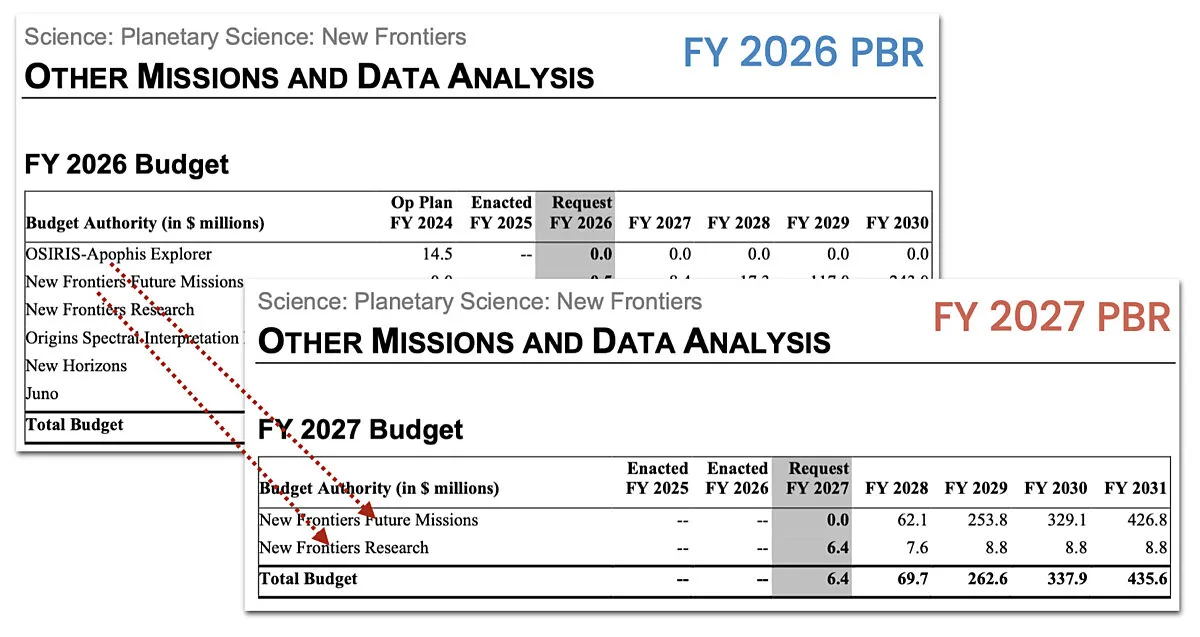
After painstakingly comparing each program area to last year’s budget proposal, The Planetary Society counted 53 missions likely facing termination, accounting for nearly half of NASA’s science portfolio. They impact every major science division. Terminations hit both ends of NASA’s mission pipeline: early-stage development (curtailing the future mission queue) and extended operations (throwing away low-cost, high-value science). They range from small missions to flagship-class projects.
It is possible that some projects are folded into other, larger account lines within the agency and are no longer represented in the budget. If so, such decisions are not stated explicitly in the budget request itself, nor is it clear which missions could be supported that way, or why they would be moved. The Planetary Society and various media institutions have made repeated requests to NASA to verify these proposed terminations since early April. NASA has not provided a response.
Given our current information, The Planetary Society identified the following breakdown of likely terminated science missions. Several broad trends emerge.
| Canceled in FY 2027 | Value of operational assets canceled ($M LCC) | |
|---|---|---|
| Planetary Science | 10 | $3,773 |
| Earth Science | 16 | $4,321 |
| Astrophysics | 10 | $2,245 |
| Heliophysics | 17 | $2,848 |
| Totals | 53 | $13,187 |
Climate and Earth-observing are systematically dismantled
The Earth Science missions proposed for cancellation monitor climate, carbon, or atmospheric composition: OCO-2 and OCO-3 (atmospheric CO₂), Aura (ozone layer), Atmosphere Observing System (aerosols), and others. The terminations impact both in-development projects and spacecraft in their extended missions. What they share is, broadly, a climate-science relevance.
Venus exploration is abandoned
The two Discovery missions selected in 2021, DAVINCI and VERITAS, as well as the U.S. contribution to ESA's EnVision mission, would be eliminated. That represents NASA’s entire Venus portfolio. Even the modest Venus Technology line, used to prove out future instrumentation and hardware for Venus exploration, would be removed. No comparable full-target elimination appears for any other Solar System destination.
International-partner missions are disproportionately cut
Fifteen of the proposed terminations would break partnerships with foreign agencies serving as prime or co-leads, including ESA (Rosalind Franklin rover, Athena, EnVision, LISA, Mars Express), JAXA (XRISM, Solar-B), the Israel Space Agency (ULTRASAT), and the Korea AeroSpace Administration (CODEX). While some of these would amount to turning off an instrument on a spacecraft, many would abandon a key ally on a project that otherwise depends on major U.S. hardware or launch contributions to ensure a successful mission.
Extended missions are terminated despite sunk costs
Nearly half of the 53 cancellations are operating in their extended mission phase. These missions offer some of the highest “science per dollar” returns in NASA’s portfolio. By operating them past their original design lifetimes, NASA squeezes every available bit of science from them, returning huge value to taxpayers. Terminating them now would permanently wipe out years of priceless data to achieve savings measured in single-digit millions per mission, a fraction of total expenditures.
Artemis-adjacent and Mars-surface assets are preserved
Missions with a direct line to Artemis architecture (instrumentation for lunar missions, VIPER, LRO) or Mars surface operations tied to future human exploration (Mars 2020 (Perseverance), MRO) are absent from the proposed terminations. Notably, however, Perseverance would see its operating funds slashed in half, forcing a significant reduction in scientific productivity. Multiple Mars missions are still slated for cancellation, including Mars Odyssey. MAVEN, not present on this list, suffered a hardware failure last year that has almost certainly ended the mission.
Science missions nearing launch are funded
NEO Surveyor, Dragonfly, and the Nancy Grace Roman Space Telescope are all funded. Notably, these missions were all started in prior administrations and are currently in their peak development phase, with launches scheduled in the next two years.
Research funding is cut across the board
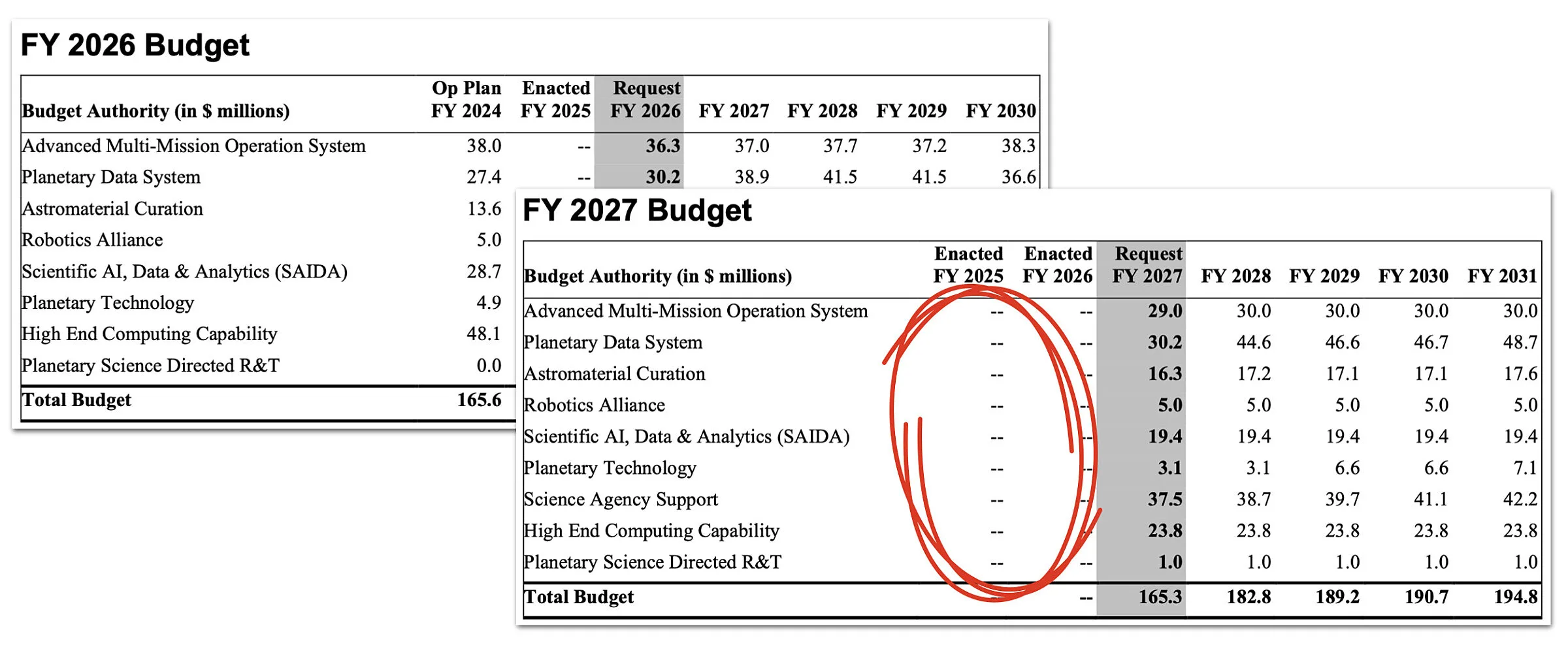
Research funding, the lifeblood of the scientific community that both maintains the professional scientific workforce and funds training of future scientists, suffers cuts across the board. It is difficult to assess the full scope of cuts applied to basic scientific research, as the FY 2027 budget request does not report baseline amounts from prior years, another dramatic departure from past budget documents presented to Congress. The only reliable numbers we have are from 2024. Those amounts theoretically should be similar to those spent in 2025, given that the entire fiscal year was under a continuing resolution that kept funding flat.
NASA has a top-line problem
Instead of clarity, the FY 2027 budget request creates uncertainty around the administration’s policies. No funding is provided for NASA’s contribution to Europe’s Rosalind Franklin Rover, but NASA just announced it purchased a Falcon Heavy to launch the mission (at a cost greater than the amount appropriated for the project this year). Mars missions are cut, despite Mars being a stated goal for the agency. No major new scientific missions are proposed. Any new science missions appear to be hitchhiker science — modest instrumentation attached to spacecraft designed for other means.
This is not a budget that drives efficiency. Terminating nearly half of the United States’ space science fleet spanning from the Sun to beyond Pluto will not improve “science per dollar.” NASA will not do more with less. Once missions are turned off, they are functionally impossible to turn back on. If the New Horizons spacecraft in the Kuiper belt is terminated, no amount of “efficiency” will restore the data gathering capability lost in that distant locale in the Solar System. Should the Chandra X-ray Observatory be switched off and left to tumble into the darkness of space, no commercial platform will be there to collect the same type of X-ray photons, because one doesn’t exist, nor is one planned.
NASA has a top-line problem. The draconian cuts of nearly 50% to space science were first put forward in 2022 by Russ Vought, who now serves as the Director of the White House’s budget office. They necessitate the termination of high-priority science projects and highly performant science projects, and turn off the pipeline of future missions and future scientists by cutting grant funding. The top-line cuts also require major cuts to NASA’s aeronautics, technology, STEM education, and International Space Station operations.
Congress has already expressed broad resistance to this proposal, given that the body rejected a near-duplicate proposal just months ago. Nevertheless, this threat must be taken seriously. It represents formal administration policy for NASA, and until Congress acts, these draconian cuts will be the baseline plan that NASA must adhere to when making plans for next year.
The Planetary Society will continue working to ensure these cuts are rejected as quickly and as overwhelmingly as they were last year, to send a clear message that the nation will not sit by and idly watch as the product of a half-century of science and exploration is so callously tossed aside.
You Power the Next Great Discovery!
Fund future scientific research that advances space science and exploration with your gift today.
Donate