

 Explore Worlds
 Find Life
 Defend Earth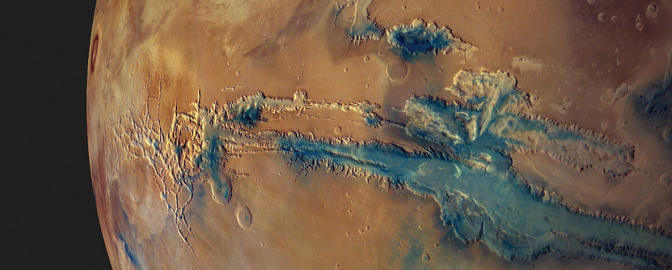


The Downlink • May 22, 2026
With a little help from our planet friends
Space Snapshot

NASA’s Psyche mission recently swung past Mars for a gravity assist on its way to the metallic asteroid Psyche. As it approached, it captured this dramatic image of the crescent red planet. Psyche came within 4,500 kilometers (2,800 miles) of the planet’s surface, moving at 19,848 kilometers per hour (12,333 miles per hour). Image credit: NASA/JPL-Caltech/ASU.
Fact Worth Sharing

A planet's gravity and motion can speed up or slow down a spacecraft. Swinging behind a moving planet transfers some of its orbital momentum to you, speeding you up. Swinging in front lets its gravity pull you backward, slowing you down. Free energy from orbital mechanics!
Mission Briefings


New research casts doubt on the existence of Europa’s plumes. A paper from the Southwest Research Institute reanalyzes Hubble Space Telescope data previously thought to show water plumes emanating from the icy moon’s subsurface oceans. The new analysis suggests that what they originally thought could be evidence of a water vapor plume might just be statistical noise. Pictured: A 2014 Hubble image that was thought to show plumes. Image credit: NASA, ESA, et al.

Meet the next lunar rover. Built by the private company Astrolab, the FLIP rover will carry four NASA payloads to the Moon’s south pole on a mission planned to launch later this year. This mission is part of NASA’s Commercial Lunar Payload Services program.
NASA is developing its plans for Artemis III. The mission will launch an Orion capsule carrying a crew to rendezvous and dock with a lander spacecraft. Both Blue Origin and SpaceX are currently designing human landing systems for the mission.
From The Planetary Society


Astronomers thought JWST might find signs of life. Now they have a new plan. Despite astronomers’ hopes, the James Webb Space Telescope’s observations haven’t uncovered any exoplanets with Earth-like conditions or signs of life. The latest article from Science Editor Asa Stahl explores why this may be, and what’s next in the hunt for life beyond our Solar System. Pictured: An artist’s impression of an Earth-like exoplanet. Image credit: University of Chicago.
Here are the latest insights into space policy. First, get the full scoop on the latest NASA funding bill from the U.S. House of Representatives. Then, read an analysis of the state of space policy from Planetary Society Chief of Space Policy, Casey Dreier.
What’s the big deal about organics on Mars? Amy Williams, astrobiologist and associate professor at the University of Florida, joins this week’s Planetary Radio to discuss a landmark experiment that revealed more than 20 organic molecules preserved in ancient Martian rock, and what this could tell us about Mars' ancient habitability.
Exploring space is fun and easy for people of all ages! Check out our new kids' page for videos and activities to introduce young people to how cool space can be, and how they can learn more about planet Earth, our Solar System, and our amazing Universe.
Experience the aurora in Alaska

Join The Planetary Society’s travel partner Betchart Expeditions on their Alaska Aurora Borealis Expedition, Feb. 28-March 6, 2027. Explore Alaska and witness the aurora borealis, the greatest light show on Earth! Enjoy a rail journey passing Denali, the Ice Art Festival, the Poker Flat Research Range, a sled dog demonstration, the Wildlife Conservation Center, and more. Contact: 1-800-252-4910 or [email protected], or visit their website to learn more.
What's Up

In the evenings this week, look for super bright Venus in the west with Jupiter above it. In the predawn, yellowish Saturn and reddish Mars are low toward the eastern horizon. Learn more about what to look for in May’s night skies.
Help save space missions. Join today!

If you are not already a member, we need your help! Funding for space science is not guaranteed. It requires the voice of passionate advocates like YOU.
NASA funding must grow, not shrink, if the agency is to succeed in returning to the Moon, exploring the Solar System, and seeking out life beyond Earth.
We must prevent future budget cuts. When you become a member of The Planetary Society, you join the world’s largest and most influential space advocacy nonprofit. Will you join us and support a future full of space exploration?
Wow of the Week

As Psyche passed by Mars, it captured some fantastic images — including this multispectral view of the double-ring crater Huygens (upper right) and the surrounding heavily cratered southern highlands. This image enhanced the color differences to bring out details of scientific interest. Image credit: NASA/JPL-Caltech/ASU.
Send us your artwork!
We love to feature space artwork in the Downlink. If you create any kind of space-related art, we invite you to send it to us by replying to any Downlink email or writing to [email protected]. Please let us know in your email if you’re a Planetary Society member!