

 Explore Worlds
 Find Life
 Defend Earth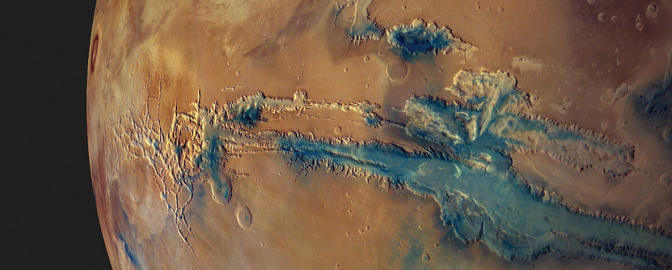


The Downlink • Jul 24, 2026
Portraits of the red planet
Space Snapshot

This is the first photograph ever taken from the surface of Mars. It was taken on July 20, 1976, by NASA’s Viking 1 lander shortly after landing on Mars. Viking 1 operated on Mars for 2,307 days, far exceeding its planned 90-day mission. Planetary Society Chief of Space Policy Casey Dreier reflects on the Viking program’s lasting impact 50 years later. Image credit: NASA.
Fact Worth Sharing

After Viking 1 and 2, it took 17 years before NASA launched another Mars mission. The Planetary Society was established during that time, motivated by a mismatch between the public’s enthusiasm for space exploration and the U.S. government's lack of funding for such programs.
Mission Briefings


Quick thinking preserved a meteorite that crashed into someone’s house. The homeowner who found it put on gloves, placed the rock (pictured) in a jar, and then called the American Meteor Society. Thanks to these measures, this is now one of the most pristine meteorites of its kind on Earth. Image credit: SETI Institute.

Astronomers have found evidence of an atmosphere around a rocky planet in its star’s habitable zone. Observations of LHS 1140 b — a rocky exoplanet 49 light-years away — using the Magellan Clay telescope in Chile, detected signs of gas escaping from the planet. This suggests the presence of an atmosphere, which would be the first direct identification of an atmosphere on a rocky exoplanet if confirmed.

NASA has shared new details about the Artemis III lunar landing test. Planned for 2027, the mission will launch a four-person crew to low Earth orbit in the Orion capsule. SpaceX and Blue Origin will also each launch test versions of their lunar landers. The Artemis III crew will perform two separate, back-to-back rendezvous and docking maneuvers between Orion and the lander test vehicles, and then return to Earth.

NASA has announced a new round of innovative mission concepts. NASA has selected a new round of visionary concepts for its Innovative Advanced Concepts (NIAC) program, supporting early-stage studies of ambitious space technologies. The 2026 selections include a balloon drone to explore the caves of Titan, a mission of 10,000 tiny satellites to orbit through Saturn's rings, and more.
From The Planetary Society


Meet two extreme “hot Jupiters.” On this week’s Planetary Radio, hear from two researchers studying worlds that push our understanding of exoplanet atmospheres to the extreme: a super-heated gas giant on one of the most eccentric orbits ever discovered, and a young planet with a strange hotspot that may suggest it is not yet fully tidally locked with its star. Pictured: An artist’s impression of exoplanet HD 80606 b and its super-heated star-facing atmosphere. Image credit: NASA/ESA/CSA/Joseph Olmsted (STScI).
The Nancy Grace Roman Space Telescope is due to launch in just over a month. Here’s what to expect from NASA’s next flagship orbital observatory, which has the power to reshape what we know about planets throughout the galaxy and help uncover the true nature of dark matter and dark energy.
Help us find them first! Every day, scientists are scanning the skies for asteroids that could threaten Earth, and every day, your support keeps that search going! A dangerous impact is rare, but preventable — but only if we act early enough. Make a gift today to help track dangerous asteroids before they find us.
What's Up
You can see Mars for yourself this week, low in the east before sunrise. In the evening, look for super-bright Venus in the western sky, with yellowish Saturn rising in the east later in the night and shining high in the sky until dawn. Learn more in our guide to July’s night skies.
Carl Sagan. Bill Nye. You.

The Planetary Society was co-founded by Carl Sagan to give you an essential role in space exploration. Not already a member? Join today! When you become a member, you join a global community of space advocates who make a critical difference in supporting a future full of space exploration. Join Chief Ambassador Bill Nye and become part of the world's most effective independent space advocacy nonprofit!
Wow of the Week

NASA’s Psyche mission flew by Mars in May on its long journey to the metallic asteroid also named Psyche. This composite image shows a series of photos of a crescent Mars taken by the spacecraft as it gradually approached the red planet. Image credit: NASA/JPL-Caltech/ASU.
Send us your artwork!
We love to feature space artwork in the Downlink. If you create any kind of space-related art, we invite you to send it to us by replying to any Downlink email or writing to [email protected]. Please let us know in your email if you’re a Planetary Society member!