

 Explore Worlds
 Find Life
 Defend Earth


Planetary Radio • Apr 29, 2026
Yuri's Night 2026: Celebrating 65 years of human spaceflight
On This Episode
Frank White
Space philosopher, Author of "The Overview Effect", Co-founder and President for Human Space Program

Ron Garan
Founder for Fragile Oasis and the Manna Energy Foundation
Bruce Betts
Chief Scientist / LightSail Program Manager for The Planetary Society
Sarah Al-Ahmed
Planetary Radio Host and Producer for The Planetary Society
Also in this episode:
- Laura Tomlin, CEO, Space for Teachers
- Kalind Carpenter, Robotics Engineer, JPL
- David Hernandez, Software Engineer, Blue Origin
- Robert Green, Research Scientist, Jet Propulsion Laboratory
- Andy Sadhwani, Aerospace Engineer and Virgin Galactic Astronaut
- Jannicke Mikkelsen, Cinematographer, Polar Explorer, and Norway's First Astronaut
- Nadine Nicole, Actress, The Expanse
- Christopher Huie, Astronaut and Aerospace Engineer
On April 12th, 1961, Yuri Gagarin became the first human in space. Sixty-five years later, we celebrated that milestone at Griffith Observatory in Los Angeles, CA.
We began on the lawn of Griffith Observatory, where host Sarah Al-Ahmed spoke with exhibitors about the tools, dreams, and technology that drive space exploration. Laura Tomlin, CEO of Space for Teachers, shares how microgravity research projects inspire the next generation. Robotics engineer Kalind Carpenter from NASA’s Jet Propulsion Laboratory (JPL) walks us through the machines he’s helping to build to explore the moon and beyond. Software engineer David Hernandez from Blue Origin describes the work happening at Club for the Future to get young people excited about space. Research scientist Robert Green from JPL talks about the invention of imaging spectroscopy and how it’s used to unlock the secrets of distant worlds. And aerospace engineer Andy Sadhwani, who flew to space aboard Virgin Galactic, reflects on seeing Earth from above and what the Artemis II astronauts experienced.
We then move inside for Yuri's Night's evening stage show, where the focus shifts to human experience and the overview effect. Cinematographer and polar explorer Jannicke Mikkelsen, Norway's first astronaut, shares her experience as part of the first crew to orbit over both Earth's north and south poles. Space philosopher Frank White, author of "The Overview Effect," leads a panel discussion with actress Nadine Nicole from The Expanse and commercial space explorer Christopher Huie about what happens to humans when we see Earth from space. Finally, NASA astronaut Ron Garan brings it all together with a powerful vision of our planet's fragility, our interconnectedness, and humanity's potential when we work together.
The episode closes with Bruce Betts' What's Up segment, revealing a little-known story about what went wrong during Yuri Gagarin's historic first flight.


Related Links
- Yuri's Night
- Griffith Observatory Foundation
- Space for Teachers
- Blue Origin's Club for the Future
- EELS (Exobiology Extant Life Surveyor)
- Moon Mineralogy Mapper - Moon Instruments
- Europa Clipper, a mission to Jupiter's icy moon
- EELS and the future of exploration
- Planetary Radio: EELS: AI-enabled snake robots and the search for life on Enceladus
- Fram2
- Frank White
- Planetary Radio: Book Club Edition: Exploring the Overview Effect with Frank White
- Inspiration4
- Working Together For a Better World, with Astronaut Ron Garan - Big Think
- Planetary Radio: Triumph and turmoil: Artemis II and the renewed fight to save NASA science
- The Artemis II mission
- Buy a Planetary Radio T-Shirt
- The Planetary Society shop
- The Night Sky
- The Downlink
Transcript
Sarah Al-Ahmed:
Yuri's Night 2026, this week on Planetary Radio. I'm Sarah Al-Ahmed of The Planetary Society with more of the human adventure across our solar system and beyond. On April 12th, 1961, Yuri Gagarin became the first human to reach space. 65 years later, we celebrated that milestone at Griffith Observatory in Los Angeles. Throughout this episode, you'll hear from educators, engineers, and space explorers, all of whom share some common ideas
We talk about what we can do in space to inspire that next generation and how seeing the earth from space changes our perspectives about humanity and our future. First, we'll hear from Laura Tomlin, who's the CEO of Space for Teachers. She talks about inspiring the next generation through hands-on microgravity research projects that put real science in the hands of students and teachers. Then robotics engineer, Kalind Carpenter from NASA's Jet Propulsion Laboratory walks us through some amazing tools and robots he's helping to build that are going to be exploring the moon and beyond
Software Engineer David Hernandez from Blue Origin was working at the Club for the Future booth, an organization dedicated to getting the next generation excited about space. Research scientist Robert Green, also from JPL, talked about the invention of imaging spectroscopy and what that can teach us about the worlds around us. Later, I caught up with Aerospace Engineer Andy Sadhwani, who flew to space aboard Virgin Galactic. He shared what it felt like to see the earth from above and reflected on what the Artemis II astronauts must have experienced
Then, we'll transition to the main stage at Yuri's Night. First, we'll hear from cinematographer and polar explorer, Jannicke Mikkelsen. She's Norway's first astronaut. She'll tell us why we need storytellers in space just as much as scientists and tell the story of her historic polar orbit mission. Space philosopher, Frank White, who's the author of The Overview Effect, is joined by actress Nadine Nicole from The Expanse and commercial space explorer, Christopher Huie, for a panel discussion on what it means to see earth from space and how that perspective can change everything
And finally, NASA astronaut Ron Garan brings it all together, sharing his own journey to space and reflecting on what we can learn when we take a step back and see our planet as a whole. Of course, we'll close out with our chief scientist, Bruce Betts, in this week's What's Up. He shares the lesser known story of what went wrong the day that Yuri Gagarin took his first historic space flight. If you love Planetary Radio and want to stay informed about the latest space discoveries, make sure you hit that subscribe button on your favorite podcasting platform
By subscribing, you'll never miss an episode filled with new and awe-inspiring ways to know the cosmos and our place within it. Yuri's Night is a global celebration of human space flight, held every year on or around April 12th. It marks the anniversary of Soviet Cosmonaut Yuri Gagarin's historic first flight, the first moment that humanity crossed that boundary into space. Yuri's Night was founded in 2001 by Loretta Hidalgo Whitesides and George Whitesides, who saw an opportunity to unite space enthusiasts around the world in a shared moment of celebration and inspiration
In the 25 years since, it's grown into one of the largest space events on the planet with gatherings around the globe. And this year's celebration was a special one. It marked the 65th anniversary of Gagarin's flight, the 45th anniversary of the space shuttle program, and the 25th anniversary of Yuri's Night itself. And by strange and beautiful coincidence, it also happened to be one day after the Artemis II mission splashed down, marking the first return of humans from lunar space in over half a century
The Los Angeles Yuri's Night celebration has traditionally been held in other locations, but this year it found a particularly fitting home at the iconic Griffith Observatory. The Observatory is perched above the city of stars with the Hollywood sign visible in the distance. I want to give a special thank you to the Griffith Observatory Foundation who not only helped make this night possible, but granted us access to the audio of this event. Griffith Observatory Foundation is the nonprofit that supports Griffith Observatory
Their mission is to keep this Los Angeles landmark open and accessible to everyone for free, supporting science literacy, public astronomy, and free education programs like their fifth grade school program. You can learn more about their work at obs.la/support, and it was quite an event to put on. The crowd that gathered that evening was a mix of space enthusiasts and families and some really special guests
The event also had ambassadors stationed throughout the grounds to talk to attendees about space exploration. It was my first time serving in that role, and I had so much fun talking to people about space for literally hours on end. Out on the front lawn, under the open sky, organizations set up booths to share their work with the public. Here are some of the conversations I had with some of the exhibitors.
Laura Tomlin: Hi, I'm Laura Tomlin. I'm the CEO of Space for Teachers. We are a nonprofit focused on microgravity research opportunities for teachers in their classrooms.
Sarah Al-Ahmed: That's amazing. As the daughter of a teacher, I know how important it is for teachers to get the resources to share this kind of thing with people out there. What have you been doing here today to try to encourage young people to get more interested in space?
Laura Tomlin:
So today, we are spreading the word that our teachers are heroes. They are working really hard every single day. They make their students rise to these challenges, right? Students are so capable of doing really hard things, and I think a lot of times they don't really get credit for that. So when you bring these difficult challenges to teachers and to students both, it's amazing what they can do in the classroom. So as our organization, we work directly with teachers to develop microgravity research projects
Basically, we help guide the teachers and then the teachers guide their students on these microgravity research projects. We work with them weekly. We take them through the technical design review of their research. We take them through payload integration, through flight safety reviews, and ultimately, the teacher will then fly their student design on a parabolic flight and test it in microgravity. So it's really powerful that these students can see the things that they built in space with their teacher being tested and getting that data back
It is just the coolest, coolest thing. And these are projects that are aligned with academic research, industry research. They work with SMEs. So it might be on a propulsion management device looking at separating out bubbles from liquids in a fuel tank and designing devices that can do that to slosh baffles to, how to flush out wounds and microgravity. There's all sorts of experiments they do that are aligned
And a lot of people think that a sixth grader can't do this or an eighth grader or a 12th grader, but they can. It's all based on fundamental science principles. And when you pose it to these students that they are answering these real questions, that is inspirational. It teaches them that they can do really hard things. And that's the beauty of space exploration is space brings everybody together under just pure inspiration, pure exploration, and it makes people strive to do the near impossible.
Sarah Al-Ahmed: Being able to work on that kind of actual science as a young person, I think would've meant the world to me. And I'm sure you've heard from a lot of young people who've been very inspired by this. What have been some of your experiences talking with both the teachers and the students?
Laura Tomlin:
It is profound. From a teacher standpoint, you're really getting ... It's uncomfortable to work in this situation. And it's not just me, this is we work with teachers all the time, and it's the same across the board. It's uncomfortable to step out of that zone of, you feel like you know everything in the classroom, been teaching it for 15 years over and over again, and all of a sudden you were the student again, and you were having to learn these things and learn them right there alongside your students
So it's this process of serious challenges, some intimidation followed by wins, followed by challenges. And it's this rollercoaster throughout the whole process that just culminates in this remarkable moment of the realization of, "Hey, these are what my students feel out here in the classroom. I understand that now." And it's just a really big learning process for both. It was for me, it is for the teachers that I work with
Before I was a teacher, I was a biologist. I was a plant pathologist, not a super well-known field. When I started teaching in the classroom, I would always bring in some plant disease aspects, some little plant pathology. And so on one of our parabolic flight, basically it was looking at disease resistance. Does a plant that has flown in microgravity have a different susceptibility to disease? And so these were sixth and seventh graders at the time
And we went through this whole process of growing plants, flying them on a parabolic flight, bringing them back, inoculating them with diseases. They had to learn all these different techniques. And at the end of the year, we always give a survey for the program that's ... what fields or careers are you interested in? And we list all ... 30% of the students checked plant pathology. And I was like, "Plant pathology has never seen these kind of numbers, never."
But it wasn't just that. It was engineering. It was biomedical research. It was all of these things. When they started, it's maybe an astronaut, a lot of astronauts, engineers, that sort of thing, but they just didn't know. So this is an opportunity for these students to see, "Hey, look at all of these opportunities. There's something out there for everybody."
Sarah Al-Ahmed: How can people learn more about your organization and help support your work?
Laura Tomlin: You can go to spaceforteachers.org. So we are called Space for Teachers because really what we try to do, our mission is to make space for teachers in real research so that they can bring this to their students and have something that is meaningful and authentic research in the classroom. There's no better way to learn. So spaceforteachers.org.
Sarah Al-Ahmed: Thank you so much.
Laura Tomlin: Thank you.
Kalind Capenter: My name's Kalind Carpenter. I tell many of the children that I give talks to, I'm a robotics footwear designer.
Sarah Al-Ahmed: What does that mean exactly?
Kalind Capenter:
Well, robots need to get from point A to point B, and depending on where they are, there's different fundamental physics available to them. So I've worked on Mars helicopters that can fly. I've worked on a lot of different drone ideas like Shapeshifter for Titan. I'm the inventor of the Exobiology Extant Life Surveyor EELS Robot, to get through the fluidized media of Enceladus, try to get down through the vents and swim in an alien ocean
One of the people that came up with the idea for Moonfall, so we were ending the sample recovery helicopter and we're like, "Well, we've done great work. What could we do on the moon?" We're like, "Well, we can't use blades, but could we use some type of thruster?" So we started looking at what we could do to basically take this team, take this great work we've done, transfer it to the moon. So thruster variants, we're looking at ones where you can actually harvest water ice from many of these bodies, have an airless body drone that would be a multibody solution
So working a bunch of component technologies to start moving into that, so we don't have to reinvent these things. But yeah, each of these ... this has moved into manipulation. I did the spring wheels that are on our endurance, a rover test bed that we want to send to the moon to do 2000 kilometer drive, get 100 kilograms of rocks to be able to age state the moon, also understand its whole entire geologic history
And then, I do sensorized grippers, underwater grippers, sampling systems. Each one of these basically touches the world. It's how the robots touch, interact with the world and do the function that they're designed for.
Sarah Al-Ahmed: You have a really cool job. Before I say anything else, can I say I love the EELS robot? That's such a cool concept.
Kalind Capenter: Thank you. Thank you. It's a personal favorite.
Sarah Al-Ahmed: So you previously worked on sample return concept, kind of like ingenuity, but to pick up some of these samples. Are you excited about these new ignition day announcements now that the plans for what we're going to be using these helicopters for has changed a little bit?
Kalind Capenter: I'm extremely excited about it. I've actually spent last weeks going through the whole entire output from that, analyzing where are there shortfalls, what technologies do we need, what's going to make this so that we can stay on schedule, on budget and really achieve it. We've broken everything down by timeline, by mass, what might be missing, what things are being overlooked, and there's requests for information out right now that we're being responsive to, to make sure that we're going to be able to meet these goals for humanity.
Sarah Al-Ahmed: Well, congratulations and good luck with that. That is a big next step. But after seeing the way that Ingenuity absolutely crushed it, I cannot wait to see what multiple Ingenuities can do.
Kalind Capenter: Thank you very much. We're very excited.
David Hernandez: I am David Hernandez. I am a software engineer at Blue Origin.
Sarah Al-Ahmed: So you're here today at this Club for the Future booth. I want to say a few years ago, I made a postcard to send to space and I waited a long time and it finally arrived back at my home. It's been so cool finally getting that. Can you talk a little bit about what your program does and what kind of outreach things you do for the young people?
David Hernandez:
Yeah. I mean, Club for the Future is really all about getting the next generation of folks excited about space, right? It's becoming an even bigger and bigger thing. I mean, Artemis just happened literally yesterday I started talking. Yeah, and you can see now currently kids are out here doing their little postcards and we'll get there back the same way that you did. So we do things like this. There are other events that are also hosted, like we go to different schools to talk to them about what is it that we're doing
Have the kids ask questions to us about what they're interested in space and any sort of engineering thing related.
Sarah Al-Ahmed: So it was the Artemis I launch. I missed the actual launch, but the day after I got to go to Blue Origin Factory for the first time, I got to see the bits of New Glenn laid out. It wasn't all the way together yet. What is it like working at a place where you guys are on the verge, you just finished erecting this giant, giant rocket?
David Hernandez: It is fantastic. I love going down to Florida because I feel like a kid at a candy shop walking through there. I'd imagine you might've felt the same way like seeing all the hardware out there, seeing how massive that rocket is, it's fantastic. And then seeing it ... Unfortunately, I wasn't there when our first New Glenn launched, but I saw it go up, be good lifted, right? So yeah, it's absolutely amazing. Yeah.
Sarah Al-Ahmed: What parts of the rocket have you worked on personally?
David Hernandez: So I am a software engineer working on our enterprise system. So I build the tools to help the engineers build the things. So focusing a lot on AI, specifically on ensuring that AI doesn't hallucinate answers. Hoping to get the engineers that are actually working on something, if they need some sort of data, if they have any sort of question, it's able to quickly give them that response and really help them 10X, 100X the work that they're doing.
Sarah Al-Ahmed: How do you prevent them from hallucinating? Are you creating just a specific kind of database for that LLM or are there other ways that you're restricting the software?
David Hernandez: Without getting too into the details. So one of the approaches that we're taking is what's called RAG, so retrieval augmented generation, wherein we give the LLM the actual data that it's going to be using and then put some guardrails around it to ensure that it uses the data and not whatever hallucination that might come from the LLM itself.
Sarah Al-Ahmed: That's a lot of fun. And honestly, that's like a juxtaposition of so many modern day technologies all at once. What has it been like seeing people finally begin to use AI in the space realm?
David Hernandez: It's been amazing, how cool is it to say that we're using AI and space related technologies? It's as futuristic as you can get. And I've really seen how ... Yeah, it's helped quite a bit. Even as a software engineer, I was a bit of a skeptic. I was like, "Ah, I don't know how good it's going to do." And then the new model started coming out. I was like, "Wow, it's amazing. You can do quite a bit with it. You can automate quite a bit of tasks." Yeah, it's been fantastic.
Sarah Al-Ahmed: Yeah. Well, we're not trying to create a full AGI or whatever at this point. We're just trying to make sure that we can augment the ways that we go to space and help automate these things so that our spacecraft can do things on their own and that our astronauts have better ways to access data. So I think this is a really cool usage of that technology.
David Hernandez: Yeah, it's fantastic. Really, that's what it's for, right? We want to make sure that we are helping and enabling the engineers, helping and enabling the entire chain that's building this rocket, right? Because it is such a complicated system that any help that we can give, it gets us to get that launch cadence to start going up pretty quickly and coming back down and reusing the rocket. So yeah, it's been fantastic.
Robert Green: So I'm Robert Green. I'm a research scientist at the Jet Propulsion Laboratory.
Sarah Al-Ahmed: And you work primarily in spectroscopy, right? What kinds of missions are you putting your work on?
Robert Green:
So I came to JPL to work on something called imaging spectroscopy, which was invented at JPL quite some time ago as a way to go to planets in the solar system and understand what molecules were on their surfaces, whether it's Mars, the moon or Europa, it also has relevance at the earth. So we built a class of instruments called imaging spectrometers. The first generation went to the outer planets to Saturn and Jupiter. The next generation is going out now
There's MISE on Europa Clipper heading to Europa. It made it, it's on the space station looking at our planet. We're building UCIS Moon to go back to the moon and we have a plan for Mars as well. All these instruments give us spectra for every point and image. So we know what molecules are present and we can pose or answer questions, whether it's scientific, whether it's institute resource utilization that you'd like to know at the moon
I was involved with the Moon Mineralogy Mapper, which of course in 2008 and nine produced those first spectacular maps showing that there was water and hydroxyl on the illuminated surface and subsequently evidence for ice at the poles of the moon. And that's driving some of the thrust as we move back for those resources focusing on the poles. And just recently at the National Academy, their science division announced the Eagle Vswear mission, which we'll look at our planet with 1.5 million specter per second, and it's also pathfinding for the next generation to go to the moon in Mars
All these spectrometers are helping us answer new questions, both applied here on earth, critical minerals, agriculture, fire fuels really relevant in California so we would know where the fire fuels are and how we might mitigate. So that's my passion and that's what I've been involved with at JPL.
Sarah Al-Ahmed: How does it feel having worked on the Moon Mineralogy Mapper knowing that in part, the future angle of where the Artemis astronauts may land on the moon is in part due to the data that you and your team collected?
Robert Green: Well, it's just extraordinarily wonderful. We built an instrument knowing we were just trying to see if there was water maybe at the edges of some of the permanently shadowed craters. And when we got there, we saw that there was hydroxyl absorption all the way down to the equator and of course, quite a bit at the poles. So we made the case with the evidence, backed it up, and now that's a pathfinder that's giving us focus to go after those resources. So it's wonderful. For me, it's the gift of sticking with good spectroscopy.
Sarah Al-Ahmed: We're all looking forward to Europa Clipper actually getting to the Jovian system, but it's not actually going to be getting beneath the ice. Clearly there's this giant ice shell, but what can we learn from the spectroscopy of the surface of this world that might give us some clues to its habitability?
Robert Green: Well, we're going to see the chemistry of what's on its surface. And there's lots of evidence that materials from the subsurface have made it to the surface in various places. So we're going to be able to interrogate those and look for the various lines of evidence to give us more information about the nature of that ocean below the ice shell. So it's extraordinary and we're so excited. It's an important first step and it's wonderful to be involved with that. Diana Blaney, of course, is the PI of the MISE imaging spectrometer and a close colleague and friend.
Sarah Al-Ahmed: Well, I always love it when people come to these kinds of events with cool props in their pocket, but I'd have never met someone who had a spectrometer in their pocket. This is amazing. How does this work?
Robert Green: We're going to show you spectra of the sun and the earth's atmosphere. Let me just get it going.
Sarah Al-Ahmed: It's wild that we now have this technology kind of shrunk down to the size where you can just literally keep it in your pocket.
Robert Green:
Easy on future Mars science helicopters. In fact, we have a version that we'd love to do that. Hopefully, we get to do that with. Let me ... So I wish everyone could see that, but that's a spectrum of the sun. And here you're seeing ... Well, I got to hold it end point. I need a third hand, but anyway, that's oxygen in the air's atmosphere. This is water vapor. These are solar Fraunhofer lines and we're seeing that all real time. If I point it down, we see the chlorophyll of plants
So all the molecules in the solar atmospheric system are revealed right now with a spectrometer pocket linked to my cell phone, which is where this display, and this is extraordinary. My vision is this will be one of the tools. You have cell phone cameras, which actually the CMOS camera was invented at JPL long ago by Eric Fossum. Hopefully we'll be jumping to full spectrometers in people's cell phones as I'm starting to take that path here with this one.
Sarah Al-Ahmed: This is such a cool technology and I cannot wait to have one for myself. I think anybody who's deep into space technology understands the power of spectroscopy, what it's taught us about our own world and the world's beyond. And honestly, it is one of the most powerful tools we have for understanding the worlds that are not in our solar system.
Robert Green: Absolutely. For exoplanets, that's what we're going to be using. We're going to use the chronographs to get the light from the exoplanet. We're going to feed that into spectrometers. We're going to see what molecules are there and what hypotheses they inform. Hopefully, maybe a case for evidence of planets like ours.
Sarah Al-Ahmed: Well, we'll see. We've seen some hints here and there, but the fact that we can even get that kind of data about these worlds at all is just so amazing. What a time to be alive.
Robert Green: Yeah. When I was born, there were nine planets, then there were eight. Now there's thousands. How extraordinary is that?
Sarah Al-Ahmed: Later that evening, I stepped inside the green room where the other ambassadors for the event were gathered. That's where I had the chance to meet Andy Sadhwani.
Andy Sadhwani: Hi, my name is Andy Sadhwani. I'm an aerospace engineer, and I had the opportunity to fly Virgin Galactic in 2024.
Sarah Al-Ahmed: What was that like to actually see the earth out the window?
Andy Sadhwani: It was absolutely incredible. The first words I had when I looked out the window were, "Oh my God, it's just an amazing, amazing planet." It looked like this giant blue ball floating in this fast sea of darkness, and it was moving quickly around the earth, and we were just amazed to see this beautiful view.
Sarah Al-Ahmed: I feel like there are some things that you can try to understand on paper, right? You can think in your head like, "I know what it might be like to go up on a rocket," but how different was the actual experience and how did it change your opinions of the experience for others?
Andy Sadhwani: I've seen so many pictures of the earth and I've also performed data review on actual launches and seen the earth and video. Nothing prepared me for what I saw at the window. It was an electrifying blue and the atmosphere looked alive and it was just this shield that would protect us and protect all of the living organisms on the planet. I don't really have the words to describe it. I guess what I could say is I discovered some new colors when I looked out the window.
Sarah Al-Ahmed: What advice would you give to people who hope to go to space and sell someday?
Andy Sadhwani: Any altitude is attainable with the right attitude and chance favors a prepared mind, like whether you think you can or you can't, you're right. Getting yourself in order and working towards the things that you think you would need to do to become a space explorer, you can start now. So whether that'd be studying about other people's space travels, reading biographies, taking flight lessons, doing scuba diving, or just touring NASA space centers.
Sarah Al-Ahmed: After having been through this experience, what do you think those Artemis II astronauts were filling when they splashed down yesterday?
Andy Sadhwani: Watching them splash down live was phenomenal. Part of me was thinking about what is the vehicle feeling. And then, the other part was what are they feeling? What's the splashdown feel like? What are the emotions that they have upon reaching earth? What are they thinking about? Are they thinking about their family, their mission? Are they thinking about what burger they're going to order? Would they get back to the mainland?
Sarah Al-Ahmed: Well, thank you so much. And honestly, it is so wonderful to meet people who have that space perspective and to be here at Yuri's Night together. So thanks for sharing that experience with everyone who came here to celebrate the first space traveler together.
Andy Sadhwani: Absolutely my pleasure, Sarah. Thank you.
Sarah Al-Ahmed: We'll be right back with the rest of Yuri's Night 2026, after this short break.
Bill Nye:
Greetings, Bill Nye here, chief ambassador of The Planetary Society. Last year, you showed up and it made all the difference. Tens of thousands of you sent messages to Congress, you traveled to Washington, you made your voices heard, and together we stopped nearly 50% in cuts to NASA science. That victory, that was you. But the fight isn't over. New challenges are here. Your gift today keeps our advocacy efforts going strong so that next time, we can act fast, fight hard and win again
Together, we're not just saving NASA's science, we're protecting humanity's greatest adventure. So please check out planetary.org/takeaction, and together, we can carry on, keep exploring, and change the world. Thank you.
Sarah Al-Ahmed:
As the sun set over Los Angeles and the city lights came out, the celebration moved inside. Many of us gathered for an evening of stage presentations that focused on human experience and space. We heard the stories from people who had ventured beyond our planet and returned transformed by what they saw. I'm only going to be sharing brief segments of the two-hour presentation, but I'm going to add a link to the full video of all the talks so you can see all of the images and the beautiful video that people shared
That's going to be on this episode's webpage. The first speaker of the evening was Jannicke Mikkelsen, who's Norway's first astronaut. She's also a cinematographer and polar explorer. When she flew to space aboard the Fram2 mission, she became part of the first crew ever to orbit over both the Earth's North and South Poles.
Jannicke Mikkelsen:
My language is film. I am an astronaut, but I'm also a cinematographer. It's amazing. It really is amazing that we come to a time where four first time flyers can fly together on what is called a side quest because the dragon was never made for this kind of space exploration. I live in Svalbard. It is an island pretty close to North Pole, the most northern settlement. And we are 2,500 people who live there in a town of 3000 polar bears that is ... And it's kind of like living on the moon except we have oxygen but we do also have polar bears
So I loved riding really fast on my horse. My horse was called Star. And then one day, I fell off and that meant I had five years of learning to walk again. And during that time I couldn't go to school. I actually studied space. My teacher was like, "Just study anything you're interested in." And right then was STS-99. And with such a boring name, it ended up being an awesome mission to follow as an 11, 12 and 13 and 14 year old. I followed this mission for years
I actually called NASA and applied for a job and my mom called NASA and told them, "Well, she's only 14, so she can't apply for that internship." And then, I refused to talk to her. But that career ... I'm going to go back because the cool thing is I probably talked to reception at the Johnson Space Center and she's like, "Well, you're in a wheelchair. Astronaut probably isn't a realistic dream for you, but you can be the world's best in 3D. You could become a 3D technician and engineer."
And I'm like, "Yeah, I'm going to be the world's best in 3D." And that's actually what recruited me to the firm to private space mission, the first ever polar orbit of a spacecraft. And my job actually, not only am I the vehicle commander, my job is to photograph and film that orbit in 3D and regular 2D. I actually landed on the 4th of April last year, 2025. So this is my one-year celebration. Yeah. Our mission is called Fram. We are honoring the polarship Fram that went to both North Pole and South Pole in 1911
What I love the most about this mission, 1911, they brought a cinematographer because they understood how people in Norway are going to understand where we've been and what we've done if we do not document it and continue telling that story. And then finally, when we're in orbit, we're safe and I'm able to do what I love the most and that's being a cinematographer. And what you can plan a lot in 18 months. So we started planning 18 months before the mission, but once you're weightless and all your equipment is weightless, man
So you do learn to switch your orientation. Look up when you lose something. Don't always look down. But the thing I noticed or the thing that puzzled me when I was in space ... I've learned about the blue planet at school, but when I looked out of the window, I didn't see a blue planet. The planet I saw was 50% of the time like this, because we're 25% Arctic, 25% Antarctic. And you don't really see countries. The easiest place to see is the Nile, and then you're like, "Ah, Egypt, got that one. That one is easy."
But it's actually really difficult to see countries when you're in space. I belong to the new generation of astronauts. We are private. There's only 11 of us and we have diverse backgrounds like myself being the first ever cinematographer, lucky enough to receive an astronaut training. And that's what I tried to talk about. When we're going back to the moon and we're going to stay and we're going to build a moon base and we got the Artemis approach, that means that we're going to have all nations joining in that moon base
And we are going to have people going to the moon to work and you are going to need all the different roles you need to operate a town on the moon. But after being in space like all of you, I was watching the Artemis II live streams and Commander Reid Wiseman said something beautiful and he says about earth, it's a special thing to be a human and it's a special thing to be on planet earth because out there, you know what? There's nothing. You're out there and you're looking down and you're like, "All molecules are there."
And it's a bizarre thing. So thank you for your time. And also, it's very important to inspire. I'm the first Norwegian astronaut. There will be more. So I'm actually waiting 40 astronauts to come to Norway to inspire my nation to become the next astronauts going to the moon.
Sarah Al-Ahmed:
Jannicke's story is just such a great reminder of why we need to send storytellers into space. The images and the video that she shared that night were absolutely spectacular. There's something really powerful about the ways that we can tell the story of space to people down on the ground through these formats, because that perspective can change a lot about the way that we see ourselves and our place in the universe
Immediately after that conversation, Frank White, who's a space philosopher and the author of the groundbreaking book, The Overview Effect, took to the stage. He was joined by actress Nadine Nicole from The Expanse and commercial space explorer, Christopher Huie, who also goes by Chuie. They talked about the Artemis II mission and what happens when people see the earth from space.
Frank White:
Something happened in 1961 that was tremendously important in terms of space. Of course, that was Yuri Gagarin's flight. Something important happened in 2021 when we had the first commercial space flight, so another space flight. What it means is everybody here could actually fly without being a NASA astronaut. We are the new astronaut core, every one of us, right? There was a contest called Inspiration Four
The current NASA administrator put that together, funded it, ran it. Loretta and I competed for one of those seeds along with two of our friends. I was all gung ho. Then, I realized there's not going to be any professional astronaut on board and there are not that many people applying. I could win. Be careful what I wish for. Well, this is also a series of speakers where the astronauts outnumber the non-astronauts. We're seeing a really big change. So Chuie and Nadine, I think we have to talk about Artemis.
Nadine Nicole: Yeah.
Frank White: We just have to.
Nadine Nicole: Yeah.
Frank White: What did it mean to both of you that we returned to the moon? We really hadn't been there in so long. It was at a time of incredible strife, division on the planet. And there we saw a perfect mission, pretty perfect. You've flown. What did it feel like to somebody who's flown? Do you think it was different for you because you've been there to see Artemis or what was it like for you, Chuie?
Christopher Huie:
I think it's relatable, but it's also just so different. Being 50, 60 miles up is nothing compared to being 250,000 miles up. And the pictures that were coming back in the video were just incredible. And I think the overview effect is about putting things into perspective. And yes, when you go to low earth orbit, you really are low in earth's orbit. And you can see the earth and you get appreciation for where we are in context of ... She said you can't see the borders unless it's a river, like the Nile
But the further out you get, the less you start to find ways to organize and divide. You just see cohesive, one unified planet. And so, seeing those pictures coming back, especially from the dark side, not really the dark side, but the far side of the moon. Pink Floyd, he's ruined it. The far side of the ... great album, by the way. The far side of the moon. It's just like, yeah, we really are alone. And I remember thinking about, when I was in space looking at the earth, I was thinking about how we are all one and how we are all together and that we're connected, the overview effect
But what I saw in the pictures from the moon in Artemis II is we are alone. Collectively, the earth is by itself. Because when you go to space, you have perspective. You can see where the earth lives. We live on the earth, but the earth lives in space, in our solar system, in the darkness and the blackness of nothing. And we got to see that, yeah, the earth has a home too, and this is it. It's basically a cabin by itself and there's nowhere else to go that can sustain our life
We have to bring life support with us wherever we go. So I think it is different and I think it'll certainly inspire. The cool thing about Artemis is, it's a long time since we've flown to the moon and we almost dropped the ball. We almost lost the ability to do big, amazing things like this because yes, we write down engineering plans and we make all these engineering drawings and to send these missions, but there's so much tribal knowledge that's built in people's head that gets passed along. Building a big complicated rocket is big and complicated
It needs really a large amount of smart people and continuity of education and just to keep the passing the torch. And so, if you wait too long to do these things, you will have to relearn those lessons and there will probably be more failures that we don't need to have. So it's just so important to keep up the momentum.
Frank White: Very well said. Nadine, you and I are the non-astronauts here.
Nadine Nicole: Yeah.
Frank White: Yeah. It's kind of weird, isn't it?
Nadine Nicole: But I think-
Frank White: What did it mean to you to watch Artemis?
Nadine Nicole:
I love that the whole world had eyes on it. It was very similar to the movie Look Up, where we had this collective moment where we could all understand that we're at this pivotal moment in time. We're not just the space explorers anymore. We're moving to inhabit space for the first time. This is our time. It's such an incredible time to be alive. The juxtaposition of all this division that's happening on our planet and the desire for connection is an interesting time for this to happen
For us to have the perspective from them and their experience up there. Because we send astronauts and we think they're going to have a technical experience, but they're up there hugging and talking about grieving and telling everyone here their message of unity, of seeing the separation dissolve and just seeing the oneness of everything. And they're sending these messages back. And I think that that gives us such a cool opportunity of this perspective that we're missing here on earth
We're living in the separation, we're living in the illusions. It's hard. We need that perspective to evolve. And just being in this time and space here now, I think it's just an incredible time. Even though it seems like a geopolitical move, it's not like ... There's a lot of tension between countries of who is going to own the moon or who's going to own space and what that's going to look like
And I think that's the big question that we need to put out there is who is space for? Who's going to have access to it and what design systems are we going to embed into it?
Sarah Al-Ahmed:
If you'd like to explore more of Frank White's thinking, we actually have a really wonderful book club edition episode that's dedicated to his book, The Overview Effect. You might want to look that one up because it's just absolutely fantastic hearing Frank's experience speaking with astronauts. But to close out the evening, we heard from NASA astronaut Ron Garan. He's a fighter pilot, a humanitarian, and someone who spent six months aboard the International Space Station
Ron had a really powerful perspective on what it means to see earth from space and what's possible when humanity works together.
Ron Garan:
Does anybody feel like we're at an inflection point in our society? And does anybody not feel like that? So yeah, we're at an inflection point. And what I've been hearing all night is about the power of perspective, and that's what leaving the planet really does for us. It gives us a perspective. So thank you for this honor to have a conversation with you, to recognize that moment where humanity was able to take the first steps towards the stars
Like I said, outside on the steps, it's really poignant that we're having this celebration the day after the splashdown of Artemis II. When those folks came back from traveling around the moon, it is amazing that we're going back to the moon. That was a sign that this isn't just an idea, this is a reality. We really are going back to the moon. We are really going to stay this time. And what the power of the space program is, is it gives us the opportunity to realize that when we set aside fear and agree to work together, we can accomplish anything, that nothing is impossible
And together, if we take that same mindset, that mindset of the space program, and we do bring it down to the earth surface, we can solve the problems that are in front of us. Seeing the planet from space, I think you'd be amazed at the thinness of our planet's atmosphere. And in that moment, you'd be hit not only by the sobering realization that that paper thin layer keeps every living thing on our planet alive, but should also be hit by the sobering contradiction between the incredible beauty of our planet
And the unfortunate realities of life on our planet for a significant number of its inhabitants. But I also think seeing the planet from space would fill you with hope. Seeing what we can accomplish when we work together, as evidenced by the International Space Station itself, would extend your optimism. Your definition of the word home would expand rapidly to encompass the entire planet, and for the first time, you might truly understand what it means to be part of one human family
Now, obviously, you don't have to go to space to realize any of this, but traveling to space started me on a journey towards a deeper understanding of the underlying inherent beauty of our interconnectedness, of our unity. Going to space made a lot of things become clear. From space, it's clear that everything is changing and things are changing faster than ever. And it's not just happening in one region or industry or nation. It's happening all across the world and it's affecting all sectors of society
As such, the mindsets, the approaches that have led us here, that have led us to this moment in history are rapidly becoming antiquated and ineffective, but this creates an opportunity for us and for those that can adapt. Now, in order to successfully capitalize on the opportunities that are all around us, we need to take a holistic approach and strive to see how everything fits together
We need to understand that moving towards a more inclusive, just and stable world, while protecting the environment, protecting national security and improving our economy and businesses are not mutually exclusive. They are all complimentary. In fact, they are more than complimentary. They are required. We can take a socially just and environmentally sustainable approach to business that also increases profitability, and we can also protect national security for the long run by rising to a higher vantage point
Expanding our perspective and seeing the bigger interdependent picture. Above all else, we need to understand that as daunting and challenging as all these changes that we've seen, they're just the tip of the iceberg. We are entering into a new human epoch where everything will change, especially how we solve the problems facing our planet and how we conduct business. And one of the best ways to navigate the uncertainty and the chaos that's all around us is through collaboration
Collaboration that leads to shared strength. Now, over the course of my career, I've had the opportunity to have some amazing experiences, and these experiences, I believe, have given me a very, very unique big picture perspective of our planet. And so today, I want to put our conversation in the context of this bigger perspective. I want to put them in the context of the orbital perspective. And in doing so, certain trends, truths, and the path forward become clear. Now, a little over 50 years ago, humanity as a whole had a collective out of body experience
An out of body experience that led to an inflection point between two human epochs. Now, the story of this inflection point begins on the winter morning of December 21st, 1968 at the Kennedy Space Center in Florida, atop the tallest, the heaviest, the most powerful rocket ever brought to operational status at the time, the Saturn V set the crew of Apollo 8. There was Commander Frank Borman, Command Module Pilot Jim Lovell, and Lunar Module Pilot Bill Anders
The aim of this mission was to become the first crude spacecraft in history to travel to and to orbit around the moon, and of course, to return to earth safely. But the inflection point came three days later when the crew of Apollo 8 came up from behind the far side of the moon on their fourth orbit, and they realized something never seen before by human eyes. Commander Borman was the first to see the amazing sight, and he called out an excitement to the others, taking a black and white photo in the process
In the ensuing scramble, Bill Anders took a more famous color photograph and it was all captured on the flight voice recorder. I wonder if they realized the significance of that moment. They had just become the first humans in history to see the whole planet hanging in the blackness of space and the first to capture this image for the rest of us. Now, this famous photograph is known as Earthrise, and this is probably the most influential photograph ever taken
This image revolutionized how we see the world, how we see ourselves with its simple message that we are one people traveling on one planet towards one shared future. But unfortunately, the significance of this image has or had for the most part, been forgotten. But back in 1968, for a brief moment, the world was won. People from all over the world, including even in the Soviet Union, a nation that was locked in a space race with the US and a Cold War with the West proclaimed this a monumental achievement for all of humanity
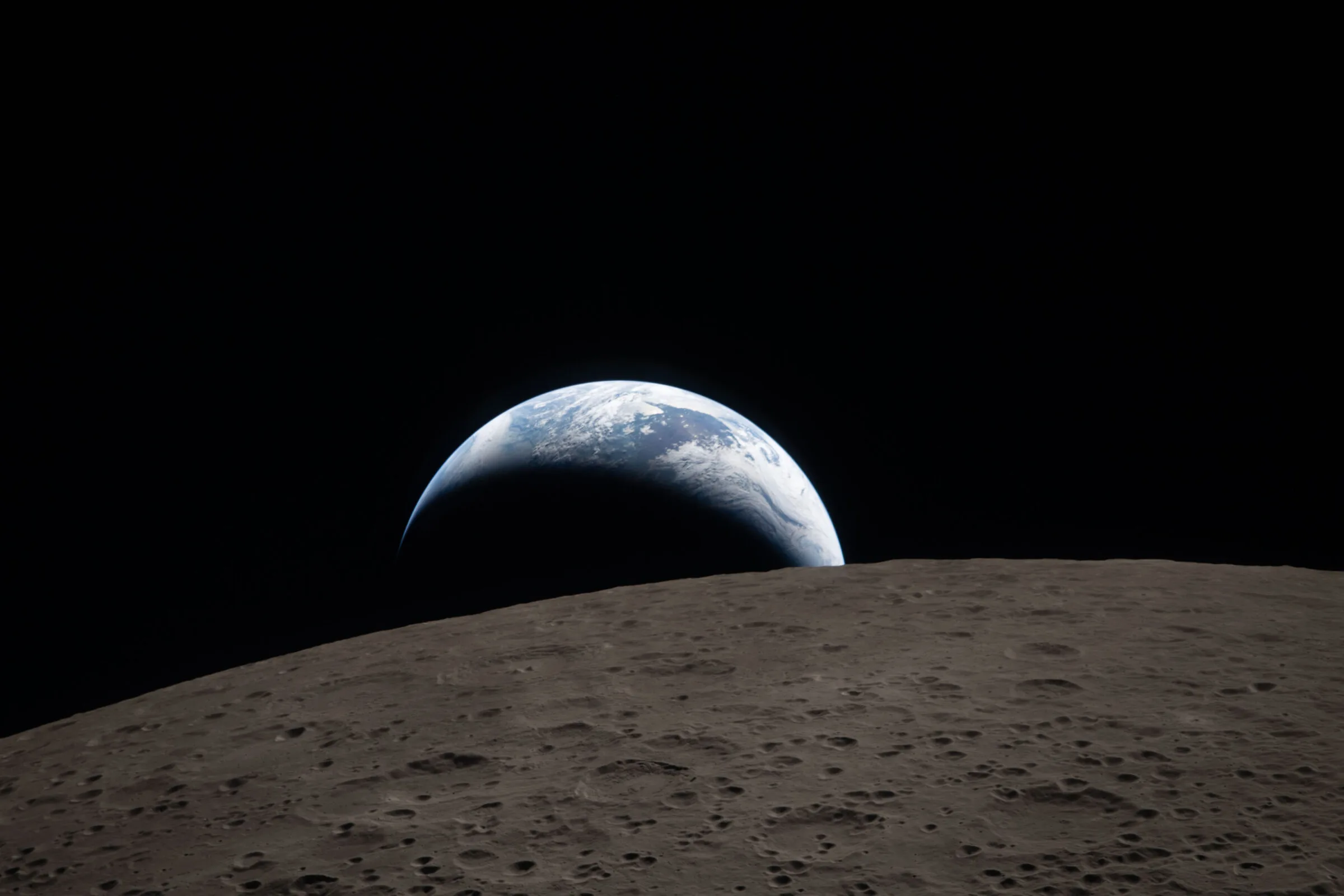
For a brief moment, the world rallied around the image of Earthrise, and this is Earthset. So you've probably all seen this photograph. It was taken about five days ago by the crew of Artemis II. Now, our return to the moon can serve as a second wake up call. It could be a second opportunity to change how we see ourselves. Now, for Apollo 8, you have to realize that Apollo 8 was taken at the end of 1968. And this was a year that was filled with much strife in the United States and most of the world
The years saw political assassinations and massive unrest in streets and cities all around the world. And although the threats that we face today are somewhat different, we are living through at least equally chaotic times. Now, one of those assassinations in 1968 was Dr. Martin Luther King Jr. But precisely one year before the Apollo 8 astronauts were hurdling through space on their journey to the moon, Dr. King gave a sermon
He gave the Christmas sermon on peace, which I believe gives words to what earth rise evoked.
Dr. Martin Luther King Jr.: It really boils down to this that at all life is interrelated. We all caught in an inescapable network of mutuality tied in a single garment of destiny, that whatever it affects one directly, affects all indirectly. We aren't going to have peace on earth, until we recognize this basic fact of the interrelated structure of all reality.
Ron Garan:
The interrelated structure of all reality. This isn't a cliche, this isn't a philosophy. This is the reality of the world that we live in. This is fact. What will help usher in a new human epoch is a greater understanding of the basic fact of the interrelated structure of all reality. So when my six-month mission was over, my two Russian crewmates and I climbed into our SOE spacecraft. We undocked from the space station. We did a couple laps around the planet and as we crossed the south tip of South America, we turned the spacecraft around, we fired the engines
We entered the upper atmosphere. It was very similar to what we saw in Artemis II yesterday. We had this fiery violent ride through the atmosphere at five miles a second. The parachutes opened, it threw us all over the place. We didn't splash down in the soft Pacific Ocean. We smashed down into Kazakhstan. And I have to point out that that video is in slow motion. So we actually hit a lot harder than it looks. We hit so hard, in fact, that we bounced and we rolled and we flipped over
And when the capsule finally came to rest, my window was pointed down at the ground and out of my window, I saw a rock, a flower and a blade of grass. And I remember thinking to myself, "I'm home." And what was really cool about that thought is I was home, but I was in Kazakhstan. So to me, at that moment, home wasn't just Houston, Texas where I lived with my family at the time, home was earth. And our definition of that word, home has profound implications for how we problem solve, how we treat each other, how we treat our planet
And the other thing I realized is expanding the definition of the word home did not come with a requirement to forget where we came from, our national, our ethic, our religious, our organizational affiliations. It simply means seeing those things in the context of the bigger picture. And so in the context of the bigger picture, I want to thank all of you for what you're doing to help make life on our planet as beautiful as our planet looks from space
You don't have to be in orbit to have the orbital perspective. And by working together, we don't have to accept the status quo on our planet. So thank you very much.
Sarah Al-Ahmed: I bet Yuri Gagarin never imagined that all of these years later, people from across the world would be shouting his name and celebrating what his flight meant for humanity. But while we're celebrating Gagarin's achievement, there's something about his story that I think is totally worth knowing. Bruce Betts, who's our chief scientist, is here with this week's What's Up and a lesser known tale about what actually went wrong on that historic flight. Hey, Bruce.
Bruce Betts: Hey, Sarah.
Sarah Al-Ahmed: Man, it has been a lot of adventures this month. I just got back from the day of action a few days ago, but now we're flashing back to this moment earlier this month, right after Artemis two dropped down and it was Yuri's Night. It's just been a lot of space celebration recently.
Bruce Betts: You're just a space party animal.
Sarah Al-Ahmed: Space party animal. So I've been going to Yuri's night for many, many years, but I was literally this many years old when I found out that Yuri Gagarin's flight was way more terrifying than I thought. I mean, going to space is scary. Going to space is the first person is terrifying, but then there was a hardware malfunction during the Vostok 1 mission and I had no idea about it. So I figured we should talk about it because that was extra surprising to me.
Bruce Betts: Yeah, all sorts of fun festive stuff. And plus ... I mean, it's not as surprising because Soviets tended to hide any failures or try to.
Sarah Al-Ahmed: Right. So me not knowing about this was actually by design.
Bruce Betts:
Yes, it was. I mean, they hid the profile of the mission for several years, whether it fit the definition or not of first, I don't know, round trip to space because they hadn't figured out how to land yet. And so, he had to bail out at seven kilometers up and parachute down, but they hid that part until '71, at least that's when they admitted it. And that was the part that worked. They just knew that didn't work
So those are courageous people to get in those spacecraft, but they had some genuine problems, anomalies, malfunctions, 10 seconds after the retrofire, the service module failed to separate from the reentry module, which is bad. That's bad. You don't really want to go through the atmosphere attached to your service module, but he did. The modules tumbled and spun violently, and I'm sure it was very fun and very calming
And then, it was still attached by some wires, but eventually good job going through the atmosphere because that burned up the wires and modules separated. And I like that Gagarin just in the process of all this said everything is okay. I mean, he said it in Russian, of course, during the gyrations because he didn't want to make noise because he figured it wasn't dangerous. That seems like that's obvious. It was probably more dangerous to upset the Soviet High Command.
Sarah Al-Ahmed: How weird is that? It's like no matter what generation of astronauts you're from, it's like they're such calm people that even in situations like this, they're like, "It'll be fine. So what if I'm spinning out?"
Bruce Betts: Yeah. Well, I mean, they chose the ... Everyone in that era was choosing test pilots who were built to be calm.
Sarah Al-Ahmed: That was the other really cool thing about Yuri's Night this year is that there were just so many people who had been to space, not just NASA astronauts, or we had a Norwegian astronaut as well, but there were a lot of people that had been to space on commercial space flights.
Bruce Betts: Did you count yourself because you sometimes seem like you're in space?
Sarah Al-Ahmed: Nope, Sarah doesn't count yet.
Bruce Betts: All right, yeah.
Sarah Al-Ahmed: Well, I mean, that was a really fun thing about something that I think Frank White said in his talk about The Overview Effect was that essentially because of this new age of commercial space flight, everybody on earth is basically part of the astronaut core. I mean, most of us are still not going to go to space, but there's a chance and that chance is getting higher all the time. And so, I won't give up hope.
Bruce Betts: You keep hoping. Believe me, we've all said we'd send you to space if we could.
Sarah Al-Ahmed: But if we could just make sure that the service module actually separates correctly and I'm not dragging things by wires and space, that sounds so terrifying. But man, he did it. That's so crazy.
Bruce Betts: Yeah. I picture him like, "Are there any scissors around?"
Sarah Al-Ahmed: Right. So we just go out on hold.
Bruce Betts: I always bring a pocket knife. Okay, I'm good. I can cut the ... Just reach outside my burning spacecraft and cut those. It'll be fine. Yeah, no, the skies were impressive.
Sarah Al-Ahmed: Seriously.
Bruce Betts: I mean, they still are, obviously, but those early spacecraft were crazy. Shall we move on?
Sarah Al-Ahmed: Let's do it.
Bruce Betts: Random space fact. So the rings of Saturn, they are ridiculously thin compared to their diameter, at least the vast majority of them when there's some strange part, but even those parts. So if the main rings of Saturn, whereas thick as a Blu-ray disc, let's say if people still know what those look like, the Blu-ray disc would have a diameter of over 33 kilometers, 21 miles.
Sarah Al-Ahmed: No way.
Bruce Betts: Well, yeah, Yahweh.
Sarah Al-Ahmed: Dude, that's-
Bruce Betts: God, it's nuts. It's nuts.
Sarah Al-Ahmed: That is nuts. I remember when Cassini started dropping those readings about the actual thickness of Saturn's rings during those ring dives. And I remember thinking like, "Wow, that's not at all what I expected." But when you put in that perspective, those are really, really thin.
Bruce Betts: Yes. Yes. Really, really thin. I mean, I believe on average they're around 10 meters thick and they're sizes of country, big countries and width. That was an odd way to say it, but you get the jam.
Sarah Al-Ahmed: Yeah. That's so cool.
Bruce Betts: Everybody, go out there, look up the night sky and think about if ring diving the thin rings of Saturn, then how long would it take for the service module wires to burn through? Thank you and goodnight.
Sarah Al-Ahmed:
We've reached the end of this week's episode of Planetary Radio, but we'll be back next week with more space science and exploration. If you love the show, you can get Planetary Radio t-shirts at planetary.org/shop, along with lots of other cool spacey merchandise. Help others discover the passion, beauty and joy of space science and exploration by leaving a review or a rating on platforms like Apple Podcasts and Spotify
Your feedback not only brightens our day, but helps other curious minds find their place and space through Planetary Radio. You can also send us your space thoughts, questions, and poetry at our email, [email protected] or if you're a Planetary Society member, you can leave a comment in the Planetary Radio Space and our online member community. Planetary Radio is produced by The Planetary Society in Pasadena, California, and is made possible by space fans all over the world
You can join us as we marvel together about what space exploration teaches us about ourselves and the worlds beyond at planetary.org/join. Mark Hilverda and Rae Paoletta are our associate producers. Casey Dreier is the host of our Monthly Space Policy edition, and Mat Kaplan hosts our monthly book club edition. Andrew Lucas is our audio editor. Josh Doyle composed our theme, which is arranged and performed by Pieter Schlosser. My name is Sarah Al-Ahmed, the host and producer of Planetary Radio. And until next week, ad astra.