The Planetary Report

December Solstice 2025

From Our Member Magazine

The year in pictures 2025

Images from an orbit

Kate Howells

Written by Kate Howells
Public Education Specialist, The Planetary Society
December 8, 2025

In the time it takes our planet to go around the Sun, we do a lot of exploring. This year, new missions took off, a powerful observatory began examining the sky, and seasoned spacecraft kept up their work. As a human endeavor, space exploration this year also brought on some emotional highs and lows. This collection of images, going as far back as late November 2024, captures some of the highlights of humanity’s exploration of space over the past year.

Moons of Uranus from JWST
A new moon Using the James Webb Space Telescope, researchers identified a previously unknown moon orbiting Uranus in February, expanding the planet’s known satellite family to 29. The moon can be seen as a faint, smudgy spot just beyond Uranus’ rings in the upper left.Image: NASA / ESA / CSA / STScI / M. El Moutamid (SWRI) / M. Hedman (University of Idaho)
Donaldjohanson
Donaldjohanson NASA’s Lucy spacecraft captured this image of the asteroid Donaldjohanson in April from a distance of roughly 1,100 kilometers (660 miles).Image: NASA / Goddard / SwRI / Johns Hopkins APL / NOIRLab
Hera sees Mars and Deimos (infrared)
A view of Mars This infrared image of Mars with its moon Deimos in the foreground was captured by the European Space Agency’s Hera spacecraft as it flew by the planet in March on its way to the asteroids Dimorphos and Didymos.Image: ESA
Coronal rain
Coronal rain In May, researchers using the Goode Solar Telescope in California shared the highest resolution images ever made of the boundary between the surface of the Sun and its corona. Images like this one show coronal rain, a phenomenon that occurs when hotter plasma in the corona cools down, becomes denser, and falls back to the surface along magnetic field lines.Image: Schmidt et al./NJIT/NSO/AURA/NSF

You can see videos of the coronal rain here.

Fired from NASA
NASA cuts Not everything that happened in the field of space exploration this year was positive. Mamta Patel Nagaraja shared this photo after being laid off from her position as NASA’s associate chief scientist for exploration and applied research as part of sweeping budget cuts and NASA office closures.Image: Mamta Patel Nagaraja
Emily Calandrelli returns to Earth
100th woman in space Emily Calandrelli celebrates returning to Earth after becoming the hundredth woman to go to space. She lifted off aboard a Blue Origin New Shepard rocket in November 2024.Image: Blue Origin
Sprite from ISS
Sprite from ISS A sprite, which is a brief light event triggered by electrical activity, photographed in July by NASA astronaut Nichole Ayers aboard the International Space Station.Image: Nichole Ayers, NASA
The Moon from Kyiv
The Moon from Kyiv This stunning photo of the Moon was captured by 19-year-old student and amateur astrophotographer Ildar Ibatullin from Kyiv, Ukraine.Image: Ildar Ibatullin
Milky Way on the Alpine Tundra
Milky Way on the alpine tundra Planetary Society member Zaakary Barnes photographed this panorama of the Milky Way over Colorado’s Rocky Mountain National Park in June.Image: Zaakary Barnes
Virgo cluster from Rubin
Virgo cluster from Rubin The Virgo galaxy cluster, shown here in a tiny fraction of a much larger composite image taken by the NSF-DOE Vera C. Rubin Observatory in June.Image: NSF–DOE Vera C. Rubin Observatory
Earth from Tianwen 2
Earth from Tianwen 2 Earth as seen from CNSA's Tianwen 2 spacecraft.Image: CNSA
Arsia Mons edge on
Arsia Mons edge on Mars' Arsia Mons volcano with clouds of water-ice around it, as seen at a low angle from NASA's Mars Odyssey orbiter.Image: NASA / JPL-Caltech / ASU
Save NASA Science Day of Action participants at the Capitol Building
Save NASA Science Day of Action participants at the Capitol Building Leaders from 20 national science, education, and space organizations, led by The Planetary Society and its CEO Bill Nye, along with nearly 300 advocates from across the country gathered to urge protection of NASA’s and the National Science Foundation’s science budgets.Image: The Planetary Society
Curiosity looks back at Gale
Curiosity looks back at Gale NASA's Curiosity rover looks back at Mars' Gale Crater from the slopes of Mount Sharp.Image: NASA / JPL-Caltech / MSSS
Wide view of the Sun
Wide view of the Sun The widest high-resolution view of the Sun ever taken by the NASA/ESA Solar Orbiter mission.Image: ESA & NASA / Solar Orbiter / EUI Team, E. Kraaikamp (ROB)
Comet C/2025 F2 (SWAN)
Comet C/2025 F2 (SWAN) This image, captured by astrophotographer Dan Bartlett, shows comet C/2025 F2 (SWAN) above June Lake, California.Image: Dan Bartlett
The Red Spider Nebula
The Red Spider Nebula The Red Spider Nebula, also known as NGC 6537, as imaged in the infrared by the NASA/ESA/CSA James Webb Space Telescope.Image: ESA/Webb, NASA & CSA, J. H. Kastner (Rochester Institute of Technology)
Lunar sunrise from Blue Ghost
Lunar sunrise from Blue Ghost This image captured by Firefly Aerospace’s Blue Ghost lander on March 3 shows sunrise on the lunar surface.Image: Firefly Aerospace
Planetvac on the Moon
Planetvac on the Moon Lunar PlanetVac, deployed on the Moon as part of Firefly Aerospace's Blue Ghost lander.Image: Firefly Aerospace, Inc
Apep
Apep The triple star system Apep, which hosts two Wolf-Rayet stars, shown amid concentric shells of cast-off gas and dust. Image taken by the NASA/ESA/CSA James Webb Space Telescope in the mid-infrared.Image: NASA, ESA, CSA, STScI, Y. Han (Caltech), R. White (Macquarie University), A. Pagan (STScI)
The Squid Nebula
The Squid Nebula This photo of the Squid Nebula won Ani Shastri the Photographer of the Year honor at the 2025 Astrophotography Prize.Image: Ani Shastri
Crescent Moon from ISS
Crescent Moon from ISS The Moon and Earth as seen from the International Space Station.Image: NASA / Bob Hines
Solar eclipse from Proba
Solar eclipse from Proba The Sun's corona, imaged by ESA's Proba-3 spacecraft. Captured on May 23, 2025, this was the first-ever image of an artificial solar eclipse in space.Image: ESA / Proba-3 / ASPIICS / WOW algorithm
Crew 10 before launch
Crew 10 before launch The SpaceX Crew Dragon capsule that will take Crew 10 to the International Space Station, seen stacked on the launchpad at NASA’s Kennedy Space Center in Florida.Image: SpaceX
The Moon occulting Mars
The Moon occulting Mars This composite image of Mars passing behind the Moon was captured from the Observatorio del Teide in Tenerife, Spain, on Jan. 14., 2025. The Moon's occultation of Mars was particularly spectacular because Mars was nearly at opposition (on the opposite side of the Earth from the Sun) and near the closest it comes to Earth, making the planet shine especially bright.Image: IAC/Daniel López/Carmelo González
Jupiter's storms in ultraviolet
Jupiter's storms in ultraviolet Jupiter is a world of storms, including magnetic tornadoes. This ultraviolet image of the gas giant shows a dark region around the south pole, within which is an oval of more concentrated haze. New research suggests that this feature might be caused by swirling vortex dynamics in Jupiter’s magnetic field.Image: Troy Tsubota/Michael Wong/UC Berkeley/NASA
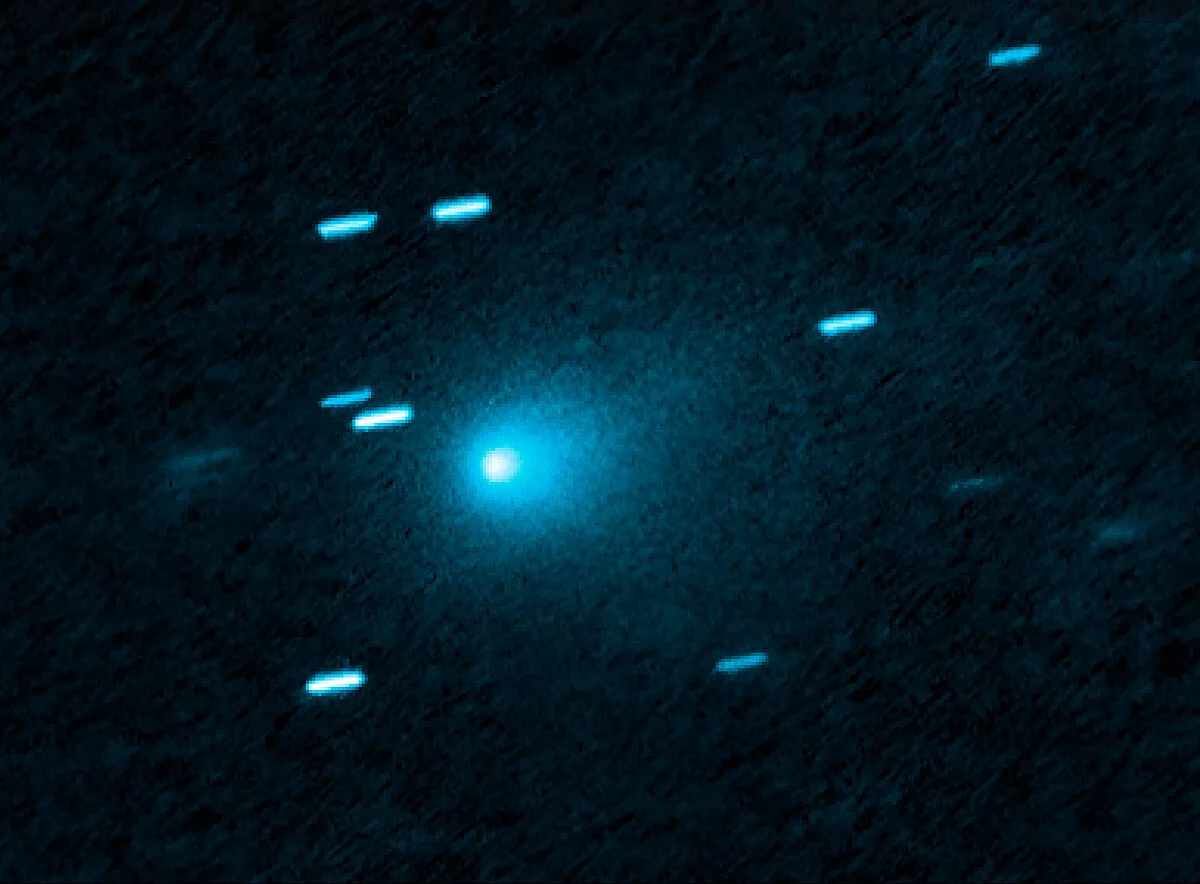
3I/ATLAS from Hubble
3I/ATLAS from Hubble Comet 3I/ATLAS as seen by the NASA/ESA Hubble Space Telescope.Image: NASA, ESA, D. Jewitt (UCLA), J. DePasquale (STScI)

Support our core enterprises

Your gift today will go far to help us close out the year strong and keep up our momentum in 2026.

Donate

The Planetary Report • December Solstice

View Table of Contents

Help advance space science and exploration! Become a member of The Planetary Society and you'll receive the full PDF and print versions of The Planetary Report.