

 Explore Worlds
 Find Life
 Defend Earth

All
All
 Sun
 Mercury
 Venus
 Earth
 Mars
 Jupiter
 Saturn
 Uranus
 Neptune
 Small Bodies
Stories, updates, insights, and original analysis from The Planetary Society.

India's launch site as seen by Japan's Daichi orbiter, now lost
I wrote the following blog entry about an image from Japan's Daichi Earth-observing orbiter last week as one to keep in my back pocket for a day when I was too busy to write, not anticipating that there'd soon be a more pressing reason to write about Daichi. On April 21, after just over five years of orbital operations, Daichi unexpectedly fell silent, and is probably lost forever.

Pluto's atmosphere changes really fast!
Pluto's atmosphere has been a subject of fascination for planetary astronomers since -- well, since astronomers first discovered that it had an atmosphere in the early '90s. The interest is partly because it's fascinating that such a distant and cold world is capable of supporting an atmosphere, and partly because the presence of the atmosphere confounds all attempts to measure Pluto's size precisely.

Historical PDF: "The Voyager Flights to Jupiter and Saturn"
A while ago I posted all 99 issues of the Voyager Mission Status Bulletins in PDF format, and now I have another cool item to add to that collection: NASA EP-191,

Nearly behind Saturn
Some recent photos that Cassini took from a position nearly in Saturn's shadow caught my eye, and I made a quick color composite. What an amazing view this would be if you were riding on the spacecraft!

Mercury's Weird Terrain
When Mariner 10 flew past Mercury, it caught an immense impact basin lying half in and half out of sunlight, which they named Caloris. Even with only half the basin visible, scientists knew it was one of the largest in the solar system. Geologists had to wait more than 25 years to see the rest of Caloris, and when they did it turned out to be even bigger than they had thought. But the fact that Caloris was only half in sunlight was fortuitous in one sense, because it meant that the spot on Mercury that was exactly opposite the area of the Caloris impact was also partially in sunlight. That spot looks weird.

Lovely crater turns up in MoonZoo; 2 million images classified, lots more Moon left
Here's a very pretty picture to start off the week: a really gorgeous fresh crater on the lunar farside. There's nothing particularly unusual about this crater; it's just recent and fresh so there's a mesmerizing amount of detail in the feathery patterns of the ejecta that fans outward from it.

So far, no moons found at Ceres or Vesta
Since the Galileo mission discovered tiny Dactyl circling Ida in 1993, quite a lot of asteroid systems have been found to be binary; there are even a few triples. So it's quite reasonable to guess that two of the biggest asteroids, Ceres and Vesta, might also have satellites.

Are there more Titans than Earths in the Milky Way?
Might there be many Titan-like planets and moons, with atmospheres and liquid methane rain, rivers, and lakes, across the galaxy? It's an important question if you think that liquid methane environments could support alien life, because it turns out that Titan-like planets might be more common than Earth-like planets.

Lots of great stuff in the latest Cassini data release
I've got some lovely pictures from Saturn to show you! Every three months, the Cassini mission dumps gigabytes worth of precious Saturn data into the Planetary Data System, and the latest gift came on April 1. This particular pile of data, which was taken between April 1 and June 30, 2010, contains a lot of really terrific moon observations.

Comparing Clementine and Chandrayaan-1 spectra from the Moon
In a paper recently published in the Journal of Geophysical Research, Georgiana Kramer and several coauthors performed a careful comparison of two data sets that seem like they're measuring the same things, so you'd think that the measurements they took would match between the two instruments. But they don't quite match.

365 Days of Astronomy Podcast: What's up in the second quarter of 2011
Regular readers of this blog will find the content of today's 365 Days of Astronomy Podcast familiar, because it's an update on what the solar system exploration spacecraft are up to, based on my monthly

Spotting Jupiter's Moons...with a Solar Telescope!?
I was astounded to learn this morning that SOHO can not only see Jupiter, it can actually resolve Jupiter's moons (at least its two outer ones) as points of light separate from their planet!

Welcome to Carnival of Space #191
Welcome, everyone, to the Planetary Society Blog for the 191st Carnival of Space! Every week, a different webmaster or blogger hosts the Carnival, showcasing articles written on the topic of space.

Lovely giant full Moon photo
Here's a photo worthy of hanging on the wall: a gorgeous, 4000-pixel-square portrait of the full Moon captured by Rolf Hempel from Germany on the night of the

FINDS: One Step Closer to Faraway Earths
Amir Alexander explains more about the FINDS Exo-Earths project and how it will help planet hunters detect distant Earths in the depths of space.
Images and data now pouring in from MESSENGER at Mercury
Today the MESSENGER mission held a press briefing to show off some of the first images and other data that are streaming in from the spacecraft, now that it has entered Mercury orbit.

MESSENGER delivers its first image from Mercury
This is MESSENGER's very first photo from Mercury orbit, a wide-angle view that reaches right to Mercury's south pole, exposing a very tiny sliver of territory not previously seen by spacecraft.

LPSC 2011: Lunar Layers
Some recent high-resolution images from the Lunar Reconnaissance Orbiter Camera (LROC) have revealed large blocks on the lunar surface that show evidence of layers. The layered blocks were seen near the crater Aristarchus, which is a bright crater in the northeast quadrant of the nearside Moon.

Saturn's storm: A quick turnaround from Hubble
Saturn's raging northern storm has been watched since it began by amateur astronomers, and now Cassini is getting in to the act too. Presumably once astronomers realized the magnitude of what was going on, some of Earth's great observatories were also occasionally pointed at the ringed planet to watch the storm grow.
A radio show on Mercury and a space carnival
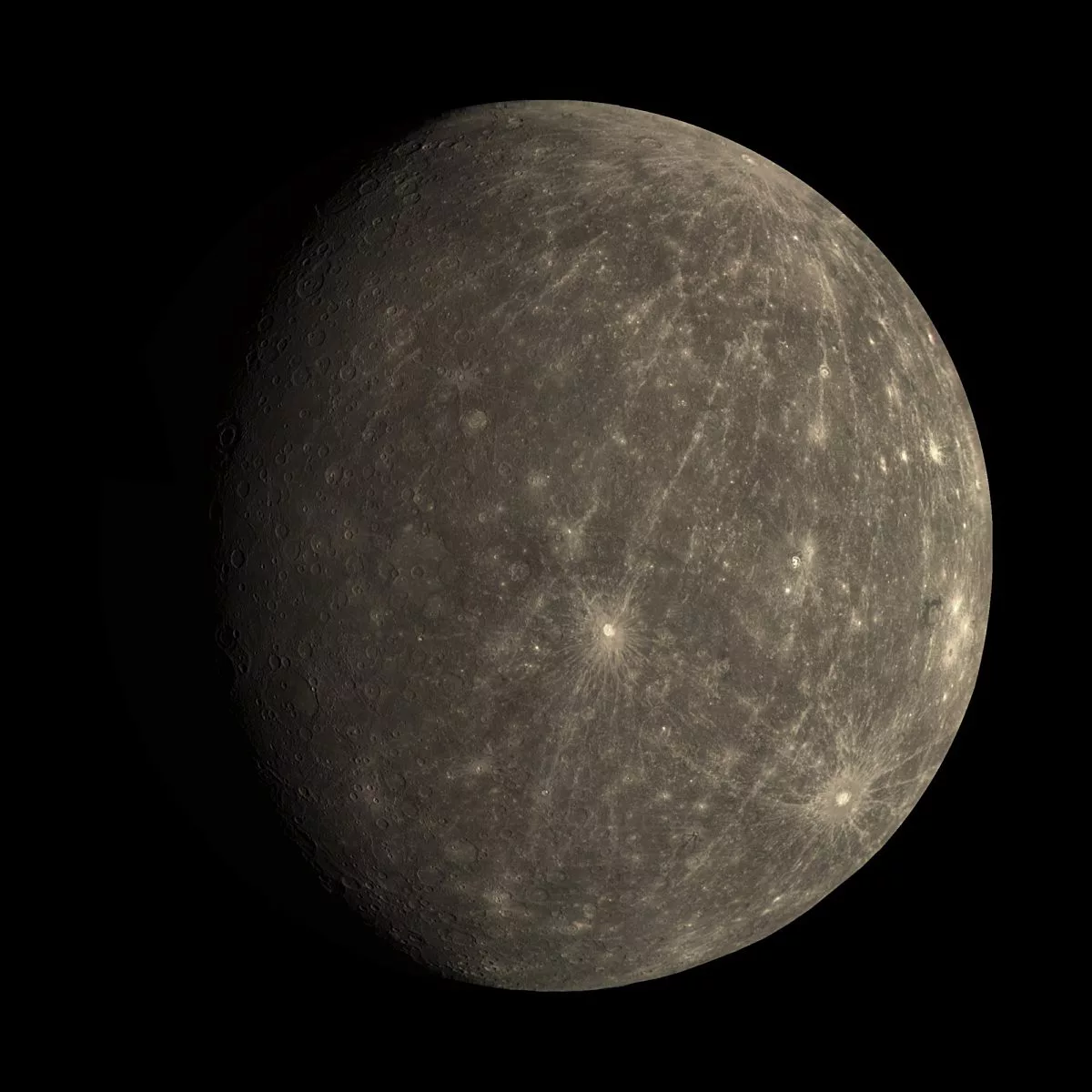
Today's Planetary Radio features Sean Solomon on the successful arrival of MESSENGER at Mercury. After checking that out, wander over to the 190th Carnival of Space, hosted this week by Paul Gilster over at Centauri Dreams.