

 Explore Worlds
 Find Life
 Defend Earth


All
All
 Sun
 Mercury
 Venus
 Earth
 Mars
 Jupiter
 Saturn
 Uranus
 Neptune
 Small Bodies
Stories, updates, insights, and original analysis from The Planetary Society.

Huygens' Descending View of Titan
Scientists from the Huygens Descent Imager Spectral Radiometer (DISR) team have released their first mosaic of images captured during Huygens' descent. The mosaic is composed of 30 images captured by the Medium Resolution Imager of Huygens' Descent Imager Spectral Radiometer while the probe was spinning and descending toward Titan.

Raw Images from Huygens
In the 48 hours since Huygens' data first began streaming back to Earth, a few processed images of the channeled landscape and bouldery landing site have been released to the public. Now, the Descent Imager Spectral Radiometer team at the University of Arizona has put all of Huygens' images online for the public to view.

Huygens blog: "It's impossible to resist the speculation."
After a mere twelve hours of work, all six of the science teams on Huygens were able to report results this morning. You could easily tell the difference between the administrators and the scientists on this morning's press panel: the administrators looked bright, fresh, and well-rested, while the scientists looked decidedly weary.

New Images from the Huygens Probe: Shorelines and Channels, But an Apparently Dry Surface
This image brought applause from everyone at the European Space Operations Centre, Darmstadt, Germany.
Huygens landing day live blog
A frequently updated blog with the tumultuous events of Huygens' landing on Titan.
Huygens blog: "This is probably not the best day to speculate."
Anticipation here at the European Space Operations Centre (ESOC) is rising to a fever pitch. The full complement of more than a hundred scientists are here from all over Europe and the U.S.; they are running around, greeting each other, getting ready for the long-awaited data.
Huygens blog: It's going to be great!
In two days, it'll all be over; for better or worse, Huygens will have hit the ground on Titan, and back on Earth we'll be waiting to see whether the data will be returned. Today, I arrived at ESA's European Space Operations Centre (ESOC) in Darmstadt, Germany.
No Longer Boring: 'Fireworks' and Other Surprises at Uranus Spotted Through Adaptive Optics
Uranus has the unfortunate reputation of being the most boring planet in the solar system. But where it appeared to be a nearly featureless, hazy blue ball to Voyager 2, it is now blooming dozens of clouds that are visible to the sharp-eyed Keck II Telescope.

Close Your Left Eye, Then Your Right: Simultaneous Observations of Asteroid 4179 Toutatis from Two Chilean Telescopes Demonstrate Parallax
This morning, asteroid 4179 Toutatis was so close to Earth that simultaneous observations from two telescopes in the same country could show parallax that is obvious even to the least experienced observer. The two telescopes belong to The European Southern Observatory and are located at La Silla and Paranal in Chile

Very Close Approach by Asteroid 4179 Toutatis: It's Not a Crisis, It's an Opportunity
On Wednesday, September 29, Earth will dodge a cannonball: the Near-Earth Asteroid known as 4179 Toutatis will buzz by at a distance only four times the distance from the Earth to the Moon -- about one and a half million kilometers, or about a million miles. But, as the wisdom goes,

Updates from Past Recipients of the Shoemaker NEO Grants (16 April 2004)
2003 was a good year with 50,779 asteroid astrometric observations submitted, including known NEOs and the discovery of a new Aten-class object, 2003 UY12. Based upon the volume of astrometric observations submitted, observatory code 683 was the world's eighth most productive asteroid astrometry station.
NASA Names Gusev Crater Hills After Apollo 1 Crew
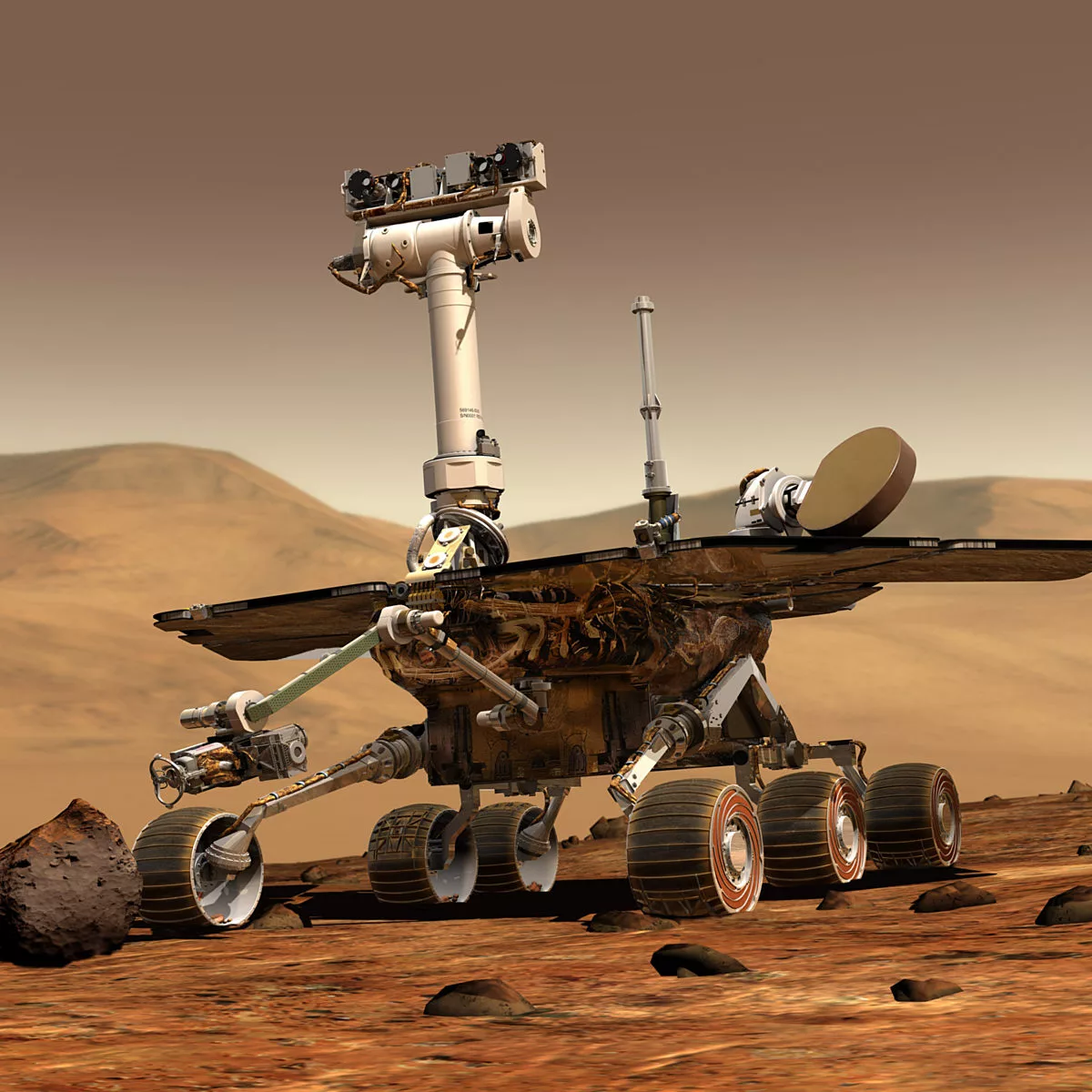
NASA Headquarters issued a press release late yesterday announcing that the agency is memorializing the Apollo 1 crew -- Gus Grissom, Ed White and Roger Chaffee -- by naming the hills surrounding the first Mars Exploration Rover Spirit's landing site after the three astronauts.
Opportunity Scores "A 300-Million-Mile, Interplanetary Hole-In-One"
Although it did appear from the very first images returned that the second Mars Exploration Rover had landed inside a small crater when it arrived at Meridiani Planum last Saturday night, that belief was confirmed with further analysis yesterday.
Spirit is "In Recovery"
Spirit stopped transmitting good data last Wednesday, but never went silent. It continued communicating with the MER team and returning good information with which the team is now working.
Mars Rover Spirit Upgraded from "Critical" to "Serious"
The specially formed Anomaly Team working overnight to unravel the mystery of what happened last Wednesday that caused the rover’s computer to fall into a reboot loop and stop functioning properly – had by this morning come up with a working hypothesis.
Second Mars Rover Opportunity Fast Approaching Mars
The second Mars Exploration Rover -- Opportunity -- Spirit's identical twin -- is approaching the atmosphere of Mars and is expected to land on the Red Planet tonight around 9:06 p.m. Pacific Standard Time.
Spirit Remains in "Intensive Care," But Continues to Radio Home
Spirit 'phoned home' this morning and returned some good engineering data, but the Mars rover remains in
Spirit Suffers "Serious Anomaly," But Continues 'Beeping' Home
Something is wrong with Spirit, but what exactly it is -- and just how serious it is -- the Mars Exploration Rover team isn't sure.
Titan: Arizona in an Icebox?
A week after Huygens' descent, the emerging picture of the surface of that smoggy world is of an arid, icy desert, where periodic storms of methane rain create transient rivers that wash sooty soil from icy highlands out to short-lived pools and lakes. The pools dry up -- perhaps sinking into a sandy soil of glass-like water ice -- and the Titanian desert waits for another methane storm.