

 Explore Worlds
 Find Life
 Defend Earth


Planetary Radio • Aug 25, 2026
The Nancy Grace Roman Space Telescope is ready to launch
On This Episode

Julie McEnery
Senior project Scientist for Roman, NASA Goddard Space Flight Center

Jason Rhodes
Principal Scientist for Jet Propulsion Laboratory
Bruce Betts
Chief Scientist / LightSail Program Manager for The Planetary Society
Sarah Al-Ahmed
Planetary Radio Host and Producer for The Planetary Society
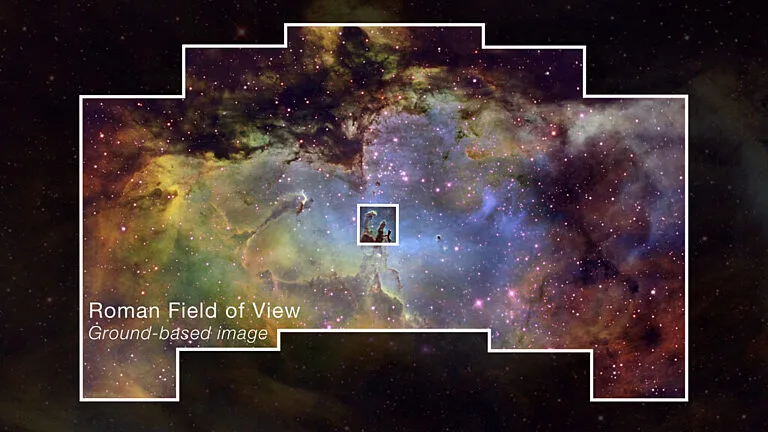
After decades of development, the Nancy Grace Roman Space Telescope is preparing to launch. Once in orbit, Roman will conduct the widest surveys of the universe ever attempted, probing the nature of dark energy, discovering thousands of new exoplanets, and capturing images of billions of galaxies. In this episode, we sit down with Julie McEnery, senior project scientist for Roman at NASA's Goddard Space Flight Center, and Jason Rhodes, project scientist for Roman at NASA’s Jet Propulsion Laboratory, to explore what the telescope will reveal and how scientists around the world will be able to access and work with its data. Plus, in What's Up, we look at Roman's coronagraph and what it will take for the Habitable Worlds Observatory to push that technology far enough to image Earth-like worlds around Sun-like stars.


Related Links
- Roman Observatory - NASA Science
- Roman Space Telescope's Coronagraph Instrument - NASA Science
- Meet Julie E McEnery
- Meet Jason Rhodes
- The Nancy Grace Roman Space Telescope launch: What to expect
- Roman Space Telescope, discovering planets and exploring dark energy
- Nancy Grace Roman Space Telescope
- Roman Science
- Announcing the Opening of the Roman Research Nexus - NASA Science
- Roman Research Nexus
- Planetary Radio: Dark Energy Attracts? Astrophysicists Jason Rhodes and Alina Kiessling
- Meet the Habitable Worlds Observatory, NASA’s life-seeking telescope
- Buy a Planetary Radio T-Shirt
- The Planetary Society shop
- The night sky
- The Downlink
Transcript
Sarah Al-Ahmed:
We're looking forward to the launch of the Nancy Grace Roman Space Telescope, this week on Planetary Radio. I'm Sarah Al-Ahmed of The Planetary Society, with more of the human adventure across our solar system and beyond. And boy, do we have an adventure this week. The launch of the most powerful survey telescope ever built is just days away. Today, we're talking about the Nancy Grace Roman Space Telescope with two of the scientists leading the mission. Jason Rhodes, the Roman project scientist at NASA's Jet Propulsion Laboratory, and Julie McEnery, the senior project scientist at NASA's Goddard Space Flight Center. Then Bruce Betts, our chief scientist at The Planetary Society, joins me for What's Up. We'll talk about the technology that could one day help us find Earth-like worlds around other stars, coronagraphs. If you love Planetary Radio and want to stay informed about the latest space discoveries, make sure you hit that subscribe button on your favorite podcasting platform. By subscribing, you'll never miss an episode filled with new and awe-inspiring ways to know the cosmos and our place within it.
After more than two decades of planning, building and testing, the Nancy Grace Roman Space Telescope is sitting on the pad at the Kennedy Space Center ready to fly. The current launch date is August 30th, when a SpaceX Falcon Heavy is going to send it on a hundred day journey to its new home, about a million miles from Earth at the Sun-Earth Lagrange Point 2. Once it completes its commissioning and turns its instruments on the sky, it's going to show us the universe in a way that no telescope ever has. And over its mission, it's expected to discover thousands of new worlds, radically expanding our census of exoplanets. I sat down with two of the mission's project scientists to talk about what's coming.
Dr. Julie McEnery is the senior project scientist at NASA's Goddard Space Flight Center, which leads the Roman mission. Before Roman, she spent years as the project scientist for the Fermi Gamma-ray Space Telescope, studying some of the most energetic and violent events in the universe, I'm talking blazars, gamma rebursts and merging neutron stars. Her background in high energy astrophysics gives her a different perspective on a mission whose headline science is the slow, quiet work of mapping dark energy and dark matter.
We're also joined by Dr. Jason Rhodes, who's the Roman project scientist at NASA's Jet Propulsion Laboratory. He's a cosmologist who helped pioneer a technique called weak gravitational lensing. Among other things, it's a way of mapping the invisible dark matter that holds the universe together by measuring how gravity subtly distorts the light from distant galaxies. He's been working on this mission since about 2002, back when it was still called the Supernova Acceleration Probe, and then later WFIRST. He's also worked on the European Space Agency's Euclid mission, and he's deeply involved in the Vera Rubin Observatory, making him one of the key people connecting all three of the major survey missions now coming online.
Hey, Jason and Julie, thanks for joining me.
Jason Rhodes: Thanks for having us.
Julie McEnery: [inaudible 00:03:20]
Sarah Al-Ahmed: Before we talk about this telescope, which I am wildly excited for, I think the entire space community has been waiting for this for so long, but I want to talk a little bit about the person who it was named for. Julie, who was Nancy Grace Roman?
Julie McEnery: Nancy Grace Roman was NASA's first chief astronomer. She is the person who had the vision for space-based astrophysics. She's sometimes called the mother of Hubble, but I actually think she's the mother or at least the instigator of an entire range of space-based astrophysics. I think it is not an exaggeration to say that without her, we might not be here today having this conversation. She was explicitly interested in coronagraphy. I think she would have been delighted that Roman includes an instrument that is going to test and debut new technologies in space to be able to image planets around other stars. She understood the technical details, she understood the engineering, she understood the project management, so she understood the science. And I think it was a combination of having all of those skills that allowed her to really push things forward.
Sarah Al-Ahmed: Jason, how did you get involved in the mission and what's kept you on it for so many years?
Jason Rhodes:
Well, soon after the accelerating expansion of the universe was discovered in the late '90s, a group of people at the Department of Energy started planning a space mission to study supernova, and they called it the Supernova Acceleration Probe. And in about 2002, they realized that there was more they could do with this space mission, including using a technique called weak gravitational lensing, which is a technique that I helped pioneer back then. So they invited me onto their mission, SNAP, as they called it, and SNAP became a concept for a NASA-DOE Joint Dark Energy Mission in the early 2000s, and that became the basis for the mission called WFIRST in 2010. And a few years ago, WFIRST was renamed Roman.
So I've been working on this mission since about 2002 under one name or another. And what's kept me going is the huge breadth of science. So I got into it for the weak gravitational lensing, but there's other ways we're going to look at exoplanets, dark energy, and the coronagraph that JPL built that Julie mentioned is a really fascinating new instrument, they being new technologies. So it's really the science and the technology that's kept me interested and engaged on this mission for so long.
Sarah Al-Ahmed: It's funny, I actually still have some WFIRST swag somewhere in my collection. Julie, before Roman, you spent years on the Fermi Gamma-ray Space Telescope studying basically the most violent events in the universe. So how did you go from gamma rays to infrared?
Julie McEnery: The kind of explorations that I like to do are surveys to find things that are new. The Fermi Gamma-ray Space Telescope surveyed the entire sky every day in Gamma rays. It has enormous breadth of science. Every observation was used for many different things. Many of those same elements carry through into Roman, including what to me is a very attractive combination of a goal to address a ground challenge problem in physics and astrophysics, the fundamental nature of our own universe with fantastic discovery potential. So I'm far from the only person who is working on Fermi who's moved on to either Roman or the Rubin Observatory.
Sarah Al-Ahmed: Well, as you kind of just alluded to, I mean, the Roman Space Telescope is not this single purpose instrument, although we are trying to aim to answer that big question about dark energy, but it's designed to tackle some of the biggest open questions in astrophysics and exoplanets all at once. I'm not sure who wants to answer this one, but in broad strokes, what are the headline science goals for this mission?
Julie McEnery:
It's potentially a delightfully long list. So we've already discussed that the study of dark energy that was originally motivated by the discovery of the accelerating universe at the end of the '90s is the prime goal for Roman. One of our strengths is that we will address this in multiple different ways, and that will give us confidence that whatever we find is likely to be an actual property of how the universe behaves and not something about our observatory that confuses us because we'll have multiple different ways of measuring the same thing.
For exoplanets, we will use a technique called microlensing to find exoplanets that are far out from their host star. And that's a region of planetary systems that we've been relatively blind to today because most of the planets that are found currently are found by Kepler and TESS via the transit technique where you look for the brightness of a star dimming when the planet goes in front, that you will not be surprised to learn is most sensitive to planets that are close to their host star and are big.
Microlensing instead uses an apparent brightening of a star when another star is precisely aligned in front of it. And when that happens, the star in front gravitationally lenses the light and causes an increase in brightness. And if the star in front has a planet around it, that planet will also provide a little bit of microlensing and will give a characteristic change in brightness of the star. So that's really cool because we will complete the census of planets around other stars in the sense that we'll understand the full equivalent of our own solar system around many, many stars through the galaxy. Those are things that drove how we designed the observatory, but we're going to do so much more.
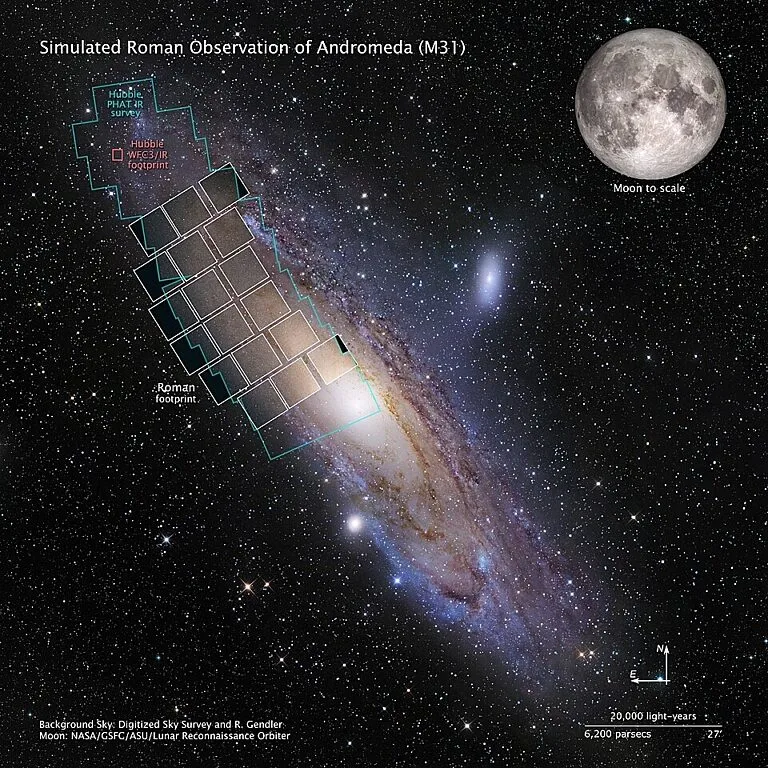
We will measure populations of stars in our own galaxy to measure the distribution of dark matter in those stars. We will see, if we have two billion galaxies, we'll have 2,000 objects that are one in a million, and that will allow us to pick out the keystone objects that will give us insight into the evolution of galaxies themselves. The same survey that we'll find exoplanets looking towards the center of our own galaxy is also going to be sensitive to finding a population of isolated black holes. And that touches on addressing another mystery that has recently been raised by the LIGO Observatory. There are a larger number of large stellar mass black holes than we expected. So there's lots of really cool stuff. And because we do a survey, it really doesn't matter what it is, we're going to see it.
And I personally think our most exciting science is going to be the discovery space. I mean, we're intrinsically a discovery mission because we don't look at things we already know about and study them in more deeply what we do because they happen to be there, but we'll be sweeping out large regions of the sky. So we'll find all the things we know about, but we're also going to find the things we didn't know to look for.
Sarah Al-Ahmed:
I think that's one of the greatest markers of a successful mission, that it opens up more questions than we went in with, right? The capabilities on this one to find things that we've never even considered before or to open up mysteries that we didn't know were there to look for is just startling. But here's the thing that really surprised me as I was beginning to learn about this telescope is that its primary mirror is about the size of Hubble's with about the same sharpness, but it's going to survey the sky about a thousand times faster than Hubble ever could. One month of Roman work is roughly equivalent to about a hundred years of Hubble.
So Jason, how does a telescope with a mirror about the same size as Hubble's get such a dramatically wider view of the sky?
Jason Rhodes:
There's a couple things that we've done on Roman that allow this thousand fold increase in survey speed. One, and the main thing is we built a camera called the Wide-Field Instrument and that was built at Goddard and BAE Aerospace. This camera is about a hundred times as large as the comparable Hubble cameras. So it surveys about a hundred times the area of the sky and it's a better, more advanced camera with increases in the detector technology that we've had in the past couple of decades. So not only does it survey about a hundred times more sky, but it does so with better characteristics of the data that we're taking with those cameras. But we're also sending Roman to the Earth-Sun Lagrange Point 2, which is beyond the moon, whereas Hubble's in low Earth orbit. So it's going in and out of the sun every 90 minutes.
So about half of each 90 minute orbit, you're not even really able to see an area of the sky. And it's also thermally cycling as it goes in and out of the sun. But by sending Roman to this L2 Lagrange Point, we're putting it in a very thermally stable area of our nearby solar system and we're able to look at areas of the sky almost uninterrupted. And so we're not having those interruptions of going in and out of the sun. And Hubble is also a little bit less able to slew as well as Roman. So Roman is very fast at slewing across the sky and taking these surveys.
So whereas Hubble was designed as a point at an object or a system and take a picture and then move on, as Julie has said, Roman is this incredible survey machine that we're just looking at huge areas of the sky and that's what's going to open up this massive discovery space.
Julie McEnery:
While we're on the topic of comparing Hubble and Roman, something that I think is worth noting, that Roman's ability to survey large regions of the sky, so that one month of Roman observations, which would take a century with Hubble, allows us to do things that Hubble couldn't even start to do. And what that means is that Roman is going to be conducting these extraordinary groundbreaking surveys and Hubble is going to continue to do the fantastic science that Hubble has always done because Roman isn't going to make observations of the sky like Hubble. We are going to be conducting our amazing surveys. Hubble is going to be conducting longer observations of individual targets and extending those observations into the visible and ultraviolet band.
Roman and Hubble are complimentary because we operate in entirely different ways. I mean, obviously we wouldn't build Roman if it didn't do something that Hubble couldn't do, but because we're doing something that Hubble couldn't do, we still need Hubble to be doing Hubble things.
Sarah Al-Ahmed: I think it's going to be really interesting to see what happens in these coming years with this telescope coming online, but also all of the other ones we have in operation. We have Hubble, but also Euclid, Vera Rubin, all of these things working together are going to give us just such a more comprehensive view of the sky. But I think something that this telescope does that's very interesting is that a lot of other space observatories, when you have more than one instrument and you're looking at something, you basically have to wait, take turns between each of these instruments, but Roman doesn't do that. So how does it get around that problem?
Julie McEnery:
Roman's optical design gives us good performance in an annulus around the center of the field of view. So if you see the Roman logo that's got that kind of weird, it depends what you look at a space invader or a smile. I personally have heard the space invader analogy. It's got that shape so it fits on that annulus. So the coronagraph is simply in another part of that annulus. It's just instrumenting another part of the field of view. So another way to think of this, if you think about say the detector in a iPhone camera, it's almost like the wide field instrument is one part and the coronagraph is another part.
So we're just looking at different parts of our field of view with the two instruments. And this is important because the wide field instrument provides the information needed for the observatory to do fine guiding, to precisely stay looking at exactly where we want it to look at. So it has to operate at the same time that the coronagraph is making its observations.
Sarah Al-Ahmed: We do have other telescopes that have coronagraphs on them. JWST has one, Hubble's done some coronagraphy, but this coronagraph is just it's next level. I got to experience some of the demos for this thing when I was at the AAS. It is unbelievable. So Jason, how does Roman's coronagraph compare to all of the things that came before?
Jason Rhodes:
So we talked about Roman being able to survey about a thousand times faster than previous telescopes. And similarly, the Roman coronagraph is a hundred to a thousand times more powerful than previous coronagraphs like the ones on James Webb and Hubble. And it's because of these new technologies that we're debuting in space together for the first time. And a few of those technologies are things like single photon counting detectors. And when you're trying to block out roughly a billion photons from a star for every photon you detect from the planet, every photon you get from that planet is very precious. So being able to count single photons at a time.
We've also got what we call an active coronagraph. And what that means is we've got these tiny deformable mirrors about the size of a silver dollar, and they've got several thousand pistons on each mirror that allow us to deform the shape of the mirror. Now, as great as Roman is, no telescope is optically perfect. And what the deformable mirror does is it allows us to correct for imperfections in other parts of the Roman optics so that some light from the stars that might be leaking through due to imperfections in the telescope is blocked out so we can make a more perfect image of that planet light only. And we've got two of these deformable mirrors, and that's the first time these deformable mirrors have been used on a telescope with a coronagraph in space.
So bringing together all of these new technologies for the first time is allowing us to demonstrate how they work, prove out these technologies, give a huge boost to the performance of Roman. And we're hoping to use these technologies together in a future observatory after Roman that we're now calling the Habitable Worlds Observatory. So we're developing technologies and proving them out for use in future national missions as well.
Sarah Al-Ahmed: It is unbelievably wild that it can correct these errors smaller than the width of a DNA strand. The precision on this thing is unbelievable, but we do need that kind of precision if we're going to do something like Habitable Worlds Observatory, detecting Earth-like worlds around other stars, that's just an unbelievably complicated thing, let alone directly imaging them. What would it mean to you guys if we could actually accomplish that? Even putting aside the future Habitable Worlds Observatory, if Nancy Grace Roman could directly image some of these smaller worlds, how would that make you feel?
Jason Rhodes:
Well, Roman isn't designed to be capable of directly imaging Earth-like planets around sun-like stars because the telescope is not big enough and not quite stable enough. And so that's why we'll need a future observatory like Habitable Worlds. But it'd be a big risk to build the Habitable Worlds Observatory without first proving out these coronagraph technologies on Roman. And so we're buying down a huge amount of risk on future missions by testing these out on Roman. And what we will be able to do on Roman is we will be able to, for the first time, take direct images of Jupiter-like exoplanets, so larger exoplanets.
But Roman, in addition to proving out these technologies, is going to do amazing coronagraph and exoplanet science with these technologies that we haven't been able to do before. And what's exciting to me is we're developing these technologies that within our lifetime and our professional careers will have the capability of potentially answering one of the biggest questions of all time is, are we alone in the universe? Because that's what the Habitable Worlds Observatory plans to attack using these technologies we prove out on Roman.
Julie McEnery:
I find the coronagraph instrument really interesting because of its technology. If I'm describing Roman to my mother and you talk about the Wide-Field Instrument and yeah, it's like a widefield view camera. It's awesome and it's going to do great science. But you describe how a coronagraph works and it's magic with physics. I mean, you're taking advantage of the wave properties of light to switch it off in the place where you need it to be switched off so that you can see something hidden very close to a really bright object. So that aspect of the coronagraph, I find incredibly cool.
Personally, I'm much more driven to how the universe works than whether or not there are planets in it. This isn't taking from other people's excitement, but one of the things that I think is great about science is that we're not all interested in the same thing. I think it'll be cool to get to an observatory that can find Earth-like planets around sunlight stars. I mean, clearly that's sort of a foundational goal for mankind, but I suspect 10, 15 years from now, I'll probably be working on a different mission.
Sarah Al-Ahmed: Well, to that effect, I mean, Roman isn't going to be just taking one static picture. It's going to be imaging patches of the sky over and over again, which means that we can catch things that change, which I think is more interesting to you, Julie, because you come from this gamma ray burst kind of background. How excited are you about Roman's time domain capabilities?
Julie McEnery:
Now you're speaking my language. I'm really excited. One of the things that is a feature of time domain astrophysics is almost by its very nature, it's hard to study because the things that we're looking at, you get to see them once and then they're gone. So to make progress and actually understand what is at the heart of these extraordinary things that happen in our universe, it's very important to have different ways of being able to look at them. So Roman is going to bring outstanding capabilities. We will make incredibly sensitive observations, which means that we can see things further out. We'll be making observations in the near infrared.
So we're going to bring not just groundbreaking observations, but groundbreaking numbers of observations to find rare and unusual supernovae, to find counterparts, to gamma ray bursts. We expect to find counterparts to merging neutron stars, gravitational wave events. I'm excited that there will be some LIGO observations early in our mission. We will be monitoring the output from super massive black holes, and there's a whole host of exciting science in there. So I'm very excited about Roman's ability to study the universe in time.
Sarah Al-Ahmed: The one problem is that getting that kind of view of the universe means that you're going to be producing a wild amount of data, it's something like 500 terabytes every single year. And I've had a lot of discussions with people more recently about this issue with the Vera Rubin telescope. Just it's producing so much data, how do you process through all of that? And on top of that, Roman is doing something that I think is really special. All of the data is going out to the public immediately with none of this exclusive access period. Can you talk a bit about the Roman Nexus platform and this open science philosophy behind it?
Julie McEnery:
You raise a good point. I mean, obviously if we're surveying the sky a thousand times faster than Hubble, we have a thousand times the data rate, and that's going to bring challenges. The old ways of doing science are just not going to work. I mean, you can't download 20 petabytes of data to your laptop, and even if you could, your laptop would keel over and die. So we address this in several different ways.
One of them is that we are developing very high quality pipelines to process the data all the way to spectra catalogs for all of the individual objects. And we're doing this in close to real time, so very shortly after data arrives. So we have a science center at IPAC in Pasadena and we have a science center at Space Telescope Science Institute in Baltimore, and they both have pipelines that address different aspects of the data so that what you end up at the end is a much smaller volume of data that is ready for science. So that's one way of addressing this problem is that we try and do as much of the processing as possible for the community.
The second aspect is we provide a interface that's put together by the Space Telescope Science Institute that is hosted in the cloud where people can log in to an interface that is a Roman environment. There's lots of tools and support to help you interact with the data, to explore the data, to do analysis of the data. And that way the scientists come to the data rather than the data being brought to the scientists. What makes me happy about that platform is that anyone can be involved. So you could be a high school class in Kentucky and you can get accounts on the Roman Research Nexus, which is what we call this cloud based platform, and get to look at data at the same time as the top scientists in the country.
Sarah Al-Ahmed:
And I'm going to be leaving links to all of the resources for how people can get involved on the website for this episode of Planetary Radio, because this is going to be something that I think is going to change everything for a lot of people. Open access to this amount of data is going to be the foundation of a million future theses, let alone the projects in school classrooms. So I'm really excited to see what comes out of all this. I do want to get into some of the different facets of the science that we can do with this telescope. I know we're The Planetary Society and we'll get into exoplanets, but my background was in astrophysics and I studied cosmology and I am really excited because there's some huge mysteries that we just don't know the answer to. So let's start with dark energy.
Dark energy makes up most of what we know in the universe. And for the longest time, there's this assumption that dark energy is kind of constant. It's this fixed property of empty space. Einstein called it a cosmological constant. But recently we have these results that hint that maybe it isn't constant at all, maybe it's changing. There's a lot that we really don't understand. And on top of that, there's this Hubble tension, this stubborn disagreement between these two independent ways of measuring how fast the universe is expanding.
So Jason, how is Roman designed to help us try to unravel these massive mysteries that have been puzzling us for decades?
Jason Rhodes:
Well, you mentioned the dark energy, which is the dominant component of the universe, and that was one of the earliest science drivers pushing us to do a mission like Roman and actually telling us what requirements Roman needed. And as you also mentioned, over the past year or so, a number of other experiments have hinted at changing dark energy rather than the cosmological constant that we thought that we had or assumed that we had for about a quarter of a century. And what's really exciting to me is we've been developing Roman for 15, 20 years. And if you look at what would you want to do next after these recent results, you would say, okay, we want to study this using multiple techniques and Roman, check, check, check. We're going to use multiple techniques. We're going to study using supernova. We're going to look at the clustering of galaxies. We're going to look at gravitational lensing.
You would also want to push to higher red shift or further away or further back in time, because if dark energy is changing over time, you want a longer time baseline to look at it. And how do you do that? You look in the infrared. And so check, Roman is doing that. So we come at this incredibly interesting time where we've got these hints at very exciting, possibly new science, and Roman is at exactly the right machine at the right time to answer these questions. And I feel incredibly lucky because one of the things scientists love to do is they love to live through a scientific revolution where their understanding of the universe or their field is upended and there's a new paradigm.
And in the 1990s, when I went to grad school, we didn't have this paradigm with dark energy. And by the time I left graduate school, we realized, okay, the universe is predominantly dark energy. So I lived through in graduate school this time of upending the cosmological status quo. And right now with the things that you mentioned, like the Hubble tension, where we're seeing discrepancies between measurements of the early universe, like with the cosmic microwave background radiation and measurements with the later universe like we're doing with current observatories or we will do with Roman and the physics that takes us from the early to the late universe, we're seeing some discrepancies. And a lot of scientists are hopeful that this might indicate we're about to have another one of these revolutions in our understanding of cosmology. And that's not to say our current models are wrong, but our current models may be incomplete and there may be components or physics we just don't understand.
And so I'm very hopeful that I get to live through another one of these revolutions in our understanding of the universe in my career. And the tool that's going to be most crucial for uncovering that is Roman.
Sarah Al-Ahmed: Wouldn't that be amazing? It would be just revolutionary if we discovered something like that.
Jason Rhodes: Yeah. There's this misconception of that scientists want to protect the status quo and keep other people from making discoveries. And every scientist I know wants to break the current paradigm because that's what's exciting. And so Roman may help us do that.
Sarah Al-Ahmed: We'll be right back with the rest of my interview with Julie McEnery and Jason Rhodes after this short break.
Bruce Betts: Hi, Bruce Betts here, chief scientist at The Planetary Society. Our organization is strongly committed to defending our planet from an asteroid or comet impact. Thanks to the support from our members, we've become a respected independent expert on the asteroid threat. So when you support us, you support planetary defense. It's a lot to do and your support is critical to power all this work. That's why we're asking for your help as a planetary defender. Together, we're advancing the global endeavor to protect the Earth from asteroid impact. Imagine the ability to prevent a large scale natural disaster. You can be part of this global effort. A gift of any amount to The Planetary Society helps keep this critical search going, protecting our planet and everyone on it. Visit planetary.org/defendearth to make your gift today. Thank you.
Sarah Al-Ahmed:
Well, dark energy is about the expansion of the universe, but dark matter is a completely separate mystery. It's about the stuff that's actually holding everything together. And there's about five times more matter in the universe that's dark matter than all the stuff that we can actually see. And we've known that since Vera Rubin's observations back in the 1970s.
Jason, you won the Lew Allen Award in 2007 for your work using weak gravitational lensing to actually build this large scale 3D map of dark matter. We've already explained a little bit of how we can use weak lensing to find planets, but can you explain how we can use it to understand more about dark matter?
Jason Rhodes:
Yes. When we look at a distant galaxy, the light from that galaxy, if there wasn't anything between us and the galaxy, would just take a straight path to us. But we know there's this dark matter out there and as a consequence of Einstein's theory of general relativity, matter bends space. So instead of taking a straight path to us, the light from that distant galaxy travels some bent or distorted path because of the dark matter. And that gives us a distorted image of that distant galaxy. And by looking at thousands or tens of thousands of galaxies in a small area of the sky, about two square degrees that we measured with Hubble, we were able to map out those coherent distortions of those distant galaxies and make a map of the dark matter. And this was about the highest resolution map we could make of the dark matter, but it really tapped out Hubble's capabilities, that is Hubble couldn't go wider than about the two square degrees that we were able to map out the dark matter in, in the early 2000s.
Now, if you fast forward to Roman, we're on the verge of course of launching Roman, and Roman is going to survey thousands of square degrees. So we're going to use these same techniques of mapping out the dark matter that we proved out on Hubble and other telescopes to map out thousands of square degrees of the dark matter distribution with Roman. And by looking at how that distribution of dark matter changes over cosmic time, there's an interplay between gravity wanting to pull the dark matter together, dark energy wanting to push it apart. So if we think we understand gravity, looking at that interplay over time helps us to understand dark energy by studying the dark matter and mapping out the dark matter. So all of these things are interconnected. And again, Roman is the key tool to using these techniques to understand not just the dark energy, but the dark matter as well.
Sarah Al-Ahmed: Well, as I said earlier, we are The Planetary Society, so I do want to dedicate some real time to talking about the exoplanets that we're going to find with this thing. As you said earlier, Julie, we're going to find maybe a hundred thousand of these things with the transit method, which is just unbelievable considering at this point in history, even after 30 years of searching, we're at I think 6,300-ish confirmed exoplanets. How is it that it's going to detect so many more exoplanets than we've ever found before?
Julie McEnery: Roman, because we operate in the infrared, we will be able to detect exoplanets by the transit technique all the way to the center of our own galaxy. So we have far more reach. We have very good angular resolution so we can point at the region of the sky that has the densest number of stars to look for signatures of exoplanets around those stars. So it's simply sheer numbers. It's the combination of field of view and sensitivity. And something that I find really quite exciting is rare things are fun. So with 100,000 ... Well, I mean, I say hundred thousands, it's actually somewhere between 60,000 and 200,000, which is telling us something about what we don't understand about planetary formation models. But in any case, with these very large numbers of planets via the transit technique, it means that we'll find rare things like seeing the signature of the light curves, the change in brightness of the star, potential ring systems or debris systems around planets. So think of something like a super Saturn. I find that really, really exciting. We're going to have the numbers of exoplanets to find what are currently rare things may actually become somewhat routine with Roman.
Sarah Al-Ahmed: Speaking of rare things, are we going to be able to detect any rogue planets?
Julie McEnery: I very much hope so. We're perfectly sensitive to finding ... So rogue planet is a planet that is not in orbit around its host star. So it's just a planet wandering through the galaxy and we will have no problem finding those. We'll find those, we will find neutron stars, we'll find isolated black holes. What we find doesn't have to be in orbit around something, and that's cool too.
Sarah Al-Ahmed: It's just unbelievable what this telescope might be able to tell us about the universe, about dark energy, dark matter, all of these worlds. But I think what's also really remarkable about this is that for one of the first times ever, this is a flagship mission that came in early and under budget. How did you guys pull this off?
Julie McEnery:
There's a lot of moving parts in putting an observatory together. In our particular case, we went through our confirmation review in early 2020. So we had just got started on the main part of actually building Roman right as COVID hit. And if I'm being charitable, that meant that we had some sort of a training on how to manage the unexpected. Our project management team were very proactive about focusing on saving an hour here, a day there, keeping moving forward, revisiting the order in which we're pulling things together to account for something being late, something being early so that we can take advantage of that. Thinking ahead to, we may need this component in a year's time. If it's not expensive, let's go ahead and order it now so that if it turns out that we need it will already be in place and we'll be able to jump right on top of it.
So some aspect to how we ended up on budget and schedule was very good project management and just paying attention to detail. But it was actually more than that. I think the team really took pride in being on time and on schedule and worked very hard to make that happen. I think this is a critical difference between us and some other missions is that we had very, very good support from NASA headquarters. That we were always provided the resources that we said we needed. And that allowed us to stick to a schedule that was optimum for budget and resources because if you underfund a project early, you're going to drag it out and make the whole thing longer and more expensive in the end. So I think it took management, a really great team and excellent support from NASA headquarters to come in on budget and schedule.
Sarah Al-Ahmed: I was actually, just last week, I went to Astronomy on Tap here in Pasadena, which is a gathering where people go and listen to lectures at a local bar, everyone hangs out together and they were doing some trivia questions. The one that really stumped people was about the origin of the mirror on this telescope. I've since learned that Roman's mirror originally came from another government agency. Can you tell us a little bit about that story and how it ended up on an astrophysics mission?
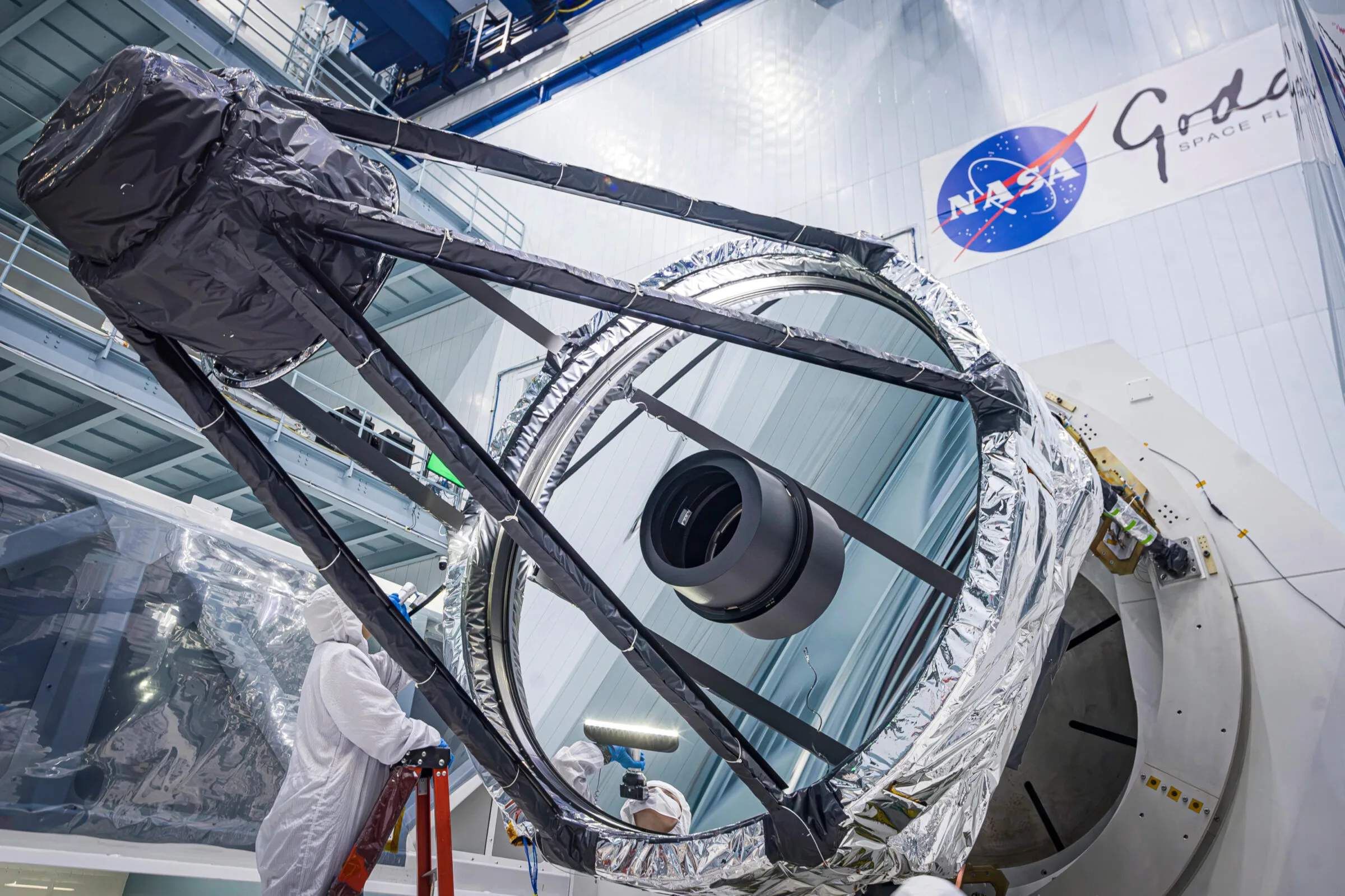
Jason Rhodes: All right. Well, soon after the mission WFIRST was selected, and in 2010 that was the name of the mission that is now called Roman, another government agency approached NASA and said, "We've got two partial telescopes that we are no longer going to use." These were telescopes that were designed to be launched into space and looked down instead of up. They said to NASA, "Do you want to use these telescopes?" NASA, which was studying WFIRST or now Roman at the time, put together a small group of us and said, "Okay, this telescope that they're offering us is 2.4 meters across as opposed to the 1.4 meter across that had been recommended for our mission." And not surprisingly, the group of scientists who got together and engineers who got together said, "Yeah, the 2.4 meter telescope is better. The bigger telescope is better." And one of the exciting things that was enabled by accepting this 2.4 meter telescope was we were now able to add a new instrument, and that was the coronagraph instrument. So this coronagraph was not originally slated to be on Roman, and it was only added because we had access to this new bigger telescope that would make it compelling to do so. I say telescope, but it was a couple of mirrors and it wasn't a complete observatory system that was offered. And so there's still quite a lot of work that needed to be done with these mirrors and getting them ready to fly on Roman. But it allowed us to use a much bigger mirror than we had originally intended, and it made for a much more capable mission for all of the dark energy and astrophysics we wanted to do, but again, also allowed us to add this coronagraph. So it's made for a really much more capable and exciting mission.
Sarah Al-Ahmed: I'm so glad that it ended up this way. That coronagraph is just so exciting. But we've just given people the smallest taste of what this telescope is capable of actually doing. The launch is just around the corner. It's been so many years coming to get to this point and to look forward to all of this science. Nominally, everything going well, August 30th is when this thing is going to be launching. Where are you both going to be on launch day?
Julie McEnery: I'm going to be at Kennedy Space Center. I'm pretty excited. A lot of my family are coming to watch it as well. It's a big deal because these scientists don't get to watch many launches that we're directly connected with.
Jason Rhodes: I'm also going to be at Kennedy watching this with family, including my wife, who's also a cosmologist that works on Roman and has done for over a decade. We're going to bring our five-year-old daughter who got to see Roman in person a few months ago. There was a friends and family day at Goddard Space Flight Center. So I took her out with me to see Roman. As Julie said, watching something that you've poured so much of your life into get launched into space with friends and colleague and family is one of those really special moments in your career that we don't get very often.
Sarah Al-Ahmed: Yeah. I wish we could send our entire Planetary Society team to go see this, but we are sending a small contingent. We got Bill Nye, our chief ambassador and our space policy team, Casey Dreier and Jack Kiraly are going to be there as well. So I'm really looking forward to hearing all their stories about what this is like because gosh, what a moment we've all been waiting for. I did want to ask though, when JWST launched, I feel like the entire space community was on the edge of their seats for weeks. There were hundreds of points of failure with that thing, with the mirror unfolding and the sunshield deploying, all of that. Do we have to be that same level of anxious with this telescope after launch or is it a much easier deployment?
Julie McEnery:
We don't have quite the same level of anxiety. I mean, we have a couple of deployments, but they're relatively straightforward. We'll unfold our solar panels, we'll deploy our high gain antenna, and then at the top of the observatory, we have a deployable aperture cover, but it kind of springs open. It wants to be open and it's being held closed and the mechanisms that release that hold, we've got backups.
I mean, obviously we think very carefully about what could go wrong. We've got a very large number of people who care deeply about this and have gone through all of the what ifs. I like to think that we've though carefully about what could go wrong and we have taken action to make ourselves comfortable that this won't happen or if it does happen, we know how to deal with it. If we're going to be surprised by anything, we're probably just going to be surprised by something that we didn't expect to happen.
But I'm actually, I'm confident. I think that something to note with this team is we're on budget and schedule, not because every part of the build and test process to date was perfect, but because we have a team that has been able to quickly and efficiently respond to problems and address them and make them right quickly. So do I think everything is going to be perfect when we first open up? Probably not. But do I think we have a team that has a demonstrated record for finding and addressing and fixing problems? Absolutely. So at the beginning of the new year, I fully expect we will be sending a very large number of glorious images to the ground.
Sarah Al-Ahmed: So is that when we're going to get our first look, about the end of the new year?
Julie McEnery: It'll be somewhere sort of December to January-ish.
Sarah Al-Ahmed: So this telescope is supposed to be operational for, the main period, about five years, but I've read that it is potentially refuelable. Is that right?
Julie McEnery: We have the capability to be refueled. We also have a five-year prime mission and a 10-year goal. So even without refueling, we expect to get to at least 10 years. And if we have a very accurate orbit insertion, we could go longer than that, similar to JWST. But if we want to go even longer than that again, if we want to do a servicing mission to L2, Roman could be a good first place to start.
Sarah Al-Ahmed: Well, I would love to see this telescope survive as long as Hubble with everything that it's capable of teaching us about the universe. It doesn't seem like there's enough time for anybody to do that amount of science. I know I'm excited about this, but I'm sure it must be even more of a weight on both of you to feel that excitement as it's coming up to this. I'm really hoping that everything goes well for both you and the entire team because you guys have done a massive amount of thoughtful work that is going to pay off so much for the space community. I really appreciate you both coming on the show to tell us a bit about it.
Jason Rhodes: One of the great joys I have is sharing my excitement about the science and the technology of Roman with as many people as possible. Thanks so much for having us on and allowing us to share that excitement.
Sarah Al-Ahmed: Well, good luck in the future weeks and go Roman.
Jason Rhodes: Thank you.
Julie McEnery: Thank you. It's been fun.
Sarah Al-Ahmed:
Over the years I've been doing this show, you've heard me get excited about a lot of things, but I cannot, cannot wait to see what Roman finds when it opens up early next year. As someone with a background in astrophysics, I've been so looking forward to seeing what mysteries this telescope can uncover. We're going to learn so much more about the universe and the worlds within it. I'm going to leave links to NASA's Roman mission page and the Roman Research Nexus, along with a bunch of other resources on the website for this episode at planetary.org/radio. We here at The Planetary Society wish the Nancy Grace Roman team all of the luck in the coming weeks. We can't wait to see it fly.
Now it's time for What's Up with our chief scientist, Dr. Bruce Betts. We're going to talk coronagraphs. Hey Bruce.
Bruce Betts: Hello, Sarah.
Sarah Al-Ahmed: Nancy Grace Roman, I'm so ready for this.
Bruce Betts: Oh, it's awesome. Awesome telescope.
Sarah Al-Ahmed: Really though. I mean, we've got some good telescopes in the last few years between this, Vera Rubin, JWST. This is a good moment.
Bruce Betts: It is. There's all sorts of spiffy stuff. Great science and pretty pictures while we're at it.
Sarah Al-Ahmed: Right? So while we were talking about Roman, we spoke a little bit about the coronagraph, and I think it was Jason said that it's kind of like a tech demo for what we might see someday on the Habitable Worlds Observatory, but it's maybe about 100 to 1,000 times more powerful than what we've flown before, and that's still not enough to do the kind of science that the Habitable Worlds Observatory wants to do. So I wanted to ask you just how much starlight do we need to block out from a star in order to actually see an Earth-like world going around it?
Bruce Betts: Yeah. The star is often typically tens of billions of times brighter than the companion planet guys. So it gives you an idea. It's basically a mosquito flying in front of a spotlight.
Sarah Al-Ahmed: Man.
Bruce Betts: So good luck with that. That's also how it comes up when they're doing transit method. I mean, they're measuring some really small drops in light, but here you are not doing that, but you want to suppress the star light, and so it means you have to have suppression factors of 10 to the minus 10. In other words, capturing one photon of light from the planet for every 10 billion photons of stellar light suppressed by the coronagraph. So it's really, really hard.
Sarah Al-Ahmed: That's just insane.
Bruce Betts: An HWO will need controllable deformable mirrors, state-of-the-art post-processing algorithms, ability to fix coffee, maybe not that. Anyway, it's really hard to ... Especially, I mean, when you get down to Earth-like planet sizes, it's just a super challenge to image them because they're going around these bright things, stars, that's really cool.
Sarah Al-Ahmed: It was actually, I want to say about two months ago, I was at the American Astronomical Society meeting, and I got invited to an after party with the Habitable Worlds Observatory people, and I met one of the people from BAE Systems that's specifically working on those little motors that try to deform things in order to get this accuracy with the coronagraph. And oh my gosh, we might have to do a whole show on it one of these days because the things that they're trying to do in order to prepare for this, we're maybe 15 years out from this telescope, but it's going to take all the efforts to try to actually get this accurate enough.
Bruce Betts: It's way crazed. Way crazed is what they have to achieve. Super mega way crazed. Every time we send one of these telescopes, they just blow through the technology requirement. I mean, it takes some years and years, but that's why we end up with these stunning instruments and telescopes. And also, by the way, why they're so darn expensive, because you're trying to do things that haven't been done before and that require this amazing amount of work and effort and construction. So it's tricky.
Sarah Al-Ahmed: I'm so proud of humans that we managed to accomplish this kind of thing. Honestly, how far we've come in even just the last few hundred years. It's really cool.
Bruce Betts: Humans, well, not all humans, but humans and humanity in general, very cool. Do you know what else is cool? Random space fact. So here's something for you that I think is neat. Surface gravity varies among the planets, but what's interesting is Mercury and Mars have the same surface gravity, approximately, 38% of Earth's gravity. Even though they're different sizes, it happens to all work out the mass of Mercury and density giving you closer to the center of mass and Mars is bigger and massive, but you're farther away. It all kind of balances out. So you end up with the same surface gravity, whether you go to Mercury or Mars. Take your pick.
Sarah Al-Ahmed: Man, Mercury is so quirky. That makes sense when you say it that way, but that is really, really weird.
Bruce Betts: We think it's cool. It's cool weird.
Sarah Al-Ahmed: Cool weird.
Bruce Betts: So there you go. All right, everybody. Go out there and look up the night sky and think about the density of ... What do you want them to think about the density of Sarah?
Sarah Al-Ahmed: The density of a spherical cow.
Bruce Betts: Density of a spherical. Imagine a spherical cow and then imagine its density. That where you're going to look up the night sky and think about. Thank you and good night.
Sarah Al-Ahmed:
We've reached the end of this week's episode of Planetary Radio, but we'll be back next week with more space science and exploration. If you love the show, you can get a Planetary Radio T-shirt at planetary.org/shop, along with lots of other cool spacey merchandise. And while you're on the Chop Shop store, I recommend looking up the Felis Celestis enamel pins. I love collecting pins, but when I saw that there was a bunch of planets represented as cats, I had to get the entire set.
Help others discover the passion, beauty, and joy of space science and exploration by leaving a review or a rating on platforms like Apple Podcasts and Spotify. Your feedback knowingly brightens our day, but helps other curious minds find their place in space through Planetary Radio. You can also send us your space thoughts, questions, and poetry at our email, [email protected]. Or if you're a Planetary Society member, you can leave a comment in the Planetary Radio space in our online member community.
Planetary Radio is produced by The Planetary Society in Pasadena, California, and is made possible by our space telescope loving members. You can join us at planetary.org/join. Mark Hilverda and Rae Paoletta are our associate producers. Casey Dreier is the host of our monthly Space Policy Edition, and Mat Kaplan hosts our monthly Book Club Edition. Andrew Lucas is our audio editor. Josh Doyle composed our theme, which is arranged and performed by Pieter Schlosser. I'm Sarah Al-Ahmed, the host and producer of Planetary Radio, and until next week, ad astra and go Roman.