

 Explore Worlds
 Find Life
 Defend Earth

SWAP, PEPSSI, and the secrets of the Solar System
What we’d lose if NASA shut down two New Horizons instruments

Written by
Kirby Runyon
Planetary geologist and research scientist at the Planetary Science Institute
September 15, 2026
“Why have we not gone back?” As a planetary scientist, I’ve been hearing that question for a long time, for many worlds in the Solar System. Of course, we’ve heard it since 1972 regarding humans on the Moon. But NASA has also not sent a mission back to Venus since the Magellan mission ended in 1994, and at that same time, it had been 20 years since NASA had been to Mars with the twin Viking landers and orbiters. Today, “Why have we not gone back?” applies to Uranus and Neptune, only explored up close by Voyager 2 in 1986 and 1989. We’re entering this unfortunate but familiar terrain again with Pluto. NASA’s New Horizons spacecraft made its historic flyby of Pluto in 2015 — 11 years ago this past summer. If I were a betting person, I would bet that another ten years from now, by 2036, people will start asking, “Why have we not gone back?” about Pluto and the broader Kuiper belt. That is, if we don’t start planning our return to the outer Solar System right now.
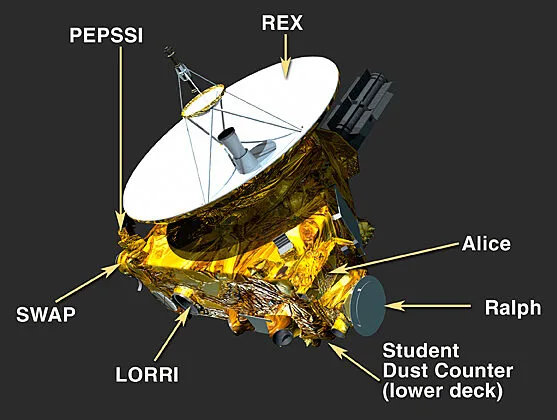
Another way of looking at the same question is to ask, “Why did we stop?” In the case of New Horizons, the spacecraft is still flying deeper into the outer Solar System and studying that mysterious environment. And yet, beginning on Oct. 1 of this year, two instruments on New Horizons — the SWAP (Solar Wind Around Pluto) and PEPSSI (Pluto Energetic Particle Spectrometer Science Investigation) instruments — will be turned off to save, essentially, a penny. The spacecraft itself is healthy, with enough power and fuel to function until around 2050. That year corresponds to about 137 astronomical units (AU; 1 AU is the average Earth-Sun distance of about 150 million kilometers or 93 million miles) from the Sun, putting the spacecraft squarely outside the Sun’s heliosphere and directly in the “star stuff” from the rest of the Milky Way Galaxy. That’s interstellar space, and it’s where the Voyager 1 and 2 spacecraft — each launched in 1977 and still working — are silently cruising right now, still sending back data to listening space physicists. What NASA is going to do is to turn off perfectly good, unique instruments on a perfectly good, unique spacecraft. Those instruments can, fortunately, be turned back on, but only if NASA can find some metaphorical change under the couch cushions.
“Shields up!” The Sun’s protection from the galaxy
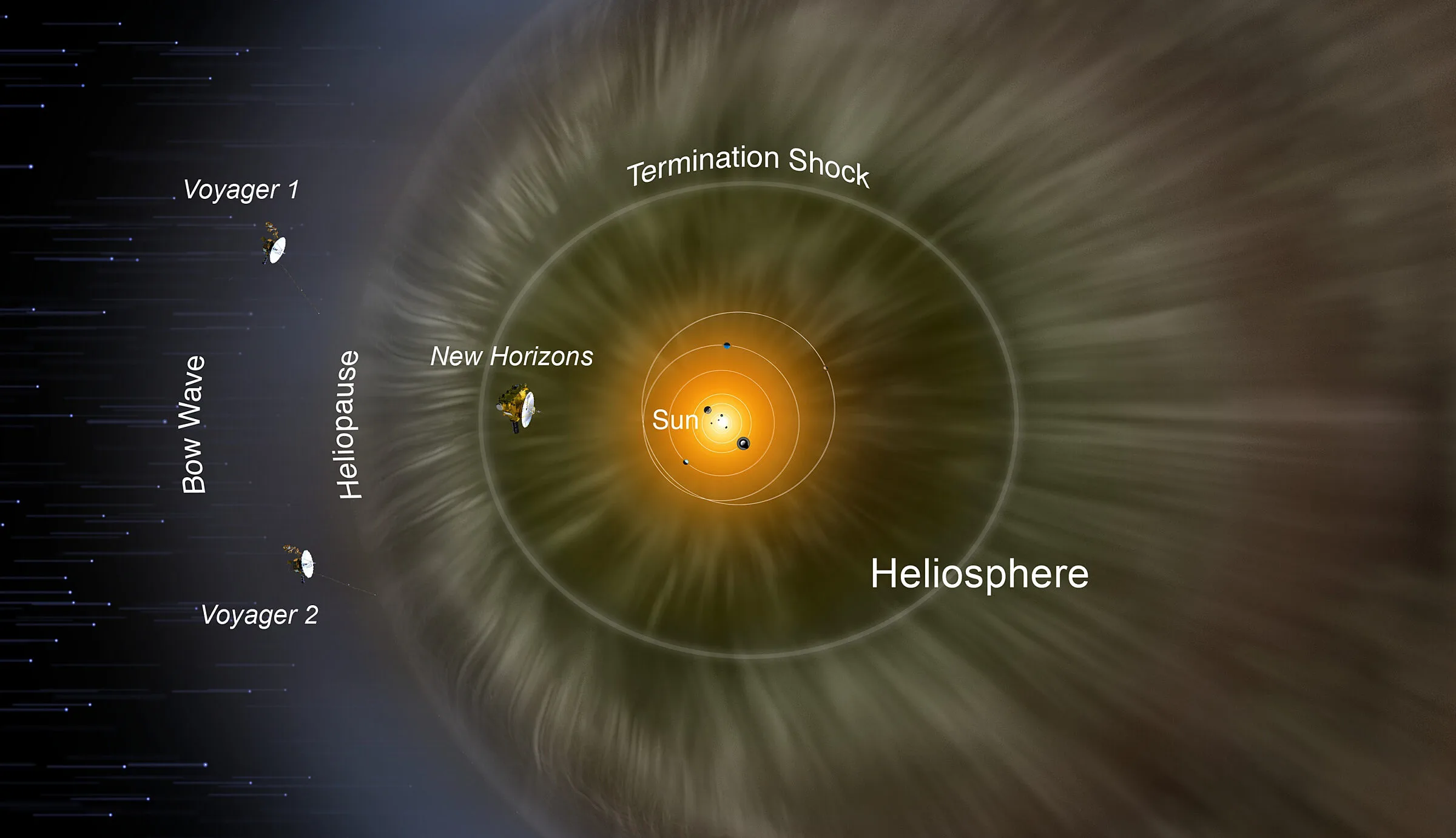
To put this situation in context, let’s chat about the heliosphere. The Sun’s truly gargantuan magnetic bubble of electrically charged plasma (the solar wind) generally extends well beyond the Kuiper belt. SWAP and PEPSSI on New Horizons are mapping the structure and energy levels of particles in the outer heliosphere, where the spacecraft is right now. Just like Voyager 1 and 2 before it, New Horizons will eventually cross into the termination shock, a region around 80-100 AU from the Sun where the solar wind slows to below the speed of sound. Once past the termination shock, the spacecraft will be in an invisible region of slower charged particles of the solar wind called the heliosheath. The edge of the heliosheath is called the heliopause, located about 120 AU away. It is beyond here that interstellar space beckons. Voyager 1 and 2 measured the locations of each of these structures when they crossed at different heliospheric positions, but they lacked the particle and energy measuring capabilities of SWAP and PEPSSI on New Horizons.
Why should we care about the heliopause? As I’ve learned myself, the size of the heliosphere may directly impact Earth’s climate and the evolution of life itself. It’s not very often that space physicists and ocean sediment geologists trade notes, but geologic records from the deep ocean show traces of the isotopes iron-60 and plutonium-244, which date back to two brief episodes 2 and 7 million years ago when Earth’s atmosphere was directly exposed to interstellar space —specifically, the part called the very local interstellar medium, or VLISM.
Numerical computer models of the magnetohydrodynamics (I love big science words like that!) of the heliosphere show that when it encounters a cold, dense interstellar cloud of hydrogen, the heliosphere can compress down to 0.22 AU from the Sun — well inside the orbit of Mercury. This appears to have happened during those episodes 2 and 7 million years ago. Earth and all the other planets would have been exposed to a wash of neutral hydrogen and galactic cosmic rays from supernovae and quasar jets. With this much radiation hitting our atmosphere, enhanced cloud nucleation would have led to climate fluctuations. Environmental changes like this drive evolution — including for our ancestors. Only New Horizons’ SWAP and PEPSSI instruments can measure how the solar wind interacts with the VLISM. And measuring these processes out there is the only way to begin to understand how interstellar space could have impacted Earth and the other planets.
Radiolysis and prebiotic chemistry
It’s not just the climate that can be affected by traversing the heliopause; it’s also the chemistry of life.
Radiolysis is the process of creating new chemical species via radiation (a.k.a. radiolysis), and it operates throughout the Solar System on worlds of every size. Ultraviolet photons and ionizing radiation (like electrons, protons, and other charged particles) break chemical bonds, and when new bonds form, it creates new chemicals. You know that orange gunk in Titan’s atmosphere or the red “hat” on Charon’s north pole? Those are radiolysis products called tholins.

One thing we don’t yet know is how the solar wind and the VLISM differ in the amounts and types of chemical species they can produce on a given type of world, including prebiotic chemistry. New Horizons’ SWAP and PEPSSI could help determine how being within or outside the heliosphere might affect radiolysis and even habitability.
Implications for habitability
Ocean worlds exist throughout the Solar System. Europa and Enceladus are the most famous, but Pluto was once — and might still be — an ocean world, too. Its dwarf planet-sized moon, Charon, likewise once hosted an underground (and maybe, for a brief instant, above-ground) ocean. Both Pluto and Charon froze within a billion years after forming. On Earth, we know that life existed by the time our planet was a billion years old, and maybe earlier. If dwarf planets can stay liquid for comparable lengths of time following their formation, might life have at least started in them, too?
And I’m not just talking about Pluto and Charon. Dwarf planets are the most common type of planet in our Solar System, and probably the Universe. Planetary astronomers have discovered about 130 worlds in the Kuiper Belt with diameters of at least 500 kilometers (310 miles), large enough to be considered dwarf planets. That means 130 small, icy planets, at least some of which could have started off with underground oceans, warmed by the heat of these bodies’ formation. With an energy source — heat — and water, these worlds would have two of the three ingredients needed for life. The last ingredient is nutrients. Remember those radiolytic chemical products we talked about earlier? They’re food. Ice tectonics, cryovolcanoes, and impact cratering could get those nutrients underground, where the water and heat are, giving any nascent alien microbes their version of Uber Eats.
Let’s SWAP some dollars for a PEPSSI
New Horizons, kitted out with SWAP and PEPSSI, can measure the heliosphere and, eventually, the VLISM’s plasma environments that drive radiolysis and planetary climates. Voyager 1 and 2, the only other spacecraft in that region, simply lack any scientific instruments with this capability. For the lifetime of most humans alive today, New Horizons is our only chance to measure the link between interstellar space, the heliosphere, habitable ocean worlds, and our home planet, Earth.
The knowledge gained with New Horizons could pave the way for Interstellar Probe — by far the coolest mission concept I got to work on during my tenure at the Johns Hopkins Applied Physics Laboratory. This conceptual mission would send a spacecraft speeding more than double the speed of Voyager or New Horizons on a 50-year mission into the VLISM, roughly 500 AU away. This cross-disciplinary mission would fly past one of those 130 dwarf planets beyond Neptune, imaging its fascinating geologic landforms and using its ultraviolet and infrared spectrometers to decipher its surface composition. Particle detectors like SWAP and PEPSSI, together with magnetometers, would reveal the invisible structure of the outer heliosphere and the VLISM.
If Interstellar Probe ever comes to fruition — and even if it doesn’t — we will still need the unique, valuable, fascinating measurements collected by SWAP and PEPSSI. In 2036, I want humanity to have already started working on the next mission to the outer Solar System and beyond. Furthermore, I don’t want us to look back and say, “Why did we let NASA turn off perfectly good instruments on New Horizons? We could have used that data!”
Let’s tell NASA and Congress to keep SWAP and PEPSSI on beyond their Sept. 30 shutdown date. With them, we can better understand our place in space. Without them, our place remains more mysterious than it needs to be. Will you sign a petition to NASA Headquarters to keep SWAP and PEPSSI doing what they were meant to do?
This New Horizons petition is being organized by members of the scientific community and the interested public. The Planetary Society is a supporter of these efforts, but not the sponsor of the petition. Learn more about The Planetary Society's advocacy program on the Save NASA Science campaign website.
You Power the Next Great Discovery!
Fund future scientific research that advances space science and exploration with your gift today.
Donate