

 Explore Worlds
 Find Life
 Defend Earth


Solstices, equinoxes, and seasons
How Earth’s tilted axis causes our seasons


Solstices
This year, June 21 marks the summer solstice in the northern hemisphere, the beginning of summer. At this moment in Earth's journey around the Sun, our planet is positioned so that the north pole is tilted as close toward the Sun as it gets all year. At the same time, the south pole is tilted its farthest away from the Sun. This makes June 21 the winter solstice in the southern hemisphere, marking the start of winter.
That tilt of Earth’s axis is what makes seasons so different from one another, especially closer to the poles. If you live in Canada, for example, you’ll know that June feels very different from December. In the city of Montreal, the average daily high temperature in June is 24°C (75°F), while the average daily high temperature in December drops to -1°C (30°F).
These extremes aren't caused by Earth’s distance from the Sun changing. Instead, they're caused by the tilt of our planet's axis.
As Earth orbits the Sun, that tilt stays pointed in the same direction. At different times of year, different parts of the planet receive different amounts of sunlight as Earth rotates. Using Montreal as an example again, on the summer solstice, the city gets more than 15 hours of daylight. On the winter solstice, it gets less than 9 hours of daylight.
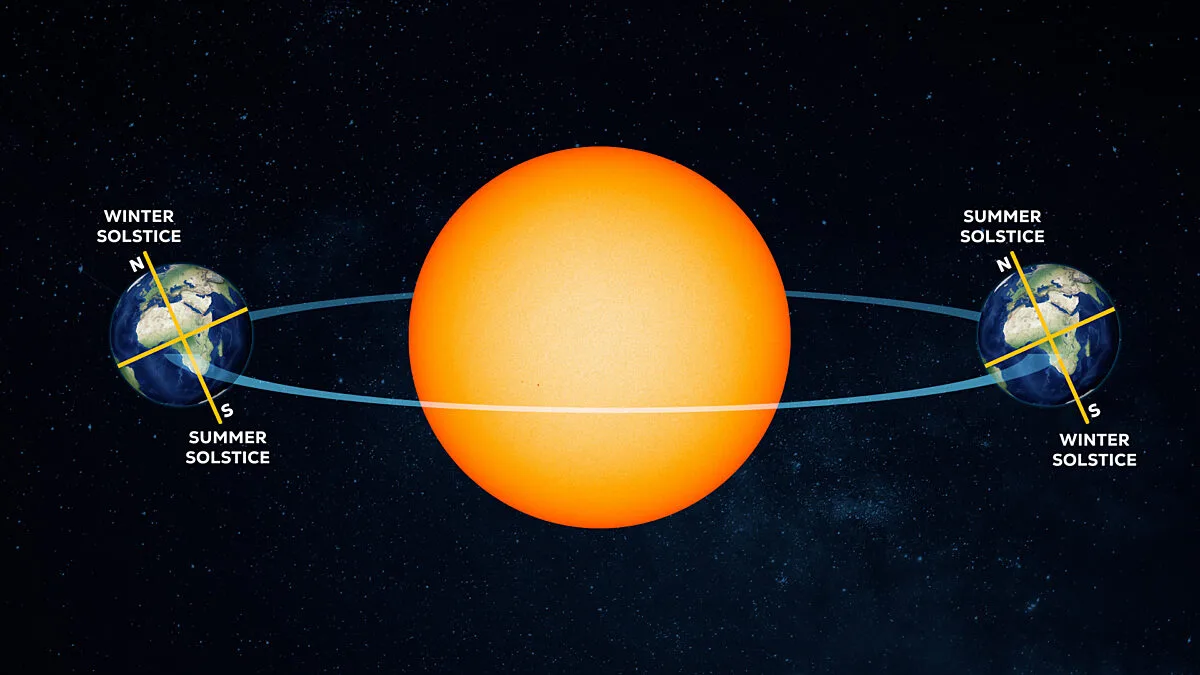
What’s more, sunlight in summertime reaches the ground at an angle perpendicular to the surface — it comes straight at the ground. In winter, sunlight comes in at a sharper angle. This spreads the Sun’s light across a larger area, delivering less light — and therefore less warmth — per square meter.
The differences in duration of daylight and the angle at which sunlight is delivered are the primary drivers of temperature changes between seasons.
These changes don’t happen across the entirety of Earth’s surface, though. Around the equator, the amount of daylight doesn’t change significantly throughout the year. Because the equator lies midway between the poles, Earth's tilt causes much smaller seasonal changes in day length and sunlight there than at higher latitudes.
In Ecuador, for example, days and nights are consistently about 12 hours long all year. Between June and December, daylight only fluctuates by about 15 to 45 minutes, depending on the exact location. In equatorial regions, slight changes in the angle at which sunlight arrives play a bigger role than daylight. But still, temperatures in Ecuador remain relatively consistent throughout the year, with seasonal changes tied more to rainfall patterns rather than to heat.
Equinoxes
Halfway between the solstices are the equinoxes, which mark the beginning of spring and autumn. During an equinox, day and night are nearly equal in length across most of Earth. This happens when neither pole is pointed toward the Sun; instead, Earth is positioned so that the Sun shines directly over the equator, and Earth's rotational axis is perpendicular to the Earth-Sun line.
Seasons on other worlds
Earth isn’t the only place in our Solar System with seasons. Any planet with an axial tilt will experience seasons, though the strength of those seasons can also be affected by the shape of its orbit.
Jupiter and Venus don’t have enough of a tilt to show much seasonal variation, and their relatively round orbits mean they stay roughly the same distance from the Sun year-round. Mercury, on the other hand, has an elliptical orbit, meaning that despite not having a significant axial tilt, it still experiences seasons. Mars, Saturn, Uranus, Neptune, and many dwarf planets all have distinct seasons due to their tilts.
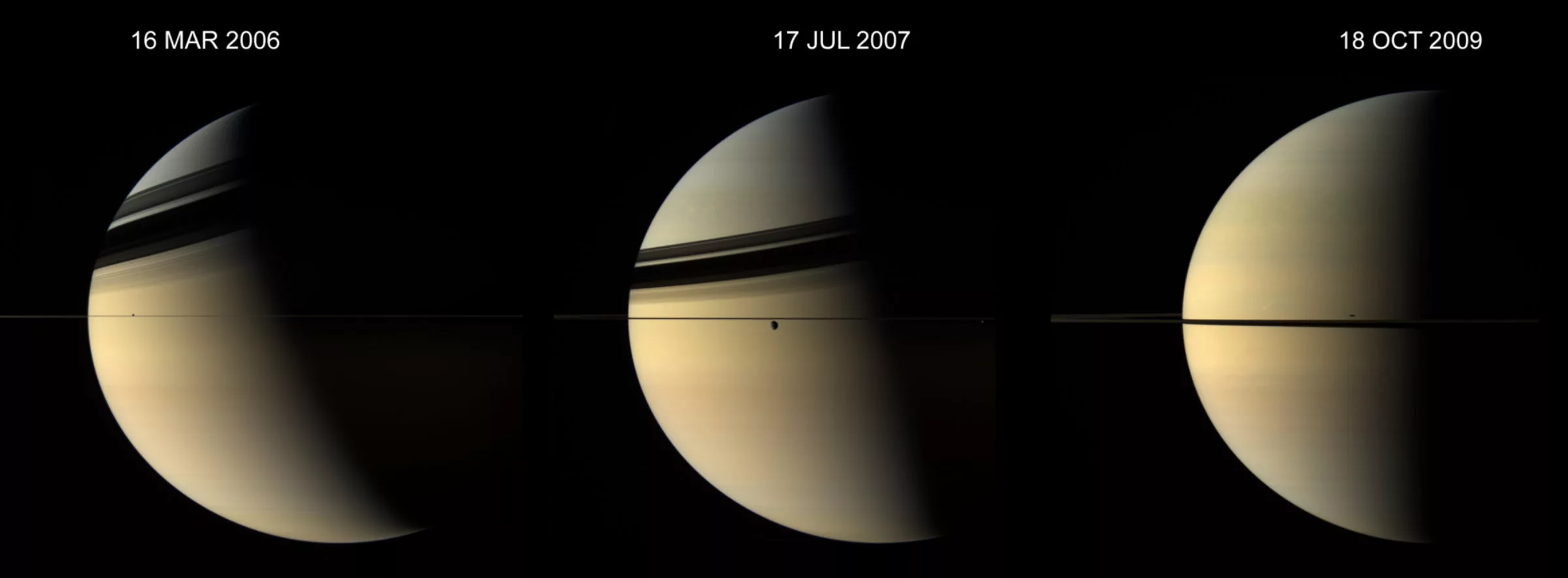
Planets that orbit farther from the Sun have longer orbital periods, meaning their seasons last longer. The four seasons on Mars, for example, each last about twice as long as they do on Earth. Because Mars also has an elliptical orbit, each of its seasons is a different length.
Uranus has the most extreme seasons of any major planet. Its axis is tilted by about 98°, meaning it goes around the Sun on its side compared to other planets. This means that one hemisphere can face the Sun continuously for decades while the other remains in darkness. Each season on Uranus lasts roughly 21 Earth years.
You Power the Next Great Discovery!
Fund future scientific research that advances space science and exploration with your gift today.
Donate