

 Explore Worlds
 Find Life
 Defend Earth

All
All
 Sun
 Mercury
 Venus
 Earth
 Mars
 Jupiter
 Saturn
 Uranus
 Neptune
 Small Bodies
Stories, updates, insights, and original analysis from The Planetary Society.

Dawn Journal: Revisiting orbital mechanics
Now that Dawn has changed its speed by nearly eight kilometers per second, Marc Rayman revisits the concept of orbital velocity.
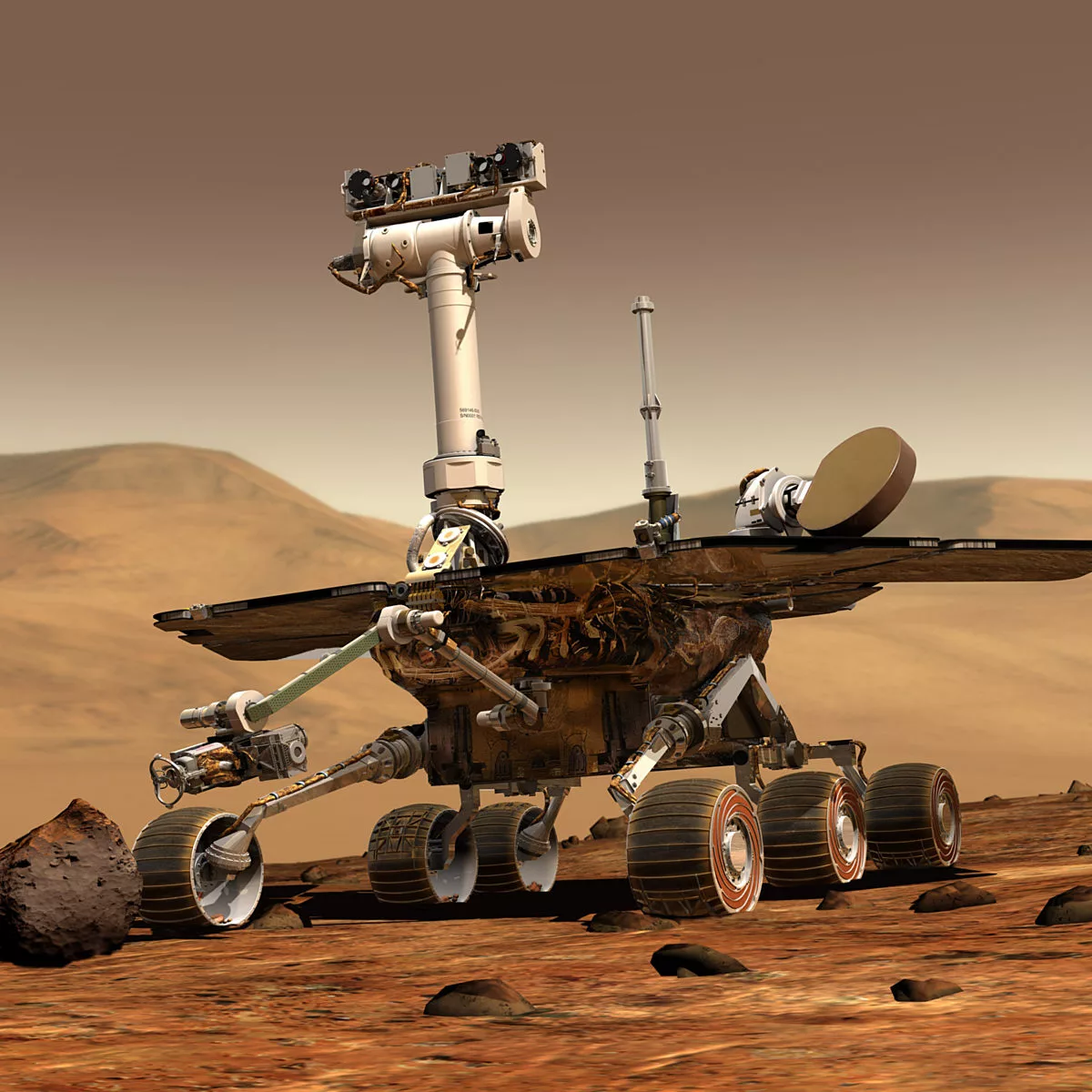
Field Report From Mars: Sol 3220-3236 - March 1, 2013
Opportunity completed the observations of the outcrop noted in the previous report and has now moved back down slope.

Planetary Society Weekly Hangout: Studying Asteroids from Earth with Andy Rivkin
Emily Lakdawalla's guest this week was Applied Physics Laboratory asteroid astronomer Andy Rivkin. We talked about the menagerie of rocks in the asteroid belt, how many of them travel in pairs and triples, how some of them are surprisingly wet, and how much you can learn about asteroids using Earth-based telescopes.
Mysterious Umbriel
Presenting a newly-processed version of Voyager 2's best images of Uranus' moon Umbriel.

Comet to whiz past Mars in October 2014
A recently discovered comet, C/2013 A1 (Siding Spring), is going to be passing very close to Mars on October 19, 2014. Does it pose a risk to spacecraft?

Postcards from Clementine
Nineteen years ago this month, the Clementine mission sent some amazing views from the moon.

Galileo got so many more images of Ida than I realized
While writing up the cruise-phase issues of the Galileo Messenger a couple of weeks ago, I came across a fuzzy montage of images of Ida that I had not seen before. So I decided to spend some time digging into the Planetary Data System to see if there were more images to be found. I found lots and lots pictures that I'd never seen before!

Pretty picture: a moon transit
A reader comment inspired me to dig up an oldie but a goodie: a sequence of photos of the Moon transiting Earth, seen from a very long way away,

Curiosity update, sol 193: drilled stuff is in the scoop, ready for analysis
There was a press briefing today to announce that Curiosity has completed her last major first-time activity: powder drilled from inside a rock at John Klein successfully made its way into the CHIMRA sample handling mechanism in the turret. Sol 193, then, marks the day that Curiosity is finally ready to start the science mission.
Webcast Tonight! Planetary Scientist and Society President Jim Bell
Professor Bell's topic is

Why don't we have any photos of asteroid 2012 DA14 if it came so close?
A frequently-asked question last week was: if asteroid 2012 DA14 is coming so close to Earth, why hasn't anyone taken any pictures of it? Now that 2012 DA14 has whizzed past us, we do finally have some radar pictures of it, but they still may not satisfy everyone.
Vermin of the Sky
Executive Director Emeritus Louis Friedman writes about Asteroid programs of The Planetary Society.

When will New Horizons have better views of Pluto than Hubble does?
Last week, I posted an explainer on why Hubble's images of galaxies show so much more detail than its images of Pluto. Then I set you all a homework problem: when will New Horizons be able to see Pluto better than Hubble does? Here's the answer.

Observing 2012 DA14
Mostly the Universe stays unchanged for hundreds, thousands or even millions of years. There are some cases however when some things change really rapidly. Recently I observed one of these rapidly changing, transient phenomena, as asteroid called 2012 DA14. I work for Las Cumbres Observatory and we have been trying to observe this asteroid since 5 February.

Arc of Ice and Light
When the sunlight catches it just right, Saturn's F Ring is something to see.
The Sky Was Falling! A Meteoric Airburst Over Russia and the Encounter with 2012 DA14
SEE IT NOW: The Planetary Society's CEO, Bill Nye the Science Guy, joined Director of Projects Bruce Betts for a live webcast as 2012 DA14, a 45-meter asteroid, was passing Earth. Bill and Bruce also marveled at video of the meteor burst high over a city in Russia.
BREAKING: Meteor fall causes damage in Russia [UPDATED]
A large meteor streaked through the skies above Russia on the morning of Feb 15th, causing a deafening sonic boom that shattered windows and injured hundreds.

An evening that brought me very close to Curiosity
Damien Bouic received some well-deserved recognition from the Chemcam team for his great Curiosity image processing work.
What We Know About the Russian Meteor Event [UPDATED]
Preliminary estimates show that the meteoroid was 15 meters wide and weighed roughly 8000 tons. The resulting airburst would have the equivalent yield of about a 1/2 megaton explosion.
Planetary Society Weekly Hangout, Thu Feb 14 1200PT/2000UT: Courtney Dressing
Emily Lakdawalla and Courtney Dressing talked about just how common Earth-sized exoplanets may be in our neighborhood. Watch the replay here.