

 Explore Worlds
 Find Life
 Defend Earth


All
All
 Sun
Sun Mercury
 Venus
Venus Earth
Earth Mars
Mars Jupiter
 Saturn
 Uranus
 Neptune
 Small Bodies
Stories, updates, insights, and original analysis from The Planetary Society.

Spectacular Hubble view of the aftermath of an asteroid collision
Hubble has caught an astonishing view of something that's never before been observed, the aftermath of a collision between two asteroids in the main belt.

WISE bags its first near-Earth object, 2010 AB78
The Wide-field Infrared Survey Explorer (WISE) just took its lens cap off on December 29, and posted its

Report #2 from the New Horizons Science Team Meeting
The second report by Ted Stryk from the New Horizons science team meeting, focusing on the search for Kuiper belt object (KBO) targets.

Report #1 from the New Horizons Science Team Meeting
The New Horizons science team is meeting this week. Ted Stryk was invited to attend the meeting, and he sent the following notes from the first day.

ESA mission analyst suggests 2010 AL30 might be Venus Express rocket
2010 AL30 zipped past us harmlessly about five hours ago. Because of its one-year orbital period, many people speculated it might be a manmade object, but 2010 AL30 might, in fact, be artificial.

Goldstone detects "STRONG" radar echoes from 2010 AL30
Radio scientist Lance Benner posted to the Minor Planets Mailing list this evening the following message:

2010 AL30: Watch out for low-flying asteroids
In less than 24 hours, a newly discovered asteroid known as 2010 AL30 will be zipping past Earth at an altitude of approximately a third the Earth-Moon distance. There's no chance it'll hit us, but it's generating a lot of excitement in the community of amateur and professional near-Earth asteroid observers.

Results from the Rosetta Encounter with Asteroid 2867 Steins
Last week in Science magazine appeared the first peer-reviewed article on the results of Rosetta's September 2008 encounter with the smallish main-belt asteroid Steins. This morning I got a chance to sit down and read the article, and I wrote up a summary.

Asteroid 2867 Steins
This description of asteroid 2867 Steins is based upon an article published in the January 8, 2010 issue of Science by H. Uwe Keller and numerous coauthors and on a related press release.

Planetary Society Advent Calendar for December 30: Tempel 1
Looking over the list of planets, moons, and smaller bodies I posted so far, I realized I didn't have an image of a comet yet.

Planetary Society Advent Calendar for December 19: Eros
Not quite ten years ago, the Near Earth Rendezvous (NEAR) spacecraft arrived at the near-Earth asteroid Eros. NEAR accomplished many firsts.

Two cool discoveries today: icy-hot exoplanet and smallest ever Kuiper Belt object
There are two cool stories circulating today on the theme of discovering new places in the cosmos.

Planetary Society Advent Calendar for December 13: Dactyl
If you don't think Pluto gets enough respect, just imagine what it's like to be a satellite of an asteroid.

Planetary Society Advent Calendar for December 8: Itokawa
I love this asteroid. It's just so weird-looking.

Four hundred and fourteen years since Galileo
Galileo, the scientist, discovered the Galilean satellites of Jupiter four hundred years ago next month, while Galileo, the mission, arrived at Jupiter to study those moons in situ fourteen years ago Sunday.

Planetary Society Advent Calendar for December 2: Mathilde
253 Mathilde is the largest asteroid that has ever been visited by a spacecraft. It's held that distinction for more than twelve years, but next year it'll be upstaged by the considerably larger 21 Lutetia, which Rosetta will fly by on July 10.

Near Earth Objects and Planetary Defense
Could a space rock hit Earth and cause widespread devastation? What could we do if we found an asteroid or comet on a collision course with Earth?
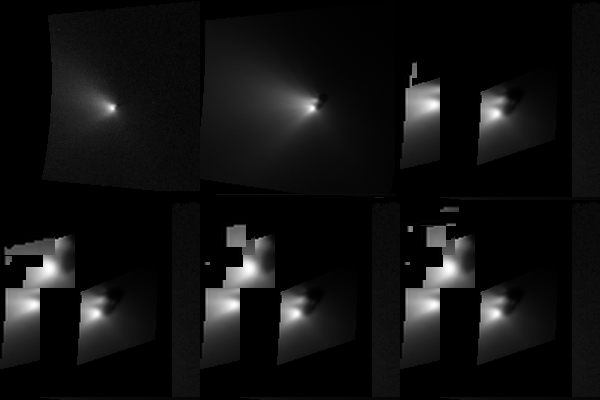
Spectacular animation of Halley's comet
It's a holiday and I'm enjoying time with the family, so rather than write a lot, I will let a spectacular image do the talking for me.

Planetary Radio Q and A: Are meteorites on Mars actually interesting?
The Mars Exploration Rover Opportunity has been studying a lot of meteorites. That made me wonder, why study meteorites on Mars when we can study them in hand on Earth? How are Mars meteorites interesting?
Apophis is less scary than it used to be
Based on analyses of previously unstudied telescopic data, NASA scientists have released new predictions for the path of the 300-meter-diameter asteroid Apophis.