

 Explore Worlds
 Find Life
 Defend Earth

A checklist for what to expect during the 2026 total solar eclipse


A total solar eclipse can be a life-changing experience. People who have seen the Moon blot out the Sun firsthand tend to agree that it’s a spectacular sight like nothing else in nature.
The next chance to see a total solar eclipse will be on August 12, 2026, when the Moon’s shadow crosses parts of Greenland, Iceland, and Spain. While some of North America will see a partial solar eclipse, a fortunate fraction of people in the path of totality will experience a total solar eclipse. If you have the means to travel to the path of totality, we highly recommend it.
A total solar eclipse only lasts a handful of minutes, depending on your location. There are a lot of things to watch for, which can make the big moment feel overwhelming — particularly for first-time viewers.
Here’s a checklist of things you might see during a total solar eclipse. The most important thing you can do is enjoy the show. There’s no need to try and check off every item we list below, but by knowing what to expect ahead of time, you’ll be more prepared to experience this cosmic spectacle.
Before totality
Watch the Moon’s movement
Starting an hour or more before totality (the exact time depends on your location), you can watch a partial eclipse as the Moon slowly crosses in front of the Sun. As seen through eclipse glasses or a solar filter-equipped viewer like a telescope or binoculars, the Moon will take a larger and larger bite out of the Sun.

You can also see the Moon’s shadow by making a pinhole projector, holding up a colander, or by looking at the dappled shade from a tree.
The quality of light
As more and more of the Sun gets eclipsed, you’ll notice some strange lighting effects.
Normally, the edges of your shadow under the full Sun are fuzzy. That’s because our big, round star sends light rays toward Earth at many different angles. But as the Sun gets eclipsed into a crescent, it behaves more like a glow stick, putting out light in a more uniform direction. Objects aligned to the axis of the Sun’s crescent will cast sharper shadows.
You may also notice daylight starting to fade. What began as a bright, sunny day may start to appear overcast as the Moon blocks more and more sunlight.
Shadow bands
Shadow bands are a rarer phenomenon to look for near totality: undulating shadows that are most easily seen on plain surfaces. They are subtle, but may appear for a few minutes before and after totality, as seen in this enhanced video.
Scientists are not certain what causes shadow bands, and their appearance is unpredictable. One theory is that they are created by the same turbulent air in the upper atmosphere that makes stars twinkle. As the Sun shrinks into a thin crescent — the same crescent that makes shadows sharp — the light may organize into twinkling lines.

The racing shadow
After observing the Moon’s leisurely progression across the Sun, you may be tempted to forget that the Earth, Moon, and Sun are locked in a high-speed orbital dance.
The Moon’s average speed around the Earth is around 3,700 kilometers per hour (2,300 miles per hour), meaning the darkest part of its shadow, the umbra, travels just as fast. The Earth’s rotation changes the shadow’s effective speed depending on where you live, but it’s still quick. If you’re watching from a spot where you can see a long way in the direction of the oncoming shadow, you may be able to see it racing toward you on the ground or in the clouds.
Baily’s beads
As the last of the Sun’s rays disappear, you may see what looks like a string of beads along the Moon’s limb. These beads are caused by sunlight slipping through valleys and craters around the Moon's edge — you’re actually seeing the Moon’s topography!
Chromosphere and prominences
For a few moments, you may be able to see a red arc along the Moon’s edge. This is a part of the Sun’s atmosphere known as the chromosphere. You might also see red prominences extending off the surface. These prominences are larger than Earth and made up of plasma.
Diamond ring
As the Baily’s beads wink out, only one will remain, shining bright like a diamond set into a glowing ring. Get ready for totality!
Totality
Twilight and sunset
The diamond ring disappears as the sky plunges into twilight, marking the start of totality. It is now safe to view the Sun with your unaided eye.
The darkness of the sky overhead depends on how close you are to the center of the path of totality. The horizon all around you glows orange like at sunset.
The solar corona
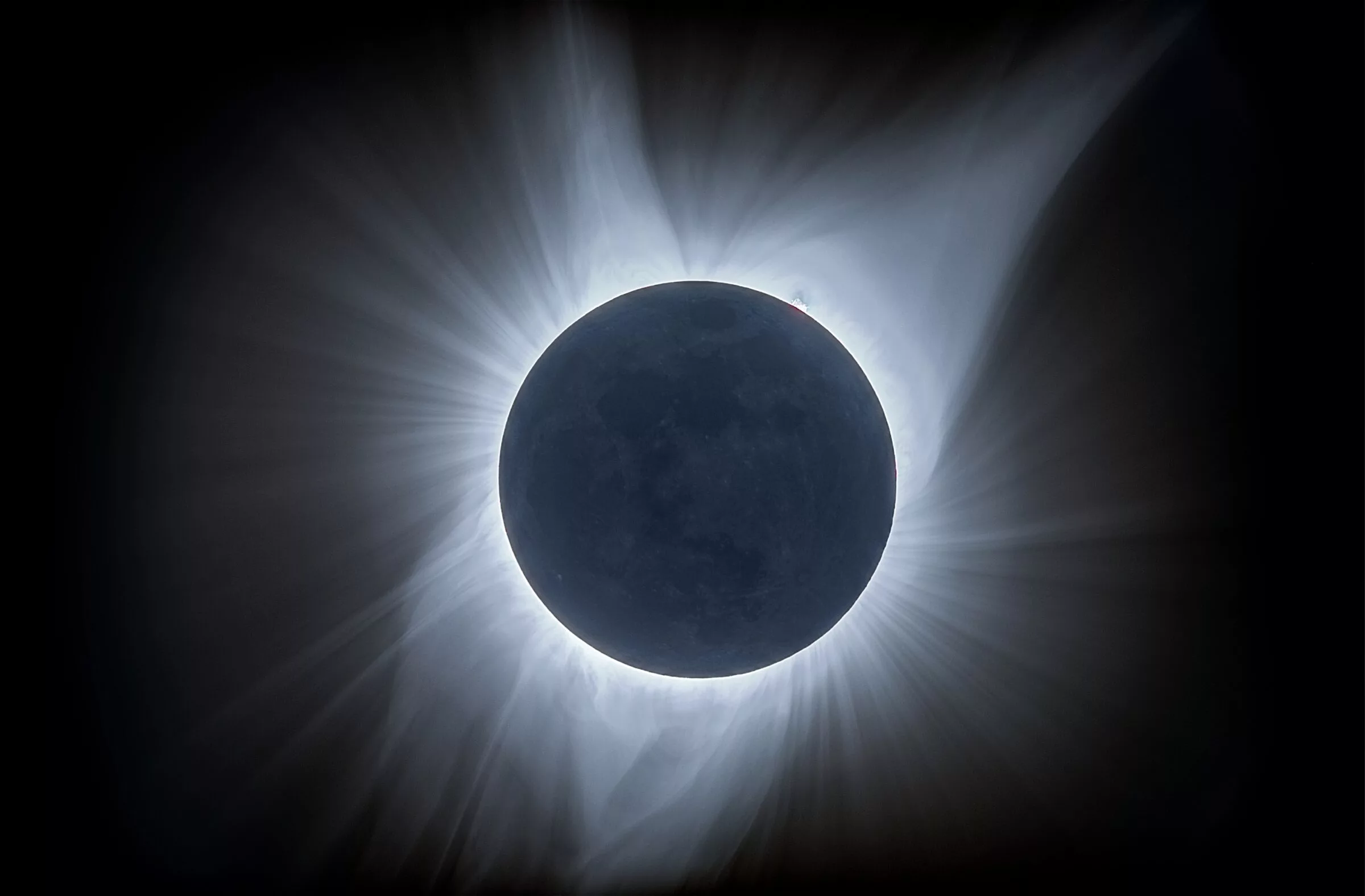
With the Sun completely eclipsed, the corona emerges. The corona is the Sun’s outer atmosphere, visible as a wispy, white expanse billowing out from the Sun. At the center of the corona, the Moon is a black disk blocking the Sun’s surface. A solar eclipse is the only time you can see the corona with the unaided eye, as it is normally lost in the glare of the Sun.
The corona is much hotter than the Sun’s surface, and scientists aren’t sure why. Data from NASA’s Parker Solar Probe recently showed that turbulence beneath the Sun’s surface may be causing magnetic field lines to vibrate like plucked guitar strings, transferring energy out to the corona.
Stars and planets
As the sky darkens, bright stars and planets may emerge. You can check what the sky will look like during totality at your location, but generally speaking, look for Venus to the left of the Sun and Mercury, Jupiter, and Mars to the right of the Sun.
Temperature drop
With the Sun temporarily hidden by the Moon, temperatures on the ground will fall. Expect a drop in temperature of about 5 degrees Celsius (10 degrees Fahrenheit), depending on humidity levels and cloud cover at your viewing site.

Animal behavior
Unlike you, animals haven’t been warned ahead of time that a major cosmic event is about to happen. As the sky fades into twilight, some diurnal animals may engage in their bedtime rituals, while nocturnal animals may wake up and become active.
Before totality, notice any animal behaviors at your viewing location. Are any birds singing or calling? Do you see or hear any noisy insects? During totality, you’ll have a lot to take in, but you may notice that some animal behaviors have changed or that different animals have appeared.
After totality
All of the events that preceded totality will now occur in reverse. The diamond ring will re-emerge. The chromosphere and prominences may appear as the Moon slides off the Sun’s disk. Baily’s beads will blink on. And then the glare of the Sun’s surface will reappear.
Look for shadow bands again, along with the Moon’s shadow racing away from your location. Temperatures will rise. Shadows will remain sharp along the Sun’s crescent axis. And finally, as seen through eclipse glasses or a solar filter, the Moon’s bite out of the Sun will decrease until it disappears.
It’s important to note again that the most important thing you can do during the eclipse is enjoy the show. It may not be possible to see every eclipse phenomenon, even if you’re trying really hard. But by knowing what to expect ahead of time, you’ll be better prepared to have a memorable experience.
Editor's note: This article was updated by Asa Stahl on May 13, 2026.
You Power the Next Great Discovery!
Fund future scientific research that advances space science and exploration with your gift today.
Donate