

 Explore Worlds
 Find Life
 Defend Earth


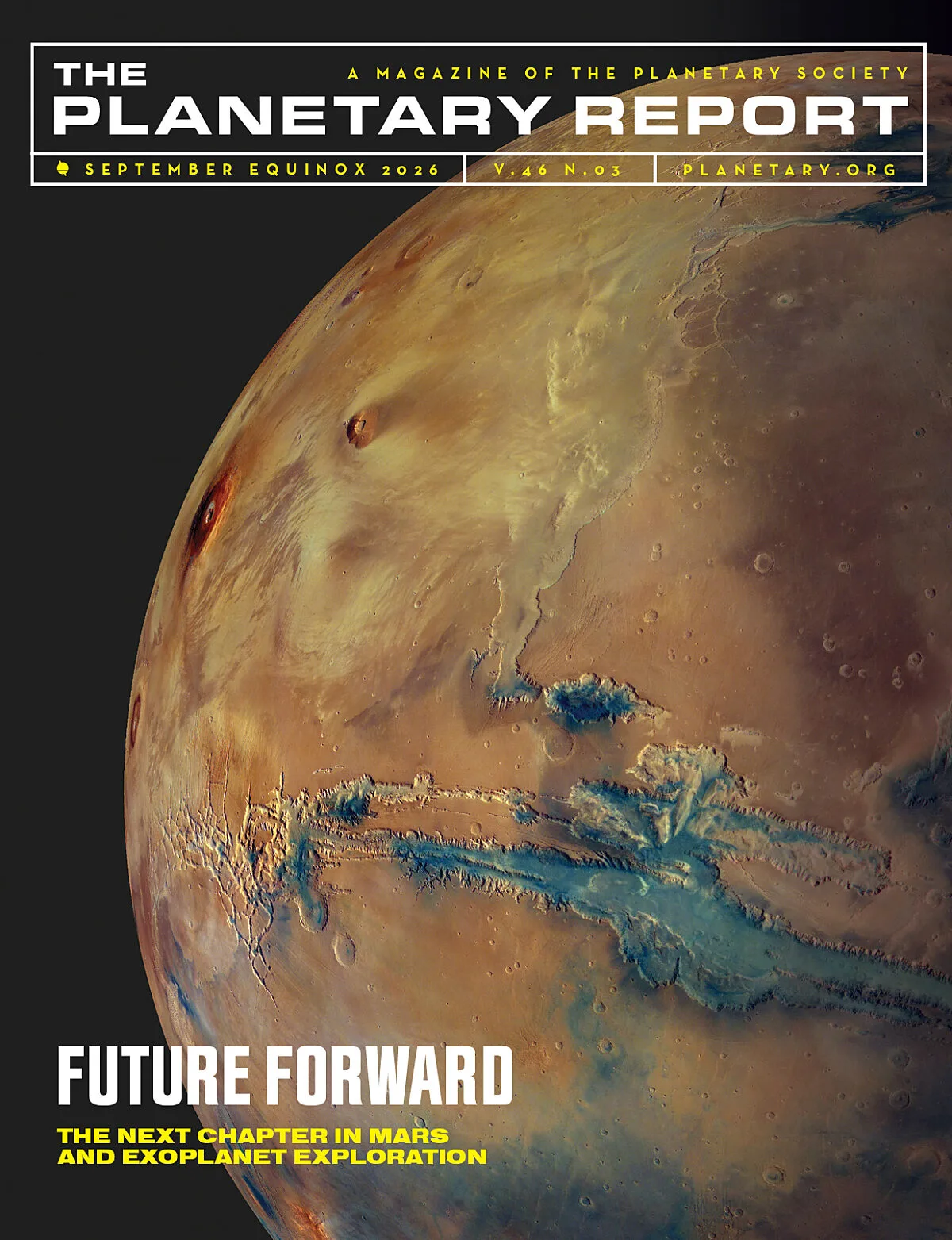
On the Cover: This view of Mars was created by combining 90 individual images captured in 2023 by the High Resolution Stereo Camera on the European Space Agency’s Mars Express orbiter. This view enhances color and contrast to highlight variation across Mars’ surface. Standing out against Mars’ classic red hues are dark and blue-toned areas, which are basaltic sands of volcanic origin.
Download PDF
Features
September Equinox 2026

An insider's look at the Nancy Grace Roman Space Telescope
Dr. Jason Rhodes, Jet Propulsion Laboratory project scientist for the Nancy Grace Roman Space Telescope, shares what to expect from NASA’s next great observatory.

Meet the next generation of Mars exploration
Countries around the world are planning missions to Mars, including rovers and a sample return from the moon Phobos.
Your place in space
Believe it to achieve it: The optimistic perspective that shapes our work
By Jennifer Vaughn, Planetary Society CEO
The American disability rights activist Helen Keller once said, “Optimism is the faith that leads to achievement; nothing can be done without hope and confidence.” For The Planetary Society, optimism is one of the core values codified in our strategic framework. We believe that humanity is capable of doing great things and making important discoveries, we have faith that technological hurdles can be overcome, and we look toward the future of space exploration with hope. When we need to, we take action to help bring that optimistic vision to life.
The missions featured in this issue of The Planetary Report reflect that optimism. The Nancy Grace Roman Space Telescope, which you’ll read about in an article by project scientist Jason Rhodes, was in danger of being canceled just last year. When Roman was in danger, The Planetary Society and our global community of members did not lose our optimism or our commitment — we rallied together to advocate for that mission and the others threatened by the White House’s proposed NASA cuts. Our shared vision that this mission could be saved — and that it would make groundbreaking discoveries — helped it get to this point. Now, Roman is poised to make some of the greatest advances in the history of exoplanet discovery, among other things.
The Japanese MMX (Martian Moons eXploration) mission, covered in a feature article by Planetary Society space policy fellow Ari Koeppel, represents another achievement of optimism. For years, Planetary Society members have supported the development of PlanetVac, a new sample-collection technology. The donations that enabled the design, building, and testing of this system were investments in optimism — in the idea that ordinary people can have an impact on space exploration. And now, PlanetVac is on a mission to the Martian moons.
You’ll also learn more in this issue about a new generation of Mars missions. Many are in very early stages of development, still just hinting at exploration that may be in our future. With vision, long-term commitment, and sustained funding, ambitious ideas like these can become realities.

In essence, we explore because we believe there is something out there worth discovering. We believe we’re capable of overcoming the challenges posed by spaceflight. We have faith that our discoveries will shape the future for the better. And so we take steps to turn optimism into reality.
Our new five-year strategic vision identifies six core values: curiosity, humanity, optimism, independence, credibility, and effectiveness. Each one is as essential to our efforts as the hopeful belief in the future emphasized here. Together, these qualities define our work, unite our members, and shape our future.
Thank you, as always, for being part of this movement for space. Let’s keep exploring!
Stay tuned for more on our 2030 strategic vision, “Together, We Explore,” in the next issue of The Planetary Report.
Members on deck
Advocacy in action: Snapshots from the 2026 Day of Action
On Monday, April 20, 2026, more than 130 space advocates from 34 states and the District of Columbia came to the nation’s capital for The Planetary Society’s annual Day of Action. Over the course of the day, these volunteer advocates held 280 meetings with House and Senate offices to deliver a simple message: Save NASA Science, again. These are some snapshots of members taking action to support space science and exploration.

“The Day of Action is a great event. It gives us a chance to be part of the process of Congress making decisions on the budget. It is great to share our passions to make a difference.” — Nathan Mohling, SC
“The Day of Action is a great opportunity to share passion for NASA science. The Planetary Society does a great job of preparing us, and no one goes alone. I was thankful for the opportunity to share my experience on Planetary Radio and hope it inspires others to join us!” — Gabe Segarra, SC

“I’ve been to every Day of Action. Casey and Jack have us — old pros and newbies both — very well prepared to present our message about the importance of congressional support for NASA — never more so than these last two Days of Action. It’s great to meet all the other participants. It’s the most awesome thing I do all year.” — David Key, MN

In context
The cascade of discovery: Every mission has its place in the architecture of exploration
No space mission is an independent adventure. When a rocket sends a spacecraft toward its destination, it isn’t just beginning a new journey — it is taking the next step in an ongoing odyssey of discovery and laying the path for future missions to tread. Every mission is both an answer and a question, both a conclusion and a premise, carrying with it the missions that made it possible and those that will follow.
In the cascade of discovery, data returned by one mission generate new hypotheses, which motivate new investigations, which incentivize new missions, which return richer data still. Each step depends on the ones before it. A telescope launched this year will spend years cataloging objects that a different observatory, not yet even approved as a formal mission, will one day study in detail. A rover drilling into the ground of another world will prove techniques and generate a scientific case to warrant the next more ambitious attempt.

This issue of The Planetary Report brings you insights into some of the latest additions to that architecture — missions on the near horizon that each fit into a history stretching back decades and forward far into the future. Each of these missions was designed to answer questions prompted by previous discoveries, and each will make it possible to ask the next generation of questions. What each mission enables matters as much as what it discovers.
When a system is based on a cascade like this, disrupting one step can have far-reaching consequences. If NASA never sends spacecraft to retrieve and return the Martian material collected and cached by the Perseverance rover, the questions that scientists hope those samples could answer will remain mysteries. If NASA’s missions to Venus are defunded, the world will be deprived not only of the discoveries that those spacecraft would make but of the entire course of exploration that those discoveries would set in motion.
The vulnerability of the cascade applies to the people as much as the hardware. The scientists and engineers behind these missions train students who go on to work on missions of their own and train the subsequent generation of explorers. When thousands of NASA staff left the agency this year due to budget cuts, that chain of knowledge and craftsmanship was permanently disrupted.
This is why The Planetary Society fights so hard to oppose cuts to NASA’s science budget. Defunding a mission doesn’t just cancel a project; it breaks a link in a chain that took decades to forge, invalidating work that came before and abandoning the potential of what would follow.
To argue for any single mission on its own terms misses the bigger stakes: What we are really fighting to protect is the architecture of exploration itself.
Advocacy
Advocacy update: Continuing the fight for NASA and space science
For the past few months, our advocacy program has taken Casey, Ari, and me to science and tech conferences in California, Wisconsin, Arizona, Washington, D.C., and even Italy. The focus of these gatherings varied, but the message we brought was consistent: We’re continuing the fight to save NASA Science. The agency still faces an existential threat of a 46% cut to its science budget, and the annual budgeting process has stalled in Congress. And though there are many new, exciting projects recently announced, NASA has not been able to clearly articulate how to pay for them without enacting the mission terminations proposed in the FY 2027 budget request.
On Capitol Hill, we’re working with members of both parties in the House and Senate to secure adequate funding and policy support for NASA and its science programs. We’ve also hosted major events showcasing the value and importance of NASA Science. At the end of April, we educated a packed room of congressional staffers about the AVATAR experiment that flew on Artemis II with representatives from NASA’s Biological and Physical Sciences Division, the American Society for Gravitational and Space Research, and Space Tango. We also joined forces with Johns Hopkins University, the National Air & Space Museum, and SpaceNews to celebrate the 50th anniversary of Viking 1 landing on Mars on July 20.

But our biggest effort was responding to the Office of Management and Budget’s proposed rewrite of federal grant rules, which would let political appointees override expert peer review, cancel grants at will, and restrict how publicly funded science reaches the public. We filed a formal comment detailing how it would raise the cost of accessing federal research, destabilize multiyear awards, and sever the pipeline of discoveries. Ours was one of nearly 500,000 filed nationwide, including more than 1,500 from our members and supporters.
And, thanks to members like you, our annual fundraising campaign for our Space Policy and Advocacy program raised just over $80,000 this year. This incredible support ensures that we can continue fighting for science, exploration, and our future in space.
From the chief scientist
What’s on our cosmic radar
By Bruce Betts, Planetary Society Chief Scientist
In the sky
The Geminids meteor shower peaks the night of Dec. 13-14, with increased activity several days before and after. The Geminids are usually the best shower of the year, with 100+ meteors per hour from a dark site. When the shower peaks, a 20% full Moon will rise around 2:00 a.m., washing out some of the meteors. The predawn east is where most of the planet party is during this period. In particular, in mid-November, super-bright Venus and Mercury below it are low in the predawn east. Very bright Jupiter is above them, very close to dimmer, reddish Mars. Yellowish Saturn rises in the eastern sky in the evening. By December, in the evening south, winter constellations such as Orion are shining brightly.
For more night sky tips, you can always check out planetary.org/night-sky.

Random space fact
Mars’ moon Phobos orbits the planet in 7 hours and 39 minutes. It rises in the west and sets in the east as seen from the surface because its orbit is faster than Mars’ rotation. Mars’ day is about 24 hours and 40 minutes, so Phobos orbits more than three times per Mars day.
Trivia contest
Our March Equinox contest winner is Edward Jordan of La Cañada, California, USA. Congratulations!
The question was: In college, when Bill Nye took the class Introduction to Astronomy, who was his professor?
The answer: Planetary Society co-founder Carl Sagan
Try to win a copy of the book “Saturn: The Ringed Planet with The Planetary Society” by Bruce Betts and a Planetary Radio T-shirt by answering this question:
What was the first Mercury orbiter?
Email your answer to planetaryreport@planetary. org or mail your answer to The Planetary Report, 60 S. Los Robles Ave., Pasadena, CA 91101. Make sure you include the answer and your name, mailing address, and email address (if you have one). By entering this contest, you are authorizing The Planetary Report to publish your name and hometown. Submissions must be received by Jan. 15, 2027. One entry per person. The winner will be chosen in a random drawing from among all the correct entries received.
Space art
Orbital Fields 07

More of Mette Oldager’s work can be found at oldager.art.
Do you want to see your artwork here? We love to feature our members throughout this magazine. Send your original, space-related artwork to [email protected].
Society notes
The Planetary Society’s celestial escape to Mauna Kea sweepstakes
The Planetary Society recently raised $542,800 to support our mission through our Celestial Escape to Mauna Kea Sweepstakes. From among 11,788 entries, Freya Sato of Duluth, Georgia, USA, won a five-night trip to Mauna Kea in Hawai’i, including a luxury stay at the Westin Hapuna Beach Resort, a special stargazing experience, private behind-the-scenes access to the Keck telescopes, and more. We thank everyone who entered as well as our partners TapKat, Mauna Kea Resort, the Westin Hapuna Beach Resort, Keck Observatory, and Hawaii Forest & Trail.
The Planetary Report • September Equinox 2026
Help advance space science and exploration! Become a member of The Planetary Society and you'll receive the full PDF and print versions of The Planetary Report.