

 Explore Worlds
 Find Life
 Defend Earth


All
All
 Sun
Sun Mercury
 Venus
Venus Earth
Earth Mars
Mars Jupiter
 Saturn
 Uranus
 Neptune
 Small Bodies
Stories, updates, insights, and original analysis from The Planetary Society.

Phobos-Grunt is no more
Phobos-Grunt has returned to Earth, a lot sooner than it should have. Yesterday, at approximately 17:45 UT, the Russian spacecraft and its passengers, including a Chinese orbiter and the Planetary Society's LIFE experiment, descended into Earth's atmosphere.

News brief: Phobos-Grunt has fallen to ground
The Russian military is stating that at 17:45 UT, Phobos-Grunt fell into the Pacific Ocean.

NASA is an Investment in the Future
The Planetary Society continues our strong political advocacy for space science and exploration. The following is an excerpt from a letter we sent to Jacob Lew of the Office of Management and Budget and the President's Chief of Staff.

Phobos-Grunt's upcoming demise: What we know and what we don't
I'm not looking forward to spending the weekend sitting deathwatch on Phobos-Grunt. It's not science, and it's a sad event, so my instincts would lead me to other subjects. But it contains the Planetary Society's Phobos LIFE experiment.

Evaporites on Titan
Evaporites form on planetary surfaces when dissolved chemical solids precipitate out of saturated solution as their liquid solvent evaporates and, until recently, were known to exist only on Earth and Mars. This article from the IAG Planetary Geomorphology Working Group describes the third planetary instance of evaporite, discovered on Saturn's moon Titan.

Watch today's Google+ Space Hangout
Fraser Cain at Universe Today has organized a weekly Space Hangout that happens at 1800 UTC on Thursdays. This week's conversation focuses on news on exoplanets and dark matter coming out of the American Astronomical Society meeting happening this week in Austin, as well as a Dawn update.

Steno's principles and planetary geology
The Google Doodle for January 11, 2012 celebrates Nicholas Steno, one of the founding fathers of modern geology, on the occasion of his 374th birthday. This article describes Steno's set of rules that guide geologists in reading rocks to tell the story of how a place came to be and how the rules are currently used in geology.

Happy LPSC Deadline Day, especially to composers of abstract haiku
January 10, 2012 was a high-stress day for many in the world of planetary geology: the deadline for submission of abstracts for the 2012 Lunar and Planetary Science Conference (LPSC). One creative coping mechanism for the stress of completing the LPSC abstract submission process is the tradition of capturing the essence of one's work in the seventeen syllables of the Haiku form.

Pretty picture: Saturn, a big moon, and a teeny one
A recent view from Cassini of Saturn with its largest moon (Titan) and one of its small ringmoons, Prometheus.

What is space exploration worth?
Investing in NASA makes us smarter, improves our lives, and increases our capability to overcome technological challenges. Even more important, though, are the intangible benefits of pride, respect from other nations, respect for our place in the universe, and hope for a future in which we can accomplish even greater things.

What's up in the solar system in January 2012, and the rest of the year
There will be no planetary launches in 2012, but there is still plenty of deep-space activity to look forward to over the coming year.

Ringing in the New Year with two new arrivals to the Moon
The twin GRAIL spacecraft are nearly at the end of their three-month cruises to the Moon. Currently being discussed is an extended mission for GRAIL that would begin after the June eclipse and last through most of December 2012.

Lovely Lovejoy pictures
Just a few of the amazing photos of Comet Lovejoy that have been taken from the southern hemisphere over the last few days. Comet Lovejoy is the first Kreutz sungrazer to have been discovered from the ground in 40 years, and after its surprising survival of its passage close to the Sun, it has been putting on a spectacular show in southern skies.

Pretty pictures from Cassini's 12 December 2011 Dione flyby
Cassini flew close by Dione on December 12 and, as usual, the close pass provided opportunities for lots of dramatic photos, not just of Dione, but of other moons wandering by in the background.
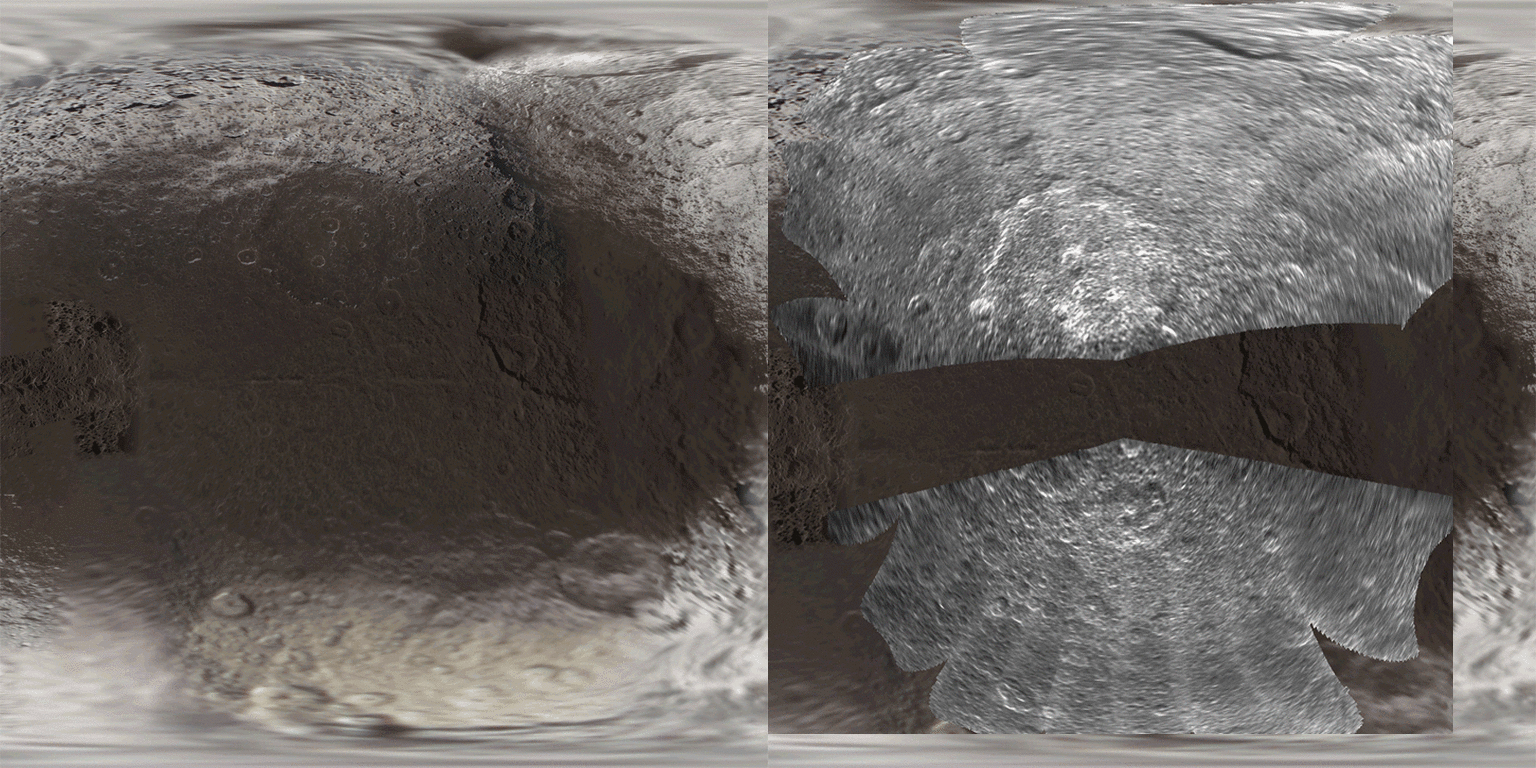
More radar images of icy moons from Cassini: Iapetus, Enceladus, and Rhea
When I posted about the really cool Cassini SAR images of Enceladus a few weeks ago, I initially wrote that this was the first-ever SAR image of an icy moon other than Titan. Several people (some readers and two members of the Cassini science team!) corrected that statement: Cassini has performed SAR imaging of other icy moons (including Enceladus) before.

Separating fact from speculation about Kepler-20's Earth-sized planets
A large team of researchers has announced in a Nature article the discovery of not one, but two, Earth-sized planets orbiting a star named Kepler-20. This article separates the observational facts from the quite-likely-to-be-true inferences from the downstream speculations.

Do you have an iPhone? Do you like the Mars rovers? Check out the awesome my3D viewer.
The Hasbro my3D viewer turns your phone into an electronic View-Master, making it easy to view color images in stereo.

MalloMars Rover: Search for S'more Data
Abigail Fraeman took third place in the Washington Post's 2011 Style Invitational edible-art contest with her entry,

What do we know about planetary rings? Quite a lot, actually!
A summary of a new article by Matt Tiscareno about planetary ring systems that reviews the known ring systems of the four giant planets and the prospects for ring systems yet to be discovered.

Video: Comet Lovejoy entered SOHO's LASCO C3 field of view this morning!
An animation of comet Lovejoy entering the field of view of one of SOHO's Sun-monitoring cameras.