

 Explore Worlds
 Find Life
 Defend Earth

All
All
 Sun
 Mercury
 Venus
 Earth
 Mars
 Jupiter
 Saturn
 Uranus
 Neptune
 Small Bodies
Stories, updates, insights, and original analysis from The Planetary Society.

Tvashtar erupting -- the movie
I practically fell out of my chair when I saw this movie.

Cassini observes a new face of Iapetus
Cassini has just begun its 44th orbit of Saturn (called Rev 43), and is starting it off with lots of views of famously two-faced Iapetus.

Dione's south pole
Cassini got a nice

Space weather affects everyday life on Earth
According to a press release issued this morning by the National Oceanic and Atmospheric Administration, the enormous solar flare that erupted on December 5 and 6 last year was accompanied by an intense radio burst that caused large numbers of Global Positioning System recivers to stop tracking the signal from the orbiting GPS satellites.

Millions of soundings yield clues to Mars' weather
Two months after the start of Mars Reconnaissance Orbiter's primary science phase, the Mars Climate Sounder instrument has already acquired more than four million soundings, building toward a vast data set on the three-dimensional structure of Mars' atmosphere over the full Martian year of the orbiter's nominal mission.

Io and Europa glimpsed by a retreating New Horizons
This image is beautiful for many reasons. It was captured by the MVIC imaging spectrometer, part of the Ralph instrument, on New Horizons, as it left the Jupiter system on March 2, 2007.

Io erupts, in color
The last one of New Horizons imaging instruments has finally checked in with a lovely image from the Jupiter flyby

Enceladus is a drag on Saturn's radio emissions
What should arrive in my inbox today but a press release from the Cassini RPWS and magnetometer teams saying, in part,

LPSC: Tuesday: Volcanism and tectonism on Saturn's satellites
I received this report on the Tuesday afternoon special session on volcanism and tectonism on Saturn's satellites from Anne Verbiscer, an astronomer from the University of Virginia who I first met at the Division of Planetary Sciences meeting in 2005.

Another amazing Io image from New Horizons
The Tvashtar eruption continues to amaze. All this time between Galileo and New Horizons, Io's volcanoes have probably continually produced spectacular eruptions like these.

LPSC: Wow, Titan can be a Really Flat Place, and other Titan Talks
Jason Perry, a member of the Cassini Imaging Team and an undergraduate student at the University of Arizona, reports from the Titan sessions.

Cassini's global views of Saturn and its rings
Since late January Cassini has been acquiring several sets of images that show all of Saturn's globe and ring system at once from perspectives well above and below the ring plane.

Updates from Past Recipients of the Shoemaker NEO Grants (1 March 2007)
Thanks to The Planetary Society Shoemaker Grant, the 1.06-meter KLENOT telescope optics was completed at the Klet Observatory. Regular observations of the KLENOT project started in March 2002 under the new IAU/MPC code 246, so we can now present results covering 5 years of this work.
Saturn from above (2007)
OK, I had planned to confine my posts this week to Rosetta and New Horizons, but I could not let these images sit on my computer until next week.

New Horizons' Jupiter flyby was successful!
According to a press release issued minutes ago, New Horizons has successfully completed its close flyby of Jupiter.

New Horizons sees Io erupting!
There were two new pictures posted on the New Horizons Science Operations Center website this morning, of Io, and if you enhance the images a bit, there are two clear volcanic plumes visible on the limb -- Tvashtar and Prometheus are active!

Rosetta Was Here
This amazing view was captured by the CIVA camera on Rosetta's Philae lander just four minutes before its closest approach to Mars on February 25, 2007. The spacecraft was only 1,000 kilometers above the planet.
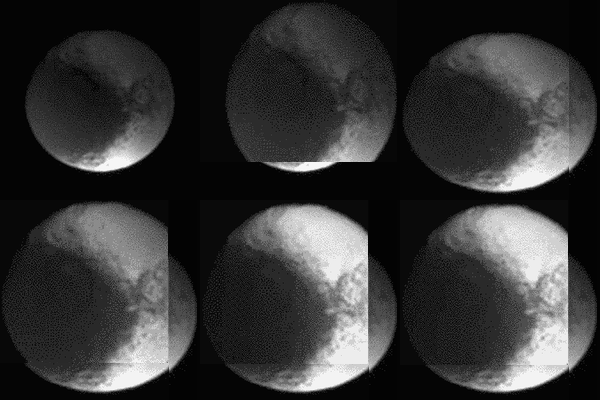
A new way to darken Iapetus
Iapetus is one of the many fascinating bodies in the Saturn system.

Autumn comes to Mars' north pole
It's easy to forget that Mars is another such world with cloudy weather and seasonally varying climate. This lovely image release from the CRISM instrument on Mars Reconnaissance Orbiter brings that point home.