

 Explore Worlds
 Find Life
 Defend Earth


All
All
 Sun
Sun Mercury
 Venus
Venus Earth
Earth Mars
Mars Jupiter
 Saturn
 Uranus
 Neptune
 Small Bodies
Stories, updates, insights, and original analysis from The Planetary Society.

Notes from Titan talks at the 2012 Lunar and Planetary Science Conference (LPSC)
One of the topics I found most exciting yesterday was a series of talks on Titan's climate. Bob West showed how Titan's detached haze has shifted with time. Zibi Turtle presented about how Titan's weather has changed with these seasonal changes. Jason Barnes followed up Zibi's talk -- which was based on Cassini camera images -- with a study of the same regions using data from Cassini's imaging spectrometer, trying to figure out what was going on with that brightening. Ralph Lorenz talked about rainfall rates on Titan. Jeff Moore asked: what if Titan hasn't always had a thick atmosphere?

Pretty picture: A study in ringlight
Clearly, this is Saturn, and its rings, and if you look closer you can see a tiny circle, on top of the rings, which is Mimas, and two stars in the background. It should look weird to you that while the rings are bright, Mimas is a black dot. What is happening here? Nearly everything in this picture is lit by light that has not arrived directly from the Sun.

Iapetus' peerless equatorial ridge
A new paper in the Journal of Geophysical Research - Planets by Dombard, Cheng, McKinnon, and KayI claims to explain how Iapetus' equatorial ridge formed. Cool!

Checking up on Jupiter and Saturn
It's amateur astronomers, not professionals, who are shouldering the burden of constant monitoring of the weather on Jupiter and Saturn. What's going on these days in the outer solar system?

Pretty picture: Enceladus, in lovely color
Here's an awesome picture to start off the week. The data came from Cassini's flyby of Enceladus on January 31, 2011; it was part of Cassini's January 2012 data release.

Parallel planetary processes create semantic headaches
I ran into a semantic problem today: what to call the science of studying liquids on Titan?

Watch this week's Google+ Space Hangout
This week's lineup is a largely astronomical crowd so most of the conversation concerned dark matter and boiling exoplanets and imaging the black hole at the center of our galaxy.

Evaporites on Titan
Evaporites form on planetary surfaces when dissolved chemical solids precipitate out of saturated solution as their liquid solvent evaporates and, until recently, were known to exist only on Earth and Mars. This article from the IAG Planetary Geomorphology Working Group describes the third planetary instance of evaporite, discovered on Saturn's moon Titan.

Pretty picture: Saturn, a big moon, and a teeny one
A recent view from Cassini of Saturn with its largest moon (Titan) and one of its small ringmoons, Prometheus.

Pretty pictures from Cassini's 12 December 2011 Dione flyby
Cassini flew close by Dione on December 12 and, as usual, the close pass provided opportunities for lots of dramatic photos, not just of Dione, but of other moons wandering by in the background.
More radar images of icy moons from Cassini: Iapetus, Enceladus, and Rhea
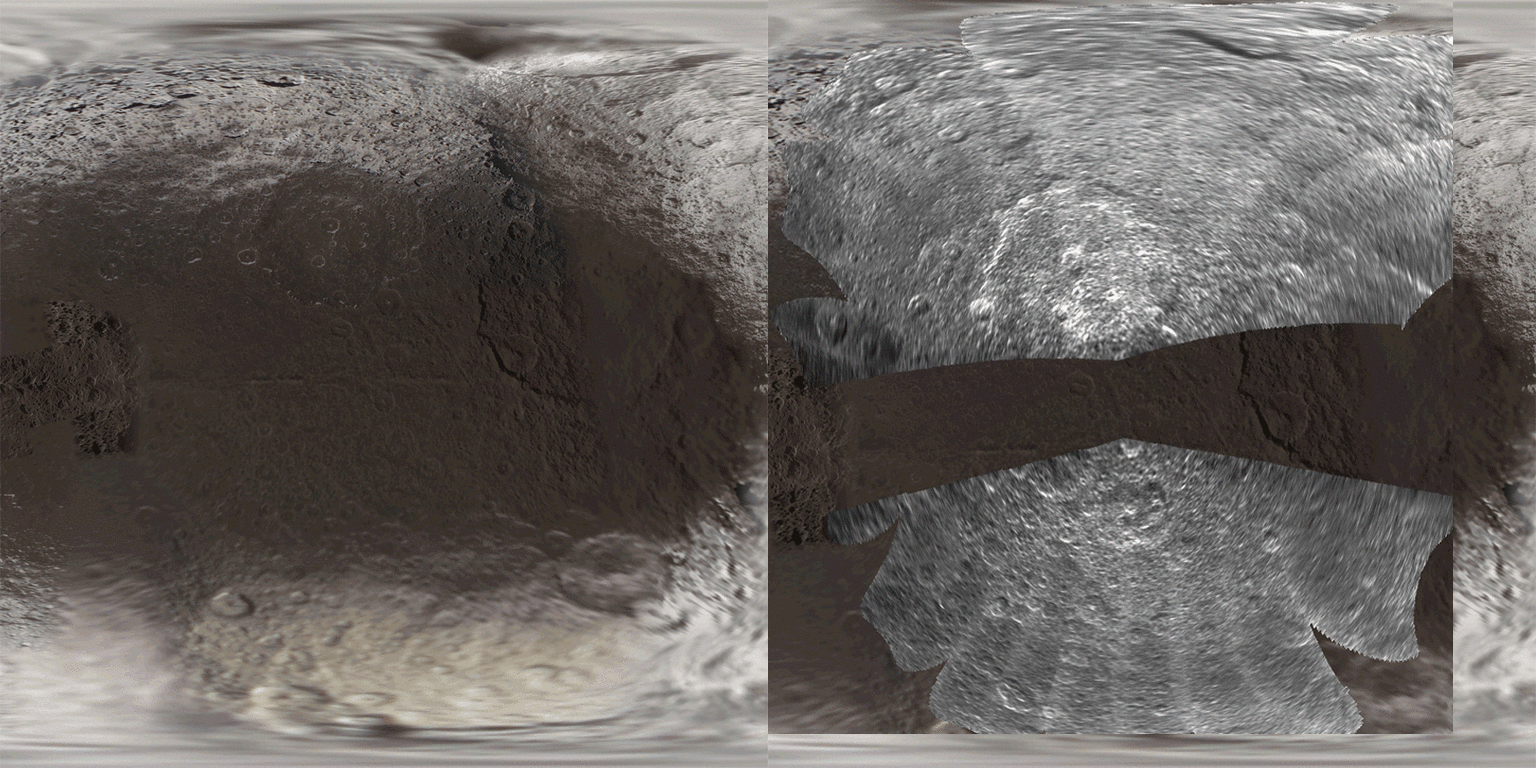
When I posted about the really cool Cassini SAR images of Enceladus a few weeks ago, I initially wrote that this was the first-ever SAR image of an icy moon other than Titan. Several people (some readers and two members of the Cassini science team!) corrected that statement: Cassini has performed SAR imaging of other icy moons (including Enceladus) before.

What do we know about planetary rings? Quite a lot, actually!
A summary of a new article by Matt Tiscareno about planetary ring systems that reviews the known ring systems of the four giant planets and the prospects for ring systems yet to be discovered.

Pretty picture: Mimas scuttles behind Dione
Images from the Cassini spacecraft's flyby of Dione.

First-ever high-resolution Synthetic Aperture Radar image of Enceladus
On the November 6, 2011 flyby of Enceladus -- the third such flyby in just a few weeks -- the Cassini mission elected to take a SAR swath instead of using the optical instruments for once. So here it is: the first-ever SAR swath on Enceladus. In fact, the only other places we've ever done SAR imaging are Earth, the Moon, Venus, Iapetus, and Titan.

Pretty pictures & movies: Eye candy from two recent Cassini Enceladus flybys
Cassini has completed two very close flybys of Enceladus in less than three weeks, one of them just this morning, and the images from that encounter have already arrived on Earth.

Saturnlit moon, sunlit fountains
It's been a week of very heavy science on this blog, so I thought it'd be nice to go into the weekend with a post in which a breathtaking picture speaks for itself, without needing my thousands of words.

Notes from Day 5 of the EPSC/DPS meeting: Saturn's storm, Phobos, and Lutetia
Today was (is) the last day of the Division of Planetary Sciences / European Planetary Science Congress meeting in Nantes, France.

Brief notes from Day 2 of the DPS-EPSC meeting
It's been a very full day at the DPS-EPSC 2011 joint meeting. My day was less full than it might have been, because I overslept and missed most of the morning's session. I really needed the rest though so I think it was probably for the best!

Some first impressions of EPSC-DPS meeting
Today they turned on the scientific fire hose at the Division of Planetary Sciences / European Planetary Science Congress meeting happening here in Nantes, France. My brain already feels full and I still have four more days!

Pretty pictures: Dancing moons
Since Cassini currently orbits Saturn within the plane of Saturn's rings, it has lots of chances to catch two or more moons in the same photo. One such