

 Explore Worlds
 Find Life
 Defend Earth


All
All
 Sun
Sun Mercury
 Venus
Venus Earth
Earth Mars
Mars Jupiter
 Saturn
 Uranus
 Neptune
 Small Bodies
Stories, updates, insights, and original analysis from The Planetary Society.

The state of Earth observation, January 2012
As of November 2011, the Earth Observing Handbook counts 109 active missions to study the Earth as a planet, with 112 more approved and planned for the future. Jason Davis provides an overview of key current and upcoming earth-observing missions.

Lovely Lovejoy pictures
Just a few of the amazing photos of Comet Lovejoy that have been taken from the southern hemisphere over the last few days. Comet Lovejoy is the first Kreutz sungrazer to have been discovered from the ground in 40 years, and after its surprising survival of its passage close to the Sun, it has been putting on a spectacular show in southern skies.

Pretty pictures from Cassini's 12 December 2011 Dione flyby
Cassini flew close by Dione on December 12 and, as usual, the close pass provided opportunities for lots of dramatic photos, not just of Dione, but of other moons wandering by in the background.

A recap of Comet Lovejoy
A timeline of one of the most memorable solar events in recent memory: the observations by six Sun-observing spacecraft of Comet Lovejoy making its perihelion passage.
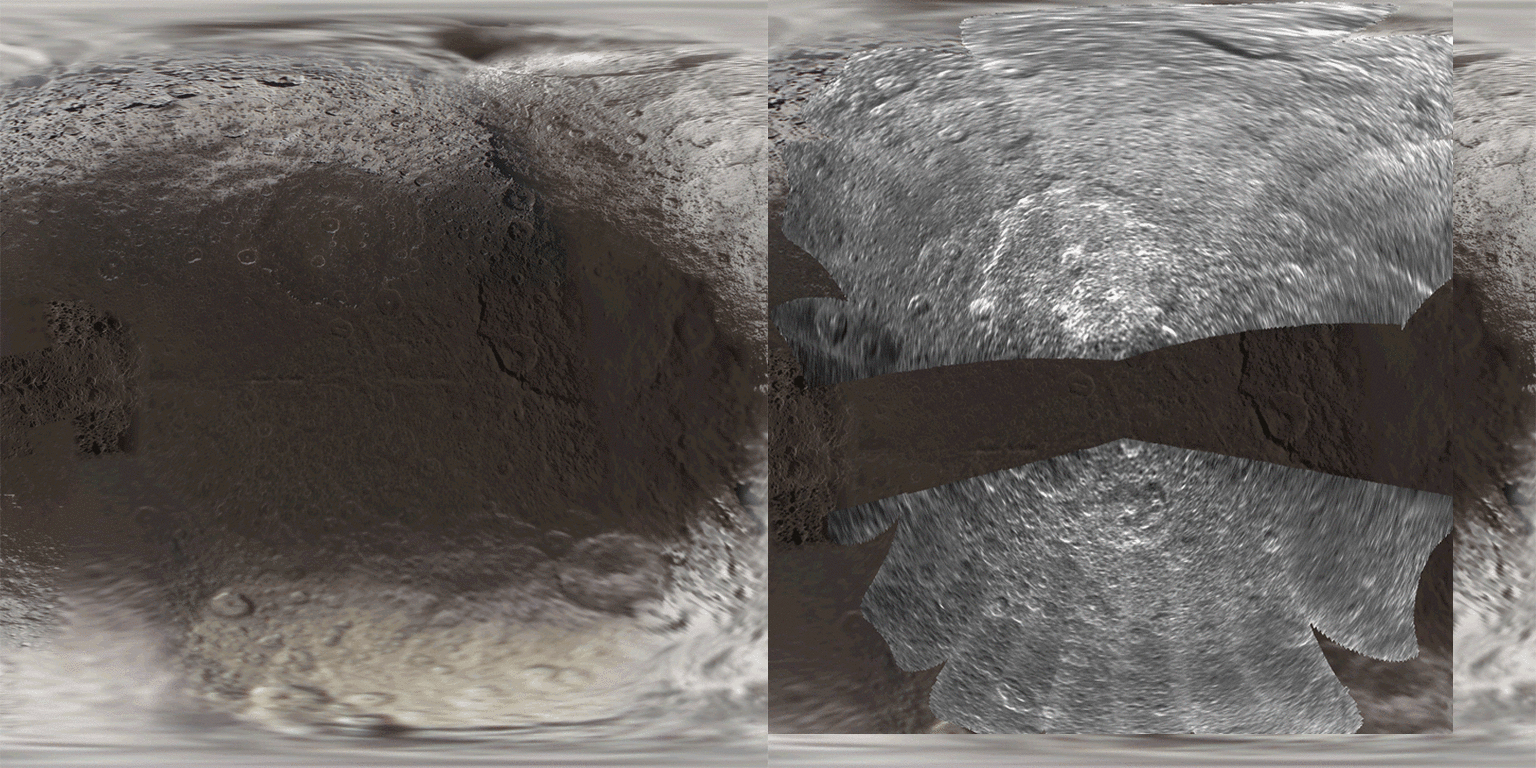
More radar images of icy moons from Cassini: Iapetus, Enceladus, and Rhea
When I posted about the really cool Cassini SAR images of Enceladus a few weeks ago, I initially wrote that this was the first-ever SAR image of an icy moon other than Titan. Several people (some readers and two members of the Cassini science team!) corrected that statement: Cassini has performed SAR imaging of other icy moons (including Enceladus) before.

Separating fact from speculation about Kepler-20's Earth-sized planets
A large team of researchers has announced in a Nature article the discovery of not one, but two, Earth-sized planets orbiting a star named Kepler-20. This article separates the observational facts from the quite-likely-to-be-true inferences from the downstream speculations.

What do we know about planetary rings? Quite a lot, actually!
A summary of a new article by Matt Tiscareno about planetary ring systems that reviews the known ring systems of the four giant planets and the prospects for ring systems yet to be discovered.

Video: Comet Lovejoy entered SOHO's LASCO C3 field of view this morning!
An animation of comet Lovejoy entering the field of view of one of SOHO's Sun-monitoring cameras.

Anahita's first eclipse
Emily wakes up her 5-year-old daughter to experience her first lunar eclipse.

Pretty picture: Mimas scuttles behind Dione
Images from the Cassini spacecraft's flyby of Dione.

Mariner 9 approaching Mars: a movie!
In celebration of the 40th anniversary of Mariner 9's November 13, 1971 arrival at Mars, Daniel Macháček has produced a morphed animation of the images that Mars' first orbiter took while approaching the planet.

Notes on Dawn at Vesta from the 2011 American Geophysical Union meeting
A report on the press briefing and talks from the Fall 2011 American Geophyisical Union meeting about the data on Vesta collected so far by Dawn.

Good news, everyone: We're getting as good at space weather forecasts as we are at Earth weather forecasts
Emily reports from the Fall 2011 American Geophyisical Union meeting about advancements in space weather prediction.
Sungrazing with Lovejoy's Comet
Observations of the newly sighted Kreutz sungrazer comet C/2011 W3 (Lovejoy) from the ground and from SOHO (a joint NASA/ESA satellite) and STEREO (NASA's Solar Terrestrial Relations Observatory).

From the 2011 Fall Meeting of the American Geophysical Union (AGU): Voyager 1 at the edge of the solar system
A report on a press briefing about Voyager 1 at the Fall 2011 American Geophyisical Union meeting. The spacecraft has entered a new region between our solar system and interstellar space, which scientists are calling the stagnation region.

Curiosity, from a 1935 perspective
With a new rover, Curiosity, on its way to Mars, Jason Davis takes a look at what we knew - or thought we knew - about the planet back in 1935.

First-ever high-resolution Synthetic Aperture Radar image of Enceladus
On the November 6, 2011 flyby of Enceladus -- the third such flyby in just a few weeks -- the Cassini mission elected to take a SAR swath instead of using the optical instruments for once. So here it is: the first-ever SAR swath on Enceladus. In fact, the only other places we've ever done SAR imaging are Earth, the Moon, Venus, Iapetus, and Titan.

At last, I've finished my scale solar system presentation slide/poster
A presentation providing a correctly scaled, reasonably correctly colored view of the largest bodies in the solar system is made available for use by teachers, professors, and informal educators.

The 70-meter dishes of the Deep Space Network
I was inspired by my recent trip to Goldstone to put together this poster showing all three of the great 70-meter dishes of the Deep Space Network. There's one at each of the three complexes, at Goldstone, at Robledo (near Madrid, Spain), and at Tidbinbilla (near Canberra, Australia).

Mars Exploration Family Portrait
Jason Davis put together this neat summary of the checkered history of Mars exploration.