

 Explore Worlds
 Find Life
 Defend Earth


John Houbolt and the Lunar Orbit Rendezvous
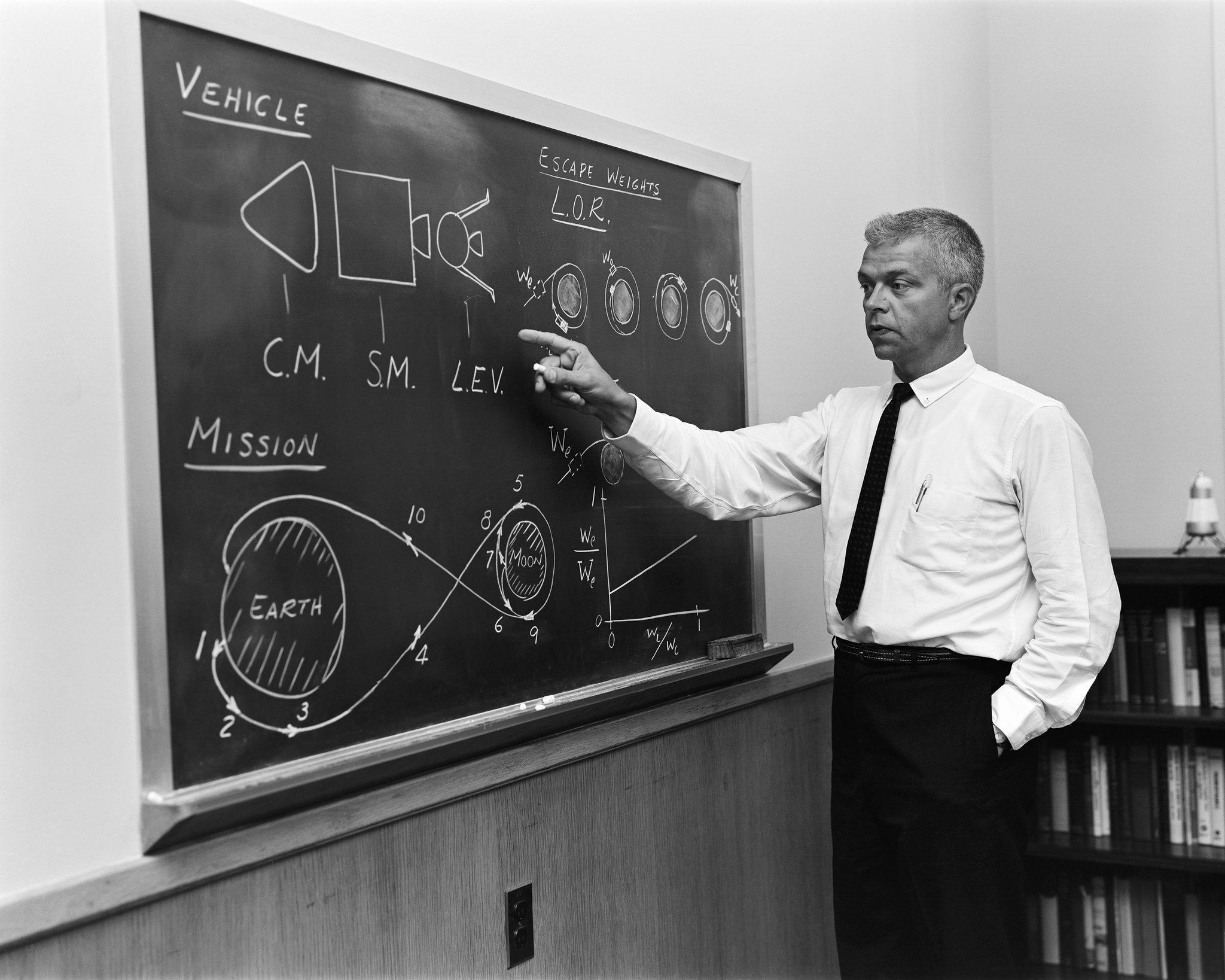
In the early 1960s, engineers and managers at NASA considered three competing ideas to carry out a human lunar landing mission:
- The Direct Ascent (DA) approach involved landing an entire fully-fueled rocket stage and crew compartment on the lunar surface and using that stage to return to Earth.
- Earth Orbit Rendezvous (EOR) also involved landing a large spacecraft on the Moon, but it would be assembled in Earth orbit rather than launched on a single rocket.
- Lunar Orbit Rendezvous (LOR) used a small lunar lander to take two astronauts to the surface, then rejoin a third crew member who remained in lunar orbit aboard the command module.
Both the Direct Ascent and Earth Orbit Rendezvous designs required a new rocket called Nova with a liftoff thrust of around 12 million pounds, nearly twice the capacity of the Saturn V rocket, as well as technologies to land a large spacecraft on the Moon. Although a few engineers supported these methods, most agreed that the development timelines of Nova and large surface spacecraft would preclude any lunar landings before the end of the decade.
The Lunar Orbit Rendezvous method had the advantages of using a single Saturn V rocket, required no assemblage of a large spacecraft in Earth orbit, and resulted in a much smaller mass to land on the Moon. It did carry the risk of requiring a spacecraft rendezvous in the relatively unknown environment of lunar orbit. A failed rendezvous would strand astronauts far from home with no possible rescue.
John C. Houbolt, an aeronautical engineer at Langley, championed the LOR approach despite initially meeting heavy resistance from various sectors within NASA. Frustrated by the opposition, he wrote a letter directly to NASA's Associate Administrator, bypassing his management chain of command, to explain its advantages. The Associate Administrator saw merit in LOR, and convened a series of high-level working groups that ultimately led to an official commitment to LOR in the summer of 1962.