

 Explore Worlds
 Find Life
 Defend Earth


The Planetary Society warns of dark age for space science under reported NASA budget cuts
Press Statement
April 11, 2025
Contact
Danielle Gunn
Email: [email protected]
Phone: +1-626-793-5100
Pasadena, CA (April 11, 2025) — The Planetary Society, the world’s largest independent space interest organization, issued the following statement in response to reports of the White House’s budget “passback” to NASA for fiscal year (FY) 2026:
Days ago, the Administration’s nominee to lead NASA called for a “new golden age of science and discovery” at the agency. The proposed budget from within the White House — which cuts NASA science by 47% — would plunge NASA into a dark age instead.
If enacted, this budget would force the premature termination of dozens of active, productive spacecraft. These spacecraft are unique assets: their instrumentation and capabilities cannot be replaced without billions of dollars of new taxpayer investment. No commercial or private space companies can fill this gap.
This budget would halt the development of nearly every future science project at NASA, wasting billions of dollars of taxpayer funds already spent on these projects, abandoning international and commercial partners, and surrendering U.S. leadership in space science to other nations.
This budget would eviscerate space science research, withering the nation’s STEM talent pipeline by removing opportunities to train future scientists and engineers.
The Planetary Society condemns this proposal for NASA and for NASA science. We urge Congress to swiftly reject this proposal and restore funding for NASA’s Science Mission Directorate. We remain committed to joining with all stakeholders to protect and promote U.S. leadership in the scientific exploration of space.
In response to these proposed cuts, The Planetary Society has launched a campaign to urge citizens to write their representatives and voice their concerns. We urge Americans supportive of space exploration to join our campaign and share their support of NASA science at planet.ly/nasacuts.
Press Resources
Casey Dreier, chief of space policy, is available for interviews. Please arrange with Danielle Gunn, chief communications officer, at [email protected]
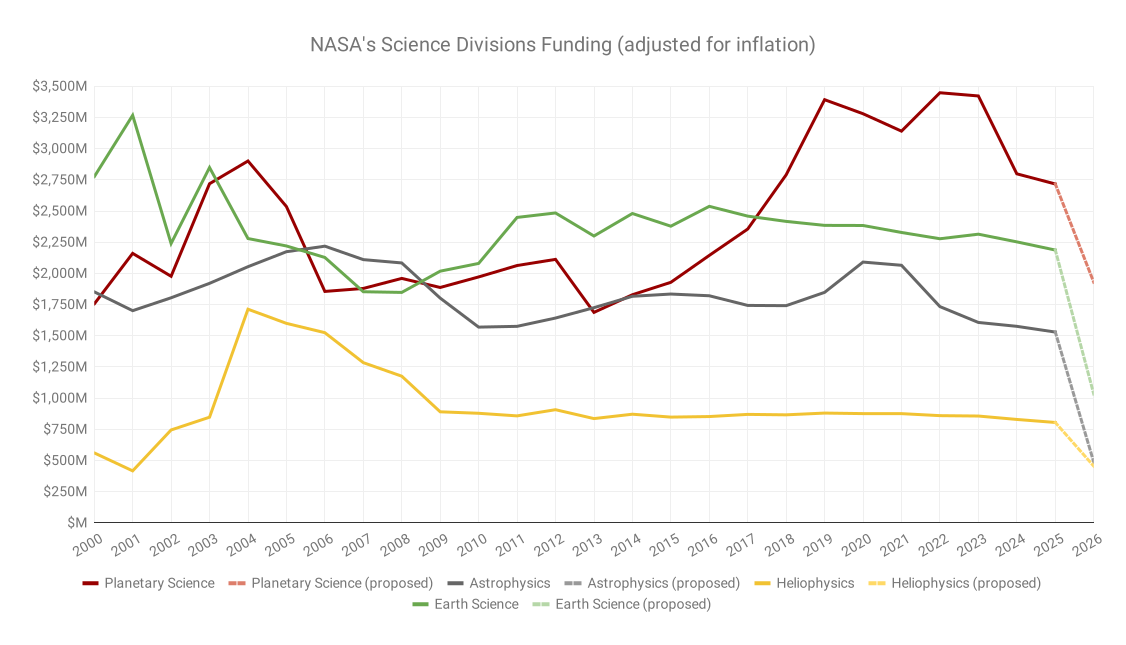
Raw data
Click to access the raw data containing all the historical NASA budget data used to populate the above chart.
About The Planetary Society
The Planetary Society is the world's largest and most influential space interest organization. Founded in 1980 by astronomer Carl Sagan with Bruce Murray and Louis Friedman of NASA's Jet Propulsion Laboratory, the 501(c)(3) nonprofit is led today by CEO Jenn Vaughn and championed by Chief Ambassador Bill Nye. Members and donors fund programs in science and technology, public outreach, and advocacy. This work advances the exploration of space, the search for life beyond Earth, and the defense of our planet from dangerous asteroids and comets. Learn more at planetary.org.
###