

 Explore Worlds
 Find Life
 Defend Earth
Voyager 1 at one light-day: A conversation with Voyager Project Scientist Linda Spilker

Written by
Sarah Al-Ahmed
Planetary Radio Host and Producer, The Planetary Society
November 20, 2026
At 5:16 a.m. ET on Nov. 18, 2026, NASA’s Voyager 1 spacecraft became the first human-made object to reach one light-day from Earth. At about 25.9 billion kilometers (16 billion miles) away, it is so distant that light needs a full day to reach it.
The twin Voyager spacecraft launched in 1977 on a mission meant to last only a few years. They took advantage of a rare alignment of the outer planets, which happens about once every 175 years, to slingshot from one giant planet to the next. At Saturn, the team sent Voyager 1 on a close pass by Titan, which flung it out of the plane of the planets and onto the path it still follows today.
Voyager 2 continued on to the ice giants and remains the only spacecraft to have flown by Uranus and Neptune. In 2012, Voyager 1 crossed the heliopause, where the Sun’s bubble of solar wind and magnetic field meets the interstellar medium, becoming the first human-made object to enter interstellar space. Voyager 2 will reach one light-day around 2035, but it probably won’t still be working by then, which makes Voyager 1 very likely the only spacecraft that will call home from that distance in our lifetimes.
To mark the milestone, I invited Linda Spilker, Voyager project scientist at NASA’s Jet Propulsion Laboratory (JPL), to speak with me on an episode of Planetary Radio. Voyager was Spilker’s first job out of college in 1977, and she was there for every planetary flyby. She went on to serve as project scientist for the Cassini-Huygens mission to Saturn before coming full circle back to Voyager, where she now leads the mission’s science, following in the footsteps of the late Ed Stone.
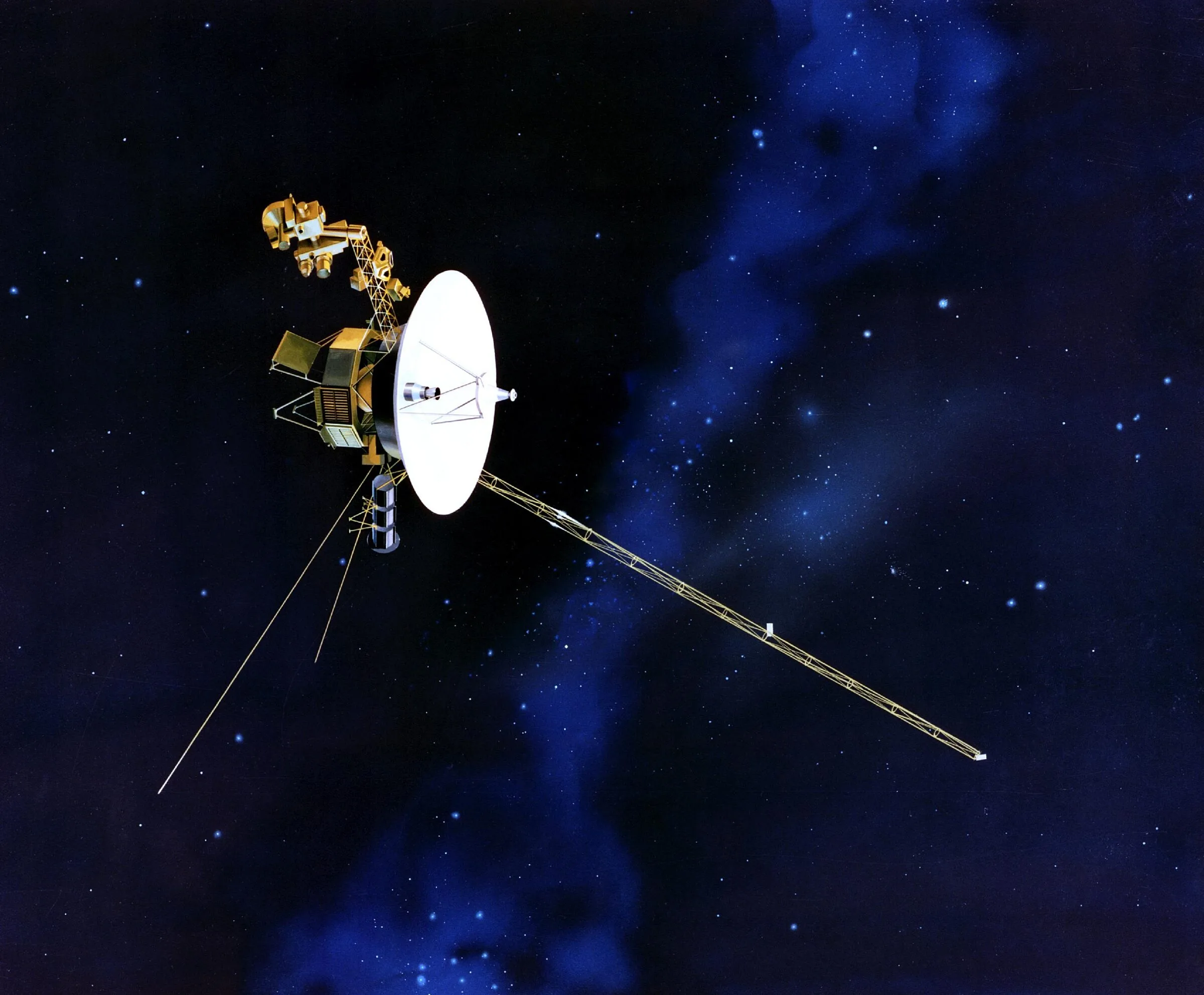
During the conversation, I shared with Spilker, for the first time, a new painting by space artist Don Davis showing Voyager 1 looking back toward home from one light-day away.
This interview has been edited for length and clarity. Listen to the full interview here.
One light-day from home
Sarah Al-Ahmed: Hey Linda, it’s wonderful to speak with you again.
Linda Spilker: It’s great to be here again, Sarah.
Sarah Al-Ahmed: And it’s a wonderful moment to celebrate. I’m so looking forward to the 50th anniversary of this mission, but one light-day feels like such a milestone. I don’t know if we’re ever going to see anything like this again in our lifetimes.
Linda Spilker: I agree with you, Sarah. One light-day is clearly a historic moment for Voyager. It’s when Voyager 1 and Earth will be exactly one light-day apart, and that’s going to happen on Nov. 18 at 2:16 a.m. PT (10:16 UTC). If you turn that into distance, Voyager 1 at that time will be about 25.9 billion kilometers (16 billion miles) away.
Sarah Al-Ahmed: That is a startlingly huge number. I can’t believe that something humanity created has actually made it out that far.
Linda Spilker: It’s truly incredible. If you think about it, it took Voyager 1 over 49 years to travel the distance that light travels in one day. To try to put that into perspective, I jotted down some other distances and converted them into times. Our closest neighbor, the Moon, is 1.3 light-seconds from Earth. The four astronauts on Artemis II became the farthest humans, and they were 1.36 light-seconds away, so they were a little bit farther than the Moon.
Our Sun is 8.3 light-minutes away. That’s 150 million kilometers (93 million miles), what we call one astronomical unit, the Earth-Sun distance. Neptune, the last planet visited by Voyager 2, is 4.2 light-hours away, and we think of Neptune and those planets as being so far from Earth. Then there’s the heliopause, a boundary that both Voyagers have crossed. That’s where the Sun’s influence ends and interstellar space begins. It’s basically the solar wind being balanced by the pressure from interstellar space, and it’s about 17 light-hours away. Voyager 1 crossed that distance in 2012.
Right now, today, Voyager 1 is 23 hours, 55 minutes from Earth, or almost 26 billion kilometers (16 billion miles). In AU, that’s 172.5 AU, so it’s 172 times farther from Earth than Earth is from the Sun. We have to talk about Voyager 2 a little bit, too. Voyager 2 is now 20 light-hours away and won’t reach one light-day until 2035.
Sarah Al-Ahmed: That’s amazing.
Linda Spilker: It’s going a little bit slower than Voyager 1. It was on a slightly slower trajectory. Voyager 1 came in very close to Jupiter, and that gave it a kick. It’s speeding away at about 61,000 kilometers per hour (38,000 miles per hour).
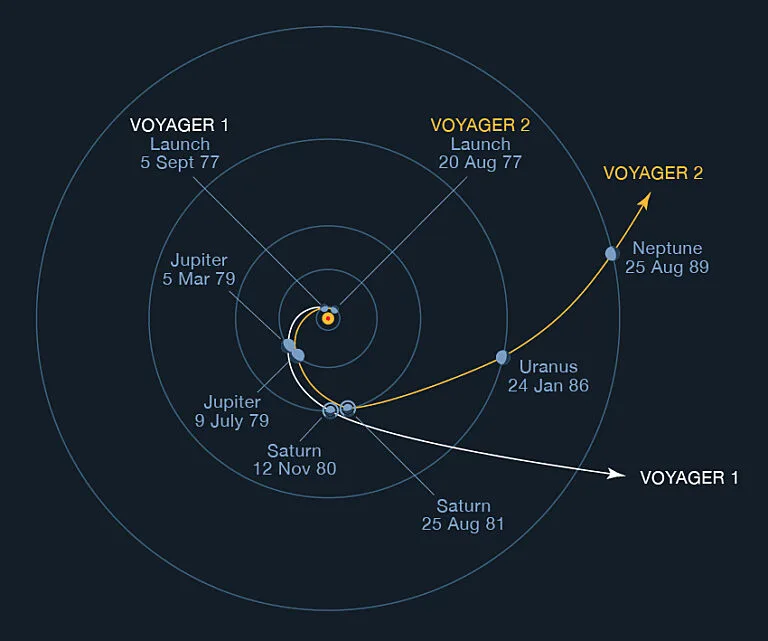
Sarah Al-Ahmed: It’s interesting, because Voyager 2 launched before Voyager 1, right? Yet the slight reconfiguration, mostly so we could see Saturn’s moon Titan, completely changed the arc of this. When you made that decision, did you realize that Voyager 1 would make it to this place out in space before Voyager 2 ever did?
Linda Spilker: For me, and I think for most of the people who worked on and built Voyager, the plan was for Voyager to visit the planets. It was nominally a four-year mission initially, and then, if all went well, on to Uranus and Neptune. I remember after the Neptune flyby, people would say, “Voyager’s well past the amount of time it was supposed to survive, so it’ll probably end in the next few years.” That’s when I went off to work on Cassini. I never imagined that I would work on Cassini through its launch and end of mission and that Voyager would still be flying. Cassini ended in 2017, now almost 30 years since its launch, and here we are with Voyager still flying. What a milestone. What an incredible mission to still be flying almost 50 years later.
Sarah Al-Ahmed: You started at NASA’s Jet Propulsion Laboratory (JPL) in 1977, right? So it’s been about 50 years, and you were just out of college. Was Voyager your first job?
Linda Spilker: Yes, Voyager was my first job out of college. I graduated with a bachelor’s degree in physics, was looking for a job, and applied at JPL. They offered me a job and said, “You have a choice. Do you want to work on the Viking extended mission” — Viking was still there on Mars — “or this new mission, which hasn’t even launched yet, called Voyager?” I asked, “Where’s Voyager going?” And they said, “Jupiter and Saturn, and if all goes well, on to Uranus and Neptune.”
I had my very first telescope in third grade, and I used it to look at the Moon, of course, and then at Jupiter and Saturn. I could see the little moons around Jupiter as dots of light and could just barely make out Saturn’s rings. And I thought, I want to go there. I want to see what these worlds that were just pinpoints of light in my telescope really look like up close. So I said, “Of course, Voyager.” I never looked back. I’m so glad I made that choice.
Keeping Voyager alive
Sarah Al-Ahmed: I’m sure you had no idea what you were walking into. You expected adventure, but I don’t know if you expected 50 years of adventure and Voyager out to one light-day. How does that feel looking back? Do you think younger Linda would have been completely shocked?
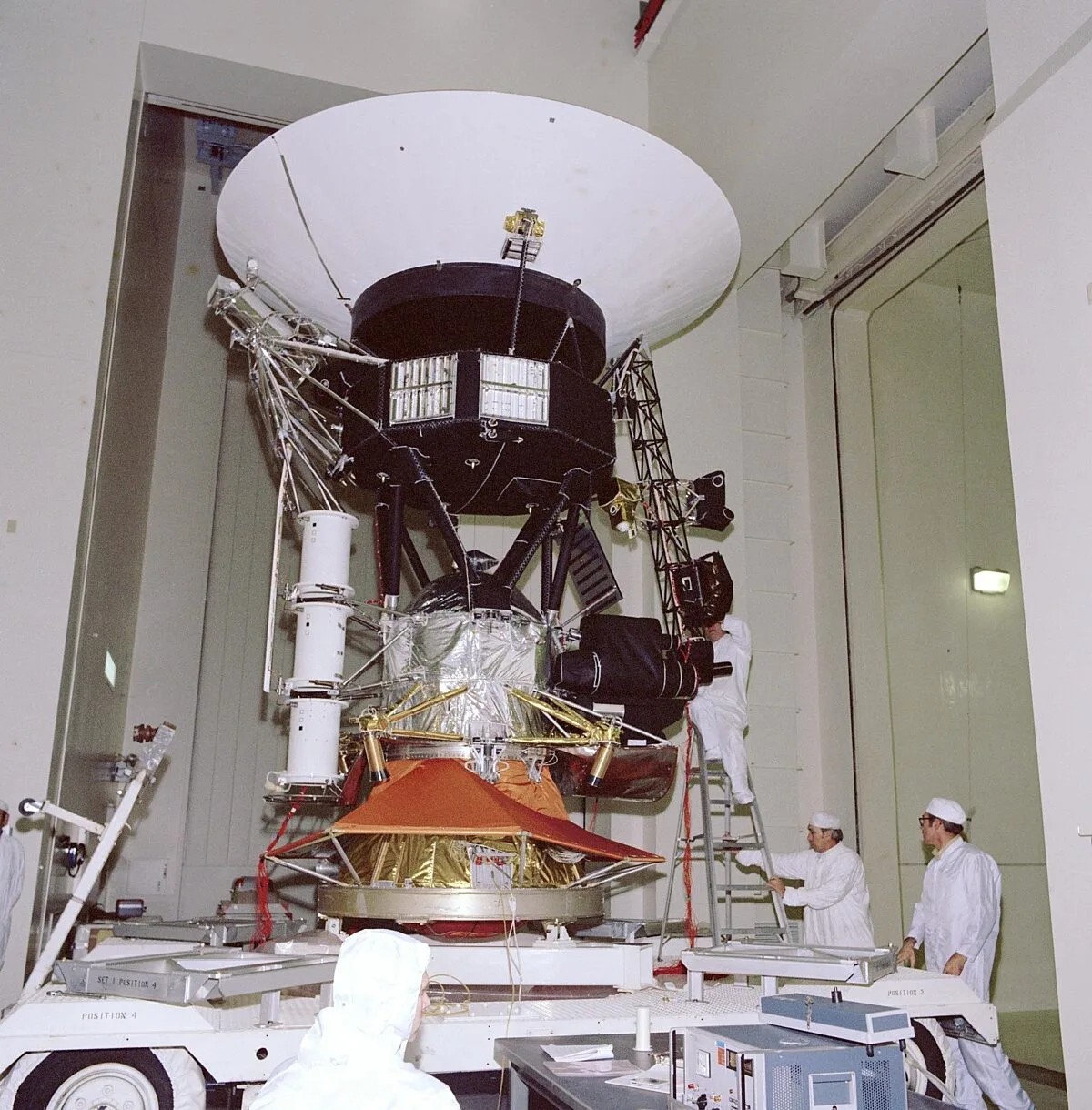
Linda Spilker: Absolutely. I was shocked when Voyager made it all the way out to the heliopause. I’d run into Ed Stone periodically and say, “How’s Voyager doing? What’s going on?” And he would say, “We crossed the heliopause, and we think the mission will last another three to five years.” That was in 2012. We just didn’t know what to expect. We knew that every four years, Voyager had four watts less power, so we slowly started turning off bits and pieces of the hardware. All of the scan platform instruments, with the cameras and spectrometers, were turned off not long after we passed Neptune. But many of the other instruments kept working, and we had a lot of redundant systems. So bit by bit, the spacecraft had less power, and it got quieter and quieter.
We have some extremely clever engineers at JPL, and they found ways to keep going. Just recently we executed something called the Big Bang. That involved turning off some heaters that were more powerful and instead turning on heaters that use less power, while at the same time balancing the thermal needs of the spacecraft. Voyager’s main system is a 10-sided bus, and we had to keep the bus warm enough in the places where the lines for the thrusters go. These tiny thrusters put out puffs of gas every once in a while to keep Voyager pointed at Earth. We knew that if we froze the thruster lines, we wouldn’t have a way to point Voyager back at Earth to send back data. Now that that’s all completed, it looks like we’ve bought ourselves another several years. We kind of laugh and say, “Maybe three to five more years on Voyager as well.”
Sarah Al-Ahmed: You’ve had scare after scare with this mission over the years: thruster revivals, memory glitches, and power drops. Of all the things you’ve had to do to keep the spacecraft alive, is there one that you’re proudest of?
Linda Spilker: I think one of the scariest anomalies happened when all of a sudden, Voyager was sending back data, and then the next day all we had was a tone. We knew the spacecraft was still there, but it wasn’t sending us any information about what had gone wrong. Over the next several months, we tried sending commands to turn things on and off, like a power-on reset of your computer, trying to figure out what was going on.
Little by little, we pieced together that one of the chips in the flight data system, which prepares the information to send back to the ground, had failed. Maybe it was a cosmic ray hit; maybe the part just got old. There are little bits of program inside that chip, so once we figured out where it had failed, we had to basically reprogram the flight data system computer to work around that failed chip.
I remember sitting there that morning in April. We’d sent up all the commands to reprogram the computer, and now we were going to see: Would Voyager come back and talk to us again? We sat there waiting as the minutes went by. Would we see a signal? Would we see data? And then there was the moment where there it was: We were seeing not just a tone anymore, but getting data back. We all cheered and stood up. It was a really fantastic moment. Going from almost no information to figuring out the problem and solving it on a spacecraft that’s billions of miles away was just incredible.
Sarah Al-Ahmed: I bet this is the spacecraft that’s caused the most cheering in human history over the course of its lifetime.
Linda Spilker: Could be, could be.
Sarah Al-Ahmed: The last time we spoke, about a year ago, you said that Voyager 1 might have to turn off its low-energy instrument. That happened back in April, I think, so it was maybe three months between the time we spoke and the time that happened. You absolutely called it. Do you think this spacecraft is going to live until the 50th anniversary? What would be your prediction?
Linda Spilker: Very, very likely. But you never know. We’ve solved the power and thermal problem, but we still have tiny thrusters that are slowly clogging, and lots of old parts on the computers. I think we’re finding out that maybe one of the best places to store your hardware is in space; everything has really lasted very well. At this point, everything is looking good for two spacecraft at the 50th anniversary, and that will be in August and September of 2027.
Sarah Al-Ahmed: I’ve heard you say that you planned a lot of the milestones of your life around this mission. What has it been like having Voyager woven into your family in this way?
Linda Spilker: That’s an interesting question. Looking back at the planetary flybys, there was a five-year window between the Saturn flyby and Voyager 2’s Uranus flyby, and that’s when I decided to start my family. I had my two daughters in that window between Saturn and Uranus, so I can honestly tell them, “Your births were based on the alignment of the planets as Voyager saw it.” Now they’re grown up and married and have children, so I get a chance to talk about Voyager with my grandchildren.
In that way, Voyager is truly a multigenerational mission. Many of your listeners probably weren’t even born when the Voyagers launched in 1977. Perhaps you and others remember the day you first heard about Voyager and have followed it ever since. So part of the story is that this one light-day accomplishment is a feat of human engineering and the work of an entire generation, and yet light travels that distance in just 24 hours.
The grand tour
Sarah Al-Ahmed: Let’s walk through this journey. Voyager 1 and Voyager 2 are the only spacecraft that have ever seen some of these places. We haven’t seen Uranus and Neptune up close since. Along the way, they made discoveries we couldn’t have made before.
If we go back to Jupiter in 1979, a few days after Voyager 1’s closest approach, Linda Morabito, whom I met at the Galileo at 30 symposium, processed an image of Io and found a plume rising off the limb. That was the first direct visual evidence of volcanism on another world.
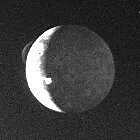
Linda Spilker: I heard about Linda Morabito and the image, which was taken for navigation purposes. The image was overexposed, and there was this bump on the limb. Of course, we had to eliminate other possibilities: Could it be a galaxy or something else that just happened to come over the limb of Io? One by one, we carefully eliminated what it might be, and finally decided that it was coming from the surface of Io itself.
One of the things that’s amazing about the Galilean satellites is that, before we got there, what did we have for comparison? Our own Moon: old and heavily cratered. So our expectation was that these worlds would look a lot like our Moon. As Voyager 1 flew in, first there was Callisto. Callisto fit the bill. Its surface is water ice, but it had lots of craters and looked unmodified since the time it was bombarded with the objects that created those craters.
On to Ganymede, and we said, “Hmm, this is interesting.” It looked like there was tectonic activity, with fractures and movement on the surface, and not nearly as many craters. Everything happens so quickly when you get in so close to Jupiter.
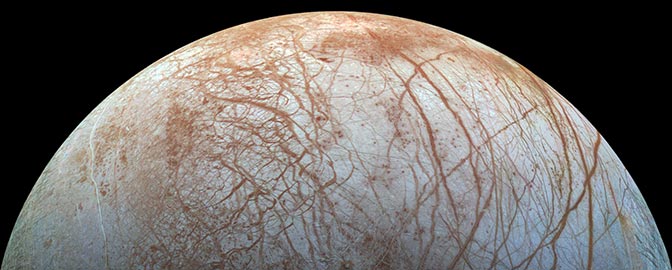
Next up came Europa. Everybody said, “Wow, this does not fit our view of the Moon at all.” It’s a bright, white, icy world with cracks and fractures and hardly any craters. We knew Europa was bright from telescopic observations on Earth, but to get up really close and see the detail was amazing.
Then, of course, came Io, the most different of any of the moons. I remember one of the imaging scientists, Larry Soderblom, saying as we came in that these moons kept getting younger and younger: no craters of this size, no craters of a smaller size, and so on. Then we saw the colors on Io, and finally we got there and realized Io has volcanoes all over its surface and really no craters at all. In a lot of ways, Io was the star of the show for that first Jupiter flyby. It was astonishing to see how different these moons looked compared to anything we’d seen before.
Sarah Al-Ahmed: It’s hard to pick a favorite moon in the Solar System. I’ve been debating this for ages, but Io is definitely a contender for my top three. It’s so weird and so terrifying.
Linda Spilker: Oh, for sure. Another interesting thing we did with Voyager 1: At the time Voyager launched, the only planet we knew had rings was Saturn. We thought, “Jupiter doesn’t have any rings, or we would have seen them in a telescope. But just in case, we’ll take one long-exposure picture to look for a possible ring.” I remember when that picture came back, it looked very odd because there were all these wiggles on it, sawtooth patterns. Those were star trails, because with such a long exposure, the stars were moving. But there was a faint band across the image, and we said, “Huh, Jupiter has a ring.” It was totally astonishing. We did a much better job of taking a picture of Jupiter’s ring with Voyager 2.
Sarah Al-Ahmed: Is it true that while the images were coming back from Voyager, there were times you were literally sleeping in the office so you could see them as soon as they came down?
Linda Spilker: That’s right. Some of the most exciting data came back within a day or so of the closest approach. They had TV monitors set up around JPL, in the cafeteria, near the elevators, and in different offices, so you could literally watch line by line as each image came back. I had basically a script: Here are the pictures that are going to come back of Io, here’s when we’re going to look at Jupiter’s Great Red Spot, and so on. I had my little book, and I would look through it and say, “OK, it’s time to make sure to be near a TV monitor for the next pictures of the Great Red Spot.”
Everyone quickly realized that if we wanted to see some of these first-ever pictures, we were going to have to stay overnight. Some people brought in their little motor homes. A lot of us just brought our sleeping bags, rolled them out under our desks, and set the alarm for when the next set of images would come back. I did that for every single encounter, because so many interesting pictures and data came back in the middle of the night.
Sarah Al-Ahmed: That would have been me as well. Although I hope at some point you upgraded to a couch.
Linda Spilker: I was a lot younger then, so the floor wasn’t quite as hard.
Sarah Al-Ahmed: Then came Saturn in 1980. Voyager 1 passed by Titan, which is why it ended up flying up and out of the plane of the ecliptic. This was one of the first close-up looks we got at Saturn’s rings. Was that where you first fell in love with Saturn enough that you ended up moving on to Cassini? Or did you always somehow know in your heart that you’d be working on Saturn someday?
Linda Spilker: I think it was really the Voyager images of Saturn’s rings. I just fell in love with the detail we saw in the rings. I worked with the Voyager infrared team as their interface between the project and the scientists, helping them with their data and planning their observations.

I also worked with another team, the photopolarimeter team. We’d found that ring at Jupiter, and by the Saturn flyby we also knew that Uranus had rings. So we decided to study Saturn’s rings in more detail by watching as a star went behind the rings and measuring the amount of starlight that came through. The Voyager photopolarimeter was one of the instruments that made this measurement. Every 100 milliseconds, we’d get a sample back.
It was just so amazing, such fine detail in the rings. When the data came back, we put it on magnetic tape and played it back, and we would put together a plot called a CalComp plot. It’s a long, long sheet of paper with a pen at one end, and slowly the paper unrolls as it plots the starlight variations as the star passed behind Saturn’s rings. There was so much detail, so many incredible features. I later took some of those long plots, rolled them out in the hallway, and circled the interesting places with a pencil so I could go back with the computer and look at them in more detail. Ultimately, I wrote my Ph.D. thesis on Saturn’s rings and also on the occultations from Uranus and Neptune. Clearly, I wanted to learn in more detail what they were about.
Then, after Neptune, the Cassini mission was just getting started. The same infrared team of scientists was proposing an instrument, and they said, “Why don’t you come and be our ring scientist and help us with the proposal?” So I did, and the instrument was selected. Part of what I did on Cassini was work on the infrared data of Saturn’s rings, putting the pieces of the puzzle together to understand what the surface of a ring particle would be like if I could hold it in my hand. That was a natural series of stepping stones that started on Voyager, led to Cassini, and has now come full circle back to Voyager.
Sarah Al-Ahmed: I can’t imagine how satisfying it must have been to see Cassini doing those ring dives, actually getting to see how thin the rings were, and everything we learned from that.
Linda Spilker: That was an incredible part of the Cassini mission, because we were flying in a region where no spacecraft had flown before and getting back new information about how tiny the ring particles in the gap are. We were worried that if a big particle hit Cassini, it might destroy it. It was a fantastic way to end the mission, with Cassini ultimately going into Saturn’s atmosphere and disintegrating in order to protect, in particular, the moon Enceladus. Enceladus has a liquid water ocean underneath its surface, just as Europa does, with jets of material coming out of its south pole and hints that there might be organic molecules and perhaps life. We wanted to protect this ocean world, since we don’t know for sure whether or not it might have life.
Sarah Al-Ahmed: Then on to Uranus in 1986, the first and only time we’ve ever seen this world up close. It turns out that we caught it during a rare solar wind event. All these years later, as we continue to process the data generation after generation, we’re still learning things from Voyager that we never expected. What is it like for you to see us rewrite these encounters as we understand them better?
Linda Spilker: It’s really wonderful to see how we continue to use the data. At Uranus, we used our experience and modeling from Cassini at Saturn, coupled that with the solar wind, and found that maybe the Uranus magnetosphere we flew through was in a very unusual state. Uranus itself was tipped on its side, looking like a giant bull’s-eye as we flew through. The magnetic field is very strange. It’s offset and tilted from the spin axis much more than any magnetic field we’ve ever studied. We saw just a snapshot in time. NASA has plans on its books to go back to Uranus with an orbiter like Cassini, carrying a probe to go into Uranus’ atmosphere. Who knows what we might find? I think it’s really time to go back with that orbiter and study an ice giant in more detail, because Uranus and Neptune are very different from Jupiter and Saturn.
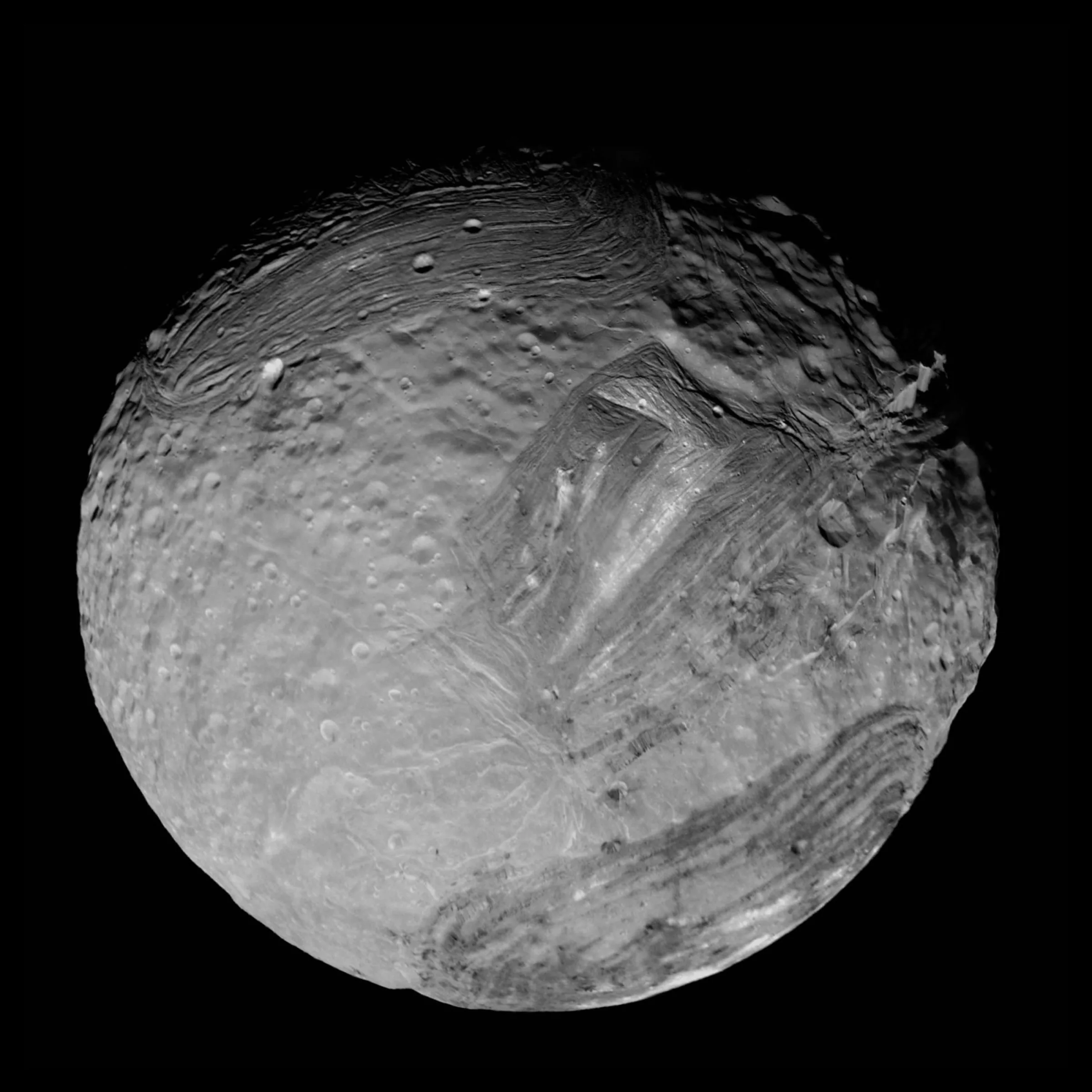
At the Uranus flyby, one of my favorite moments was looking at the images of the tiny moon Miranda. Since Uranus was tipped like a bull’s-eye, we could only fly close to a single moon, the one that would send us on our way to Neptune, and that happened to be Miranda. Here was a world that looked like it had been torn apart and shoved back together in a very interesting configuration, with a 19-kilometer (12-mile) high ridge and all kinds of unique features. Before we got there, we had no idea what the moons would look like. With Voyager, we at least got a look at the one side of the moon we could see in that configuration, and there’s so much more for a Uranus orbiter to do when we go back.
Another favorite moment at Uranus has to do with the rings. We knew about nine narrow rings from Earth, and Voyager discovered a couple more. But what you can’t do from Earth is go around behind the planet and look back toward the Sun through the rings. When you do, all the tiny dust particles light up, much like driving into the Sun with a very dusty windshield: It gets harder and harder to see because the dust starts to glow. We thought, “The system doesn’t look like it has much dust. It just has these narrow rings. But just in case, let’s take some pictures on the way out to take a look.” That was on my list of pictures I wanted to see. I watched as it came back line by line, and it didn’t look like the Uranian rings at all. The system was filled with dust, and some of the brightest dusty regions didn’t even coincide with any rings. That was such a surprise — a nice surprise. You say, “Oh, there’s another one for Voyager.”
Sarah Al-Ahmed: And then, of course, Neptune, the last stop on this planetary voyage, in 1989. We saw plumes of nitrogen coming off Triton, and the Great Dark Spot on Neptune. How did it feel knowing that this was going to be the last world this mission would see up close? That must have been a heavy but really beautiful and uplifting moment in your life.
Linda Spilker: It really was very uplifting to know that Voyager had made it out to Neptune, when there were doubters who didn’t think we’d make it much past Jupiter and Saturn. To see the surface of Triton, most likely a captured Kuiper Belt object in this very unusual retrograde orbit, and to see activity when the surface is so very cold, made us wonder how that could take place.
That was a very special moment, because when we first saw those pictures of Triton coming back, we could see dark streaks on the surface, or at least we thought they were on the surface, and we wondered how they got there. Then Larry Soderblom looked at two of the images side by side, and he said, “Look, this dark streak has moved a little bit as the spacecraft has gone past Triton. That’s telling me it’s up above the surface, and it’s actually a geyser coming out of the surface itself.” I just remember that was a very clever way to do a blink comparison between two images.
It would be wonderful to also have a Neptune orbiter at some point, maybe with a probe for Triton, to figure out more about Triton, because we really only saw one pole up close. What’s nice is that we now have cameras so sensitive that we can study the dark sides of these worlds with light from the planet. Cassini showed we could do that: In Saturnshine, you could actually see the unlit sides of each of these worlds. It would be so interesting to go back with the cameras we could put together these days and look at those light levels. I think of just how good my iPhone is at low light levels; they must have really good cameras now that could do that as well.
Looking back at home
Sarah Al-Ahmed: You mentioned earlier that we shut the cameras off after Neptune, almost immediately after taking the Pale Blue Dot image and the family portrait. Carl Sagan campaigned for years to turn Voyager around to look back at our Solar System and see it from the outside. That became our family portrait: about 60 frames, and the only time we’ve seen our Solar System together in one photo. How did it feel to pull that off as a team, to actually see our Solar System together as a family?

Linda Spilker: It was a really wonderful idea. After the last flyby was over, the team finally had time to put it together. We knew that to save power we’d be turning off the optical remote sensing instruments on the scan platform, so it made sense to try to take those images then. We took narrow-angle pictures through multiple filters so we could get color images of those worlds as well.
What’s really remarkable about the Pale Blue Dot picture is that my friend and colleague Candy Hansen helped design and put together those images, and she was one of the first people to see and process them. She started by looking for Uranus and Neptune and worked her way in. She got to the picture of Earth and couldn’t find it, and she thought, “Oh no, I hope we didn’t miss the pictures of our own planet.”
Sarah Al-Ahmed: Oh no.
Linda Spilker: She looked more carefully and saw a little bright spot in a ray of light scattered in the camera, in a sunbeam. She looked at several of the images, because we’d taken them through different filters, and the dot was in the same place. So she said, “We didn’t miss the picture of Earth.” It was a wonderful moment for her. She said first she called her dad, and then she called Carl Sagan.
Sarah Al-Ahmed: I bet her dad was excited to hear that. But how poetic that our moment looking back happened at just the right time to show that mote of dust suspended in a sunbeam. It’s really beautiful timing. At The Planetary Society, we were very curious what it would look like now if the cameras were still working. Last week on the show, we had space artist Don Davis, who has worked on space art for many decades, and I wanted to show you the image he created. It’s not available to the public yet, but I wanted to get your reaction, because I think it’s so beautiful and that you would love it.

Linda Spilker: Oh, that’s beautiful.
Sarah Al-Ahmed: What is it like that all these years later, people are still trying to replicate that Pale Blue Dot feeling? I see this image, and I feel like I needed to see it.
Linda Spilker: Oh, it’s wonderful. For me, it brings back a lot of memories, and with it a tremendous sense of pride at having had the opportunity to be part of Voyager’s story, Voyager’s timeline, for so many years. It’s beautiful. Thank you for sharing that.
Sarah Al-Ahmed: You’re welcome. I hope I get a chance to give you a copy of it.
Linda Spilker: Oh, absolutely. That gives me goosebumps. It’s very special to think about Voyager looking back, and what the Solar System might be like if we could see it. It’s so wonderful that he’s looked out for Voyager in this way.
Sarah Al-Ahmed: I don’t think space art would be what it is today without the inspiration the Voyager mission gave everyone. It was our first close-up look at these worlds, and it’s been fodder for space art ever since. I know it had a big impact on his life, and on all the space artists who came after.
Linda Spilker: It’s beautiful. Tell him thank you.
Talking across a light-day
Sarah Al-Ahmed: As Voyager approaches this one light-day marker, it takes about a day for communications to get all the way out to Voyager, and about another day for it to send things back. What is it like to take care of a spacecraft when you’re speaking to it across this vast gulf of space?
Linda Spilker: At this point in the Voyager mission, being part of the flight team takes patience. If you send a command up, it’s going to take a day to get there and then another day until you know whether the command executed as you expected and what the results were. So it takes a lot of planning. It turns out there’s only one Deep Space Network station that we can use to command both Voyagers: the 70-meter dish in Canberra, Australia. It has a very powerful transmitter, and the two Voyagers are so far away that it’s the only station powerful enough to send the commands up. Voyager 2 has gone down out of the ecliptic after flying over the north pole of Triton, so only the Australian stations can still view Voyager 2. We can see Voyager 1 with more of the stations, but we’re down to just that one station to command Voyager. Sometimes I think, wow, I hope nothing happens to that station before the 50th anniversary.
Sarah Al-Ahmed: A friend of mine who works at JPL on the Deep Space Network, Serena Naban, was in mission control at the 49-year mark. She took a photo of that exact moment and sent it to me because she was so excited. I know everyone is going to absolutely lose their minds when you hit the 50th anniversary.
Linda Spilker: The DSN has been such a key part of Voyager’s story. Initially, at Jupiter and Saturn, we had 64-meter antennas, not 70 meters. We realized that if we wanted to get back higher data rates, we had to make these stations bigger. So extra panels were added around all three stations, at Goldstone, Madrid, and Canberra, to turn them into 70-meter stations so we could return data at a faster rate. We had a very small tape recorder that could only hold about 100 pictures, so we wanted the ability to send those pictures back as close to real time as we could. That was one of the upgrades. You wouldn’t have Voyager and the data we’ve returned without the Deep Space Network.
For me, one very beautiful example: With Voyager 1, the tape recorder was still working, so we could record some of the high-rate plasma wave data on it, and about every six months we’d play that data back. But at the tape recorder’s slowest rate, it took arraying the 70-meter antenna at Madrid with five more 34-meter antennas — everything Madrid had — to pick up that faint signal. So the DSN is a very important part of Voyager’s story.
Sarah Al-Ahmed: What are you planning to do for the 50th anniversary to mark this huge milestone?
Linda Spilker: Clearly, the 50th anniversary needs a big celebration. We’re working together with The Planetary Society and other groups to see if we can put on a big celebration for Voyager’s 50th anniversary. As part of that, I’m organizing a science symposium. It’ll probably be a couple of days at Caltech, with scientists talking about everything from the planetary phase through the interstellar mission phase, and even some of the amazing milestones on the engineering side of the house.
We’re also in the process of putting together 16 chapters that we hope to put into a hard-copy book telling Voyager’s story. It will include everything from launch through the highlights of the planetary phase, the interstellar mission phase, some chapters about the engineering, and a final chapter about how you make two spacecraft that can last 50 years. So stay tuned; that’s still in the works. It’s all to help celebrate Voyager’s legacy, the legacy of a multigenerational mission that has lasted 50 years. Such an awesome, amazing thing to be a part of.
Sarah Al-Ahmed: As you said, maybe space is one of the best places to keep our hardware. But it’s also an absolute testament to the rigor, love, and dedication of everybody who worked on this that both spacecraft are still operational all these years later, even if we do have to shut instruments off. I don’t think any of us expected this.
The last time we spoke, we were looking forward to both the one light-day moment and the 50-year mark. You said you really hoped that on Nov. 18 at 2:16 a.m. PT, people would leave their homes, go outside, look up at the sky, and maybe wave at Voyager. Are you going to be doing that that night?
Linda Spilker: Oh, absolutely. This is a historic, once-in-a-lifetime milestone. I am sure I will be out there looking up and saying, “Happy one light-day, Voyager 1, and onward to the 50th.”

Sarah Al-Ahmed: This moment is so concrete. We know the spacecraft is still alive, and we’ll be able to celebrate in that moment. But the end of the mission might be very nebulous. We might not know the moment it goes down, and there will probably be a lot of communicating back and forth with the spacecraft when that happens, so it’s going to be harder to mark that moment. How would that feel different from what you experienced with Cassini, where there was a definitive end of mission, versus Voyager maybe just going quiet someday without us really knowing?
Linda Spilker: With Cassini, we knew almost to the minute when the mission would end, so there was a chance to be prepared and to put together a celebration. We had the teams and their families all gathered at JPL and Caltech for a grand celebration of the end of the Cassini mission. You’re right, for Voyager it’s going to be different. One day, as has happened in the past, there might be no signal from Voyager. And maybe this time there won’t even be a tone telling us Voyager is still there.
Of course, we have a checklist. We’ll try everything we can think of and send up all sorts of commands, just in case there’s a hiccup or something went wrong and maybe we can get Voyager back. But at some point, when we get to the bottom of that list, we’ll have to quietly say, “OK, it looks like that Voyager spacecraft is now humanity’s silent ambassador, carrying the Golden Record out into space, a true interstellar traveler.” That’s going to be a hard moment to admit, because I’ll be one of the ones saying, “Have we tried everything? Did we try this? Did we try that?” But finally we’ll have to say, “OK, for this Voyager, it’s the end of the mission.”
Then the same thing will happen for the second Voyager. It might be a short time later, or it might be years later, until we no longer hear from the second spacecraft. Then it, too, will become another silent ambassador for humanity, carrying the Golden Record with the sights and sounds and the information about our planet that we’d like another civilization to know. And who knows? Maybe as our silent ambassadors are sailing the seas of space, one day an extraterrestrial civilization might find them and perhaps even bring them home.
Sarah Al-Ahmed: Wouldn’t that be something? Tens of thousands or millions of years later: “Hey, we found this. Would you like it back?” But it’s quite possible that these spacecraft will outlast everything else we’ve made. Here on Earth, things change and degrade. Out in space, they degrade slowly. It’s quite conceivable that these might be the things that carry us out into the Universe further than anything ever in the history of humanity. That’s such a profound thing to think about; I can’t even wrap my head around it. How do you process knowing that this thing you worked on could outlast all of us and outlast humanity?
Linda Spilker: You’re right, Sarah. The Golden Record is made to last a billion years, and that’s a long time. We will have rotated around quite a bit in our own spiral arm of the galaxy. On the cover, there’s a diagram showing where we’re located in the galaxy relative to, I think, the 14 nearest pulsars, showing where Earth is and how to backtrack to find us. In something like 40,000 years, each Voyager will come within about 700 light-days or so of a neighboring star. Voyager is so tiny that it might take much longer for a civilization at such a star to be able to find it. But to know that there’s a small piece of humanity out there for someone else to find is, I don’t know, kind of a comforting feeling.
Sarah Al-Ahmed: Thank you so much for coming on the show and sharing this moment. I’m going to be out there in the middle of the night waving at the sky, and I think a lot of our listeners will, too. This mission has not only inspired generations to go into the field of space, but it showed us worlds we’d never seen before and sparked a love of space across the entire world in a way I don’t know any other spacecraft will again. I’d like to thank you and everybody else who worked on this mission for not only making that possible, but keeping it alive long enough that we can say something humans made reached one light-day.
Linda Spilker: I completely agree. And you’re right, there are only so many firsts. When it comes to exploring those four outer planets and their moons, Voyager has a lot of those.
Sarah Al-Ahmed: Thank you so much, Linda. I wish you and the entire team amazing luck over the next year. We need those spacecraft to survive until the 50th. After that, I’ll still be sad if they go down, but at least I’ll know they made it to that milestone.
Linda Spilker: Thank you, Sarah. I completely agree, and I just want to say: Go, Voyager.
Sarah Al-Ahmed: Go, Voyager.

Voyager 1 reaches one light-day from Earth
Voyager 1 is now one light-day from Earth. Voyager Project Scientist Linda Spilker reflects on nearly 50 years with the spacecraft carrying humanity's message into interstellar space.
Powered by people like you
Together, we make space exploration and discoveries possible. Please make your gift today to keep that work going strong into 2027 and beyond.
Donate