

 Explore Worlds
 Find Life
 Defend Earth


All
All
 Sun
Sun Mercury
 Venus
Venus Earth
Earth Mars
Mars Jupiter
 Saturn
 Uranus
 Neptune
 Small Bodies
Stories, updates, insights, and original analysis from The Planetary Society.

The Next 10 Years
Six scientists share the major planetary science discoveries of the past decade, and the questions that will drive the next 10 years of solar system exploration.

The Solar System According to Carolyn Porco
The leader of the Cassini spacecraft imaging team discusses pale blue dots, life on Enceladus, terraforming Mars, Pluto, Carl Sagan, and more.

In 1983, Carl Sagan Urged NASA to Send a Mission to Saturn and Titan
Long before the Cassini-Hugygens spacecraft launched in 1997 to explore Saturn and Titan, The Planetary Society urged NASA to make the mission a reality.

Voyager Wide-Angle Views of Jupiter
Last month marked the 40th anniversary of the historic Voyager 1 encounter with Jupiter in 1979.

The subtle color difference between Uranus and Neptune
The color of Uranus and Neptune is similar, but not identical. Uranus appears greener and Neptune bluer.

Looking Back at MU69
A crescent view of MU69 reveals its bizarre shape. Let's look at lots of other fun-shaped space crescents.

Why are there no stars in most space images?
Look up at space at night from a dark location and you can see innumerable stars. Why, then, do photos of so many things in space show black space, devoid of stars?

A few new images of MU69
New Horizons is back in action after going quiet for a period of solar conjunction following the 1 January flyby of 2014 MU69 (informally nicknamed

MU69 appears as a bi-lobed baby comet in latest New Horizons images
The latest images downlinked from New Horizons show MU69 to be a textbook example of a contact binary. How do contact binaries form? Updated with images released on 3 January.

Happy New Year! The New Horizons flyby was successful!
New Horizons has

New Horizons fast approaching 2014 MU69
Unaffected by the shutdown of the U.S. government, New Horizons is still on course for its New Year’s encounter with 2014 MU69 (nicknamed “Ultima Thule”). This post collects the latest images from New Horizons' approach to the tiny Kuiper belt object and will be updated regularly.

A new look at Europa, with old data
Ted Stryk shows us a new color, near-global view of Europa made from Galileo spacecraft data captured in 1996.

What to Expect When New Horizons Visits 2014 MU69, Ultima Thule
New Horizons is rapidly approaching its New Year’s encounter with the most distant world ever visited, 2014 MU69. Closest approach will be at a distance of 3,500 kilometers at about 05:33 on 1 January UTC.

News brief: Voyager 2 has passed beyond the heliopause
Voyager 2 is now outside the reach of the solar wind, traveling in the interstellar medium. Unlike Voyager 1, Voyager 2 has a working plasma spectrometer so will be doing exciting new science. It is expected to last another 5 to 10 years, though not with all instruments operating.

My 18-Month Affair With Titan
Ian Regan, producer of the Titan segment of In Saturn's Rings, describes the meticulous process of creating the stunning visuals of this shrouded moon.
'Everything about this flyby is tougher': New Horizons just over 100 days from Ultima Thule
On Jan. 1, NASA's New Horizons will perform a high-risk, high-reward flyby of an ancient world on the outskirts of the solar system.
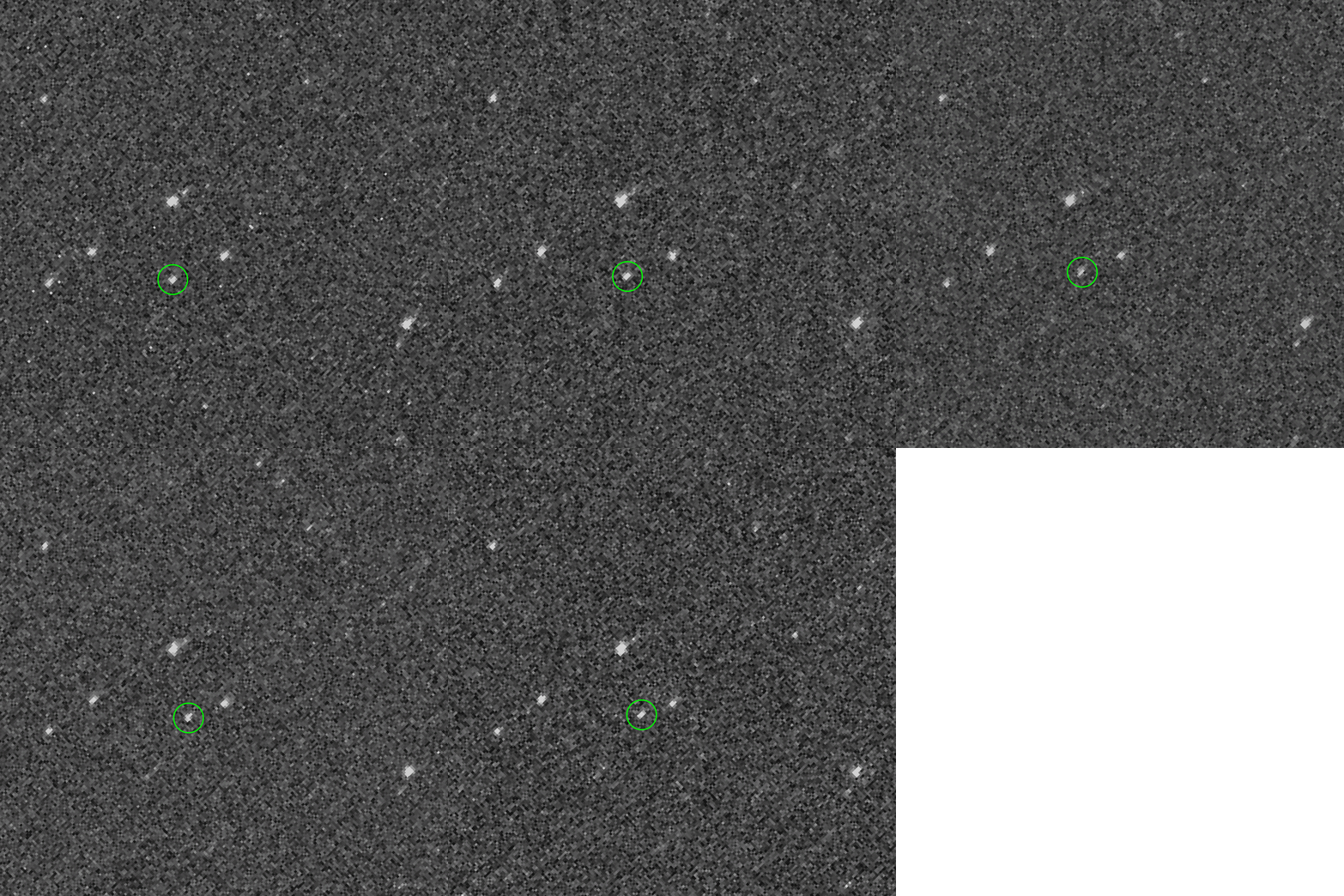
OSIRIS-REx and New Horizons catch first sight of their targets
Both OSIRIS-REx and New Horizons achieved first light on their still-distant targets this week. Between now and the end of 2018, Bennu and 2014 MU69 will turn from points of light into places.

Here are some recent postcards from Jupiter
Let's check in on NASA's Juno spacecraft, which completed its 14th close flyby of Jupiter last month.

How long is a day on Saturn?
One of the Cassini mission's goals was to figure out how long a day on Saturn is. We still don't know. A new paper reports a measurement of the rotation period of Saturn that is different from past measurements.

Eleven perijoves
Seán Doran has made a cool visual index to the images that JunoCam took during Juno's first 12 closest approaches to Jupiter.