

 Explore Worlds
 Find Life
 Defend Earth


All
All
 Sun
Sun Mercury
 Venus
Venus Earth
Earth Mars
Mars Jupiter
 Saturn
 Uranus
 Neptune
 Small Bodies
Stories, updates, insights, and original analysis from The Planetary Society.

In Pictures: DSCOVR Headed for Deep Space
On Wednesday evening, a SpaceX Falcon 9 rocketed into orbit with DSCOVR, the Deep Space Climate Observatory. Here's a photo and video roundup.

Rosetta shifts from sedate circular orbits to swooping flybys
For the period of time before and after the Philae landing, Rosetta was able to orbit the comet close enough that it was in gravitationally bound orbits, circling the comet's center of gravity. As the comet's activity increases, the spacecraft has to spend most of its time farther away, performing occasional close flybys. The first of these is at 6 kilometers, on February 14.

A new mission for Akatsuki, and status updates for Hayabusa2 and Chang'e
Brief updates on four ongoing missions: JAXA's Akatsuki and Hayabusa2, and China's Chang'e 3 and Chang'e 5 test vehicle. JAXA has articulated the new science plan for Akatsuki. Hayabusa2's ion engines have checked out successfully. The Yutu rover is still alive on the Moon, and Chang'e 5 test vehicle has successfully tested crucial rendezvous operations in lunar orbit.

Planet Formation and the Origin of Life
To understand the possible distribution of life in the Universe it is important to study planet formation and evolution. These processes are recorded in the chemistry and mineralogy of asteroids and comets, and in the geology of ancient planetary surfaces in our Solar System.

Two Days, Two Launches and Three Landings
Within a two-day span, two rocket launches and three ocean landings are scheduled—one of which involves an autonomous spaceport drone ship.
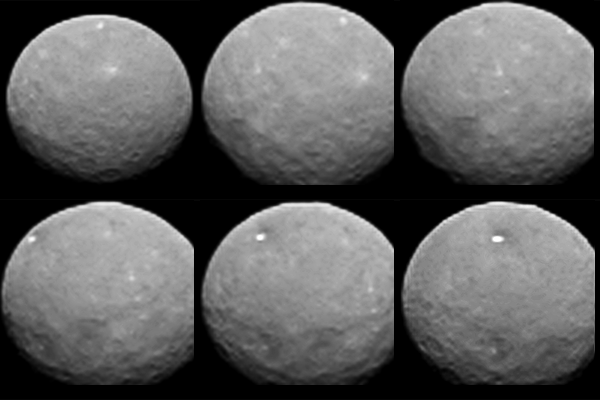
Ceres coming into focus
The Dawn mission released new images of Ceres yesterday, taken on February 4, when Dawn had approached to within 145,000 kilometers. More details are coming into view, and they're fascinating. For one thing, there's not just one white spot any more: there are several.

FOIA Request Sheds Light on NASA Mission Extension Process
A FOIA request offers insight into NASA's planetary science extended mission review process, which seems, at best, confusing, and at worst—with adjectival ratings like “Very Good/Good”—arbitrary.

Mars Orbiter Mission images Mars' moons, including the far side of Deimos
Today I'm excited to show you some previously unreleased images from Mars Orbiter Mission, containing Mars' moons Phobos and Deimos.

New Horizons returns first images from mission's Pluto approach phase
Here they are, the first images of Pluto from the approach phase of the New Horizons mission. Science has begun; we're on the home stretch!

Mars Exploration Rovers Update: Opportunity Completes 11th Year of Surface Operations!
On January 24th, something wonderful happened on Mars. Opportunity completed her 11th year of exploring the surface of the Red Planet! The veteran rover couldn't exactly go to Disneyland to celebrate this amazing achievement, so she did what she loves to do – roved on.

Ceres Coming Into View
Dawn is on approach to Ceres, the largest of the asteroids, and is starting to resolve features.

It's official: We're on the way to Europa
NASA's 2016 budget request increases the space agency's budget by $519 million, starts a new mission to Europa, increases funds to Commercial Crew, and threatens some long-running planetary missions.

Flawed Beauties
More examples of imperfect--but tantalizing--images from deep space.
Camera now measuring even fainter Near-Earth Objects
Camera purchased with the support of a 2009 Shoemaker NEO Grant is now on a new telescope providing follow-up measurements for even fainter near-Earth objects.

Talking to Pluto is hard! Why it takes so long to get data back from New Horizons
As I write this post, New Horizons is nearing the end of a weeklong optical navigation campaign. The last optical navigation images in the weeklong series will be taken tomorrow, but it will likely take two weeks or more for all the data to get to Earth. Two weeks! Why does it take so long?
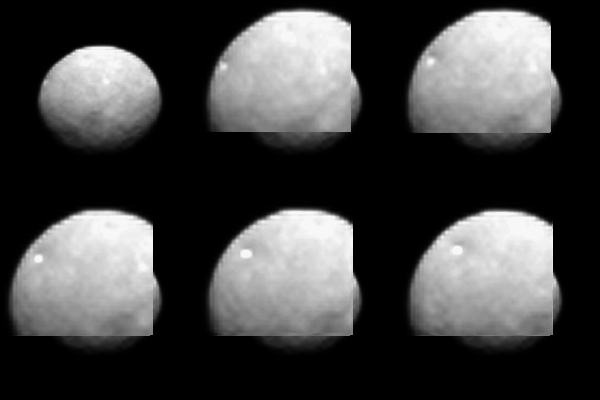
Dawn Journal: Closing in on Ceres
Dawn's chief engineer Marc Rayman gives an update on the mission as it gets ever closer to its next target: The dwarf planet Ceres.
Ceres: Just a little bit closer (and officially better than Hubble)
Last week's Dawn images of Ceres were just slightly less detailed than Hubble's best. This week's are just slightly better.

At last! A slew of OSIRIS images shows fascinating landscapes on Rosetta's comet
The first results of the Rosetta mission are out in Science magazine. The publication of these papers means that the OSIRIS camera team has finally released a large quantity of closeup images of comet Churyumov-Gerasimenko, taken in August and September of last year. I explain most of them, with help from my notes from December's American Geophysical Union meeting.

Fountains of Water Vapor and Ice
Deepak Dhingra shares some of the latest research on Enceladus' geysers presented at the American Geophysical Union (AGU) Fall Meeting in San Francisco last month.
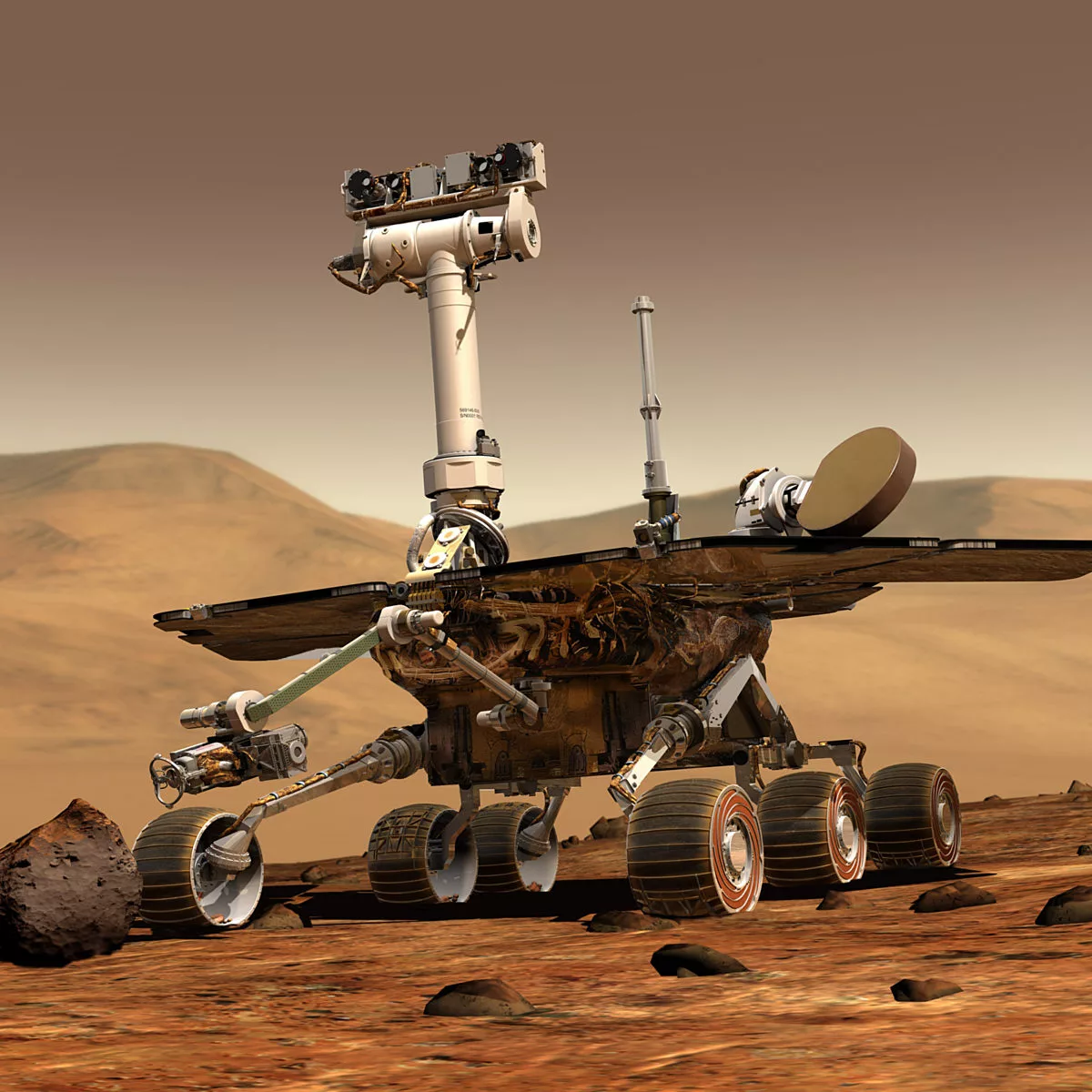
Field Report from Mars: Sol 3902 - January 15, 2015
Larry Crumpler gives an update on the status of Opportunity's traverse toward Marathon Valley.