

 Explore Worlds
 Find Life
 Defend Earth

All
All
 Sun
Sun Mercury
 Venus
Venus Earth
Earth Mars
Mars Jupiter
 Saturn
 Uranus
 Neptune
 Small Bodies
Stories, updates, insights, and original analysis from The Planetary Society.

Is the Opportunity Rover a Mission 'Whose Time Has Passed'?
The NASA Administrator declared that the Opportunity rover is a mission 'whose time has passed' and will be defunded next year. Will Congress act to save it?

Adding Churyumov-Gerasimenko to my scale comparison of comets and asteroids
Having found a color photo of the comet, I finally added Churyumov-Gerasimenko to my scale comparison of comets and asteroids visited by spacecraft.

An internal ocean on Ganymede: Hooray for consistency with previous results!
A newly published paper confirms a subsurface ocean at Ganymede. An ocean there was already suspected from its magnetic field and predicted by geophysics; new Hubble data confirms it, and even says it is in the same place we thought it was before. Such consistency is rare enough in planetary science to be worth celebration.

What to expect when you're expecting a flyby: Planning your July around New Horizons' Pluto pictures
As New Horizons approaches Pluto, when will the images get good? In this explainer, I tell you what images will be coming down from Pluto, when. Mark your calendars!

A Sky Full of Stars
In pictures of the planets, the stars aren't usually visible. But when they do appear, they're spectacular.

Mini mission updates: Dawn in orbit; Curiosity short circuit; Rosetta image release; Hayabusa2 in cruise phase; and more
Dawn has successfully entered orbit at Ceres, becoming the first mission to orbit a dwarf planet and the first to orbit two different bodies beyond Earth. I also have updates on Curiosity, Rosetta, Mars Express, Hayabusa2, the Chang'e program, InSIGHT, and OSIRIS-REx.

Seeing Ceres: Then and Now
Technology writer Paul Gilster shares his interest in how we depict astronomical objects, focusing on the dwarf planet Ceres.

Dawn Journal: Ceres Orbit Insertion!
Dawn's Chief Engineer, Marc Rayman, gives an update on the mission's highly anticipated arrival at Ceres.

Mars Exploration Rovers Update: Opportunity Discovers New Rock Type, Updates Flight Software
From the discovery of a new rock type to a successful flight software upload that should enable the robot field geologist to regain her long-term, flash memory, Opportunity and her team delivered what turned out to be a hugely productive and memorable 133rd month on the Red Planet.

Mars Orbiter Mission Methane Sensor for Mars is at work
After several months of near-silence, ISRO's Mars Orbiter Mission has released on Facebook the first data product from its Methane Sensor For Mars. Don't get too excited about methane yet: there is no positive or negative detection. The news here is that the Methane Sensor for Mars is working, systematically gathering data. They also released several new photos of Mars.

Watch Ceres rotate: A guide to interpreting Dawn's images
NASA held a press briefing on the Dawn mission yesterday, sharing some new images and early interpretations of them. I see lots of things that intrigue me, and I'm looking forward to Dawn investigating them in more detail. I invite you to check out these photos yourself, and offer you some guidance on things to look for.

Pluto Science, on the Surface
New Horizons' Principal Investigator Alan Stern gives an update on the mission's progress toward Pluto.
At last, Ceres is a geological world
I've been resisting all urges to speculate on what kinds of geological features are present on Ceres, until now. Finally, Dawn has gotten close enough that the pictures it has returned show geology: bright spots, flat-floored craters, and enigmatic grooves.

Dawn Journal: Ceres' Deepening Mysteries
Even as we discover more about Ceres, some mysteries only deepen. Mission Director Marc Rayman gives an update on Dawn as it moves ever closer to its next target.

Clouds and Chasmata
New landscapes from Mars Express.

Curiosity update, sols 864-895: Drilling at Pink Cliffs
Curiosity's second drilling campaign at the foot of Mount Sharp is complete. The rover spent about a month near Pink Cliffs, an area at the base of the Pahrump Hills outcrop, drilling and documenting a site named Mojave, where lighter-colored crystals were scattered through a very fine-grained rock.
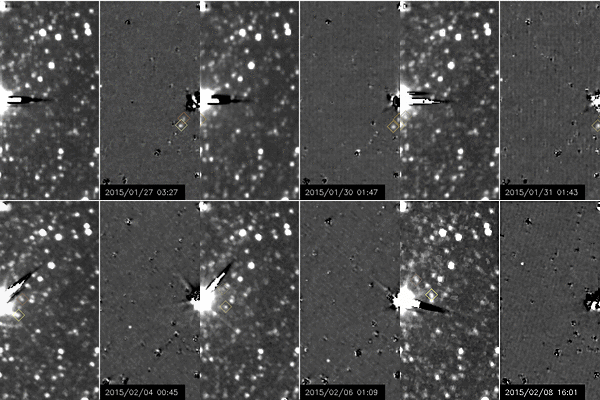
New Horizons spots Nix and Hydra circling Pluto and Charon
A series of images just sent to Earth from New Horizons clearly shows Pluto's moons Nix and Hydra orbiting the Pluto-Charon binary.

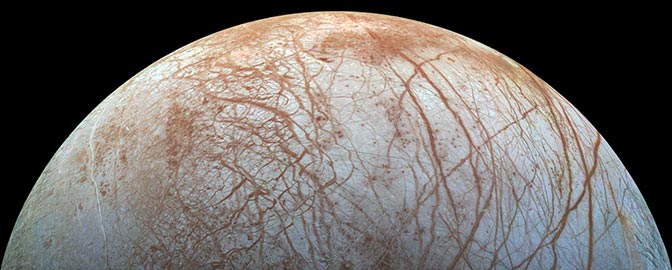
Mapping Europa
Several global maps have been made of Europa, but amateur image processor Björn Jónsson felt they could be improved—so he decided to make a new one.

An active comet, from a distance
Rosetta has closed to within 50 kilometers of Churyumov-Gerasimenko, on its way to a very close, 6-kilometer flyby of the comet tomorrow. To prepare for the flyby, Rosetta traveled much farther away, allowing it to snap these amazing photos of an increasingly active comet from a great distance.

Cassini begins a year of icy moon encounters with a flyby of Rhea
At last! Cassini is orbiting in Saturn's ring plane again. I do enjoy the dramatic photographs of Saturn's open ring system that Cassini can get from an inclined orbit, and we won't be getting those again for another year. But with an orbit close to the ring plane, Cassini can repeatedly encounter Saturn's icy moons, and icy moon flybys are my favorite thing about the Cassini mission.