

 Explore Worlds
 Find Life
 Defend Earth

All
All
 Sun
Sun Mercury
 Venus
Venus Earth
Earth Mars
Mars Jupiter
 Saturn
 Uranus
 Neptune
 Small Bodies
Stories, updates, insights, and original analysis from The Planetary Society.

Happy LPSC Deadline Day, especially to composers of abstract haiku
January 10, 2012 was a high-stress day for many in the world of planetary geology: the deadline for submission of abstracts for the 2012 Lunar and Planetary Science Conference (LPSC). One creative coping mechanism for the stress of completing the LPSC abstract submission process is the tradition of capturing the essence of one's work in the seventeen syllables of the Haiku form.

A Tale of Two Martians
It's the best of times for Mars exploration because we've got three orbiters and a rover studying the Red Planet. It's also the worst of times for my Russian, European, and Chinese colleagues who were part of the Phobos-Grunt mission.

Pretty picture: Saturn, a big moon, and a teeny one
A recent view from Cassini of Saturn with its largest moon (Titan) and one of its small ringmoons, Prometheus.

The state of Earth observation, January 2012
As of November 2011, the Earth Observing Handbook counts 109 active missions to study the Earth as a planet, with 112 more approved and planned for the future. Jason Davis provides an overview of key current and upcoming earth-observing missions.

Dawn Journal: The Om of Orbit Adjustment
The Dawn mission's Project System Engineer Marc Rayman reports that Dawn concluded 2011 more than 40 thousand times nearer to Vesta than it began the year. It is now at its lowest altitude of the mission, conducting a detailed exploration of the protoplanet and continuing to make new discoveries.

How Spacecraft Make Color Pictures
Whether you heard the show or not, you'll be fascinated by Emily's great presentation. It also proves she is not part of the great conspiracy that is hiding evidence of alien bases on the moons of Saturn!
Mars Exploration Rovers Update:Opportunity Climbs to Greeley Haven for Winter, and We Look Back at 2011
As New Year's Eve moved from time zone to time zone across planet Earth, the Mars Exploration Rover (MER) team looked to 2012 and wrapping its eighth Earth year of exploring, while up on the Red Planet Opportunity settled into the

What is space exploration worth?
Investing in NASA makes us smarter, improves our lives, and increases our capability to overcome technological challenges. Even more important, though, are the intangible benefits of pride, respect from other nations, respect for our place in the universe, and hope for a future in which we can accomplish even greater things.

What's up in the solar system in January 2012, and the rest of the year
There will be no planetary launches in 2012, but there is still plenty of deep-space activity to look forward to over the coming year.

Ringing in the New Year with two new arrivals to the Moon
The twin GRAIL spacecraft are nearly at the end of their three-month cruises to the Moon. Currently being discussed is an extended mission for GRAIL that would begin after the June eclipse and last through most of December 2012.

Lovely Lovejoy pictures
Just a few of the amazing photos of Comet Lovejoy that have been taken from the southern hemisphere over the last few days. Comet Lovejoy is the first Kreutz sungrazer to have been discovered from the ground in 40 years, and after its surprising survival of its passage close to the Sun, it has been putting on a spectacular show in southern skies.

Pretty pictures from Cassini's 12 December 2011 Dione flyby
Cassini flew close by Dione on December 12 and, as usual, the close pass provided opportunities for lots of dramatic photos, not just of Dione, but of other moons wandering by in the background.

A recap of Comet Lovejoy
A timeline of one of the most memorable solar events in recent memory: the observations by six Sun-observing spacecraft of Comet Lovejoy making its perihelion passage.
Project for Awesome Video On Behalf of the Planetary Society
WhirledSol posted a cool Youtube tribute to the Planetary Society a year ago, and we just now found it! It has a nice explanation of why we are so passionate about space exploration.
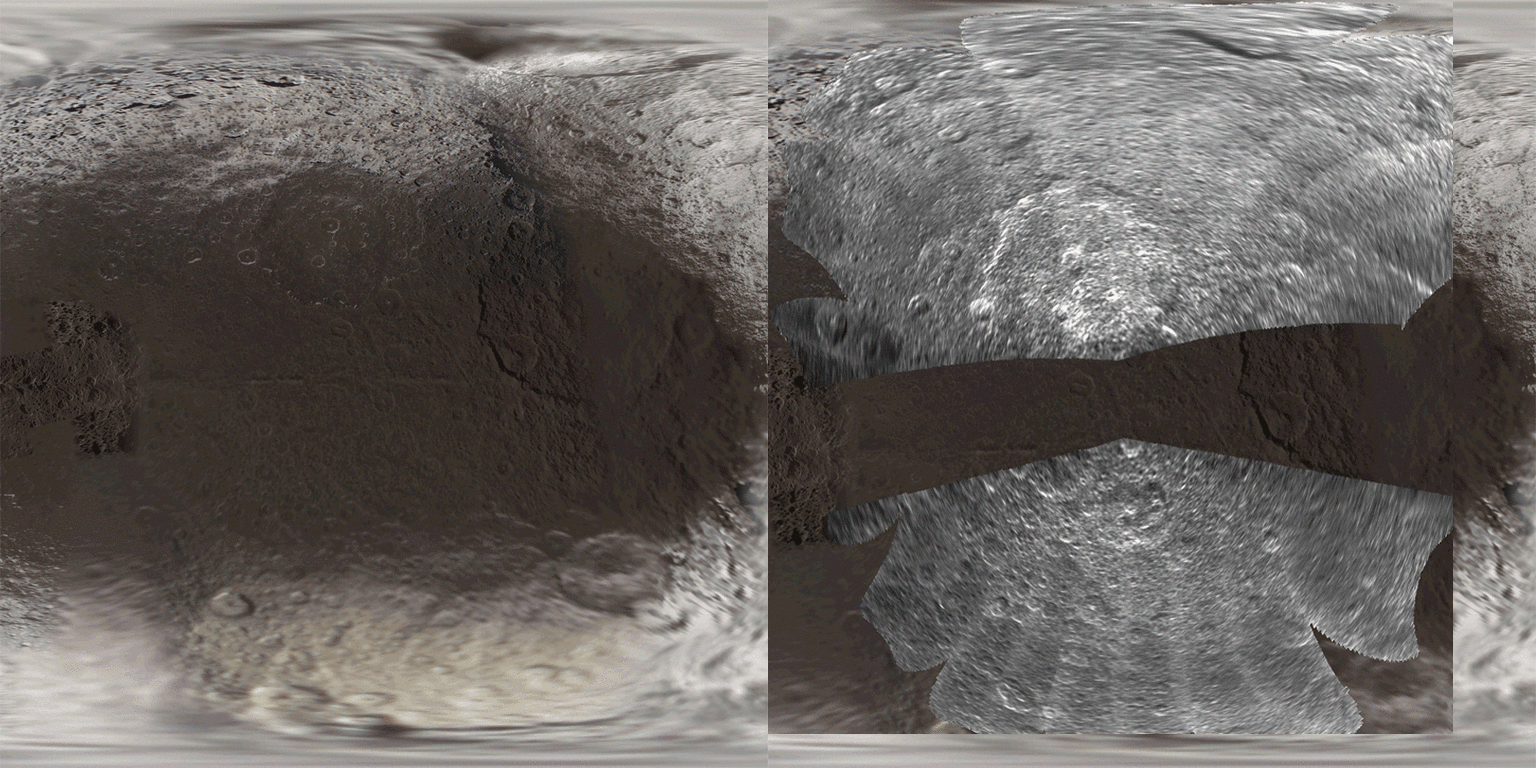
More radar images of icy moons from Cassini: Iapetus, Enceladus, and Rhea
When I posted about the really cool Cassini SAR images of Enceladus a few weeks ago, I initially wrote that this was the first-ever SAR image of an icy moon other than Titan. Several people (some readers and two members of the Cassini science team!) corrected that statement: Cassini has performed SAR imaging of other icy moons (including Enceladus) before.

Separating fact from speculation about Kepler-20's Earth-sized planets
A large team of researchers has announced in a Nature article the discovery of not one, but two, Earth-sized planets orbiting a star named Kepler-20. This article separates the observational facts from the quite-likely-to-be-true inferences from the downstream speculations.

Do you have an iPhone? Do you like the Mars rovers? Check out the awesome my3D viewer.
The Hasbro my3D viewer turns your phone into an electronic View-Master, making it easy to view color images in stereo.

NASA, NOAA Spared Further Cuts for Now
On December 16, 2011, the U.S. Senate voted down the House of Representatives bill that would have sliced an additional 1.83 percent from discretionary spending accounts, including NASA and NOAA.

MalloMars Rover: Search for S'more Data
Abigail Fraeman took third place in the Washington Post's 2011 Style Invitational edible-art contest with her entry,
NASA and NOAA Hit Again by Across-the-Board Budget Cuts
The U.S. House of Representatives has passed appropriations bills that will provide $8.1 billion disaster aid for this year's