

 Explore Worlds
 Find Life
 Defend Earth

All
All
 Sun
Sun Mercury
 Venus
Venus Earth
Earth Mars
Mars Jupiter
 Saturn
 Uranus
 Neptune
 Small Bodies
Stories, updates, insights, and original analysis from The Planetary Society.

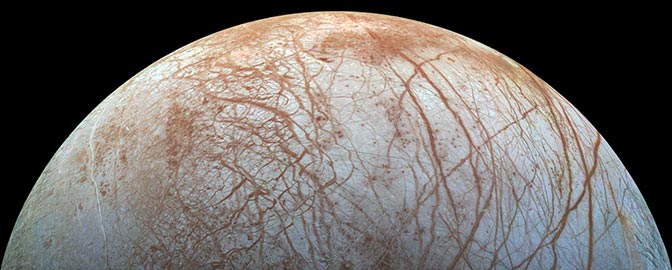
The most amazing image of Enceladus Cassini has captured yet
Every time I think Cassini has captured the coolest image of Enceladus ever, it does better.

Pretty picture: Messier 83
What does a barred spiral galaxy look like? THIS is what a barred spiral galaxy looks like.

Pictures hitting Earth from Cassini's close Enceladus flyby today
Cassini flew within 436 kilometers of Enceladus' surface today. Although it's Cassini's 11th targeted flyby of Enceladus, these close buzzes are never routine.

Dione and Telesto, close on camera but far apart in fact
This image, released today by Cassini's imaging team, is pretty cool; it shows one of Saturn's larger moons together with one of its smaller ones. I probably noticed the nice photo of Dione when it appeared on the Cassini raw images page two months ago, but I know I didn't notice the little speck below and to the left of the bigger moon. That speck is a small moon, Telesto.

Sighting the homeworld
Coming closer every day, Mr. Hayabusa has sighted his final destination: his homeworld, Earth, and its attendant Moon.

Happy solstice -- on Mars
It's the solstice on Mars today: summer in the north, winter in the south.

New maps of Enceladus and other moons
Every time Cassini gets reasonably close to one of the moons of Saturn, whether the close approach is a targeted one or just an opportunistic encounter, its planners usually take advantage of the proximity to take a bunch of photos.

Talking Lasers on Aussie Radio
Through a crazy random happenstance, I was just interviewed by a friend of a friend of a friend at Australian radio station 'triple j' for a feature on lasers!

Moon Zoo is ready for you
I'm delighted to point you to a citizen science project for wannabe space geologists like me: Moon Zoo.

A Martian Moment in Time, revisited
A good start to my day today: The New York Times' Lens Blog featured the

Radar glories in Titan rivers
Wow, this is a cool paper. Here's the gist: the Cassini RADAR team has spotted some river channels on Titan that shine so brightly in radar images, there must be something special going on to explain that brightness.

Jupiter has lost a belt!
Via Daniel Fischer's Tweet about a blog entry by Astro BobI learned of something which should be obvious to anyone who has trained even a rather small telescope on Jupiter over the past few weeks: one of its iconic stripes is just plain gone.

A moment in time
On Mars, at 15:00 local true solar time on May 2, a solitary rover gazed southward across her own dusty deck and snapped three photos, actually three sets of three photos, which were combined to make this view.

Morphology and mineralogy on Mars
A recent entry by Bethany Ehlmann from the blog of the Planetary Geomorphology Working Group of the International Association of Geomorphologists demonstrates how you can combine the power of different types of data to tease out a rich story of the past history of one spot on Mars.

Saturn's hexagon recreated in the laboratory
A lot of readers have expressed interest in the origin of Saturn's north polar hexagon. The hexagon is a long-lived pattern in the clouds surrounding Saturn's north pole, which has been observed since the Voyagers passed by in 1980 and 1981.

Space carnival, rover update, Planetary Radio Live!
Just a linky post today, as I am nanny-less.

MarsSed 2010 Field Trip Day 2: Stromatolites, Gypsum and Layers
We started off Day 2 of the field trip by driving up onto the eroded rocks of what used to be the tidal flats of the ancient reef, between the shore and the continental shelf.

Naming X: A contest for kids to name small bodies
A contest has just been announced that appears to create a pathway for schoolchildren to suggest names to the International Astronomical Union for minor planets -- all those small things in the solar system that don't orbit the eight big ones.

Arecibo saves us from another potentially hazardous asteroid
That's a bit of an overdramatic title, but it's true that the most efficient way for us to reduce the risk we face from asteroids that have a very small chance of hitting Earth in the future is to determine their orbits more precisely.

How radio telescopes get "images" of asteroids [DEPRECATED]
Every time I post a radio telescope image of a near-Earth asteroid, I get at least one reader question asking me to explain how radio telescopes take photos, so I'm hereby writing a post explaining the basics of how delay-Doppler imaging works.