

 Explore Worlds
 Find Life
 Defend Earth
The Planetary Society to unveil never-before-seen view of Voyager 1 at one light-day from Earth
Livestream with NASA's Voyager team on Nov. 18 marks the first time a human-made object has traveled one light-day from Earth
For Immediate Release
November 16, 2026
Contact
Danielle Gunn
Email: [email protected]
Phone: +1-626-793-5100
PASADENA, CA (November 16, 2026) — On Wednesday, Nov. 18, NASA's Voyager 1 will become the first human-made object to reach one light-day from Earth: about 25.9 billion kilometers (16.1 billion miles) away, so far that radio signals traveling at the speed of light take a full 24 hours to make the trip in either direction. The spacecraft is expected to cross the milestone at 5:16 a.m. ET (10:16 UTC).
To celebrate, The Planetary Society will host a free public livestream that evening from 8:00 to 9:00 p.m. ET on its YouTube channel and in its digital member community. During the broadcast, legendary space artist Don Davis will reveal a never-before-seen illustration depicting what Voyager 1 looks like from one light-day away, rendered in painstaking scientific detail. The livestream will be the first place anyone can see the new work.
Planetary Radio host Mat Kaplan will be joined by three members of the Voyager mission team from NASA's Jet Propulsion Laboratory (JPL) — Project Manager Suzanne Dodd, Mission Manager Kareem Badaruddin, and Project Scientist Linda Spilker — who will share stories from their decades on the mission. Additional special guests will appear throughout the program.
Launched in 1977, Voyager 1 flew past Jupiter and Saturn, turned its camera back toward home in 1990 at the urging of Planetary Society co-founder Carl Sagan, capturing the iconic Pale Blue Dot image of Earth, and in 2012 became the first spacecraft to enter interstellar space. It is already the farthest human-made object from Earth. Reaching one light-day — roughly 173 times the distance between Earth and the Sun — marks a new benchmark for the mission and for humanity.
Bill Nye, chief ambassador of The Planetary Society, was a student in Carl Sagan's class while the Voyager spacecraft were being assembled.
"The majority of people on Earth today were not alive when Voyager 1 and 2 were launched. But all of us — everyone on Earth — have been touched by these missions," said Nye. "The images and information these remarkable machines have sent back to us over the last 49 years, across the nearly unimaginable distance of one light-day, have changed the way all of us feel about outer space and our home world, our Pale Blue Dot."
"On Wednesday, Nov. 18, Voyager 1 will be one full light-day from here and still collecting data," Nye added. "The scientific exploration of space is a bargain.”
A view from one light-day away
Don Davis is one of the most celebrated space artists of the past half-century. His new illustration imagines Voyager 1's vantage point at this historic distance, grounded in the scientific rigor that has defined his career. It will be published on November 18 at 8 p.m. ET on planetary.org.
How to watch
- What: Voyager 1 One Light-Day livestream and Don Davis art reveal
- When: Wednesday, Nov. 18, 2026, 8:00 to 9:00 p.m. ET (5:00 to 6:00 p.m. PT; 01:00 to 02:00 UTC Nov. 19)
- Where: The Planetary Society’s YouTube channel, planetary.org/live, and The Planetary Society's digital member community
- Cost: Free and open to the public
Media note: A high-resolution image of the Don Davis painting is available to media under embargo until the on-air reveal at 8:00 p.m. ET Nov. 18 (01:00 UTC Nov. 19). To request it, contact Danielle Gunn at [email protected]. Interviews with Planetary Society Chief Scientist Bruce Betts and Chief Ambassador Bill Nye are also available on request.
About The Planetary Society
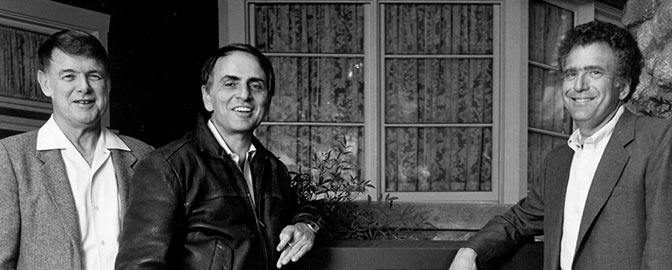
The Planetary Society is the world's largest and most influential space interest organization. Founded in 1980 by astronomer Carl Sagan with Bruce Murray and Louis Friedman of NASA's Jet Propulsion Laboratory, the 501(c)(3) nonprofit is led today by CEO Jenn Vaughn and championed by Chief Ambassador Bill Nye. Members and donors fund programs in science and technology, public outreach, and advocacy. This work advances the exploration of space, the search for life beyond Earth, and the defense of our planet from dangerous asteroids and comets. Learn more at planetary.org.
###