

 Explore Worlds
 Find Life
 Defend Earth


Planetary Radio • Jul 17, 2026
Book Club Edition: “The Edge of Space-Time” by Chanda Prescod-Weinstein
On This Episode

Chanda Prescod-Weinstein
Associate Professor of Physics and Core Faculty Member in Women’s and Gender Studies at the University of New Hampshire
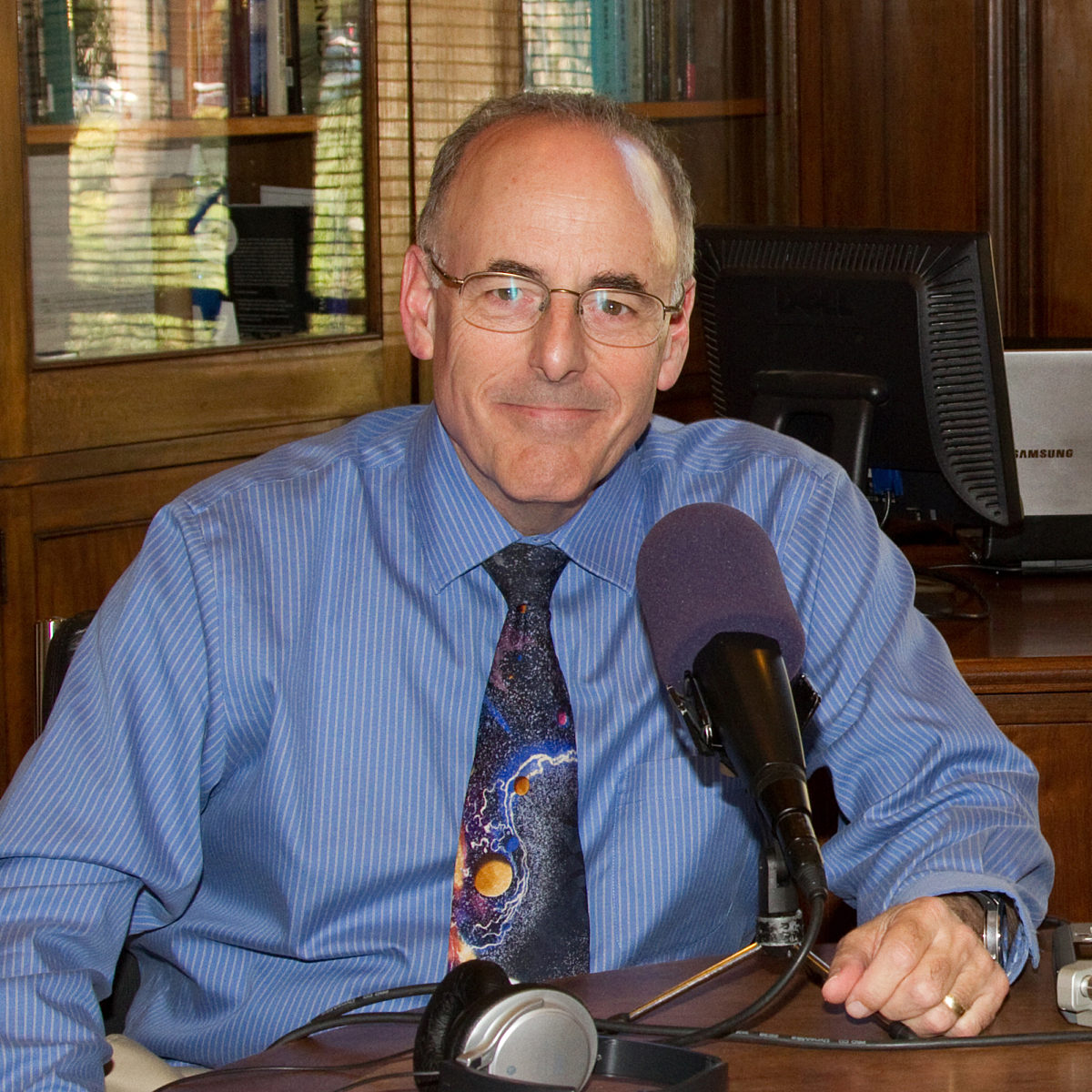
Mat Kaplan
Senior Communications Adviser and former Host of Planetary Radio for The Planetary Society
It may be the best book subtitle we’ve encountered in the Planetary Society book club: “Particles, Poetry and the Cosmic Dream Boogie.” Theoretical physicist and black feminist science theorist Chanda Prescod-Weinstein has followed her acclaimed first book, “The Disordered Cosmos,” with this new, equally celebrated, deeply personal romp across the Universe, “The Edge of Space-Time”. Swinging from quantum mechanics to hip-hop, and from galaxies to Alice in Wonderland, she guides us through the looking glass to what we know and would love to know about the Universe. It all but guaranteed a mind-bending conversation with host Mat Kaplan that begins with Chanda’s concern for the state of scientific research in the United States, and ends among the stars.


The Planetary Society Book Club: The Edge of Space-Time with author Chanda Prescod-Weinstein In her latest book, particle physicist and cosmologist Prescod-Weinstein explores the vastness of the universe and the infinitesimal weirdness of quantum mechanics, bringing both to bear on the human-scale challenges faced by society and scientific institutions in 2026. Host Mat Kaplan joins her for a deeply-personal conversation that spans the Cosmos.
Transcript
Mat Kaplan:
The Edge of Space-Time, this time on Planetary Radio Book Club Edition. Welcome. I'm Mat Kaplan, senior communications advisor for the Planetary Society with more of the human adventure across the solar system and beyond. It was our May selection for the Society's book club. It encompasses literally everything in the universe from corks to galaxies along with the dark matter that holds those galaxies together. It also has one of the most enticing and intriguing titles anyone in our universe could hope for. The Edge of Space-Time: Particles, Poetry, and the Cosmic Dream Boogie. The Los Angeles Times called it astonishing, and I'm inclined to agree. I've read a lot of books about physics and cosmology, but never before one that so astoundingly ties these fields to culturally-aware poetry, hip hop, the prescient cosmologies of ancient thinkers, and the dire challenges faced by science and scientists in 2026.
Let's meet its author, Dr. Chanda Prescod-Weinstein. She is an associate professor of physics and astronomy and a core faculty member in women's and gender studies at the University of New Hampshire. She conducts award-winning theoretical physics research on dark matter and neutron stars, and also does research on Black feminist science studies. Her first book, The Disordered Cosmos: A Journey Into Dark Matter, Space Time, and Dreams Deferred, won the 2011 Los Angeles Times Book Prize in science and technology and the 2022 Phi Beta Kappa Award in Science. And she is also a columnist for New Scientist magazine. So please help me welcome Dr. Prescod-Weinstein. Welcome Chanda.
Chanda Prescod-Weinstein: Hi, thank you for having me.
Mat Kaplan: It is a great pleasure and it was a great pleasure to read this book. Challenging at times, I will say, when we really got into the thick of it, as you tried to explain some things that ever since humans conceived of them, like quantum mechanics, have been difficult, I think, to explain, but I think you did an admirable job.
Chanda Prescod-Weinstein: Thank you.
Mat Kaplan: Let me start where you do with a quote from the great Langston Hughes. "Good morning, daddy. Ain't you heard the boogie-woogie rumble of a dream deferred?" Which of course you incorporated into the title of the book. So what to you is the dream boogie, and why do you celebrate this epic poem in a book that is largely about physics and cosmology?
Chanda Prescod-Weinstein:
So I think you may have noticed that this poem is actually cited in the subtitle of both of my books. So it appears in The Disordered Cosmos, which ends as dreams deferred. It also appears in The Edge of Space-Time, which has the cosmic dream boogie. And the name of this section of, this is from a book length poem called Montage of a Dream Deferred. And the name of this section is called Dream Boogie. In it, Langston Hughes is talking about the beauty and the brilliance of the blues and also the grief and trauma that the blues emerge from and represent particularly for Black life in the United States. So the boogie-woogie rumble in particular, I think really, in that line, he captures that feeling of there's great joy and brilliance and genius and noise and excitement and also grief. And I think in a lot of ways I knew while I was writing The Edge of Space-Time that it was going to emerge into a political moment where people were feeling a lot of those emotions at the same time.
The audience that I think about when I'm writing is an audience that is trying to grapple with what's difficult about the world and figuring out what it means to be hopeful. I wanted to address that head on in a book about physics where I'm asking people to spend a few hundred pages thinking about how the universe works and all of these things that seem, at least on the surface, like they're very detached from everyday life. I wanted to acknowledge that there are other things happening in the world and then actually use that as a way to draw people in and say that doing the work of spending time with physics can actually help you with these other pieces. And then I also wanted to say that the universe itself is a boogie-woogie rumble. It's frustrating, it's hard, it's difficult. And also it's beautiful and glorious and exciting and poetic.
And so I just feel like that line captures it. There's also a personal element, which is that Langston Hughes just echoes in my brain a lot. And so some of this book is like, if you have physicist brain, if you have Black, queer, physicist brain, this is what the universe looks like. So welcome inside my brain.
Mat Kaplan: And in what many of us believe are difficult times, every bit of hope that we can find across the universe is much appreciated. It was a delight to learn that I would be speaking with yet another Trekkie as well in this conversation.
Chanda Prescod-Weinstein: Yes.
Mat Kaplan: So here's a quote, and maybe only the first of a couple, from Michael Burnham, the captain of the starship Discovery in the Star Trek series of the same name. The actress, of course, Sonequa Martin-Green, who was brilliant, at one point makes a reference to an enormous letter in a bottle made of space and time visible only to those whose hearts were open enough to receive it, which to me speaks of another word that I think is one of the key words that you base this entire book on, which is metaphor. But please, am I right about that?
Chanda Prescod-Weinstein:
Yeah. I mean, so for folks who haven't read the book yet, I'll just say that what you're quoting from is the opening narration of season two of Discovery, and also is the opening epigraph of the book. And so it's really the first thing that the reader sees in the book and reads in the book. And so there were a couple of layers that I wanted to work with there, which is that, one, that opening monologue is really about keeping your heart open to the universe and keeping your heart open to learning about the universe. And so there was just a piece of that where I'm just trying to prime the reader that I want you to keep your heart and mind open to the idea that the concepts in this book are worth your time and worth you spending effort on. And then, yes, there is this metaphor, which is I think the first of many that you meet in the book of how do we think about the universe and how do we communicate about the universe? And really, how do we tell stories to ourselves and to each other?
And it turns out that a figurative language is very important to that. I think in the sciences, it's actually especially important, especially when you are not using equations to talk with people about concepts because you have to use metaphors to start with something that is familiar to people and use that thing that's familiar to them to try and bring them into what is more unfamiliar to them or may feel unfamiliar to them. So that's really what the figurative does is it takes the familiar and makes it unfamiliar in a way that maybe helps you look at the familiar in a different light, but also helps you meet something about the universe that maybe you didn't know or didn't see before. And this is very important in science communication.
So there's a little bit of this just being like, I don't know, breaking down the fourth wall and looking into the camera and saying, "I know that we have a language difference because high likelihood you're reading this book and you're not a professional scientist, but I still need to talk to you about professional science because that's why we're here." So how am I going to do that? I'm going to use metaphor.
Mat Kaplan: This cross pollination of science and art through metaphor is throughout the book. I mean, literature and poetry and music, rap, it's everywhere. The visual arts as well, including those charming illustrations in the book. And so sticking with the arts, I'm a blues fan. I used to help run the late, great Long Beach, California Blues Festival. I got to meet B.B. King because of that. But I never expected-
Chanda Prescod-Weinstein: Awesome.
Mat Kaplan: ... that I would have reason to bring up appreciation for the blues in a conversation about physics and cosmology. And yet there it is.
Chanda Prescod-Weinstein: Again, particularly because most of my audience for this book is not going to be professional scientists or science students or physicists, even if they do some other kind of science. Part of the work of the science communicator is to convince the reader that there is something in this for them. And there are a lot of people out there who like hip hop and like poetry and like Jane Austen and all of these other things that I like. And so there's just a piece of this that is, again, a matter of technique and science communication. And there is a kind of urgency. I wrote the book with a sense of urgency because even before the 2024 election or everything that's happened to science in the last year, I was already seeing the writing on the wall with astrophysics funding, cosmology funding, and particle physics funding. I've spent a lot of the last five years doing policy work, and in fact was in a formal federal policy advisory role until Donald Trump fired me during Yom Kippur last year.
Mat Kaplan: You were one of those. Okay.
Chanda Prescod-Weinstein:
I was on the High Energy Physics Advisory Panel, and they sent us an email during Yom Kippur while I was in services thanking us for our service, and not quite clearly saying we were fired, but reading between the lines, we figured it out. And in the process of doing this work on policy, I was learning a lot about, and I was paying a lot of attention to how public attitudes about research on the fundamental sciences have been shifting and how the government attitude has been shifting including from elected officials. I was like, we need to make the case for particle physics and cosmology. And I think traditionally the way that scientific organizations have approached this has been by just lobbying members of Congress behind closed doors. And there's a time when that tactic was more effective than it is now. And I actually, one of the things I really appreciate about the Planetary Society in particular is that I think the Planetary Society has been leaps and bounds ahead of other organizations, and understanding that engaging the general public on this is essential and critical.
And so in a lot of ways for me, The Edge of Space-Time was me, with a real sense of urgency, saying, "Please don't let me be the last of my kind." Like an American who pursued this and became a professor and is now contributing back to the community the knowledge that I have. And I don't think that this is about national borders, but there is a large population here in the United States, and that population deserves to be served by local institutions. So for me, it's not about, I don't want outsiders. I think I've benefited a lot from how international American physics is, but I also want to make sure that Americans have local opportunities to engage. And I really had a great fear and even more so now. But even as I was writing this in 2023, 2024, I was very worried about it.
And so there was really this piece of me thinking, how do I reach the audience and say these are stories that matter to you? And that in a healthy democracy, you have people in society like me who keep these stories and share them and make sure that five generations from now, there are people who know whatever the most contemporary version of that story is.
Mat Kaplan: And that sense of you being a storyteller, I'm going to come back to later. Let's start talking about physics. Another of those keywords that comes up over and over in the book, and it is right in the title, is edge. We can also think of it, I suppose, you point out, as a boundary. And it appears to be taken as the boundary at which our understanding of how the cosmos works ends. Except that maybe it's just that it's not a physical boundary so much as just our understanding, our ability to understand it doesn't quite extend far enough yet.
Chanda Prescod-Weinstein:
Yeah. I mean, so for folks who've read the book, you know that the name of the book, The Edge of Space-Time, actually comes from the first page of a textbook by Stephen Hawking and George F.R. Ellis where they basically make the claim that most problems in cosmology can be thought of as questions about The Edge of Space-Time. They meant this in very much the mathematical sense. So they were really thinking about when you sit down to solve a physical problem, even once you have an equation that you think describes the system, there's information you need in order to solve this equation. So if you think about like, I'm sitting in my home office right now, it has a ceiling, it has a floor, I have walls around me. Those things that I just mentioned, the ceiling, the floor, the walls constitute the boundaries of the room.
And so if I want to solve an equation that describes how air is moving in this room, then the condition that I'm going to have to put on the equation, the boundary condition is what we would call it, is that I will have to impose the presence of the ceiling, the presence of the floor. And so what they were talking about is that most problems in cosmology, mathematically speaking, come down to figuring out what boundaries you need to impose on these equations. And they called these boundaries the edge of space-time. So that's really where the title of the book comes from. One, I just thought it was a very poetic way of putting the problem. And also, I think thinking about the universe from the perspective of these edges, whether it's the cosmological horizon beyond which we can't get certain types of information, or the black hole event horizon, which I think of as like the best laid edges in the universe.
There isn't really a more intense edge in the universe than a black hole event horizon. So there were a couple of opportunities there, which is, one, I get to talk about that. It connects really nicely with the Black feminist concept of thinking from the margins and putting the margin at the center. So putting the edge at the center of the story as opposed to pushing it to the margin to the side. But I think the other piece of it is getting to actually have an excuse to explain boundary conditions to people. So there is an element also in this book of I wanted to explain some of the things that maybe we don't always put into science writing because people think it won't be interesting to the audience or like it's hard to explain to people so why even try? And I was like, "Okay, I'll bite. I'll try."
Because I also want people to know that it's okay if they didn't fully understand it the first time because part of the work here is actually just having the experience of reading through it and grappling with it. You can look at the night sky and have an experience with it without being able to name a single constellation. And so I think reading through a science book can be like that too. And so I wanted to tell people we have this thing called boundary conditions and they're very important in physics. And usually we don't talk about them.
Mat Kaplan: That book that you mentioned by Hawking and Ellis, The Large Scale Structure of Space-Time, I was warned, "Don't try to read it," since I do not have the math, but I was fascinated that talks about, this is right from that book you quoted. "The subject of this book is the structure of space-time on length scales from 10 to the minus 13 centimeters, the radius of an elementary particle, up to 10 to the 28th centimeters, the radius of the universe." And that it leads to two remarkable predictions about the universe. First, the final fate of massive stars is to collapse into that, beyond that event horizon that you mentioned. And secondly, there's a singularity in our past, all of which, of course, you address in the book, which really takes us beyond the looking glass, which is yet another literary reference and metaphor. I mean, Alice, old Lewis Carroll or Reverend Dodgson's work, comes up over and over in the book. And I guess it made a big impression on you as a kid too, didn't it?
Chanda Prescod-Weinstein: Yeah. So first I want to say thank you for correcting the typo in that quote, which other readers in the club may have caught. But unfortunately it got typeset as 10 to the 13 in the first and second printing of the book. I did actually manage to verify today that the third printing of the book will have that typo and a couple of other typos corrected.
Mat Kaplan: That's great.
Chanda Prescod-Weinstein:
So I appreciate you getting that one right. It should be 10 to the minus 13. Anyone who was reading it was like, "But 10 to the 13 is still pretty big." It is still pretty big. The incredible thing about doing cosmology is that as a subject, it has extraordinary range, particularly... I would consider myself a particle cosmologist. So I think about the extraordinarily small, say, subatomic particles. And I think of my job as trying to tell the story of the evolution of space-time and everything inside of it. So the biggest possible story that's out there, the largest possible length scales out there through the lens of information that we know about subatomic particles. So connecting the very small with the very large.
Cosmology naturally calls on us to pull these extremes of abstraction and the cosmic together in ways that we are not necessarily asked to do in everyday life unless we pick up a book like Alice in Wonderland. And so I think Alice in Wonderland is a fun text to riff off of because it asks us to suspend our sense of normal and grapple with what other sensibilities of normal might be out there in the universe. And I think it's a good training ground for doing that.
And you see this in the first part in Alice's Adventures in Wonderland and then also in Through the Looking Glass. One of the examples that I give in the book is the Jabberwocky poem-
Mat Kaplan: Yes.
Chanda Prescod-Weinstein: ... which is this complete nonsense poem that has words that he just totally made up. So he has this line like, "T'was brillig." And what is brillig? Nobody knows what brillig is, right? But for generations, children have learned to recite the poem and parents have read the book to their children and that sort of thing.
Mat Kaplan: "T'was brillig, and the slithy toves did gyre and gimble in the wabe."
Chanda Prescod-Weinstein:
Exactly. Exactly. And so there's something about that experience of being like, oh, there's another way of being with words. It's not necessarily my sensibility of what makes sense. And I actually think that there is a lot in that that prepares us very nicely for the way in which our universe, when we really start to look at it in the details, is a little bit nonsensical, and at least compared to what we consider daily life. I really think that it's important to say that this doesn't mean that there aren't rules. There are rules that govern how, for example, quantum physics works. But it's also the case that when you're writing, I know this firsthand, a sentence is a problem. It is a puzzle that you have to solve of how do I make the sentence work? And there are things you can do and things that you can't.
And there are always different kinds of boundary conditions of where does the punctuation go? That also constitutes a boundary condition. So I think again, this is a lot of taking things that people think can't necessarily be conceptually connected and connecting them in a way that I hope helps people see the same questions that we might ask about The Edge of Space-Time or the questions that we might ask about what does it mean when Alice has to choose a side of the mushroom to bite, but it's a circular mushroom. So how is she going to choose a side? Because the circle doesn't have a side, right?
And in the same way we're asking this similar question of like, where is the universe expanding? Well, it's not expanding anywhere. The universe is just expanding. It's not inside of something. It just is. Where is it expanding from? It's not expanding from anything because there's no center. So there is this... But my sense of geometry tells me that we can't talk about it in those terms. And then here I am saying, "Well, actually you have to." That's physics.
Mat Kaplan: And another theme in the book, which we won't have time to go into, which is that can you separate the observer from the observed? And I think it's your belief that you really can't.
Chanda Prescod-Weinstein: Yeah. I mean, again, I think one of the things.. Quantum physics gets taken up a lot by people who are woo-woo. And I think it lends itself to that because there's a lot of, "Oh, anything goes in quantum mechanics." And the interesting thing about quantum physics I think is that actually it has very clear, hard and fast rules, particularly when it comes to time evolution. It just happens to be that the things that we feel we can know for certain are different in quantum physics than the things that we think we can know for certain in Newtonian physics. So there's a different set of rules that we have to be attentive to, but the reason that quantum physics, I think, can be really hard for students to learn is actually because there are a lot of rules. There's a lot of math that you can either do right or do very wrong. A lot of the book, in a way, is built around me wanting to talk about one particular quantum physics experiment called the Stern-Gerlach experiment.
Mat Kaplan: Oh yes. Which-
Chanda Prescod-Weinstein: And one of the outcomes-
Mat Kaplan: ... comes up several times in the book. Yeah.
Chanda Prescod-Weinstein: ... of the Stern-Gerlach experiment...
Mat Kaplan: Yeah.
Chanda Prescod-Weinstein: Yeah. So one of the outcomes of the Stern-Gerlach experiment is that a piece of information that you thought you knew about a particle might not be available anymore because you looked at the particle at a particular point in the experimental process. And so in that sense, the act of observation can impact the outcome of an experimental phenomenon. Is that about a human looking at it? No. We could have like an electron look at it and you would have the same outcome. But that does suggest that there is, I guess if I'm thinking about what metaphor I might use, I think about the late Zen master Thich Nhat Hanh who talked a lot about how we interare. And it turns out that the Stern-Gerlach experiment teaches us that the particles somehow interare with their environment because the fact that their environment interacted with them changed what information became available about them.
Mat Kaplan: It's still one of those, I think.
Chanda Prescod-Weinstein: Yes. Which is like a very physicist experience to have, right?
Mat Kaplan: Yeah. We bring it up at least once every show with that PB&J, that passion, beauty, and joy, and shock, and surprise, which are so delicious in science. It also occurred to me, I didn't think of this, but the story, or a book that we featured just last month, Becky Chambers' wonderful novella, Alice in Wonderland also came up, but from the biological standpoint in that story. So Lewis Carroll speaks to us across the years. Chanda Prescod-Weinstein will continue to guide us across the cosmos right after this brief break.
Bruce Betts: Hi, Bruce Betts here, chief scientist at the Planetary Society. Our organization is strongly committed to defending our planet from an asteroid or comet impact. Thanks to the support from our members, we've become a respected independent expert on the asteroid threat. So when you support us, you support planetary defense. It's a lot to do and your support is critical to power all this work. That's why we're asking for your help as a planetary defender. Together we're advancing the global endeavor to protect the earth from asteroid impact. Imagine the ability to prevent a large scale natural disaster. You can be part of this global effort. A gift of any amount to the Planetary Society helps keep this critical search going, protecting our planet and everyone on it. Visit planetary.org/defendearth to make your gift today. Thank you.
Mat Kaplan: One of the many interesting revelations in the book is how some ancient peoples and thinkers may have at least approximated some very contemporary thinking about the cosmos. For example, and I'm not going to get the name pronounced correctly, so apologies for that. You write that over 2,000 years ago, this is the quote, "The Zhuangzi, considered one of the founding texts of Daoism, in it, philosopher Zhuang Zhou says, 'What has solidity and resides in nothingness is the cosmos as it extends. What grows older but has no root or tip is the cosmos as it endures.'" And so you say it seems that the Zhuangzi is making a distinction between that which has space-like characteristics and that which has time-like characteristics. You add space extends, time endures, which is fascinating in itself, but especially so that someone came so close to this very modern concept a couple of millennia ago. Fascinating.
Chanda Prescod-Weinstein:
Yeah. I think for me, one of the fun parts of working on the book was actually getting to spend time with how different communities had thought about space and how different communities have though about time. A lot of 19th century physics and pieces of 20th century physics, but really 19th century physics, was very focused on a framework that was built out of Isaac Newton's idea of absolute space and absolute time. And as a physics student, we're never asked as part of our coursework to read Newton in the original. So I had never read any of Principia until I was working on this book. And the reason I finally picked it up was I was like, okay, well, I want to see how Newton rationalized why he was making these proclamations about time and space being absolute.
And so I went and looked at it and Newton was like, "No, no. I'm just going to make that declaration and then I'm going to make a series of statements that follow." And I was like, okay, that was bold, very bold. It was particularly interesting for me to go back and look at it because that's the first... Newtonian mechanics is the first subject that a physics student is asked to study. And I actually really didn't like that class in college. And not just because I don't think I had a great professor for it. I just was like, this material is boring. I don't care about balls rolling down inclines. I want to get to the cool quantum stuff. I want to get to the cool cosmic stuff. And this was the first time that I started asking questions of why is this considered foundational? Why is this the thing that I was taught first?
And in the process of going, okay, how can I make this interesting for myself, because if I'm going to talk about it to an audience, I need to be interested or else the audience isn't going to go with me, I read that there were some Zhou Kingdom philosophers who had actually been worrying about these problems millennia before Newton had. For example, in that section that you quote, that's people who are like, "I can't just make the declaration. I have to justify it. I actually have to explain why I think that this is a reasonable statement to make." For me, actually what I really saw was in a way, a much more advanced approach to the question of how do we talk about space and how do we talk about time, which is feeling like you really need to rationalize the point that you're making to your audience instead of just declaring it as a statement that your audience has to accept.
At the same time, also thinking about, as a Jewish person, one of the words that comes up a lot in the Torah is the word Olam in Hebrew, which depending on context, means the world, it also means the universe. It also means all of eternity. It also means all of space. And so even in the texts that are like the abiding narratives and metaphors for communities, for the millennia that lead up to Newton, even in the Christian culture that Newton is in that has taken up the Old Testament as part of its main cultural reference, really, the Bible at that point was, that this idea of something being space and time at the same time was actually not so foreign. And in a weird way, you can think of Einstein making the claim about absolute space and absolute time as a little bit of a blip historically and maybe culturally, contextually, because a lot of other communities never made that distinction in the first place.
Mat Kaplan:
Fascinating. Sheila, hello, Sheila. Sheila says, "Alice in Wonderland is my favorite book. My high school term paper was on the math in it. Having it referenced by you and Burnham, Captain Burnham, was so fun," she says. We are so rapidly running out of time. I've already skipped so many topics from the book that I was hoping to talk to you about, but I really want to talk about fields. And one of the ways that you introduce it is by quoting from that Insane Clown Posse song, Miracles. There's this famous line that you quote. I won't do it exactly verbatim. Effing magnets, how do they work? The next line says they don't want to talk to a scientist about it, which is too bad because you say, "We do in fact know how they work." I too have been fascinated by magnets, at least since I was a toddler.
Electromagnetism, gravity, and those other two forces that don't enter into our lives at least visibly as much as... No less important, the strong force, the weak force, but absolutely fascinating. And for you to take this on was pretty admirable I think as well because it's not the easiest thing. Although you do talk about a fairly simple definition of a field. Here it is. "In physics, a field is simply a physical quantity that has a value at every place in space and time, like the wind moving through sugarcane," which is I think just a lovely statement. Do you stand by that?
Chanda Prescod-Weinstein:
Yeah. I mean, it's interesting. The question of how to talk to people about fields is like a problem that I'm trying to solve on a daily basis. And so as we were talking about before we got started, I actually wrote my last New Scientist, my main New Scientist. I have a monthly column for New Scientist. So my main column was about fields. And I was again trying to experiment with, how do I explain this? And the New Scientist column is always an interesting challenge because I have somewhere between 650 and 700 words. And so you have to get it all done, start to finish, with not a lot of word space to get it done. And I'm also actually, I'm teaching quantum field theory next spring. So I'm actually spending a lot of time looking at textbooks that talk about what a field is and what a field isn't, and being very picky about, okay, almost every definition that you will see out in the world starts with the idea of this is a function that takes a value everywhere in space and time.
Which for those of us who are comfortable with our algebra two knowledge and who did Calculus, that's a great definition. But for everybody else, they're like, "What the heck is a function?" And so I will actually say that from my point of view, the hard part of talking to people about fields is actually primarily the problem of talking to people about a function without ever mentioning a function.
Mat Kaplan: It's a sidelight, which is a bit of a pun, by the way, intentional pun. In your conversation or as you talk to us in the book about fields, you mentioned this American hero, Edward Bouchet, the first African-American PhD in the United States who was working on light, the propagation of light, right? I mean, this is well before I think even... Well, I guess it was about the time of Maxwell coming up with his equations. 1876 you said. He earned his doctorate in 1876. But just the fact that this fellow who faced these enormous challenges was able to make a pretty substantial contribution to our understanding of something as basic as light, a field.
Chanda Prescod-Weinstein:
Edward Bouchet, I think physicists tend to know that he was the first Black person to earn a PhD in physics. And then people who do African-American studies often know that he was the first Black person to earn a PhD in the United States. And often you don't have people who know both at the same time that the first African-American PhD in the United States was in physics and this was in 1876. And his work focused on electromagnetism. In fact, his family went through a lot to ensure that he could go to Yale for college and then he did his PhD at Yale. Then unfortunately, unlike his classmates, he didn't have a lot of professional opportunities to continue his work as a researcher after he graduated. And so he went on to teach at the Institute for Colored Youth, which today is Cheyney University.
And the Institute for Colored Youth, ICY, is a very important institution in Black educational history. So Cheyney University is considered a historically Black college or university in HBCU. And ICY was one of the few places where free Black people could get an education. So I tend to think of Bouchet as someone who both had to deal with living a dream deferred because he never got to continue research in his field even though it was what he had trained for. But he also played a key role in preparing future generations, and those future generations then laid the groundwork for people like me to go on and earn a PhD in physics. And so there's an element of telling his story that is about tracing my own lineage and it's very much a Black American practice, a Black diasporic practice, to honor our ancestors who prepare the ground for us.
So there's an element of me practicing my own cultural traditions in that part of the book. But I also think it's important to say in the history of thinking about fields that Edward Bouchet should be firmly placed in that story. It was considered such a hot topic that this is what someone thought, this is what I should write my PhD on at Yale University in 1876. So I do think that there's also that part of making clear to people that what is a matter of frosh or sophomore physics at an American university in 2026 was something people were writing their PhDs on in the late 19th century, which I think gives beautiful perspective on what a multi-generational inheritance in science looks like.
Mat Kaplan: Let me go to some comments that are coming in, just a few of them. Jeff says he's fascinated by the interpretation and translation of ancient philosophical ideas, which you address as we mentioned that example from the book. Craig says, "Thank you for making a very heady subject far more understandable for those of us who are not formally educated in the advanced sciences." I include myself in that club, Craig. "I really enjoyed reading your book." And Brandon says, "Love the examples of art/songs used to help understand and communicate about science. As a big fan of instrumental music, I wonder about the idea of the actual music, not lyrics, as a tool or metaphor to understand and explore reality." And the phrase that comes to mind when I read that is the music of the spheres. Does that also speak to you if you'll pardon what is not really a pun?
Chanda Prescod-Weinstein:
Yeah. I guess so I touch on this like a tiny bit in the book in the section where I talk about trap musics and the chapter Trap Phenomenology. I think I have a footnote where I mention which book inspired my discussion there, which I would encourage people to go to because it's mostly about jazz music and Black lives. But I do talk about this a little bit in relation to the structuring of trap music and not the lyrical element, but the actual structuring of the beat and thinking about what the beat does. I do think that there is a lot to be done there.
I think for me, the thing that comes to mind as someone... I used to play jazz music and I trained as a jazz alto sax player from when I was 10 until I graduated from high school. And I was the lead alto and the band leader for my high school under my teacher, my junior and senior year of high school. And I remember the first thing, I never actually liked music theory very much, which is funny for someone who loved math, but I was very much someone who felt music and I had a hard time with the idea of turning it into an equation. And I remember the first thing that I was really like, oh, that's weird, was triplets.
Mat Kaplan: Mm-hmm.
Chanda Prescod-Weinstein:
The idea of fitting three notes into two beats was odd. Evenly spacing three over two. So I think when it comes to mind, thinking about where we might look for metaphors, I think like triplets, particularly because you see various iterations of triplets come up in particle physics. If you're thinking about how you want to describe a spin-one boson, for example, that's a vector particle. And so you're thinking about like these three components. And there are other ways that triplets come up.
I'm thinking also, I talk in the book about non-trinary neutrinos, and they're non-trinary because they randomly oscillate between three different flavors. I think there could be some interesting questions when you start to think about the cadence of the triplet and the feeling that that gives you that maybe also you get some of that same feeling from these ideas. And I do think that there is an affective, what we call in social studies theory, an affective element of science, which is that you have an emotional experience of that aha moment when the equation clicks or when you understand something. I think that you can have that same feeling maybe from certain types of melodies or rhythms.
Mat Kaplan: I also think of Einstein doing some of his best thinking while playing the violin.
Chanda Prescod-Weinstein: Yes.
Mat Kaplan: Worked for him. You can't talk for long about fields without thinking about quantum mechanics, which of course you also address at great length in the book. Does quantum mechanics make sense to you even though it is often sold as something that is far outside our everyday world, the micro versus the macro argument and that kind of stuff?
Chanda Prescod-Weinstein:
I think what is intuitive to us is, on a level, social. Social can mean a lot of different things. It could just be like how you're going about and living your life and interacting with the outside world. But the outside world that you interact with is usually structured in a way that through social decisions. If you go and you talk to architects, even about the average prefab home for example, there is a social element to the decisions that are being made about where things will be put. And that structures your sense of what is normal about how a space is organized, for example. As a theoretical physicist who's now had, it's been over 20 years since my first degree in physics, I have some intuition for things like general relativity and for quantum physics. And I've taught graduate quantum mechanics. And the Stern-Gerlach experiment seems perfectly normal to me, but it seems perfectly normal to me because I've taught it a bunch of times and I've thought about it a lot.
There's also a piece of doing this kind of physics that is like you have to let go of wanting to be comfortable with things. And the moment that you stop being like, "Okay, well I need it to make linear orderly sense to me," you can start to just... I do think there's a piece of it, and this is part of what I say in the Trap Phenomenology chapter, that you just have to start becoming accustomed to a different rhythm. So I do think that quantum mechanics calls on you to have a different rhythmic feel for the science and you can develop that different rhythmic feel.
Can I explain to you why certain things in quantum mechanics are... Why is quantum mechanics structured in the way that it is? Some things, yes. If you ask me why we need to do our calculations in Hilbert space, I actually make an argument in the book for why we need to be in Hilbert space. But there are other things like some of these interpretive issues that relate to maybe we can interpret ourselves as living in a multiverse. The questions of what does it mean to think about cosmological evolution when you take the indeterminacy of quantum mechanics into account? I think we're still working those things out.
Mat Kaplan: I love this. You quote your former postdoctoral advisor, Anne Nelson. And so my question to you based on that is, should we care about truly understanding the nature of quantum mechanics or just accept that there's a moose on the wall with a purple scarf and we may never know why that moose is up there and has a purple scarf? Seems to me the effort to understand is awfully important.
Chanda Prescod-Weinstein: Part of the lesson that Anne was giving me with that example, and I feel like she tried to give me this lesson, maybe there was a pattern here, she tried to give me this lesson in different ways at different points. Because I remember once also having a conversation with her where she was like, "At some point you just have to make a decision." I don't even remember exactly what we were talking about, but I do think there is an element of you have to take the things in steps and in chunks, which is if you set out to say, "I'm going to solve the universe," that's actually a very indeterminate statement. What do you mean by solve? What do you mean by the universe? Okay. You need to get into more detail than that. And so there is an element of I think that story of what Anne was saying to me, which was you can worry about why the purple scarf is there later, but first you should figure out what it means for the purple scarf to be there.
Mat Kaplan: Yeah. So in this related quote, which I will just quote, we don't have to talk about, "Physics should create models of the real world that both help us characterize what matters about a physical system and enable us to gain insight into the fundamental workings of that system." That it seems to me should be on the wall of every physicist.
Chanda Prescod-Weinstein: It may surprise people to hear that that was actually one of the harder parts to write because I don't actually think all physicists agree on what physics is and what it does and what it should do. That was one where I had to pick a position and I was like, well, I hope everyone's okay with the choice that I made here.
Mat Kaplan: Yeah, I certainly was. As we wrap up, let me turn to the fact that you're an amateur astronomer, an amateur astrophotographer. And you mentioned the Scottish astronomer, Mary Somerville, who wrote in her very popular, it's come up before as we've talked about books here in the book club, her incredibly popular 19th century book, On the Connexion to the Physical Sciences. This from the book, "The heavens afford the most sublime subject of study which can be derived from science." You added, "Somerville's words reflect the attitude of generations of humans across our planet. We look up and see poetry." That's very nice. Lots of quotable quotes in this book. You have one of those cool new little tiny telescopes that does image intensification. And I guess they're not great for looking at planets in the solar system, but they sure can deliver great results with nebulae and distant galaxies and so on.
Chanda Prescod-Weinstein: Yeah. So I actually have three telescopes, but that's the one that.. I have a SeeStar S50 and that's the one that I travel with. And so there's some images. There's an image in the book that I think comes from my 102 millimeter refractor. And then there's also one that's from the SeeStar S50 that I took out to Joshua Tree. It's interesting actually, right? Because I have two degrees in astrophysics. I'm like a professional astrophysicist, but like amateur astronomer. And that was actually a really fun thing to write about for people which was like even as someone who has degrees in this subject, there was a way in which I had to come at this with beginner's mind, then welcome people into a journey that in a lot of ways I'm still very much a beginner. Also saying, "You can go as deep or stay as superficial with this as you want." The images that I put in the book plates of the book are not the best amateur astro images that even I could have taken. I have darks and flats for some of those and I just didn't use them to clean up the image. And part of that is I wanted to say, you can get an image that's fun for you without spending the 15 hours or whatever that some people actually do to make the images beautiful. But the point isn't to be the one who made the best image that looks the prettiest on the internet or whatever. The point is to say, "This is my effort with my moment with the sky and this is what I decided to do with it." Whatever is good enough for you, that's good enough for you and I'm happy that you did it.
Mat Kaplan: You talked with Vera Rubin and Nancy Grace Roman, be still my heart, on the same day.
Chanda Prescod-Weinstein: At the same table.
Mat Kaplan: Oh gosh.
Chanda Prescod-Weinstein: We had lunch together.
Mat Kaplan: The telescope named for Vera Rubin has already begun its amazing scanning work of the sky. The Roman telescope is, as we speak, about to be shipped to be put on top of a rocket and sent up into space. Monumental new instruments that are going to reveal so much more about the universe and ourselves. A couple more women who were real pioneers and both of whom faced real challenges in getting their work done and yet made these enormous contributions that really more than justified having these new instruments named after them. Things are better, I think, but the challenge continues, doesn't it?
Chanda Prescod-Weinstein:
Yeah, certainly when you look at the demographic numbers for astronomy, in particular for white women, that the numbers are almost at parity. The numbers don't look so good when you disaggregate by race. And so it's always really important that not just look at gender, but it is certainly a very different time from when Vera Rubin came of age and when Nancy Grace Roman came of age. I know more about Vera Rubin's track record than Nancy Grace Roman's, but I know that in both cases they were advocates and they did that advocacy in their own ways. The way that I saw that with Vera Rubin in a personal way was that she was very attuned to when she crossed paths with a younger woman who was enthusiastic about science or who's really making progress in science, that she would do things like invite them to give a talk.
I don't know if the general public understands how big of a deal it is to give speaking invitations to early career researchers, particularly graduate students and postdoctoral fellows, because there's a tendency to want to give invitations to people who are more senior and who are more established or whoever the person is who's considered the rising star in the field, and that disproportionately tends to be some young man. So really making an effort to not lower standards because I think that this is often how it's interpreted as lowering standards, but rather to seek out where excellence is and then promote the hell out of it. And so I think that that is a lot of... I know that there are many different stories about Vera Rubin, but that was certainly part of my experience with her, which is that when I met her, she didn't want to talk to me about like, "Oh, what is it like to be...? Do you want to ask me some questions about being a woman in science?"
The first thing she said to me was, "How do you think we solve the dark matter problem?" And so her approach was, I'm just going to talk to her like she is my colleague. That was the first time that I think anybody had ever really talked to me like I was a colleague. And it was sending the signal to me, be prepared to be spoken to like a colleague. And that means you have to be ready to answer the question, which I wasn't really at the time. And I think that she wasn't surprised that a graduate student wouldn't necessarily be. But there was a lesson in that there. And so she was teaching me and training me even in just spending a few minutes together.
Mat Kaplan: Give us a word or two at least about the work that is currently keeping you busy other than sharing that PB&J with the rest of us.
Chanda Prescod-Weinstein:
Believe it or not, while I was in the middle of preparing to go on book tour in March, I hired a new postdoc for my research group. So I now have two postdocs in my research group. The second one is starting next week actually. And we are thinking a lot right now about scenarios where dark matter is comprised of not just one particle, but maybe two. We're actually interested in scenarios where there's more than two types, but two is what we would call a toy model. So it starts to give us some insights into the kinds of problems that will arise when you have more than one type of particle there. Just to give people a feel for why this might seem natural, we have a whole standard model of visible particles out there. There's really no cosmic rule that says the invisible particles that we already don't understand all have to be one kind.
So part of what my research group is doing now is exploring what it would mean for observations of early universe cosmology, like the cosmic microwave background radiation, if there was more than one particle. And we're also very interested in observations of the late universe. And so that would be like the universe we live in and specifically the formation of dark matter halos around galaxies. And we're hopeful that we can give some sense of direction to people using data from experiments like the Rubin Observatory and the Nancy Grace Roman Space Telescope. There's going to be lots of data about galaxies coming back from both of those. And so we're hopeful that we will be able to interact with those together. I feel very excited to continue the legacy of their work, literally in conversation with these instruments that bear their names.
In one of my recent New Scientist columns, I think it was in the April issue, I said that this is like the era of galaxies. And I really think this is actually, maybe this is... Did I just put that one in? I think I just put that one in. It is. So I'm giving you guys a preview. 2026 is really the year of galaxies. And between Nancy Grace Roman and Vera Rubin Observatory's legacy survey of space and time, the European Space Agency Euclid continues to fly and is in its pretty early stages. And then also JWST, or what I like to call the Just Wonderful Space Telescope, is also breaking our understanding of galaxy formation. So we have these four incredible instruments that are going to be working synergistically to transform our understanding of galaxies and dark matter, and I'm pretty excited about it.
Mat Kaplan: So in spite of things going on in our society that are a lot less cheerful, still a lot to look forward to. And clearly sharing all of this is also very important to you. Here's a bit from the book. "Our species evolved under the night sky and the Black feminist philosopher of science, Sylvia Wynter, has proclaimed us to be homo narrans, a storytelling species." And you say, "This is how I, the cosmologist, the cosmic storyteller am made." That pretty much says it all, but you're proud to be a storyteller, aren't you?
Chanda Prescod-Weinstein:
I am. And also while I'm in the middle of all of this, I was under contract for two books at the same time. So I'm now trying to finish book three, which is called The Cosmos as a Black Aesthetic. And I hope, knock on wood, that it will be out on Duke University Press next year. It does have to go through peer review because it's an academic book, but I do hope it will be accessible to broad audiences. And I think of it as a partner text to The Edge of Space-Time. So there are a lot of threads that I start in The Edge of Space-Time, but I really get to pull on in The Cosmos as a Black Aesthetic, which is much more focused on Black thought and philosophy of science.
I have learned so much about the scientific revolution and Black history and Black culture and Black arts and the process of doing that work. And I feel so lucky that I get to work on those things at the same time. I hope I continue to live in a society that values intellectual curiosity and cultivates that for the next generation. I think that's part of my task now is to prepare the way for the next generation.
Mat Kaplan: Here, here. Keep it up. Here is a excellent last comment from Michael. "Brilliant book, brilliant chat. Thank you both," Michael adds. I give you all the credit, Chanda. This is the book that we've been talking about. And I hope that you've read The Edge of Space-Time: Particles, Poetry, and The Cosmic Dream Boogie published by Pantheon, which is an imprint of Penguin Random House. Thank you so much for this wonderful conversation. And I'm going to save my list of questions that we didn't get to because I would love to pick up this conversation another time if we ever have the opportunity.
Chanda Prescod-Weinstein: Yeah. Thank you so much for having me. And folks in the UK and Europe can get the book from Canongate. And actually it has an inverted color cover. So it's a little bit like Pokemon. You should collect them all.
Mat Kaplan:
Oh, I love that. Okay. Collect the whole set. Thank you, Chanda, for a really wonderful conversation, and live long and prosper, of course. Thanks for joining us for the Planetary Radio Book Club edition. I'll be back in August with biologist and science communicator, Scott Solomon. His great book is Becoming Martian: How Living in Space Will Change Our Bodies and Minds. PlanRad host, Sarah, has another fine regular episode lined up for you this coming Wednesday. Want to wear your passion for space? Get your Planetary Radio T-shirt at planetary.org/shop and check out all our other great merch. And here's something you can do for us that doesn't cost a nickel. Leave us a review on Apple Podcasts, Spotify, or any of the other podcast providers. You can also share your thoughts, questions, and poetry by sending them to [email protected].
Hey, Planetary Society members, take a look at the Planetary Radio space within our online member community. It's just one of the many benefits of membership. It's also where you can find our live conversations with the great authors we feature each month. Planetary Radio is produced by the Planetary Society in Pasadena, California and is made possible by those members I was just talking to. Sign up at planetary.org/join. Sarah Al-Ahmed is the host and producer of Planetary Radio. Mark Hilverda and Rae Paoletta are our associate producers. Casey Dreier is the host of the monthly Space Policy Edition. Andrew Lucas our audio editor. Josh Doyle composed our theme, which is arranged and performed by Pieter Schlosser. I'm Mat Kaplan. Ad astra.