

 Explore Worlds
 Find Life
 Defend Earth


Planetary Radio • Jul 08, 2026
Small Town Universe: Inside Green Bank's Radio Quiet Zone
On This Episode

Katie Dellamaggiore
Director, Small Town Universe

Ellie White
PhD student, West Virginia University
Kate Howells
Public Education Specialist for The Planetary Society
Bruce Betts
Chief Scientist / LightSail Program Manager for The Planetary Society
Sarah Al-Ahmed
Planetary Radio Host and Producer for The Planetary Society
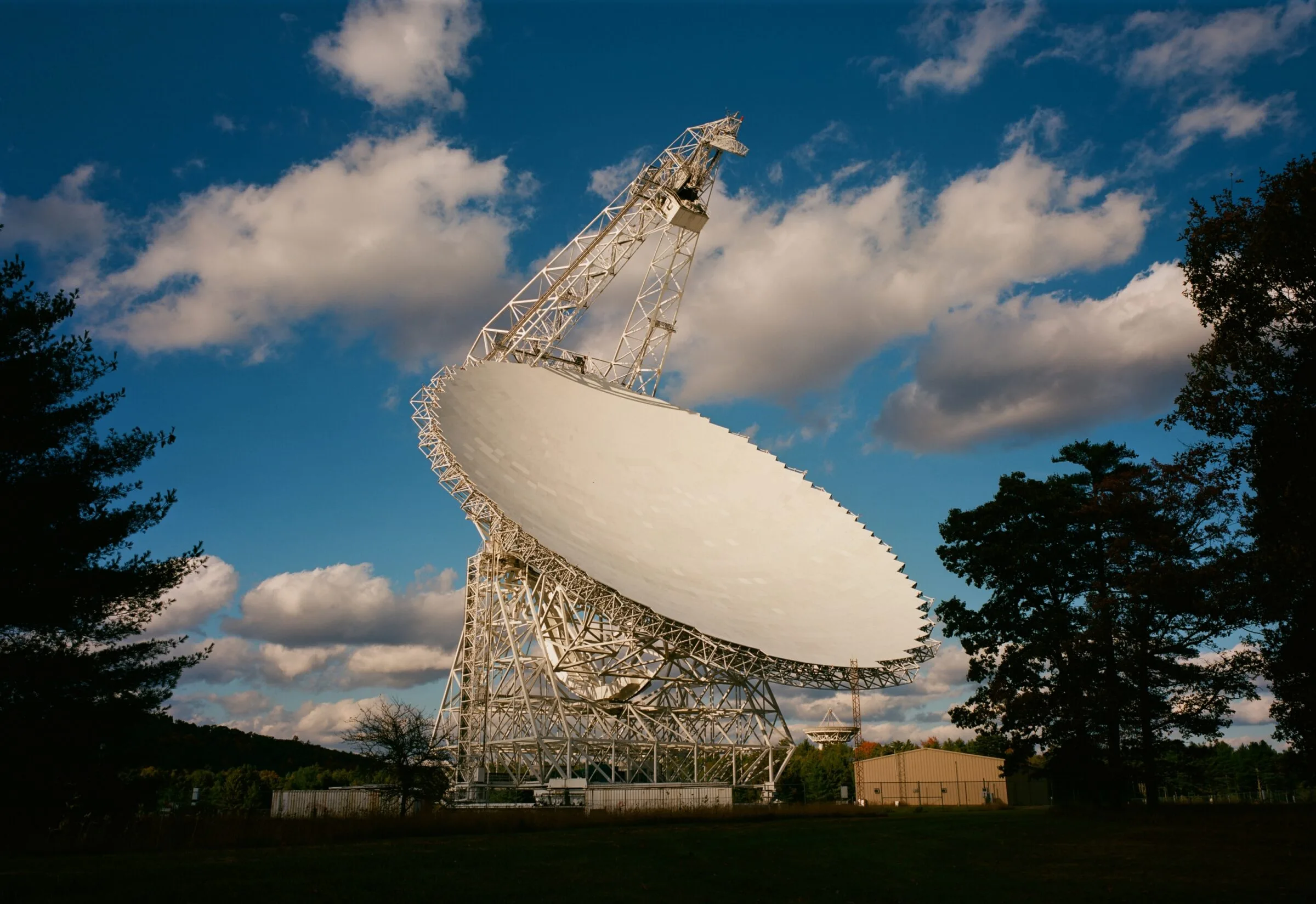
Green Bank, West Virginia, is home to the world's largest fully steerable radio telescope. It's also the only town in the United States where cell phones and Wi-Fi are banned, so that the telescope can listen for faint signals from across the Universe undisturbed. This week, we bring you a special conversation recorded after The Planetary Society's virtual screening of "Small Town Universe," the documentary that follows the people whose lives are shaped by that place. Mat Kaplan, The Planetary Society's senior communications advisor, talks with filmmaker Katie Dellamaggiore and physicist Ellie White about making the film, the beauty and stakes of life at Green Bank, and the ongoing fight to keep the observatory funded.
Before that, Kate Howells, public communications specialist, previews the total solar eclipse crossing parts of the northern hemisphere on Aug. 12, the first visible from western Europe since 1999. And Bruce Betts, chief scientist, joins for What's Up, breaking down Hayabusa2's July 5 flyby of asteroid Torifune.


Related Links
- Small Town Universe
- Find or request screenings of Small Town Universe
- Green Bank Observatory
- Go Green Bank Observatory
- Katie Dellamaggiore - IMDb
- Ellie White | Department of Physics and Astronomy | West Virginia University
- Experience the Total Solar Eclipse
- Hayabusa2’s flyby of asteroid Torifune
- Buy a Planetary Radio T-Shirt
- The Planetary Society shop
- The night sky
- The Downlink
Transcript
Sarah Al-Ahmed:
Small Town Universe, this week on Planetary Radio. I'm Sarah Al-Ahmed of The Planetary Society with more of the human adventure across our Solar System and beyond. In the mountains of West Virginia, USA, sits a town where cell phones and WiFi are banned. That's also that the world's most sensitive radio telescope can listen undisturbed for signals from the cosmos.
This week, we're bringing you a special conversation recorded live at The Planetary Society's screening of Small Town Universe, a documentary that follows the people whose lives are woven into that remarkable place. Mat Kaplan, our Senior Communications Advisor here at The Planetary Society and the original creator of Planetary Radio sat down with director Katie Dellamaggiore and physicist Ellie White. They talked about the making of the film, the beauty of Green Bank Observatory, and the fight to keep its funding secure.
But before that, we've got a preview of the total solar eclipse coming to European skies next month with Kate Howells, our public education specialist. And Bruce Betts, our chief scientist, joins me for What's Up, where we look at Hayabusa2's recent flyby of asteroid Torifune. If you love Planetary Radio and want to stay informed by the latest space discoveries, make sure you hit that subscribe button on your favorite podcasting platform. By subscribing, you'll never miss an episode filled with new and awe-inspiring ways to know the cosmos and our place within it.
We begin with a preview of something that you really don't want to miss. On August 12, 2026, just a little over a month after this episode airs, a total solar eclipse will sweep across parts of the Northern Hemisphere. For the first time since 1999, it's going to be visible from Western Europe. The path of totality runs through Iceland, Greenland, and Spain with up to two minutes and 18 seconds of darkness in the middle of the day. You guys know how I feel about total solar eclipses. They're one of the most magical things that we can se here on earth. It's pretty rare to have a situation where the angular size of the sun and the moon on the sky are exactly the same, especially on a world with life like ours.
I'm joined now by Planetary Society's public education specialist, Kate Howells. She's heading to Spain to catch this total solar eclipse, on her honeymoon no less. We'll talk about what makes this eclipse special, how different it's going to be from Europe's last one, which was in a world before live streams and social media, and how The Planetary Society is offering resources in French, Spanish, and German so even more people can experience it. Hey, Kate.
Kate Howells: Hi, Sarah.
Sarah Al-Ahmed: Oh man, we only have only a month. It's a little over a month until the next major total solar eclipse. I want to bring you on to talk about this, not only because this is a huge moment, but because as a member of our staff, you're going to be celebrating your honeymoon at this eclipse. Where are you going to be going?
Kate Howells: Yes, indeed. My new husband and I will be going to Spain for the total solar eclipse. We're going to be there for a couple of weeks in August, but we timed it specifically to be there for the eclipse. We'll be a little north of Madrid, got a little country Airbnb, and we are going to take it all in. Having witnessed the last total solar eclipse that passed over North America where we live, we're both addicted now. We're just hooked. We are unfortunately going to be lifelong... Well, I don't want to say unfortunately. We are going to be lifelong eclipse chasers, I think.
Sarah Al-Ahmed: I always love it when people use total solar eclipses as a moment to celebrate relationships. It's probably because of that imagery of the diamond ring effect that you get right as the sun peaks out from behind totality. It just feels like one of the most romantic space moments, to me anyway.
Kate Howells: That's true. I didn't even think of the diamond ring connection, but it's very fitting for a honeymoon.
Sarah Al-Ahmed: Well, we only have a month out. So anybody who hasn't planned to go to this already is probably a little out of luck because everyone's really excited about it. I still wanted to give people a moment to understand when this is happening and maybe warn some of the people who are listening from Europe that this is going to be going down because anytime there's a total solar eclipse, I know traffic patterns change, the sky changes, animals change, so much goes down. Even if you don't plan to be at one of these things, you should probably be aware of when it's going to be happening. So, when's the next one coming up?
Kate Howells:
This is going to be August 12th of this year, 2026. The path of totality is passing across Greenland, Iceland, and Spain. However, pretty much all of Europe and even some parts of Eastern North America are going to see partial solar eclipses. If you live in Europe anywhere, go to planetary.org/eclipse. You'll find our map that will show you exactly how much of the sun will be obscured from where you live. If you're close to the path of totality, yes, traffic is going to be a bit wild, but it's definitely worth making the journey to go see the total solar eclipse because it is unlike anything else you'll ever see in your life.
However, if you can't make that trip and you're in the path of partiality, it's definitely worth getting some solar eclipse glasses and looking up safely to see the sun eclipsed because that is also a really cool phenomenon that you do not get to see very often.
Sarah Al-Ahmed: Yeah. There are so many cool ways that partial eclipses display themselves in the world around us. My first total solar eclipse was back in 2017, I want to say. The way that the shadows came through the leaves on the trees is something I am never going to forget. That was just amazing. I do want to reiterate people need to be observing this safely, so get the solar eclipse glasses now. Because at the last eclipse, I did speak with an optometrist about what this has done to people's eyeballs throughout the years who didn't know. It is an actual thing that they can see burnt into people's retinas.
Kate Howells:
Yes. Staring at the sun is never a good idea. Even glancing at the sun is a bad idea. However, yes, if you're listening to this on August 11th and you don't have your eclipse glasses, and you don't know where to get any, you can definitely still enjoy the side effects of the eclipse, like what you were talking about with the shadows of leaves. We've actually got an article on our website, again at planetary.org/eclipse, that tells you how to enjoy a partial solar eclipse.
There are lots of cool things like you can hold a colander like what you'd strain pasta in. You hold that up and look at the shadow that it casts on the ground, and instead of little circles where the light would shine through the holes in the colander, it's little crescents. You can even just put your fingers into a sort of lattice shape and hold that out to make a crisscross shadow on the ground. That will create little crescents in the spaces between your fingers. It's really, really cool. Definitely worth getting outside if you can and just experiencing this eclipse in whatever way is possible for you.
Sarah Al-Ahmed: I feel like in North America, we've been really lucky over the last decade or so. There's been a number of these events coming past us, but this is the first time that Europe has been able to experience a total solar eclipse in a while. I could just go into my closet and pull out 50 eclipse glasses. I literally keep a bag just in case, but I'm sure there's a lot of people who just, they don't have that because it's been so long. When was the last time that Europe experienced anything like this?
Kate Howells: Yeah. It was almost exactly 27 years ahead of the one that's coming up, so it was August 11, 1999. This was the last total solar eclipse to pass over mainland Europe. People in Europe have not had a lot of opportunities to go out and experience this, so all the more reason to try to witness this in some way. With a month left, hopefully you can still get some... I'm sure you can get eclipse glasses online somewhere, but make sure that they're properly certified safe eclipse glasses because you don't want some scam glasses that are actually going to burn your eyeballs, and certainly don't just stack a bunch of sunglasses on each other. That's a real no-no. Again, one of our many eclipse resources is a guide to eclipse glasses safety, so check that out for sure.
Sarah Al-Ahmed: Something I keep thinking about with this is that that was 1999. I can flashback to what I was doing in my personal life, but it was also a time before we had social media. In recent years, whenever there's a total solar eclipse, part of what I love doing is watching videos as it crosses over different countries, different states and seeing their reactions. This is the first time that Europe's going to be able to do anything like that, and I think that's really going to change the experience for people, and for us and other nations that aren't going to be watching it.
Kate Howells:
Absolutely, because not only can you experience sort of secondhand what it's like to see an eclipse, but also this just makes it so many, many more people are aware that there is an eclipse taking place. I know that the last big total solar eclipse to pass over the United States had many, many more people travel into the path of totality than previous eclipses because the internet and social media amplified the news in advance that this was happening.
And so, I'm sure the same thing will be true in the European eclipse. People are just so much more tuned into all different kinds of news. It's not just the news that your local station, or your national paper, or whatever opts to include. If you're a person who's interested in space, you have so much more access to space information. I'm sure there are going to be lots of people who maybe would have traveled to the 1999 eclipse in Europe had they known it was happening, but who will be traveling to this one, or at the very least stepping outside and looking up safely.
Sarah Al-Ahmed: Speaking of increasing access to the eclipse, I mean, we communicate mostly in English at The Planetary Society. Most of our members speak English as their primary language, but this is one of those moments where we really wanted to give people an opportunity to have access to some of those resources. And so, for the first time ever, we translated some of our eclipse resources for people. Can you tell people a little bit about that and where they can find them?
Kate Howells:
Yeah, absolutely. This is super cool. I mean, yes, like you said, as a global organization, we've got members around the world and we've always been curious about translating our resources, but we've got this huge website with so much content, and there are so many languages in the world, and we've got members from everywhere. So how do you decide what to do? This was a great test case where we said, okay, this eclipse totality is passing over Spain, so let's definitely translate into Spanish. It's also passing over Iceland, but I think something like 99% of people in Iceland speak fluent English so we said, all right, maybe we'll save our resources.
We've translated into French and German as well because those are countries where a huge amount of people live who are in striking distance of the total solar eclipse. So reasonable to expect people to travel to the path of totality, or at least to go outside and look up and experience the partial solar eclipse. We focused on those three languages: Spanish, French, and German just because of population and proximity, but we're really hopeful that this will expand people's access to the kind of resources that we provide that help people know what to look for.
When you go outside and if you're in the path of totality, make sure you listen for the chirping of birds to stop. Make sure you look for the diamond ring effect that we mentioned earlier. And then if you're in the path of a partial eclipse, got those tips on how to make the little crescent shadows and stuff like that, all of these cool resources you're not necessarily going to get just from your local news. We wanted to make sure that those were available to as many people as possible, so we've expanded into these languages.
If all goes well and it has an impact, it's definitely going to fuel future efforts to translate more of our educational resources into other languages, which I think would just be such a great way for us to further engage people all around the world in the adventure of space.
Sarah Al-Ahmed: I love that so much. I mean, I want so much for us to become a more Planetary Society. We have members all across the world, and this is something not a lot of people know, a third of all Planetary Radio listeners live outside of the United States. We're reaching people all over the world. Every single country has listened to this show, and we want to make sure that everybody has access to space. I'm really glad that we're doing this.
Kate Howells: Me too. Absolutely. It makes me very proud and I hope it helps people.
Sarah Al-Ahmed: Right. Well, I know you've got a lot to do to pack and get ready for this trip. You're going to be gone for a little while and we're all going to miss you, but it sounds like it's going to be just a totally magical moment to have a honeymoon and an adventure. I'm really looking forward to hearing about your adventure once you get back.
Kate Howells: Thanks, Sarah. I'm really looking forward to it. It's going to be a totally magical total eclipse.
Sarah Al-Ahmed: I'll talk to you later, Kate. Thank you.
Kate Howells: Thanks, Sarah.
Sarah Al-Ahmed:
If you're one of the lucky ones catching next month's eclipse, we'd love to see your images. Send us your photos by replying to our DownLink newsletter emails or by writing to [email protected]. Just let us know whether or not you're a Planetary Society member. You can also share them with your fellow members right inside our online member community.
That eclipse is still a month out, but our next story is about a different kind of looking at the skies, one that's been going on for decades in a small town in West Virginia, USA. Green Bank is home to the Green Bank Telescope, the world's largest fully steerable radio telescope, which is run by the National Science Foundation supported Green Bank Observatory. To protect its work, the U.S. Federal Communications Commission established the National Radio Quiet Zone back when the Observatory was founded. It's a roughly 13,000 square mile area that also shields a federal facility in Sugar Grove, West Virginia.
Within the town itself, cell phones and WiFi are completely banned, making Green Bank the only town in the United States where that's the case. All of that so that the telescope can listen to faint signals from across the Universe undisturbed. The Green Bank Telescope is sensitive enough that in theory, it could detect a cell phone on Mars, even in airplane mode. That's the setting of the documentary Small Town Universe from filmmaker Katie Dellamaggiore, whose work has been supported by the Sundance Institute and the National Endowment for the Arts.
Her debut film, Brooklyn Castle, was a New York Times Critic's Pick and earned an Emmy nomination. And Small Town Universe has since been screened on PBS's Reel South and at festivals across the United States. Right now, the film is only screening by request, so if you'd like to see it, check out smalltownUniversefilm.com for upcoming U.S. screenings, or you can request a live or virtual screening of your own. And that's exactly what The Planetary Society did.
On May 20th, The Planetary Society hosted a live virtual screening of the film in our online member community. We followed it up with a conversation with Katie Dellamaggiore and physicist Ellie White, one of the film subjects. Ellie is now a PhD student at West Virginia University where she's continuing her work in radio astronomy, including recent research on Breakthrough Listens observations of the interstellar object 3I/ATLAS using the Green Bank Telescope. One quick note before we get into this. Some of the audio from that evening came through a little garbled.
At one point, someone name checks the film's animator, Lottie Kingslake, whose hand-drawn painterly work brings a lot of the film science to life. So I wanted to make sure that you had that name in case it's hard to catch in the recording. Here's that conversation hosted by our Senior Communications Advisor and the creator of Planetary Radio, Mat Kaplan.
Mat Kaplan: Welcome back everyone. I am so glad to have seen all the wonderful comments that so many of you have been posting throughout that terrific film. I've now seen it three times, and I think I love it more each time. So once again, congratulations.
Katie Dellamaggiore: Thank you. That is lovely to hear. [inaudible 00:16:29].
Mat Kaplan: I have a lot of questions for you, but I'd also like you to introduce our other very special guest because I have questions for her too. So go ahead and do that, and I will in a moment bring up her picture.
Katie Dellamaggiore:
I am very excited to introduce someone very special from the film. Her name is Ellie White. I first met Ellie and her family back in 2016 when they were hoping to lead the effort to save the Green Bank Observatory during an uncertain moment in its history. Ellie and her mom, Dina, became important voices in GBO's growing advocacy movement, helping people understand why this space matters, not just as a world-class scientific facility, but as a source of inspiration for future generations of scientists like Ellie.
Even back then as a high school student, she had this incredible way to connect science and humanity, and big ideas, and everyday ideas in a way that felt like super grounded and relatable, especially to someone like me. Since 2016, you might not be surprised to learn that Ellie has accomplished quite a lot. She earned her undergraduate and master's degrees in physics at Marshall University where she also taught Intro to Astronomy. She's worked on projects and instrumentation and study with the GBO, NRAO, UC Berkeley Study Research, and the Study Institute. And along the way, she's also received the 2021 Study Forward Award, a prestigious Goldwater Scholarship, and an NSF Graduate Research Fellowship.
Beyond all of those accomplishments, what's also so remarkable about Ellie is that she embodies that thing that I wanted to capture in this film, which is that the idea that science is deeply human. She's very generous and committed to sharing science with others, and that's something that continues with her work, is Go Green Bank and its ongoing efforts to help promote this future of the Observatory, protect the future of the Observatory. It has been such a privilege to document even just a small part of her and her family's story. I'm so happy that she's here with us. So please welcome Ellie.
Mat Kaplan: Ellie, thank you so much for joining us and for your absolutely wonderful contribution to this great film.
Ellie White: Thank you, Katie, for the lovely introduction. You're the only reason that I am part of this film, so thank you to you and your team for making such a beautiful piece of art. Of course, my family is... not for them, I would not be here either, of course. Thank you Mat and Planetary Society for hosting this wonderful screening, and for inviting me to participate. It means a lot. Thank you for all that you guys do to support science education and advocacy. It's super important. So yeah, happy to be here.
Mat Kaplan: We're going to talk more about the advocacy side because that's something you're deeply involved with as well. I will have a link because, sad to say, the Green Bank Observatory is once again under threat because of the possible cancellation of funding, or at least de-production in funding, but we'll come back to that. Ellie, I'm seeing such amazing reactions to people. I'm really glad we made you a surprise. We've got some OMGs. We've got... Joe says, "Ellie, yes." Grace says, "She famous." "Hi Ellie. Hi Ellie." Anyway, it's very, very nice to see. Congratulations on that NSF fellowship that you received, what, just a couple of years ago or last year?
Ellie White: Thank you. I just finished my first year as a fellow. So yeah.
Mat Kaplan: And so now your studies continue, but you're a graduate assistant. As we heard from Katie, you're teaching.
Ellie White: Yes. I just finished teaching this spring. It's one of my favorite things to do. If any of my students happen to be watching, I'm so proud of you guys. I'm actually going to be starting my PhD at Western University in the fall and continuing on with that fellowship.
Mat Kaplan: Fantastic. Congratulations. There's so much that I want to talk to both of you about. Ellie, I'm going to turn back to Katie for a moment and learn a little bit more about the film. Just beginning with how in the world did you come up with the thought that, oh, this is a story that we should tell as a documentary?
Katie Dellamaggiore:
Yeah. I didn't come to this as someone who knew anything about Green Bank or really anything about radio astronomy at all. I was inspired by the idea that there was a town without cell phones and WiFi. At the time that I learned about Green Bank, I was kind of grappling with my own questions of what it meant to connect with people via this technology. My mom had just died and kind of was missing her cell phone calls, but also was way too addicted to my own cell phone for other reasons.
Yeah. I was just like, well, what if it all just went away? And so, a Google search led me to Green Bank, and yeah, as a filmmaker, I knew there was something there, but I wasn't quite sure of the way in yet or what would make the film more meaningful than just about a town without cell phones. It only took one trip there for me to realize that the Observatory was really the heartbeat of the film, and the anchor, and that some of the wonderful folks that I met in town, including George, and Donnie, and of course Karen and the boys, and eventually Ellie would kind of orbit the telescope with their personal stories, and that they would kind of bring to life these bigger ideas about radio astronomy that, to be honest, I knew nothing about.
I knew we needed a human way in for other folks like me to understand and appreciate it. And so, that kind of became the inspiration for the film was to go in deep with [inaudible 00:22:32] story.
Mat Kaplan: How did you manage to get your camera, and I assume a crew of course, into so many intimate situations, really deeply affecting situations with Ellie and with so many others?
Katie Dellamaggiore: Yeah. It's an interesting question and probably a question that maybe some of them can answer from their point of view, but from my point of view, it took a long time to make this film. Nowadays, content is created so quickly and you go out and shoot something, you edit it, you upload it, boom, done. But this film took like eight years to make.
Mat Kaplan: Wow.
Katie Dellamaggiore: And so, that was real time spent with people, and going back, and going back, and going back. I think with that hopefully just comes a level of trust through that kind of continued connection, and not just like going into Green Bank and trying to tell a story in a couple of days and then that's it. I think that the investment of time probably is a big part of it.
Mat Kaplan: Eight years making this, but not your first outing. I mean, I've only seen the trailer so far for Brooklyn Castle, but now I very much want to see this terrific story about these kids. Most of them disadvantaged in Brooklyn, of course, and they're chess champions. This film, I mean, I think I only know about a couple of the awards, New York Times Critics Pick, Emmy nominated. Obviously, you hit your stride pretty well even with your first attempt.
Katie Dellamaggiore:
Yeah. That film is available if anyone wants to watch it. It's on Apple and Amazon, I believe. Winning chess team from Brooklyn, who knew that we had chess superstars here in our public school system? Again, I think that the unexpectedness is what drew me to that story, much like Green Bank, uncovering a story that breaks a cliche or challenges your assumptions about a place, or what you're told people somewhere might be like.
Fun fact, my kids who are 12 and 13 now, go to their public school. They were not born when the show came out. They do not play chess, but they do go to that school that's featured in the film. So yeah, I invite everyone to go rent it if they're...
Mat Kaplan: You want to say something about your professional and life partner at the company that you run?
Katie Dellamaggiore: They call him Jared Nelson.
Mat Kaplan: Yeah. Yeah. Nelson, who also edited this film, right?
Katie Dellamaggiore: Yes. He edits everything because he is the best editor I know, so thankfully he sticks around and he keeps doing it.
Mat Kaplan: There were several comments as we were rolling the film about the terrific animation. And that one also struck me the first time that I saw it because it really adds a lot, and it's beautiful. Can you talk about that a little bit?
Katie Dellamaggiore:
Yeah. I think from the very beginning, we knew that we wanted to bring some more complex ideas to life through animation and wanted to approach it in a way that felt like it was in the spirit of the film with a human touch, so to speak. And so, the animation has this painterly hand-drawn human kind of collage feel to it, and that was very intentional because we wanted it to feel like the film, feel intimate like the film. And so yeah, we stumbled across this artist's work and she seemed like she got it, and she nailed it.
Her name is Lottie Kingslake, and yeah, it was amazing to collaborate with her. I think that a lot of people love the animation, just like you said. I think it does its job and it kind of helps to explain those concepts, but also it's just really beautiful, which I think is in line with the theme of the film, the beauty of the Universe. The animation is beautiful.
Mat Kaplan: It is a wonderful contrast between the glory of the Universe, beautiful in itself, and this gorgeous little piece of land that the United States has set aside for this very special work. Ellie, I invite you to comment on that as well, but the sense that it is really a film about... In some ways anyway, it's also about beautiful human beings, but it's about beauty in that way at many scales.
Ellie White:
Yeah. Yeah, for sure. I mean, my family and I, our relationship with the Observatory kind of predated me. My parents first went there in the '90s. When my brother and I were young, they of course took us to the Observatory many times, and eventually I got into astronomy, wanted to be an astronomer, a physicist. And so, we started going up there much more often. Of course, you see what happens in the film.
I totally agree, the animations do such a great job of capturing both how beautiful it is, but also as Katie was mentioning, kind of cozy feel, I guess. It's a really special place for a lot of reasons, and I've had the good fortune both to experience the site as a visitor and as an employee a few years back between my undergrad and my master's. I worked there as a data analyst. We have a lot of special friends that live there between the beauty of the natural surroundings and the telescopes themselves. Quite a few in addition to the Green Lake Telescope, the main one that people know.
Of course, you saw the 140 foot in the film, and that one I think is one of the most beautiful telescopes. It's the largest equatorially-mounted telescope in the world. Just an amazing juxtaposition of natural beauty as well as the beauty of taking new knowledge through science.
Mat Kaplan: To say nothing of that small dish that we saw being placed in concrete, I assume in your backyard there back at home, that dish is still there, I assume?
Ellie White:
It is. I'm embarrassed to say it is not yet functioning, but that's one of my goals for the summer actually is to get that started. There's actually a really cool project out there called Wow At Home, if people are interested in researching ways to get involved in radio astronomy. There's also the Society of Amateur Radio Astronomers. They offer some pretty cool kits and things if you're interested in building your own radio telescope and talking to some pretty cool people that know a lot about what they're doing.
Of course, the Zooniverse project is another great citizen science [inaudible 00:29:10]. Yeah. A lot of times those are a bit more like computer-based, but sometimes that's what [inaudible 00:29:16], so if you don't want to get into some of the equipment and that kind of thing, if you're more interested in contributing to efforts to help scientists analyze data, Zooniverse is a fantastic project. I've used it with my classes with my Intro Astronomy students and it always seems to be a hit. I recommend Zooniverse for sure.
Mat Kaplan: I'm very proud to mention, most of our members probably know that Planetary Society has been part of the SETI effort for many, many, many years, and we helped to start the SETI at Home project, which I used to have running on my machine back when it was active. It was nice to note that I was a little bit of the search.
Sarah Al-Ahmed: We'll be right back after this short break.
Kirby Runyon:
Hi, I'm Kirby Runyan, Planetary Geologist at the Planetary Science Institute, and founder of Planetary Experience Consulting. Think of your favorite photograph from the moon or Mars. Have you ever wanted to read the stories recorded in those rocks? You can learn how. This October, I'm co-leading a three-day expedition to some of New Mexico's finest planetary geology analog sites, and I'd love for you to join me. From October 15th through 19th, we'll explore tube-fed lava flows at Carrizozo, soak in the volcanic desolation of Kilbourne Hole volcanic crater, and stand at sunset over the sublime White Sands National Park.
These are some of the same landscapes where Apollo and Artemis astronauts have trained. We'll also visit Spaceport America, the New Mexico Museum of Space History, and the Las Cruces Challenger Learning Center. Space is limited to just 20 people, and for every person who registers, The Planetary Society will receive a donation. Head to planetary.org/travel to learn more and save your spot. I hope to see you there.
Mat Kaplan: One of the beautiful human beings in this film is known to a lot of us in this field and fans of this field, Frank Drake makes a brief appearance, Katie, in a couple of scenes. Just an absolutely lovely man. I'm glad that you were able to include him as one of the true founders of the Search for Extraterrestrial Intelligence. How long a time did you have with Frank?
Katie Dellamaggiore: Oh, dear. That footage, we did not have the joy of capturing ourselves. That was footage [inaudible 00:31:59], unfortunately. Yeah, we did not have the pleasure of meeting him.
Mat Kaplan: Ellie, in your time there, I mean, we lost Frank, of course, just not too many years ago, did you ever run into him or see him around town or around the Observatory?
Ellie White:
I did. Actually, I was working there when he passed. That was a really sad day. It was at the same time very special to be able to look at the telescope that he used to do his search while remembering him. Back in 2016 when I was still in high school, my mom and I crashed a Breakthrough Listen conference that was being held at the Observatory. So Breakthrough Listen, of course, as mentioned in the film, is currently the largest study effort to date.
And so, they were having their conference at Green Bank, and we were there, and Frank was there. I think the first time that I saw him was actually at the Dollar General down the street, but we didn't talk until we were in that conference. He was very kind, of course, and signed a book for me and we chatted briefly. But yeah, I just remember he was a very kind and gentle guy, and just really great to talk to.
Mat Kaplan: A truly lovely man. Yeah, absolutely. And a pioneer, which is the direction that you appear to be headed in. I mean, not only do you obviously share what our former CEO and now Chief Ambassador Bill Nye calls the PB&J, the passion, beauty and joy, of space and science, but you really seem very dedicated to sharing that PB&J. I mean, you're teaching, and just what we saw in the film of you with those young children.
Ellie White:
Absolutely. Yes. I knew that I enjoyed outreach from early on, but I didn't realize how much I would love it until I actually got in the classroom and started teaching as a graduate assistant. That was really... I mean, it's not exaggerating to say that was life-changing for me. Getting to work with students on a weekly basis, and see their progress, and hear about maybe struggles or joys they were going through, and be able to share, basically get to spend four hours a week yapping at them about my favorite space topics. That's never a bad thing, but they might say otherwise.
It was just a really wonderful experience, and I'm very, very lucky to have had that through Marshall. People sometimes ask me like, "What's the most exciting thing that you've found in your research," or things like that, and I would say working with my students, seeing how hard they work, their dedication. Many of them are working multiple jobs, put themselves through school, and they're still showing up every day and doing their best. I just find that super-inspiring, and each of them are unique and special, and I love hearing their stories. I love being able to share my passion for astronomy and space science with them in whatever small way that I can and helping them get involved in things like Zooniverse or using the 20-meter telescope at the Observatory. We do that as part of our class.
There's so much that I love about teaching. I could talk for a really long time about that, but now that I've taught once, I don't think I'll ever be able to stay away from the classroom for long.
Mat Kaplan: That's great. That's a gift to your students.
Ellie White: Yeah. Thank you.
Mat Kaplan: What is the West Virginia Alliance for STEM and the Arts?
Ellie White:
Thank you for asking that. That's actually the nonprofit that my family, particularly my mom, Dina, and the rest of my family and I started along with several other wonderful people. [inaudible 00:35:34] with the goal to try and help connect West Virginia students to exciting STEM and arts opportunities around the state and beyond. One of our projects was actually programmed by my brother in addition to some other interns, Zariah and another, Josh, and my mom, Dina.
The point of that is basically to let kids explore different resources from different museums, science museums, art museums from around the state and elsewhere during COVID. It is still up. It's still available, but we were trying to figure out a way to make some of those resources available more broadly. In addition to that, the nonprofit has hosted a screening tour of Small Town Universe, and also just trying to... audiences in West Virginia to experience the film. My mom might say coordinated this, along with several like panels and events around the screenings to create that discussion and make sure it's a film with the people that it's kind of about.
Mat Kaplan: Katie, we've had so many people in the chat before we got started today who told us, "Oh, I can't do this," or they're in Europe and it's 4:00 in the morning or whatever, who want to know how they're going to be able to see the film in the future, and what can they do to be able to get it on a screen near them or on a service they can get?
Katie Dellamaggiore:
Yeah. Thank you. I would love for as many people to see it as possible. We had a film festival screening tour, and the film was on PBS for a short while. And now, we're in the third phase of things, which is a grassroots impact campaign where we take the film out and share it with organizations like yours. And so, we're trying to put the film in front of real life audiences, as many real life audiences as possible before we make it available on iTunes or Amazon, which is coming down the road.
First and foremost, if anybody is interested in bringing the film to their community, they can just go to smalltownUniversefilm.com and there's information there on how to get in touch with us and request a screening. Then we work with everybody to figure out what they can afford and accommodate for their group. We really want to make it accessible. There's in-person screenings that we're booking. It's not really on demand yet, but if you sign up for our newsletter, which is also on the website, or follow us on Instagram or Facebook, which is us on the website, you'll be sure to find out when it is available on digital platforms, which will probably be by the end of the year, I would imagine.
So yeah, just kind of follow us on socials or sign up for a newsletter and you'll get news on when it's available more broadly. SmalltownUniversefilm.com is the website, and there you can access all the ways to get in touch.
Mat Kaplan:
You can also learn more about Katie's entire team that worked on the film, and other ways to be involved, and just the background of the film as well. All right Ellie, I'm going to come back to you, but first I'm going to post that very simple URL in the chat. For those people who maybe aren't looking at the chat, it's easy. It's gogreenbankobservatory.org., just like we are planetary.org.
How do you feel about the fact that we are back kind of where this film started? I want to ask both of you, but we'll start with you, Ellie, that this absolutely irreplaceable facility, which should be the pride of all Americans, and maybe all humans, is once again threatened?
Ellie White:
Yeah. I think anybody that's worked in science, of course you all with all the advocacy work that you do, know what a struggle it always is to make sure that science funding is secured and that these wonderful facilities like the Green Bank Observatory retain their funding because they do create such a huge impact on their communities. Of course, you saw that in the film. You may have heard Mike Holstein, the Business Director at the time, talking about how much it contributes to the local community, the local economy. It contributes 30 million a year at least into its surrounding community, and that's about three times its operating budget per year.
That of course might arguably be... As big of an impact as that is, that's arguably maybe one of the smaller impacts compared to how much of an influence the facility has on students in West Virginia, across the country, across the world, ranging from K-12 up through graduate students, postdocs, up through retirees. I did want to talk about this a little bit in case anyone here is listening and would like to do something to help the Observatory. That's always super appreciated. Of course, the link that you so kindly shared, Mat, is a great place to start.
To get a little bit more background, the NSS 2027 draft budget proposes drastic cuts to the GBS budget as well as potentially decommissioning and disposition of the site, which means either shutting it down or changing how it operates beyond recognition. In other words, it would no longer be a scientific research or education-focused facility. This is why my family and I, especially again, my mom, Dina, along with many others, formed this advocacy group get organized for the Green Bank Observatory, or GoGBO. So, we of course formed that back in 2016, but we've had to kind of re-up our efforts every time a threat like this comes up.
Something similar happened last year, very similar wording in the 2026 budget. Now, they're proposing the same cuts again in 2027. If you are interested in helping, there's a couple ways you can do it. One is you can write and/or call your Congress people. We have guidance information and draft language that you can use on our website. In the process of trying to set up an endowment to help try and sustain GBO's future as a science education-focused facility, there is a donate button on our website where you can donate to those efforts if you want.
Thank you, Mat, for the opportunity to talk about this, and again, for all that you and your team are doing to protect science funding. It's always, always donated.
Mat Kaplan: Absolutely. And it's one of our primary purposes at The Planetary Society. I have just one more question, but Katie, before I ask, I want to see if you have any final words or anything that you would like to share?
Katie Dellamaggiore: The idea that this film has become and will continue to be a tool to advocate for the GBO is really special to me and my team. I do believe in the power of film and storytelling to move people to action, so I'm hoping the film can be a tool in the arsenal to do that.
Mat Kaplan: Well, thank you for that. I mentioned The Planetary Society and what we're up to, and how thrilled we have been to be able to bring this film to our members in our member community. Running throughout the film was yet another personality, another great contributor who was of course long gone sadly before the film was created, but had a huge influence on you, Ellie. That, of course, is the co-founder, one of the three co-founders of the Society, Carl Sagan. We just loved seeing you holding up his book Cosmos and hearing about the influence that it had on you. Can you maybe add a little bit to that and say how important his legacy is to you?
Ellie White:
Absolutely. Yes. I can't say enough good things about Carl Sagan's writing, his works, how much that influenced me, especially early on as I was getting into astronomy, thinking about whether it was something I could do or not. And so, I think Cosmos was kind of the first grownup science book that I ever read, so just kind of seeing how he presented science in a way that's really pretty artistic because it kind of mentions in the film that when I was 12 or 13, I kind of thought that I would be an artist, but at the same time, I wasn't really sure if that was the path that I wanted.
And so, once I started reading Carl Sagan's books, things like that, the way that he conveyed astronomy and science as something that's not just interesting from a logical and scientific perspective, but from a storytelling perspective and an artistic perspective, how understanding astronomy helps us understand ourselves, and where we came from, and where we're going. I think seeing things in the bigger picture, the way that he was so amazingly gifted at conveying, really changed my view of both what I could do and how the world is.
I mean, that sounds kind of goofy, but really it just gave me a bigger view of the part that we all play in the Universe, why even though we might be small, we're still a very significant part of the story of our Universe. I think seeing how he connected all those dots, and just was such an amazing storyteller and really an artist at the same time as being a scientist, it was really moving and had a big impact on me, and continues to. There's still many books of his I've not read yet. They're on my shelf. I'm working through them. At the same time, I kind of don't want to work through them too fast because I always want to have a new one to read with it.
Yeah.
Mat Kaplan: Yeah. Great scientist, great storyteller. That's the key word. Katie, is that the goal that you strive for as well? Because you certainly told this story very, very well.
Katie Dellamaggiore: Thank you. Yeah, it is as a filmmaker, I think the only job we have is to tell a good story and then, at least in my opinion, all the other stuff flows from that. The understanding, and the connection, and the action, and the impact all starts with the kernel of a good story.
Mat Kaplan: Thank you again so much for being part of this first-ever virtual screening of a film in The Planetary Society member community. We are extremely grateful. Gogreenbankobservatory.org and smalltownUniversefilm.com. One more time, Katie, Ellie, thanks for this, and best of luck to both of you.
Katie Dellamaggiore: Thank you, Mat. Thank you everyone.
Ellie White: Thank you so much.
Sarah Al-Ahmed:
That conversation with Katie Dellamaggiore and Ellie White is a great reminder of how much a place like Green Bank shapes the people who call it home. It's where Ellie found her path into astronomy, and where students, teachers, and researchers still build their futures today. If you want to help protect it, head to gogreenbankobservatory.org, where you can find guidance on contacting Congress about ways to support the Observatory directly. And if you'd like to see the film yourself, there are screenings happening all across the United States. To find one near you or to request one of your own, head to smalltownUniversefilm.com/tune-in.
Coming up, Dr. Bruce Betts, our chief scientist, joins me for What's Up. We're going to talk about a risky originally unplanned flyby that just paid off. On July 5th, the Japanese Aerospace Exploration Agency, or JAXA's Hayabusa2 spacecraft swept past a small double lobe asteroid called Torifune. Hayabusa2 launched back in December 2014 and is the successor to the original Hayabusa mission, which visited the peanut-shaped asteroid Itokawa in 2005. Hayabusa2 itself is already famous for bringing back samples from asteroid Ryugu, samples that turned out to contain all five nucleo bases found in DNA and RNA.
Torifune belongs to the same family of asteroids as Ryugu and Itokawa, the Apollo asteroids, a group of earth-crossing near-earth objects. It circles the sun roughly every 383 days. Hayabusa2 captured images and thermal data during the flyby, and it's all still coming back to earth. That's next.
Hey, Bruce.
Bruce Betts: Hey, Sarah.
Sarah Al-Ahmed: So we got a bit of a grab bag of episode topics this week. We got some eclipse content, some Small Town Universe, but now also a story that we talked a little bit about, I want to say two weeks ago on the show. We were talking about all the upcoming asteroid moments, and one of them finally happened. Hayabusa2 reached Torifune on July 5th, so I wanted to talk a little bit about it because we got a really cool photo out of it.
Bruce Betts:
Yeah. They were testing close flybys, and as I understand it, they got really close. I mean, they've also used the same spacecraft to sample an asteroid at Ryugu. So yeah, Hayabusa2, impressive. Launched in 2014, did its primary mission, which was to go to Ryugu, hang out there, grab some sample, bring it back, drop it off in the sample return capsule. And then the orbiter flyby spacecraft was just hanging out, so they nicely targeted another asteroid.
And so, there's a lovely picture of Torifune, a 450-meter asteroid that is double lobed. It looks like someone glued two balls together again, very much like Hayabusa1, which was just called Hayabusa, found at Itokawa. We've seen the various asteroids and objects, now this two lobes thing, and pretty cool. They were like 100 million kilometers from earth at the time, and they were going to try to do an 800-meter away pass. I'm not sure how close they got, but they made it, and they've got a nice picture.
Sarah Al-Ahmed: I mean, I think it's pretty brave after your spacecraft has gone through its primary mission to try to do something that close. I'm sure that gave a few people a little bit of anxiety doing it, but really interesting.
Bruce Betts: Now once you're done with your primary mission, it's expendable.
Sarah Al-Ahmed: I guess, but they still have another target after this, right?
Bruce Betts: Yeah, no, I know it's not... They don't want to splatter it into something, but yes, they're going to 1998 KY26 arriving in 2031. This is supposed to be only 11 meters across. And so, it would be the smallest asteroid we've flown by in space and one that would make a heck of a fireball, but not do any damage on the surface, presumably, if it hit. Anyway, it's not hitting. It's a side note of... But it'll be interesting because these objects are flying around out there and we don't see them until they fireball in the Earth's atmosphere occasionally, so getting a closeup of that'll be interesting. I'm sure they've got a lot more data coming back, I presume from... In fact, I know from Torifune, so that'll be interesting to see what we see and get some more pretty pictures of the dog bone asteroid, and it'll be good.
Sarah Al-Ahmed: It's so interesting that so many of these are these double-lobed, weird little guys. I wonder what percentage of them are literally two asteroids that came together and formed this contact binary, and what amount of them used to be one body that flung off material and then came back together somehow. I don't know how we would figure that out.
Bruce Betts: We don't completely, but we're getting more and more statistics between flybys where we can distinguish something even of close flybys of Earth, and then of course the spacecraft. We're starting to see some shapes that are repeating themselves, and so presumably similar processes going on. But very cool if you haven't, check out the picture of Torifune.
Sarah Al-Ahmed: Torifune. I'll put that picture on the website for this episode of Planetary Radio so people can look at it. It's strikingly similar to Itokawa. That's really cool.
Bruce Betts: It looks a little like it has cornflakes on it, kind of like some of the others. That may be just me being hungry. I'm not sure.
Sarah Al-Ahmed: All space objects are food if you try hard enough. I don't mean that.
Bruce Betts: Quote from Sarah, "All space objects are food if you try hard enough." Anyway, congratulations to JAXA on another successful use of a spacecraft that already has given us a lot. Let us go on to-
Rewind: Random Space Fact: [inaudible 00:52:38] random space fact. Rewind.
Bruce Betts: So there's been this thing going on that some of the world cares about. It's soccer. We call it soccer. There's the World [inaudible 00:52:59] World Cup. In honor of that, we will do a soccer ball-related random space fact. If the sun were the size of a soccer ball. So there it is, sitting there, soccer ball-size sun. Neptune would be almost a kilometer away.
Sarah Al-Ahmed: It'd take you a long time to get that ball all the way over there.
Bruce Betts: Yeah. No, it's really kind of far. Yeah. Yeah. So anyway, far out. All right everybody, go out there, look up the night sky and think about making that goal.
Sarah Al-Ahmed: Goal.
Bruce Betts: Goal. Thank you, and good night.
Sarah Al-Ahmed:
We've reached the end of this week's episode of Planetary Radio, but we'll be back next week with more space science and exploration. If you love the show, you can get Planetary Radio T-shirts at planetary.org/shop, along with lots of other cool spacey merchandise. Help others discover the passion, beauty, and joy of space science and exploration by leaving a review and a rating on platforms like Apple Podcasts and Spotify. Your feedback not only brightens our day, but helps other curious minds find their place in space through Planetary Radio.
You can also send us your space thoughts, questions and poetry at our email, [email protected]. Or if you're a Planetary Society member, leave a comment in the Planetary Radio space in our online member community. Planetary Radio is produced by The Planetary Society in Pasadena, California, and is made possible by our members from all over this beautiful planet. You can join us as we help support the planetary community across the world at planetary.org/join.
Mark Hilverda and Rae Paoletta are our associate producers. Casey Dreier is the host of our monthly Space Policy edition, and Mat Kaplan hosts our monthly book club edition. Andrew Lucas is our audio editor. Josh Doyle composed our theme, which is arranged and performed by Pieter Schlosser. I'm Sarah Al-Ahmed, the host and producer of Planetary Radio. Until next week, ad astra.