

 Explore Worlds
 Find Life
 Defend Earth


All
All
 Sun
Sun Mercury
 Venus
Venus Earth
Earth Mars
Mars Jupiter
 Saturn
 Uranus
 Neptune
 Small Bodies
Stories, updates, insights, and original analysis from The Planetary Society.

More things to see in the amazing HiRISE image of Phoenix' descent
I have posted several times about the amazing photo captured by HiRISE of Phoenix under its parachute as it descended. There have been two common questions I've received about the photo: was there any color data taken, and what more can I tell you about how hard it was to take the photo? I've got answers to both questions for you today.

Opportunity route map update
Eduardo Tesheiner was kind enough to send me an updated version of his route map for Opportunity so we can get a sense of just how close the rover is getting to Cape Verde.

Yep, it's ice!
The Phoenix mission confirmed it this morning: the disappearing act pulled by those chunks of bright material in the Dodo trench pretty much nails the identification of the bright material as ice, which is great news for the mission. Ice is what Phoenix went all the way to Mars to study; it's what the team has been aiming for all these years.

Sands on Earth, Sands on Mars
One of the ways that planetary scientists try to understand the origin and evolution of landforms on other planets is by studying similar kinds of landforms or

Phoenix Sol 2 press conference, in a nutshell
Emily hits the high points of today's press conference.

Some beautiful video from the Spirit and Opportunity landing sites
A majority of the people who work in planetary geology are usually associated with one or maybe two missions, doing all their research on the results from one instrument on one mission. But there are a few people whose expertise cuts across many space missions, and an even smaller number of people who seem to work on almost everything. Randy Kirk is one of those people.

White Rock through the Ages: Mars Reconnaissance Orbiter (2006-present)
I apologize for the long hiatus in this White Rock series, but I hope this entry will be worth the wait.

What's up in the solar system for the week of April 28
I thought it would be fun to start the week by taking stock of what's going on with all the active planetary missions out there.

A bit of fun with Mars Express images of Phobos
I recently found the focus to work on a big project: namely, downloading and examining every Mars Express High Resolution Stereo Camera image of Mars' two moons, Phobos and Deimos.

Shadows cast from Victoria's capes and bays
This is from the

White Rock through the ages: Mars Express (2004-present)
When we last visited White Rock on Mars, both Mars Global Surveyor and 2001 Mars Odyssey were mapping the planet.
Spirit, seen from space
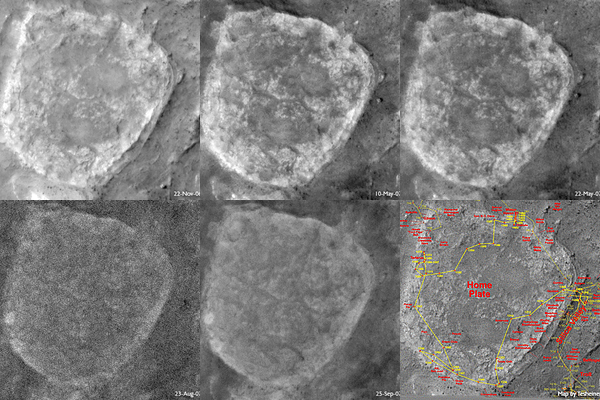
The HiRISE instrument on Mars Reconnaissance Orbiter really is a spy camera in space. Check out this sequence of nine images from the HiRISE archives, which Doug Ellison pulled together into an animation covering more than a year of Spirit's mission.

Mars Budget Cuts
Exploring another planet is an expensive business. We all know this, but sometimes it hits home harder than others. Today was one of those times.
LPSC: Thursday: Rovers, Titan, Mars, Venus Express, Neptune
I spent a large portion of the day at the Lunar and Planetary Institute's library and presented my own poster during the poster sessions, so my coverage of Thursday's sessions is limited.
Mars Climate Sounder Collects 20 Millionth Sounding
Last week Mars Climate Sounder collected its 20 millionth sounding at Mars. Mars Climate Sounder is scanning without problems, collecting science observations of the atmosphere of Mars. Mars Climate Sounder has now been observing Mars for over 17 months (three quarters of a Mars year and also approximately three quarters of the Mars Reconnaissance Orbiter primary science mission).

White Rock through the ages: 2001 Mars Odyssey (2001-present)
In the fourth installment in my look at one spot on Mars as seen through the eyes of different spacecraft, we finally get to a mission that is still operational: 2001 Mars Odyssey.

Mapping Meridiani: Part 2
Last time, I gave some of the background information about my research. Now, armed with that knowledge, we can press forward and talk about what I do.
Mapping Meridiani: Part 1
The mantra of Mars exploration is

White Rock through the ages: Mars Global Surveyor (1997-2006)
We first spotted the strange bright feature colloquially known as

White Rock through the ages: Viking (1976-1980)
This is the second installment in my look at one enigmatic feature on Mars as seen by all its orbiters through the more than thirty years of spacecraft observations.