

 Explore Worlds
 Find Life
 Defend Earth


All
All
 Sun
Sun Mercury
 Venus
Venus Earth
Earth Mars
Mars Jupiter
 Saturn
 Uranus
 Neptune
 Small Bodies
Stories, updates, insights, and original analysis from The Planetary Society.

Notes from Titan talks at the 2012 Lunar and Planetary Science Conference (LPSC)
One of the topics I found most exciting yesterday was a series of talks on Titan's climate. Bob West showed how Titan's detached haze has shifted with time. Zibi Turtle presented about how Titan's weather has changed with these seasonal changes. Jason Barnes followed up Zibi's talk -- which was based on Cassini camera images -- with a study of the same regions using data from Cassini's imaging spectrometer, trying to figure out what was going on with that brightening. Ralph Lorenz talked about rainfall rates on Titan. Jeff Moore asked: what if Titan hasn't always had a thick atmosphere?

Snapshots From Space Video: Revealing Jupiter's (Mostly) Unseen Treasures
Tens of thousands of Jupiter images were taken by the Voyager spacecraft, but relatively few have been processed to reveal their true beauty and wonder. The latest Snapshots video from Emily Lakdawalla explains why.

Pretty Picture: A snapshot of Voyager 1's departure from Jupiter
In this week's Snapshots from Space video, I talk about the Voyager 1 images of Jupiter -- how many there are (tens of thousands), and what a challenge they represent for image processors. But, I promise, the effort is worth it. Here's just one example: it's a color, crescent view of Jupiter, taken by Voyager 1 as it departed.

Pretty picture: A study in ringlight
Clearly, this is Saturn, and its rings, and if you look closer you can see a tiny circle, on top of the rings, which is Mimas, and two stars in the background. It should look weird to you that while the rings are bright, Mimas is a black dot. What is happening here? Nearly everything in this picture is lit by light that has not arrived directly from the Sun.

Pretty pictures: Voyager 2 at Jupiter
Here are two perfect examples of Voyager 2's amazing untapped treasures.

Iapetus' peerless equatorial ridge
A new paper in the Journal of Geophysical Research - Planets by Dombard, Cheng, McKinnon, and KayI claims to explain how Iapetus' equatorial ridge formed. Cool!

Put New Horizons on a stamp
A week ago, the New Horizons team announced an effort to gather signatures in support of a petition to the U.S. Postal Service to commemorate the historic flyby of Pluto on a stamp.

Pretty picture: Enceladus, in lovely color
Here's an awesome picture to start off the week. The data came from Cassini's flyby of Enceladus on January 31, 2011; it was part of Cassini's January 2012 data release.
![Juno [DEPRECATED]](https://planetary.s3.amazonaws.com/web/assets/pictures/_1200x1200_crop_center-center_82_line/juno_art_at-jupiter.jpg.webp)
Yay for Juno! First major course correction complete
JPL issued a news note today that the Jupiter-bound Juno spacecraft has successfully completed the first of twelve trajectory correction maneuvers it'll perform between launch last year and Jupiter arrival in 2016. Its next maneuver will take place in August of this year. Go Juno!

Blast from the past: The Galileo Messenger
From 1981 to 1997, the Galileo mission published an approximately quarterly newsletter called the Galileo Messenger. It eventually ran to 45 issues, until the end of the Prime Mission. The first 20 were published before Galileo ever got off the ground. That period is the subject of this post.

Pretty picture: Saturn, a big moon, and a teeny one
A recent view from Cassini of Saturn with its largest moon (Titan) and one of its small ringmoons, Prometheus.

Pretty pictures from Cassini's 12 December 2011 Dione flyby
Cassini flew close by Dione on December 12 and, as usual, the close pass provided opportunities for lots of dramatic photos, not just of Dione, but of other moons wandering by in the background.
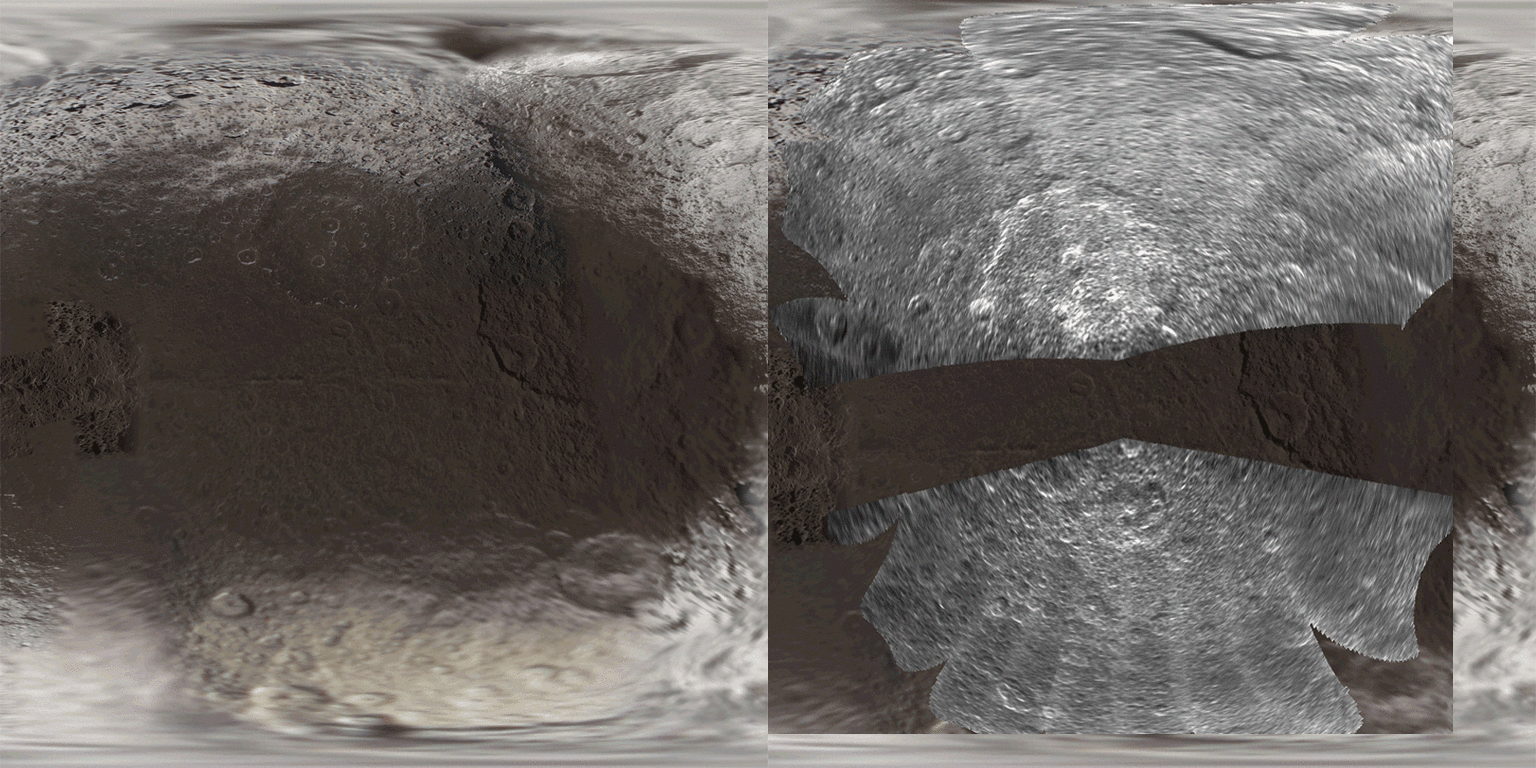
More radar images of icy moons from Cassini: Iapetus, Enceladus, and Rhea
When I posted about the really cool Cassini SAR images of Enceladus a few weeks ago, I initially wrote that this was the first-ever SAR image of an icy moon other than Titan. Several people (some readers and two members of the Cassini science team!) corrected that statement: Cassini has performed SAR imaging of other icy moons (including Enceladus) before.

Pretty picture: Mimas scuttles behind Dione
Images from the Cassini spacecraft's flyby of Dione.

From the 2011 Fall Meeting of the American Geophysical Union (AGU): Voyager 1 at the edge of the solar system
A report on a press briefing about Voyager 1 at the Fall 2011 American Geophyisical Union meeting. The spacecraft has entered a new region between our solar system and interstellar space, which scientists are calling the stagnation region.

First-ever high-resolution Synthetic Aperture Radar image of Enceladus
On the November 6, 2011 flyby of Enceladus -- the third such flyby in just a few weeks -- the Cassini mission elected to take a SAR swath instead of using the optical instruments for once. So here it is: the first-ever SAR swath on Enceladus. In fact, the only other places we've ever done SAR imaging are Earth, the Moon, Venus, Iapetus, and Titan.

Is Europa's ice thin or thick? At chaos terrain, it's both!
Among Europa scientists there are two warring factions: the thick-icers and the thin-icers. The question is how thick is the ice shell that overlies Europa's subsurface ocean (the existence of which pretty much everyone agrees on).

Pretty pictures & movies: Eye candy from two recent Cassini Enceladus flybys
Cassini has completed two very close flybys of Enceladus in less than three weeks, one of them just this morning, and the images from that encounter have already arrived on Earth.

Saturnlit moon, sunlit fountains
It's been a week of very heavy science on this blog, so I thought it'd be nice to go into the weekend with a post in which a breathtaking picture speaks for itself, without needing my thousands of words.

Notes from Day 5 of the EPSC/DPS meeting: Saturn's storm, Phobos, and Lutetia
Today was (is) the last day of the Division of Planetary Sciences / European Planetary Science Congress meeting in Nantes, France.