

 Explore Worlds
 Find Life
 Defend Earth


All
All
 Sun
Sun Mercury
 Venus
Venus Earth
Earth Mars
Mars Jupiter
 Saturn
 Uranus
 Neptune
 Small Bodies
Stories, updates, insights, and original analysis from The Planetary Society.

Saturn from above, in color
I wrote recently about a set of images of Saturn acquired by Cassini from a unique vantage point, well above the planet, looking down on the rings. Someone has taken up the challenge of assembling the 36 different images into a single mosaic, in color, and it is as lovely as I'd hoped.
A cool Cassini ring plane crossing animation
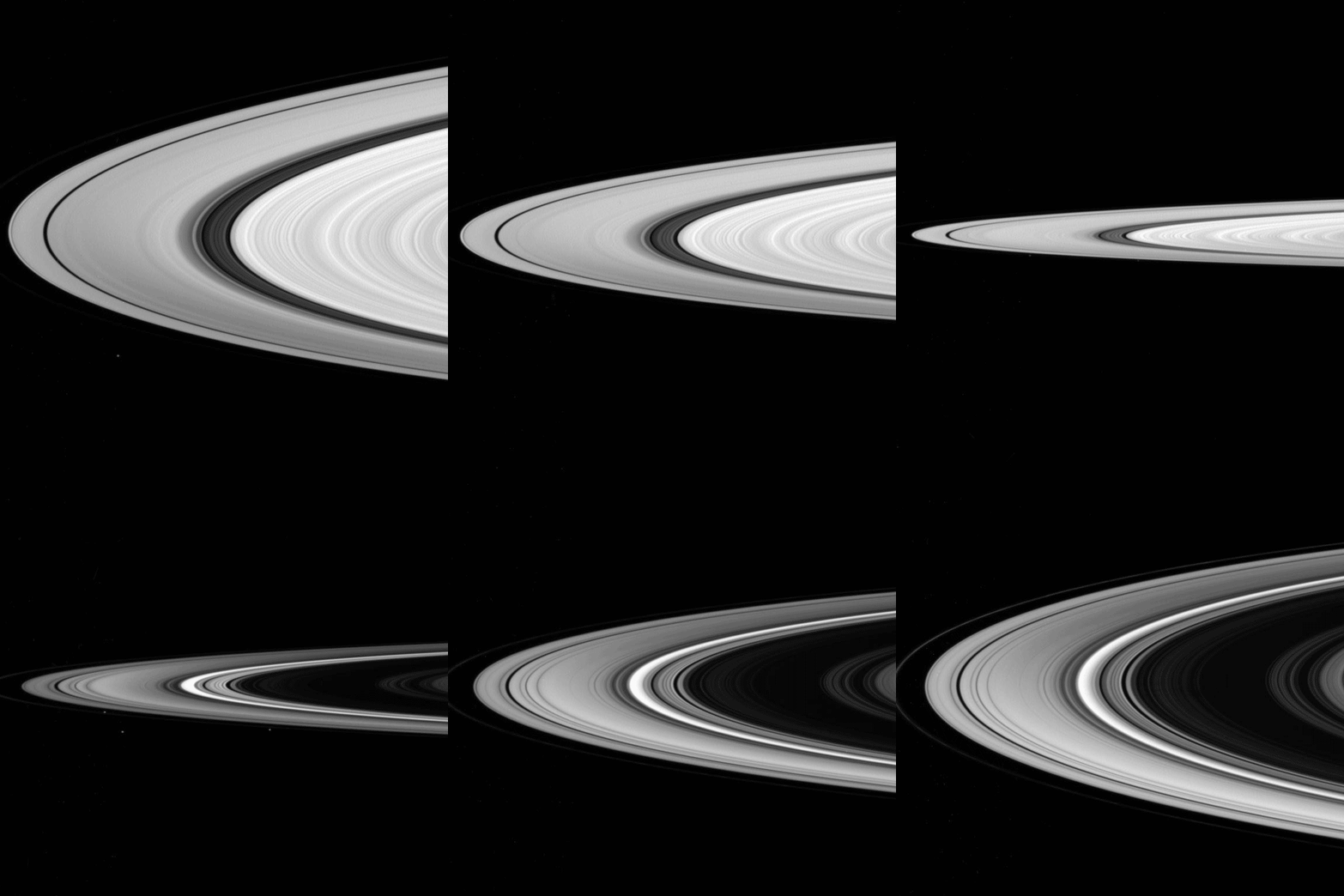
Another recent, cool set of images that came down from Cassini was a series taken last week as the spacecraft crossed the ring plane.

The Saturn view I've been waiting for
Over the weekend, Cassini acquired a set of images that will (I am assuming) eventually be used to produce a glorious portrait of the ringed planet from a point of view that's never been seen before.

More Cassini RADAR images
Cassini just flew by Titan again on Saturday, and should have acquired a new swath of RADAR data.

Titan's Lakes
The first peer-reviewed article on Titan's lakes comes out in tomorrow's issue of the journal Nature.

Mountain range on Titan
A couple of weeks ago there were press releases coming out of the American Geophysical Union meeting about the discovery of a

CIRS gets another view of Enceladus' south polar hot spot
There's a new image product released from the Composite Infrared Spectrometer (CIRS) on Cassini, an instrument that is capable of measuring the temperatures on the extremely cold surfaces of Saturn's moons and rings.

Saturn from above (2006)
Ever since I first read about the plans for Cassini's tour of the Saturn system I've been looking forward to the current phase of the mission.

Breaking a tie on the Cassini science teams
This week's Cassini Project Update was particularly interesting, because it contained a story about how a difficult decision was made regarding the prioritizing of different science teams' desires for an upcoming Titan flyby.

Cassini VIMS and RADAR: a cryovolcano on Titan?
Yesterday, the VIMS team released several images from Cassini's

New names for Enceladus' features
The IAU has just approved new names for 35 craters, dorsa, fossae, and sulci on the surface of Enceladus, based upon Cassini's high-resolution mapping of the little moon. What are dorsa, fossae, and sulci, you might ask?

Cassini's view from the backside of Saturn
Over time, Cassini's orbit apoapsis—the point on the orbit that is farthest from Saturn—has been shifting slowly toward Saturn's night side. Lately, this point of view has resulted in some truly lovely photos of the planet.

They released the entire Cassini RADAR swath across Xanadu!
Following immediately on the heels of the release of the

Cassini's T7 RADAR view of southern Titan; northern swath coming soon
Cassini's T7 flyby of Titan occurred on September 7, 2005. They've now released the full swath of RADAR image data to the Planetary Data System; here it is for your enjoyment.

The official publication on the second Titan RADAR swath is out
Today Nature published an article titled

Cassini RADAR: Another Flyby, Another Completely Different View of Titan
OK, I finally got a story written about the latest and greatest of the Cassini RADAR data based upon a conversation I had with with Ralph Lorenz late last week.

Cassini RADAR images of the surface of Titan
Since the last Titan flyby on April 30, the Cassini RADAR team has been releasing quite a large number of pieces of the swath to the Web.

OPAG, Day 1: Hot-air ballooning on Titan
The next presentation at OPAG was given by Ralph Lorenz and Tom Spilker on a Titan Montgolfiere Mission Study. What's a Montgolfiere, you ask?
Too much outer planets news for me to read (much less report on)
Before I get to my notes from OPAG I want to minimally acknowledge today's news, which I'll have to get to in more detail later.

LPSC: Wednesday afternoon: Cassini at Enceladus
So after those two rover talks I skipped over to the other large room to listen to what the Cassini science teams had to say about Enceladus.