

 Explore Worlds
 Find Life
 Defend Earth


All
All
 Sun
Sun Mercury
 Venus
Venus Earth
Earth Mars
Mars Jupiter
 Saturn
 Uranus
 Neptune
 Small Bodies
Stories, updates, insights, and original analysis from The Planetary Society.

How Do We Know When We Have Collected a Sample of Bennu?
A huge amount of effort goes into deciding where to try to collect a sample on Bennu. There are roughly nine months to survey, map and model the asteroid to help make this decision.

Adding Churyumov-Gerasimenko to my scale comparison of comets and asteroids
Having found a color photo of the comet, I finally added Churyumov-Gerasimenko to my scale comparison of comets and asteroids visited by spacecraft.

Dawn Journal: Ceres Orbit Insertion!
Dawn's Chief Engineer, Marc Rayman, gives an update on the mission's highly anticipated arrival at Ceres.

Seeing Ceres: Then and Now
Technology writer Paul Gilster shares his interest in how we depict astronomical objects, focusing on the dwarf planet Ceres.

Mini mission updates: Dawn in orbit; Curiosity short circuit; Rosetta image release; Hayabusa2 in cruise phase; and more
Dawn has successfully entered orbit at Ceres, becoming the first mission to orbit a dwarf planet and the first to orbit two different bodies beyond Earth. I also have updates on Curiosity, Rosetta, Mars Express, Hayabusa2, the Chang'e program, InSIGHT, and OSIRIS-REx.

Watch Ceres rotate: A guide to interpreting Dawn's images
NASA held a press briefing on the Dawn mission yesterday, sharing some new images and early interpretations of them. I see lots of things that intrigue me, and I'm looking forward to Dawn investigating them in more detail. I invite you to check out these photos yourself, and offer you some guidance on things to look for.
At last, Ceres is a geological world
I've been resisting all urges to speculate on what kinds of geological features are present on Ceres, until now. Finally, Dawn has gotten close enough that the pictures it has returned show geology: bright spots, flat-floored craters, and enigmatic grooves.

Dawn Journal: Ceres' Deepening Mysteries
Even as we discover more about Ceres, some mysteries only deepen. Mission Director Marc Rayman gives an update on Dawn as it moves ever closer to its next target.

Planet Formation and the Origin of Life
To understand the possible distribution of life in the Universe it is important to study planet formation and evolution. These processes are recorded in the chemistry and mineralogy of asteroids and comets, and in the geology of ancient planetary surfaces in our Solar System.
Ceres coming into focus
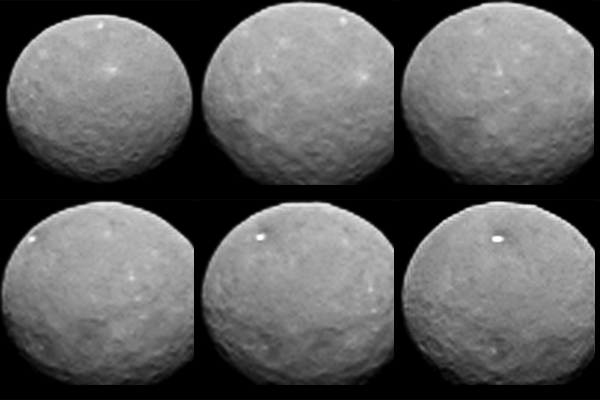
The Dawn mission released new images of Ceres yesterday, taken on February 4, when Dawn had approached to within 145,000 kilometers. More details are coming into view, and they're fascinating. For one thing, there's not just one white spot any more: there are several.

Ceres Coming Into View
Dawn is on approach to Ceres, the largest of the asteroids, and is starting to resolve features.
Dawn Journal: Closing in on Ceres
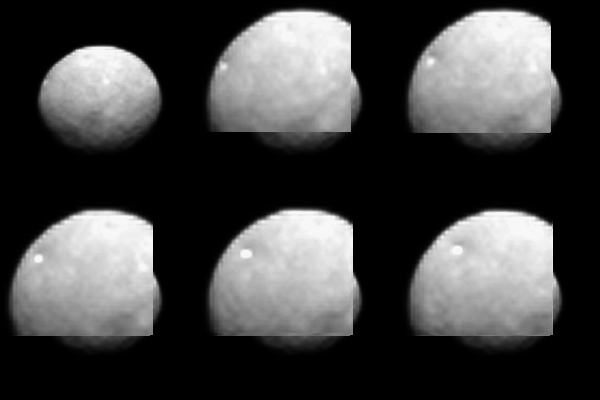
Dawn's chief engineer Marc Rayman gives an update on the mission as it gets ever closer to its next target: The dwarf planet Ceres.

Camera now measuring even fainter Near-Earth Objects
Camera purchased with the support of a 2009 Shoemaker NEO Grant is now on a new telescope providing follow-up measurements for even fainter near-Earth objects.
Ceres: Just a little bit closer (and officially better than Hubble)
Last week's Dawn images of Ceres were just slightly less detailed than Hubble's best. This week's are just slightly better.

New Dawn images of Ceres: comparable to Hubble
Dawn has captured a series of photos of a rotating Ceres whose resolution is very close to Hubble's, and they show tantalizing surface details.

Sky survey grant helps lead to a space science career
Quan-Zhi Ye was an 18 year-old college student and the principal investigator of the Lulin Sky Survey when he won a 2007 Shoemaker NEO grant. He's now a Ph.D. candidate and provides an update on his work in meteor studies.

Year of the 'Dwarves': Ceres and Pluto Get Their Due
This year we achieve the first exploration of these curious but fascinating objects. Paul Schenk explains what we may learn about them.

2007 Shoemaker Grant Still Yielding Asteroid Science
Telescope purchased in 2007 with the support of a Shoemaker grant is still in service and has worked on over 100 near-Earth asteroids over its 8 years of operation.

Dawn Journal: History of Ceres
As Dawn looks toward the new world of Ceres, Mission Director Marc Rayman looks back on Ceres' discovery.

New camera improves a California near-Earth asteroid program
A new camera is improving the efficiency of the Near-Earth Asteroid Program at the Center for Solar System Studies. This update from Shoemaker NEO Grant winner Bob Stephens reveals amazing recent progress using his 2013 Planetary Society grant.