

 Explore Worlds
 Find Life
 Defend Earth


All
All
 Sun
Sun Mercury
 Venus
Venus Earth
Earth Mars
Mars Jupiter
 Saturn
 Uranus
 Neptune
 Small Bodies
Stories, updates, insights, and original analysis from The Planetary Society.

Observing at the WIYN
On May 5 and 6, I had a run on the WIYN (Wisconsin-Indiana-Yale-NOAO) telescope, a 3.5 m telescope, the second largest telescope on Kitt Peak in Arizona.

A plea for more pictures from Dawn
If you had asked me last year what I was most looking forward to in space in 2011, my answer would have been unhesitating: Dawn's approach to Vesta. Never in my adult life have I been able to follow a space mission as it discovered a large new world for the first time.

Color versions of the recent Titan & moon beauty shots
Last week I got very excited about a set of pictures that had appeared on Cassini's raw images website, but was sad that I couldn't make color versions myself. I was so excited that I failed to identify the little icy moon in the picture correctly.

Two new views of Curiosity
This week two cool new views of the next Mars rover appeared in the Jet Propulsion Lab's image database, the Planetary Photojournal. One was real, and one simulated; I've been waiting to see both for many months.

Mars Exploration Rovers Update: Spirit Mission Declared Over, Opportunity Roves Closer to Endeavour
The Mars Exploration mission suffered the loss of Spirit and shifted to one-rover operations in May, but Opportunity carried on, blasting across the plains of Meridiani to within 2 miles (3.5 kilometers) of its next major destination and discovery.

Dawn Journal: Vesta to choose Dawn's arrival time
Dawn remains healthy and on course as it continues to approach Vesta. Thrusting with its ion propulsion system, as it has for most of its interplanetary journey so far, the spacecraft is gradually matching its solar orbit to that of the protoplanet just ahead.
Zapping Rocks for Science
Laser beams and space exploration are perfect for each other, and not just because all self-respecting starship captains know their way around a blaster. It turns out that zapping rocks with a laser is not only fun, it also can tell you what they're made of!
Mars Exploration Rovers Update: NASA Ends Spirit Mission
The intensified effort to recover Mars Exploration Rover (MER) Spirit came to an end early Wednesday morning Pacific time and NASA has now transitioned the mission to a single-rover operation focused on Spirit's still-active twin, Opportunity.

South of the Border
The last decade has seen an explosion in our understanding of the solar system with the discovery of the largest Kuiper belt objects (KBOs) of comparable size to Pluto.

A picture of Spirit that's too poetical for words
Yesterday, I remarked that despite the declaration of her death we'll be seeing Spirit frequently over the next few years, as long as Mars Reconnaissance Orbiter is still monitoring her landing site with its HiRISE camera. I said that Spirit is a lump that's relatively easy to spot because of her dark shadow. Well, Spirit's managed to make herself even easier to spot than that.

NASA Selects Next New Frontiers Mission
NASA has selected the OSIRIS-REx mission as the next New Frontiers mission. OSIRIS-REx (Origins-Spectral Interpretation-Resource Identification-Security-Regolith Explorer) will be the first U.S. asteroid sample return.
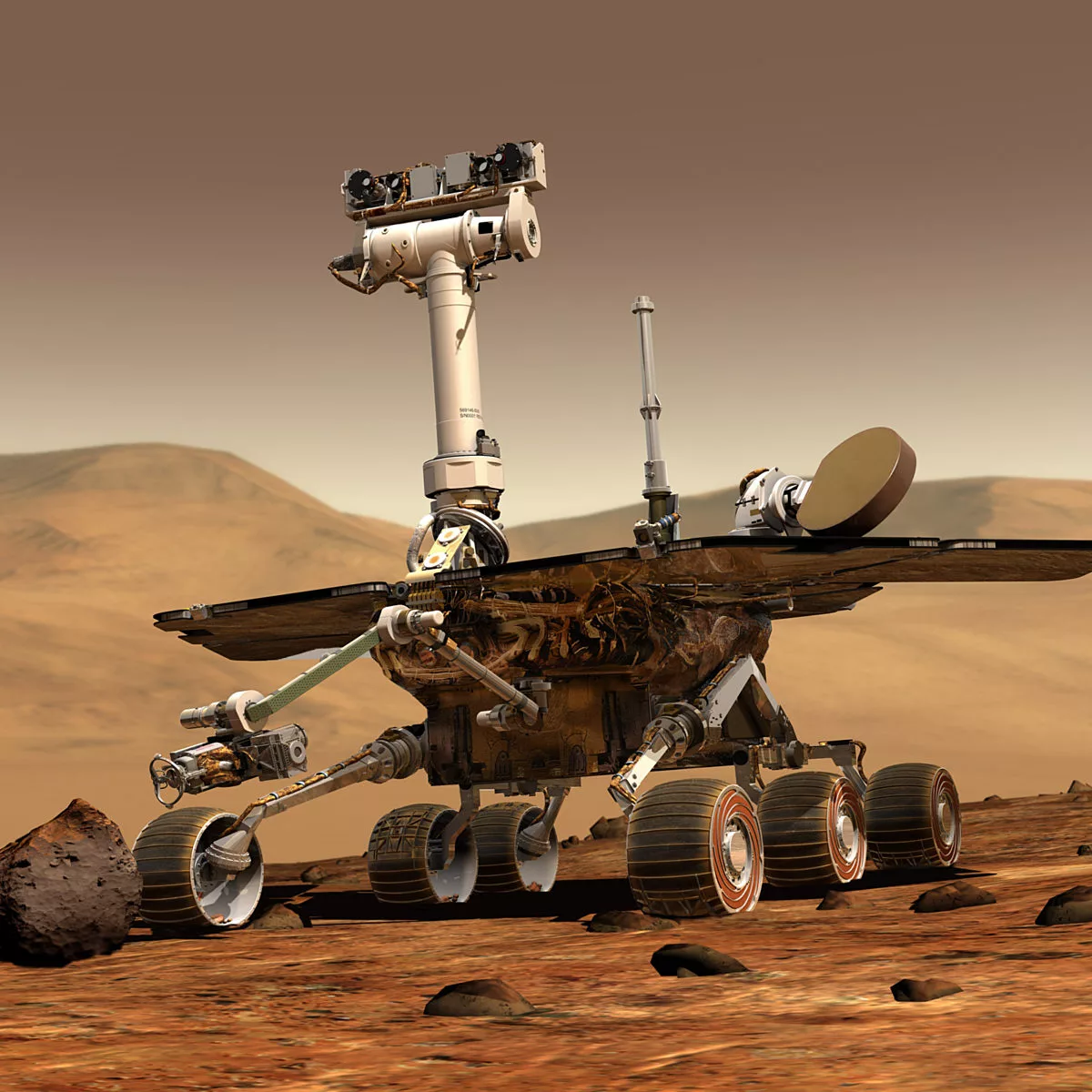
Sad news for Spirit: It's All Over But the Crying
Alicia Chang reported today that, according to project manager John Callas, the last attempt to uplink a command to the Mars Exploration Rover Spirit will be made tomorrow. NASA will cease listening for signals from Spirit on Tuesday.

Tantalizing photos of Titan, Dione, Tethys, and Saturn
It figures. I just start a three-week trip, with my only computer a diminutive Netbook, and guess what's just been radioed across the 1.3 billion kilometers separating us and Saturn? A set of photos that should become -- when properly processed -- an iconic image from Cassini's fourteen-year mission to the Saturn system.
Titan's lack of lightning
It's a fact of life in science that not all of your hypotheses will turn out to be correct (or even verifiable at all). But there's a bias toward the publication of positive results -- the discovery of this, or the proof of that.

It's opposite day at the Curiosity landing site selection meeting
I've been attending the final Mars Science Laboratory Landing Site Community Workshop meeting this week, taking copious notes for a future article in The Planetary Report, some of which I'll post here when I get a chance. But I just had to write a brief post about the totally crazy role reversal that is going on at this meeting.

Chang'E 2 to depart for L2 on June 16
According to a story posted on xinmin.xn and run through Google Translate, there's now been an official announcement from China about Chang'e 2's extended mission: it will depart lunar orbit in mid-June and journey to L2.

Bj�rn J�nsson's Voyager 1 Jupiter animation, new and improved
Late last year I posted an amazing video of Jupiter's moving clouds, an animation made from images that Voyager 1 took as it approached. Below is a new and improved version of that animation. The first one was based on 16 Voyager color photos; this one covers a much longer period of time, and includes 58 images.

SETI@home Following Up on Kepler Discoveries
Remember SETI@home? The ground-breaking computing project is now taking a look at candidate Earth-like planets that have been detected by NASA's Kepler space telescope.

Citizen Science projects for Planetary Science: Get Involved! Do Science!
Citizen Science projects let volunteers easily contribute to active science programs. They're useful when there is so much data it overwhelms computing algorithms (if they exist) or the scientific research team attempting to process it.
Land ho!
It's hard to convey just how excited I am to see Dawn's first image of asteroid Vesta.