

 Explore Worlds
 Find Life
 Defend Earth
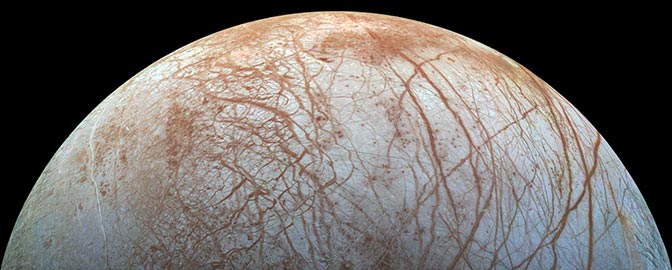

Mars, the red planet
Highlights
- Mars once had liquid water on its surface and could have supported life.
- Scientists are uncovering how Mars transformed into the cold, dry desert world it is today.
- We explore Mars to understand the planet's history and look for evidence of past or even present life.
Mars facts
Surface temperature: -153°C (-243°F) to 20°C (70°F)
Average distance from Sun: 228 million kilometers (142 million miles), or 1.5 times farther from the Sun than Earth
Diameter: 6,780 kilometers (4,212 miles), Earth is 1.9 times larger
Volume: 163 billion km³ (39 billion mi³), Mars could fit inside Earth a little over 6 times
Gravity: 3.73 m/s², or 38% that of Earth’s
Solar day: 25 Earth hours
Solar year: 687 Earth days
Atmosphere: 95% carbon dioxide, 2.6% nitrogen, 1.9% argon, 0.5% other gases
Is there life on Mars?
This question has intrigued humans for centuries. Early telescope observations in the 18th and 19th centuries seemed to show a planet not all that different from Earth, with ice caps, seasons, and features that were mistaken for seas and artificial canals. A few scientists even thought that Mars was inhabited by intelligent life.
We now know that Mars is very cold and dry, with no breathable atmosphere and no global magnetic field to protect it from the Sun's radiation. But Mars wasn't always that way. Space missions have shown us that the planet once had liquid water on its surface and could have been hospitable to life as we know it. Today, there may still be life beneath the Martian surface, with access to water and protection from radiation and extreme temperatures.
Scientists have discovered that Mars was habitable to life as we know it for at least some periods of time around 3 or 4 billion years ago. But we don't know whether the planet was warm and wet long enough for life to arise, or mostly cold and dry with only brief intervals that could have supported life.
How did Mars go from a potential life-supporting oasis to a cold, dry desert? Does life still flourish underground? The answers to these questions will teach us more about where we come from and whether we are alone in the cosmos.

Spotting Mars at night
Mars can be seen from Earth with the naked eye. As the fourth planet from the Sun, it is one of the closest worlds to Earth and one of the brightest planets in the Solar System. Venus and Jupiter are typically the only planets brighter than Mars in the night sky.
You can spot the planet Mars by its distinctive red color. Some ancient peoples associated this color with blood and named Mars after their god of war. Today, we use the name of the Roman god of war to describe Mars itself, but the Greek names of two figures related to Mars, Phobos and Deimos, to describe the planet’s two moons.
How we explore Mars
Humans have sent more spacecraft to Mars than any other planet beyond Earth. Today, there are several missions operating on or around the planet.
The United States and the Soviet Union both began trying to send robotic probes to Mars in the 1960s. Each country failed at first. Then, in 1965, NASA achieved a milestone when its Mariner 4 spacecraft became the first to successfully fly by Mars. The probe revealed a barren landscape, but later Mariner missions refined that picture. NASA’s Mariner 9, for example, spotted Mars in the throes of a giant dust storm that covered almost the entire planet. After the dust storm cleared, Mariner 9 discovered Valles Marineris, the largest canyon in the Solar System. The eventual discovery of other dry canyons, deltas, lakebeds, and river valleys would go on to suggest that liquid water once flowed on the Martian surface.

The NASA Viking landers of the mid-1970s — the first spacecraft to land on Mars successfully — tested the Martian soil to look for possible signs of life. The results showed no clear evidence of living microorganisms in the soil near the landing sites. What exactly these experiments revealed remains a source of debate to this day.
To help determine whether life once existed on Mars — and possibly still exists underground today — NASA initiated the Mars Exploration Program in the mid-1990s. In 2000, the program adopted a goal to "follow the water." Since liquid water is essential to life on Earth, the search for life on Mars shifted to focus more on looking in places where this key ingredient exists or used to exist.
Much of what we know about water on Mars comes from orbiters like the European Space Agency’s (ESA’s) Mars Express or NASA’s Mars Reconnaissance Orbiter. These spacecraft have studied the Martian atmosphere, mapped its geologic features, and determined the composition of its surface. Data from Mars Express led to the discovery of water ice underneath Mars’ polar ice cap in the southern hemisphere. Together with the northern ice cap and ice scattered elsewhere on the surface, there may be enough ice frozen on and beneath the Martian surface to cover the planet with a layer of ocean more than 20 meters (about 66 feet) deep.
Although much can be learned from Mars orbiters, some detailed observations can only be done on the surface. At first, Mars landers were stationary and only analyzed the location where they touched down. Then, beginning with the rover Sojourner — which The Planetary Society helped name — NASA developed a series of spacecraft able to travel widely and build a more complete picture of Mars’ past and present. After Sojourner,the Spirit, Opportunity, Curiosity, and Perseverance rovers have all helped advance our understanding of the red planet. With its Tianwen-1 mission in 2021, China became the second country to successfully deploy a rover on Mars.

Future missions to Mars
The next rover set to arrive on Mars is the European Space Agency’s Rosalind Franklin rover. Currently scheduled to launch in 2028, this mission will drill deep into the Martian soil to look for signs of life.
After Rosalind Franklin, the next phase of Mars exploration may involve returning surface samples back to Earth. Although rovers are highly capable mobile science labs, there are certain experiments that only facilities back on Earth are able to do. Retrieving just a few small samples would allow researchers to better understand the history of Mars, its water, and whether the planet may have supported life.
The groundwork for sample return is already underway. NASA's Perseverance rover began collecting soil and rock samples in 2021, storing them in small tubes and depositing them on the surface for future pickup. The NASA-ESA joint Mars Sample Return mission was slated to bring back these samples to Earth in 2030, but that is now in flux.
By then, Japan’s MMX mission will have already collected samples of Mars' moon Phobos. Its goal will be to investigate how the moons of Mars formed and what the inner Solar System used to be like. To grab its samples, MMX will use a derivative of PlanetVac, a technology that The Planetary Society helped support in development and testing.

Sending humans to Mars would also provide a powerful way to explore and study the planet. A person in a spacesuit would be able to move, collect samples, and make decisions much more quickly than a robot controlled from Earth, where the average round-trip time to send and receive rover signals is 25 minutes. One major step toward human exploration of Mars would be simply placing astronauts in orbit, where they could control rovers on the surface in real-time. Though there are currently no NASA missions slated to put humans on or around Mars, some private corporations, like Elon Musk’s SpaceX, have that as their goal.
Exploring Mars responsibly
If we send humans to the surface of Mars, we must do so responsibly. To avoid harming any existing ecosystems or any features of the planet with important scientific or cultural value, humanity must commit to abiding by certain guidelines. The Planetary Society advocates for scientifically motivated planetary protection policies, like those described by The National Academies of Sciences, Engineering, and Medicine, that balance responsibility with the desire to explore.

Acknowledgments: This page was originally written by Jason Davis. It was revised by Asa Stahl in May 2024.

Action Center
Whether it's advocating, teaching, inspiring, or learning, you can do something for space, right now. Let's get to work.