

 Explore Worlds
 Find Life
 Defend Earth


All
All
 Sun
Sun Mercury
 Venus
Venus Earth
Earth Mars
Mars Jupiter
 Saturn
 Uranus
 Neptune
 Small Bodies
Stories, updates, insights, and original analysis from The Planetary Society.

Congratulations to the California Science Center on getting Space Shuttle Endeavour!
Space exploration is an international endeavor and I usually try to speak as a citizen of Earth rather than one of my nation, state, or city, but I'm going to ask you to indulge me in a little local boosterism today.

Lots of great stuff in the latest Cassini data release
I've got some lovely pictures from Saturn to show you! Every three months, the Cassini mission dumps gigabytes worth of precious Saturn data into the Planetary Data System, and the latest gift came on April 1. This particular pile of data, which was taken between April 1 and June 30, 2010, contains a lot of really terrific moon observations.

Happy 50th birthday of human spaceflight
On April 12, 1961, Yuri Gagarin became the first human to see firsthand the blackness of space above our home planet's thin atmosphere. Since there's lots of thoughtful reporting and commentary being posted on this anniversary, I thought it'd be more useful to link to some particularly interesting posts than to add in my comments.

Comparing Clementine and Chandrayaan-1 spectra from the Moon
In a paper recently published in the Journal of Geophysical Research, Georgiana Kramer and several coauthors performed a careful comparison of two data sets that seem like they're measuring the same things, so you'd think that the measurements they took would match between the two instruments. But they don't quite match.

Having some fun with Curiosity's pretty face (plus, a conversation about Curiosity with a 4-year-old)
The photo I took of Curiosity's

Juno is being shipped to Cape Canaveral today
Spaceflight Now is following along as the next Jupiter orbiter, Juno, is journeying from its birthplace at Lockheed Martin in Denver to Cape Canaveral. As of this moment it has been packed up and loaded onto a flatbed trailer, which is driving through Denver with police escort, en route to the Denver airport, where it'll board a C-17 for the trip to Florida.

365 Days of Astronomy Podcast: What's up in the second quarter of 2011
Regular readers of this blog will find the content of today's 365 Days of Astronomy Podcast familiar, because it's an update on what the solar system exploration spacecraft are up to, based on my monthly

Dawn Journal: Calibrating instruments and thrusters on Vesta approach
Three and a half years after launch, Dawn continues its travels around the Sun, maneuvering to take the same orbital path as Vesta. The spacecraft has spent most of the past month gently thrusting with its ion propulsion system. Some of the thrusting this month, however, was not designed to propel Dawn to Vesta.

Spotting Jupiter's Moons...with a Solar Telescope!?
I was astounded to learn this morning that SOHO can not only see Jupiter, it can actually resolve Jupiter's moons (at least its two outer ones) as points of light separate from their planet!

Welcome to Carnival of Space #191
Welcome, everyone, to the Planetary Society Blog for the 191st Carnival of Space! Every week, a different webmaster or blogger hosts the Carnival, showcasing articles written on the topic of space.

SpaceX announces new Falcon Heavy
Today, Elon Musk, CEO and chief rocket designer of Space Exploration Technologies (SpaceX) -- as well as member of the Planetary Society Board of Directors -- unveiled plans and price points for their new Falcon Heavy.

Chang'E 2 update: primary mission successful
For months I've had no information about China's Chang'e 2 lunar orbiter for my monthly
Face-to-face with Curiosity
I had a once-in-a-lifetime opportunity today for a face-to-face visit with one of the biggest celebrities in my world: Curiosity, the next Mars rover. The Jet Propulsion Laboratory gave members of the media a chance to suit up in the white coveralls known as

Lovely giant full Moon photo
Here's a photo worthy of hanging on the wall: a gorgeous, 4000-pixel-square portrait of the full Moon captured by Rolf Hempel from Germany on the night of the

FINDS: One Step Closer to Faraway Earths
Amir Alexander explains more about the FINDS Exo-Earths project and how it will help planet hunters detect distant Earths in the depths of space.
What's up in the solar system in April 2011
April 2011 will see MESSENGER begin the science phase of its orbital mission at Mercury, and should, I think, also see the start of Dawn's approach observations of Vesta. At Mars, Opportunity is back on the road again, rolling inexorably toward Endeavour. At Saturn, Cassini will continue its focus on Saturn and Titan science.

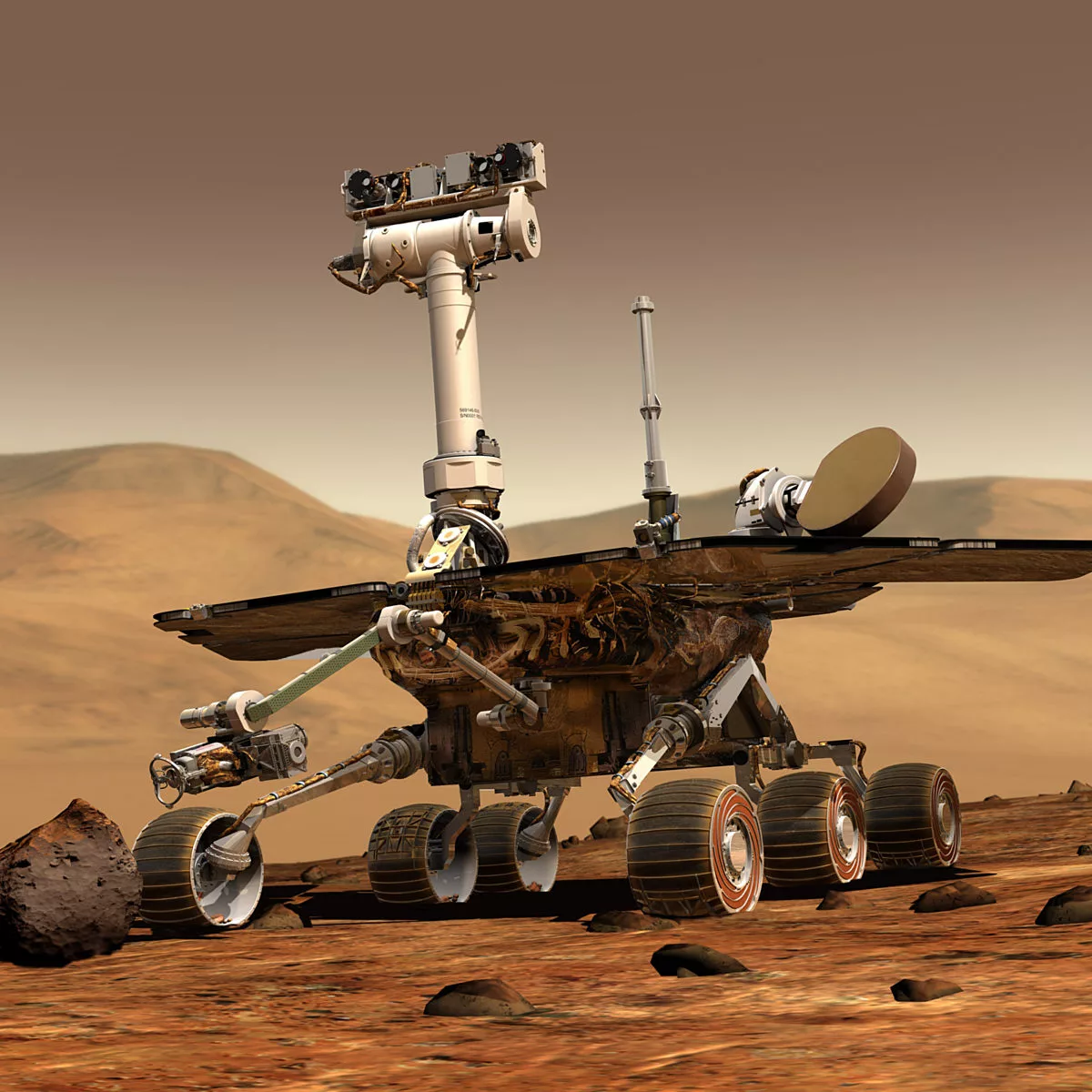
Mars Exploration Rovers Update: Spirit's Silence Haunts, Opportunity Roves on to Endeavour
The Mars Exploration Rover mission experienced a month of highs tempered by one haunting low as it neared completion of its 87th month of a three-month tour this month. While Opportunity wrapped up its work at the youngest, freshest crater the rovers have explored to date, Spirit remained silent as the point of maximum sunshine for the Martian year came and went, further dimming once high hopes that the rover would phone home and rove on as summer settled on the southern hemisphere of Mars.
Images and data now pouring in from MESSENGER at Mercury
Today the MESSENGER mission held a press briefing to show off some of the first images and other data that are streaming in from the spacecraft, now that it has entered Mercury orbit.

MESSENGER delivers its first image from Mercury
This is MESSENGER's very first photo from Mercury orbit, a wide-angle view that reaches right to Mercury's south pole, exposing a very tiny sliver of territory not previously seen by spacecraft.

LPSC 2011: Lunar Layers
Some recent high-resolution images from the Lunar Reconnaissance Orbiter Camera (LROC) have revealed large blocks on the lunar surface that show evidence of layers. The layered blocks were seen near the crater Aristarchus, which is a bright crater in the northeast quadrant of the nearside Moon.