

 Explore Worlds
 Find Life
 Defend Earth


All
All
 Sun
Sun Mercury
 Venus
Venus Earth
Earth Mars
Mars Jupiter
 Saturn
 Uranus
 Neptune
 Small Bodies
Stories, updates, insights, and original analysis from The Planetary Society.
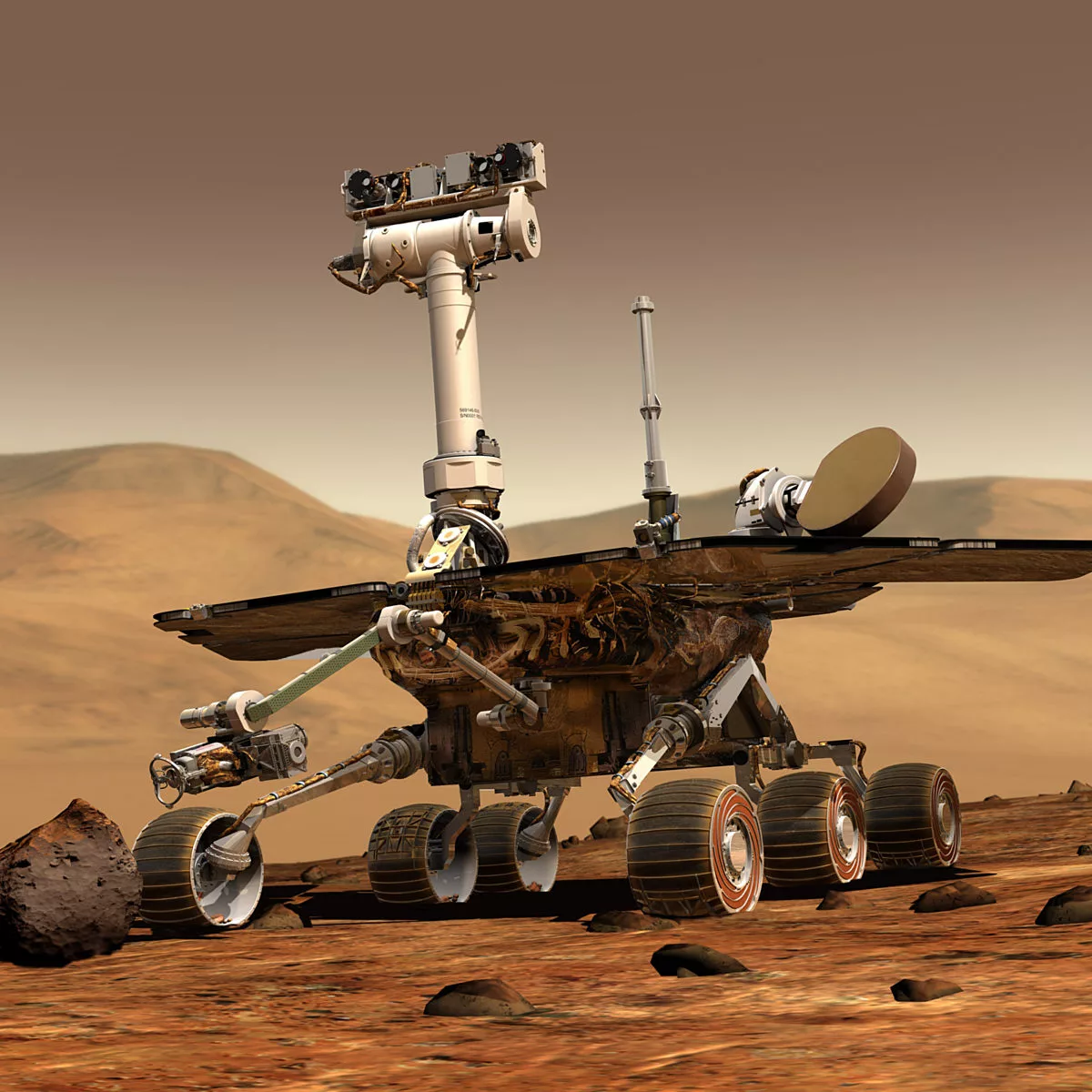
The Spirit Rover, and Why Cuteness Matters
There is something about the Spirit Mars rover, something that tugs at our hearts. I finally figured it out: it's cute.

Historic Final Flight of Space Shuttle Endeavour
After a 16 day journey of more than sixteen million miles, Space Shuttle Endeavour and her six man crew glided to a safe nighttime landing at 2:35 a.m. EDT on June 1 at NASA's Kennedy Space Center in Florida. I watched from close by the shuttle landing strip as the ghostly ship flew past, preceded by shocking twin sonic booms.

URGENT: Call Appropriations Committee members to support Pu-238 production
I just got the following email from the American Geophysical Union (AGU), requesting anyone whose Congressperson sits on the Appropriations Committee to place a phone call to support the production of Plutonium-238, the isotope of plutonium that powers spacecraft that cannot run on solar power.

Rosetta has entered its long sleep
One big space event that I missed while I was on vacation was Rosetta's entry into hibernation. Rosetta is the biggest interplanetary spacecraft that has been launched by ESA, and it has the groundbreaking goal of entering orbit around a comet and dropping a lander onto it.

A Vesta rotation movie from Dawn!!
What do you know! I spend my last pre-vacation post whining about the lack of image releases from Dawn as it approaches Vesta and what do I find in my Inbox on the morning of my return to work but: an image release from Dawn!

Europa on the Ropes
For now, Mars continues to eclipse Jupiter's moon Europa (shown here to scale) in NASA's flagship mission plans, but not in its appeal to many planetary scientists.

Shuttle LIFE Organisms Return from Space
In the middle of the night on June 1, 2011, millions of passengers returned safely to Earth as part of the great conclusion to space shuttle Endeavour's last flight, STS-134. Many of those millions of passengers were part of the Planetary Society's Shuttle LIFE experiment. Five different kinds of creatures from all three domains of life are part of Shuttle LIFE.

Observing at the WIYN
On May 5 and 6, I had a run on the WIYN (Wisconsin-Indiana-Yale-NOAO) telescope, a 3.5 m telescope, the second largest telescope on Kitt Peak in Arizona.

Summer Sights of the Solar System
What can you expect to see if you look at the night sky this summer (2011)?


A plea for more pictures from Dawn
If you had asked me last year what I was most looking forward to in space in 2011, my answer would have been unhesitating: Dawn's approach to Vesta. Never in my adult life have I been able to follow a space mission as it discovered a large new world for the first time.

Color versions of the recent Titan & moon beauty shots
Last week I got very excited about a set of pictures that had appeared on Cassini's raw images website, but was sad that I couldn't make color versions myself. I was so excited that I failed to identify the little icy moon in the picture correctly.

Two new views of Curiosity
This week two cool new views of the next Mars rover appeared in the Jet Propulsion Lab's image database, the Planetary Photojournal. One was real, and one simulated; I've been waiting to see both for many months.

Welcome Home Shuttle LIFE and Space Shuttle Endeavour
The Planetary Society welcomes home space shuttle Endeavour and the microscopic passengers it carried in Shuttle LIFE an experiment designed to test aspects of the transpermia hypothesis -- the ability of microbial life to survive an interplanetary voyage.

What's up in the solar system in June 2011
Time again for my monthly look at what's going on with the robots exploring the solar system! It'll be a busy month for Cassini, with lots of cool icy moon observations.
Mars Exploration Rovers Update: Spirit Mission Declared Over, Opportunity Roves Closer to Endeavour
The Mars Exploration mission suffered the loss of Spirit and shifted to one-rover operations in May, but Opportunity carried on, blasting across the plains of Meridiani to within 2 miles (3.5 kilometers) of its next major destination and discovery.

Dawn Journal: Vesta to choose Dawn's arrival time
Dawn remains healthy and on course as it continues to approach Vesta. Thrusting with its ion propulsion system, as it has for most of its interplanetary journey so far, the spacecraft is gradually matching its solar orbit to that of the protoplanet just ahead.
Zapping Rocks for Science
Laser beams and space exploration are perfect for each other, and not just because all self-respecting starship captains know their way around a blaster. It turns out that zapping rocks with a laser is not only fun, it also can tell you what they're made of!
Mars Exploration Rovers Update: NASA Ends Spirit Mission
The intensified effort to recover Mars Exploration Rover (MER) Spirit came to an end early Wednesday morning Pacific time and NASA has now transitioned the mission to a single-rover operation focused on Spirit's still-active twin, Opportunity.

NASA Selects Next New Frontiers Mission
NASA has selected the OSIRIS-REx mission as the next New Frontiers mission. OSIRIS-REx (Origins-Spectral Interpretation-Resource Identification-Security-Regolith Explorer) will be the first U.S. asteroid sample return.