

 Explore Worlds
 Find Life
 Defend Earth


All
All
 Sun
Sun Mercury
 Venus
Venus Earth
Earth Mars
Mars Jupiter
 Saturn
 Uranus
 Neptune
 Small Bodies
Stories, updates, insights, and original analysis from The Planetary Society.

At last, Ceres is a geological world
I've been resisting all urges to speculate on what kinds of geological features are present on Ceres, until now. Finally, Dawn has gotten close enough that the pictures it has returned show geology: bright spots, flat-floored craters, and enigmatic grooves.

Mapping Europa
Several global maps have been made of Europa, but amateur image processor Björn Jónsson felt they could be improved—so he decided to make a new one.
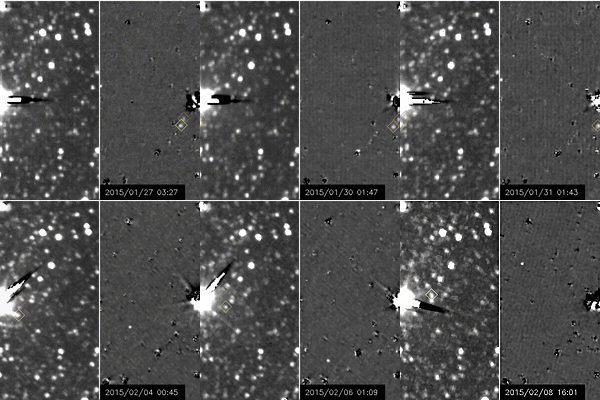
New Horizons spots Nix and Hydra circling Pluto and Charon
A series of images just sent to Earth from New Horizons clearly shows Pluto's moons Nix and Hydra orbiting the Pluto-Charon binary.

Cassini begins a year of icy moon encounters with a flyby of Rhea
At last! Cassini is orbiting in Saturn's ring plane again. I do enjoy the dramatic photographs of Saturn's open ring system that Cassini can get from an inclined orbit, and we won't be getting those again for another year. But with an orbit close to the ring plane, Cassini can repeatedly encounter Saturn's icy moons, and icy moon flybys are my favorite thing about the Cassini mission.

FOIA Request Sheds Light on NASA Mission Extension Process
A FOIA request offers insight into NASA's planetary science extended mission review process, which seems, at best, confusing, and at worst—with adjectival ratings like “Very Good/Good”—arbitrary.

New Horizons returns first images from mission's Pluto approach phase
Here they are, the first images of Pluto from the approach phase of the New Horizons mission. Science has begun; we're on the home stretch!

Ceres Coming Into View
Dawn is on approach to Ceres, the largest of the asteroids, and is starting to resolve features.

It's official: We're on the way to Europa
NASA's 2016 budget request increases the space agency's budget by $519 million, starts a new mission to Europa, increases funds to Commercial Crew, and threatens some long-running planetary missions.

Flawed Beauties
More examples of imperfect--but tantalizing--images from deep space.

Talking to Pluto is hard! Why it takes so long to get data back from New Horizons
As I write this post, New Horizons is nearing the end of a weeklong optical navigation campaign. The last optical navigation images in the weeklong series will be taken tomorrow, but it will likely take two weeks or more for all the data to get to Earth. Two weeks! Why does it take so long?
Ceres: Just a little bit closer (and officially better than Hubble)
Last week's Dawn images of Ceres were just slightly less detailed than Hubble's best. This week's are just slightly better.

Fountains of Water Vapor and Ice
Deepak Dhingra shares some of the latest research on Enceladus' geysers presented at the American Geophysical Union (AGU) Fall Meeting in San Francisco last month.

Year of the 'Dwarves': Ceres and Pluto Get Their Due
This year we achieve the first exploration of these curious but fascinating objects. Paul Schenk explains what we may learn about them.

Ten years after the Huygens landing: The story of its images
The landing of Huygens on Titan was a significant moment for planetary science and a great accomplishment for Europe. But the Huygens landing also stimulated the development of the international community of amateur image processors that does such great work with space images today. I was in the midst of it all at the European Space Operations Centre in Darmstadt.

JUICE at Europa
Europe's JUICE spacecraft will provide us with a detailed regional study of this icy moon of Jupiter.

Planetary exploration in 2015: The Year of the Dwarf Planet
Looking ahead to what we can expect from Earth's exploration of the rest of the solar system in 2015, there's an obvious theme: Dwarf planets.

Riding With Cassini Through 2014
Video: see some of the sights Cassini saw this year.

Revisiting Uranus with Voyager 2
Amateur image processor Björn Jónsson brings us some new views of Uranus from reprocessed Voyager 2 data.

The New Horizons science mission to the Pluto-Charon system is about to begin
It's been a long journey, but it's nearly over: New Horizons is just about ready to begin its science mission to Pluto, Charon, Styx, Nix, Kerberos, and Hydra. I'll remind you of New Horizons' capabilities and simulate how Pluto will appear in optical navigation images.

A Mission to Europa Just Got a Whole Lot More Likely
Rep. John Culberson, an outspoken supporter of Europa exploration, will assume leadership of an influential congressional committee that funds NASA.