

 Explore Worlds
 Find Life
 Defend Earth


Triple near-Earth asteroid discovered

Written by
Emily Lakdawalla
February 13, 2008
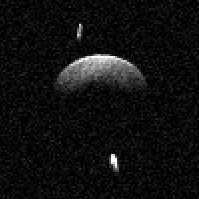
Astronomers using the soon-to-be-closed(?) Arecibo observatory announced today the discovery of the first near-Earth object known to be a triple system. Asteroid 153591 (2001 SN263) was first discovered as a mote of light by the LINEAR project on September 19, 2001. Asteroid 153591 (2001 SN263) is now on a relatively close pass by Earth; it'll approach within 10 million kilometers on February 20. (Here's a link to the JPL Near Earth Object Program dynamic orbit diagram.) Arecibo is routinely used to study the shapes and sizes of near-Earth asteroids on close approaches to Earth, and Arecibo radar images of such asteroids have yielded the discoveries of numerous binaries among the near-Earth asteroid population. But this is the first time it's turned up a triple system. The three bodies are 2, 1, and 0.4 kilometers across -- really quite remarkably similar in size. It's hard for me to imagine how such a system would be stable, unless one of the components orbits the others at quite a great distance. The release didn't make it clear what the separation is between the components.
Arecibo Observatory
Triple asteroid 153591 (2001 SN263)
Observing a close pass of asteroid 153591 (2001 SN263) on February 11, 2008, astronomers discovered that it was a triple system. This image from the Arecibo radio telescope shows all three components. The three are rather similar in size: 2, 1, and 0.4 kilometers in diameter.You Power the Next Great Discovery!
Fund future scientific research that advances space science and exploration with your gift today.
Donate