

 Explore Worlds
 Find Life
 Defend Earth


Messages from Earth
Sending millions of names to the planets and beyond
The Planetary Society has helped send names, messages, images, and good wishes aboard more than a dozen spacecraft. To date, we've sent our members and supporters to the Moon, Venus, Mars, Saturn, asteroids, comets, Pluto, and out of the solar system entirely.
In some cases, we built the hardware used to carry the names into space. In others, we partnered with other groups to collect names. Below is a list of all missions that have carried or are carrying Planetary Society member names.
LightSail 2 - OSIRIS-REx - MAVEN - Hayabusa2 - IKAROS - Akatsuki - Glory - Lunar Reconnaissance Orbiter - Kaguya (SELENE) - Phoenix - Dawn - New Horizons - Deep Impact - Cosmos 1 - Mars Exploration Rovers Spirit and Opportunity - Hayabusa (MUSES-C) - Stardust - Cassini-Huygens - Mars Pathfinder - Mars '96
LightSail 2

The Planetary Society collected names, selfies, and other messages to fly aboard our LightSail 2 spacecraft, which launched in July of 2019. You can find your mission participation certificate here.
LightSail 2 is the first spacecraft in Earth orbit propelled solely by sunlight. It is a technology demonstration showing that solar sailing is a viable means of propulsion for CubeSats—small, standardized spacecraft that are part of a global effort to lower the cost of space exploration.
OSIRIS-REx

The Planetary Society collected names for NASA's OSIRIS-REx mission in October 2014, sending a total of 442,803 names aboard the spacecraft on a microchip. If you participated, you can find your certificate here.
OSIRIS-REx stands for Origins Spectral Interpretation Resource Identification Security -- Regolith Explorer. This NASA mission launched in 2016 to explore asteroid Bennu. Names hitched a ride to the asteroid, spent over two years there, and returned in the Sample Return Capsule to Earth in 2023. A duplicate set of names is also onboard the main spacecraft, now operating as the OSIRIS-APEX (APophis EXplorer) mission, which remains in space after dropping off the Sample Return Capsule.

Names are on this spacecraft, which started its journey to Mars on 18 November 2014.
MAVEN stands for Mars Atmosphere and Volatile EvolutioN; it's a mission designed to study Mars' upper atmosphere and its interactions with the Sun. One key scientific question will be how quickly Mars' atmosphere is currently escaping into space -- the current loss rate is an important variable that controls models of what Mars' climate was in the past. Here's the MAVEN mission website, if you want to find out more.
Names were provided September 2011 to the mission for inclusion on the spacecraft and are on their way to Mars.

The Planetary Society and Japan Aerospace Exploration Agency (JAXA) collected names for the Hayabusa2 mission to asteroid Ryugu. Participants could elect to have their name on the target markers the spacecraft dropped on Ryugu, and/or inside the sample return capsule that returned to Earth in 2020. If you were a member of The Planetary Society prior to the names collection closing date of 9 August 2013, your name was included on both.
You can find your certificate here.
IKAROS

Names are on this solar sail spacecraft orbiting the Sun between Earth and Venus orbits.
IKAROS (Interplanetary Kite-craft Accelerated by Radiation Of the Sun) launched with Akatsuki 21 May 2010. An experimental spacecraft, JAXA designed the IKAROS mission to further test and understand solar-sail technology for interplanetary missions. Solar sail spacecraft are propelled by solar pressure, or pressure due to radiation from the Sun, across the surface of the spacecraft. IKAROS successfully unfurled its sail, deployed two cameras, and traveled beyond Venus.
The Planetary Society provided a silica glass mini-DVD that is flying on board the IKAROS solar sail mission flown by the Japan Aerospace Exploration Agency (JAXA). The mini-DVD contains names and messages from those collected on the web as well as all Planetary Society member names as of March 2010.


Akatsuki is a Japan Aerospace Exploration Agency (JAXA) Venus orbiter that launched with IKAROS on 21 May 2010.
Names included members of The Planetary Society (as of January 2010) as well as message submitted by people from around Earth. The names are on aluminum plates created by JAXA.


Launch failure: Names somewhere in the Pacific Ocean.
Glory was an Earth-orbiting satellite designed to study aerosols in the atmosphere and solar irradiance, both of which are important inputs into Earth's energy balance and global climate. Participants' names, including names of Planetary Society members (as of January 2010), were recorded on a microchip that was incorporated into the spacecraft.
After a previous launch delay, the rescheduled launch on 4 March 2011 was unsuccessful resulting in the spacecraft re-entering probably in the Pacific Ocean.

LRO's mission focuses on the "selection of safe landing sites, identification of lunar resources, and the study of how the lunar radiation environment will affect humans." NASA launched LRO on June 18, 2009 and on board was a microchip containing 1.6 million names.

Names are on this spacecraft impacted the Moon.
The Planetary Society joined with The Planetary Society of Japan and the Japan Aerospace Exploration Agency (JAXA) in the "Wish Upon the Moon" campaign, sending thousands of names and messages to the Moon. Names were micro-written on a thin film of metal foil and mounted on the exterior of the spacecraft. The Planetary Society provided a list of member names on 11 February 2007.
Kaguya, a JAXA lunar orbiter, launched 14 September 2007, arrived 3 October 2007, and intentionally crashed into Moon after a successful mission on 10 June 2009.

Top line: “Wish Upon the Moon” Campaign;
Bold text to upper right: Open application period: 12/1/2006 (Friday) – 2/28/2007 (Wednesday). Soliciting 412,627 people (234,498 from Japan, 178,129 from abroad);
Text in image to the upper left: ~Send your name and message to the moon~ Selene “Wish Upon the Moon” Campaign;
Text in lower right: Size: 280x160 mm Character size: 70 micrometers;
Text in lower left: 1 name sheet set (group of two sheets) attached to two faces of Kaguya.Image: JAXA. Thanks to Kevin Carr for the translation.

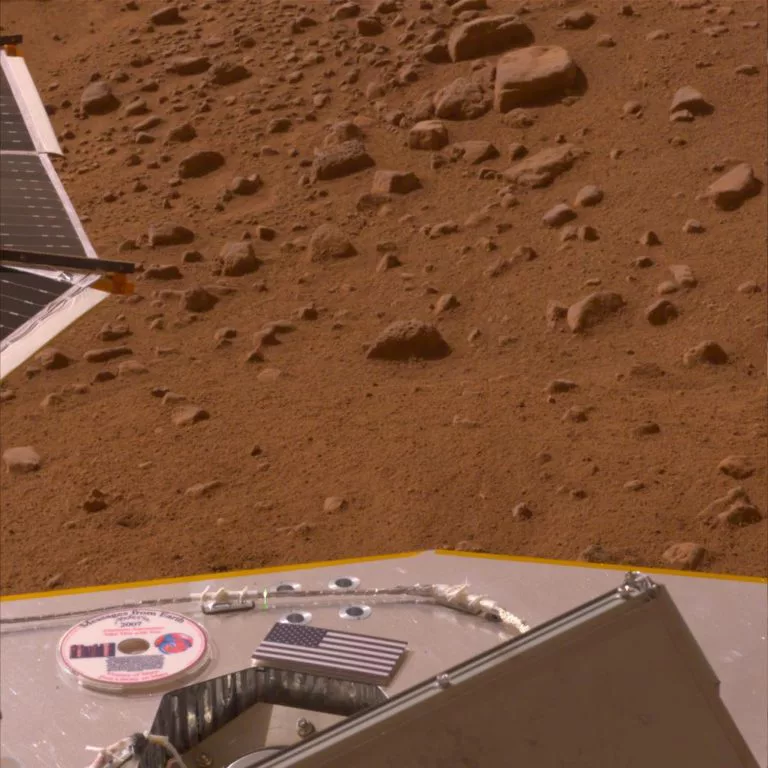
Names are on the Phoenix lander on the surface of Mars.
Phoenix was the first lander to explore the Martian arctic, landing near 70 degrees north latitude. Phoenix launched on 4 August 2007 and landed on the surface of Mars on 25 May 2008. The Planetary Society provided a list of member names on 1 February 2007.
The Planetary Society provided, at no cost to NASA, a silica glass mini-DVD containing "Visions of Mars," the first Martian library, and 250,000 names. The mini-DVD was affixed to the lander deck, and is visible in many of the images returned to Earth from the northern polar plains of Mars.

Names on this spacecraft orbited the main-belt asteroid Vesta in 2011 followed by the asteroid Ceres 2015.
A microchip containing the names of 360,000 people who signed up on the internet, plus all the names of Planetary Society members, are recorded on a microchip affixed to a side brace of the spacecraft.


These names flew by Pluto in 2015, the Kupier belt object Arrokoth in 2019, and are now heading toward interstellar space.
New Horizons is a NASA flyby mission to Pluto and the Kuiper belt. It launched on 19 January 2006. A compact disc containing 434,738 names is mounted on the exterior of the New Horizons spacecraft.


Launch failure: names likely in the Arctic Ocean or nearby.
Cosmos 1 is a failed Planetary Society mission to test solar sail technology in Earth orbit. Launched on launched 21 June 2005, it contained Planetary Society member names based on a list provided on 20 August 2003.
A compact disc containing 76,922 names of current members of The Planetary Society and The Planetary Society of Japan was affixed to the body of the spacecraft. The disc also contained letters, stories, and texts relating to the rich history of solar sailing in science and science fiction. At present, it is not possible to download a participant certificate from the Internet.


Names slammed into Comet Tempel 1.
Deep Impact was a NASA mission to fly by and impact comet Tempel 1. The spacecraft launched on 12 January 2005 and impacted the comet occurred on 4 July 2005.
A disc containing 650,000 names was mounted on the impactor portion of the Deep Impact spacecraft. When the impactor slammed into Tempel 1, it and all the names it carried vaporized.

Names on Mars in two locations at the Spirit and Opportunity landing sites. This included the names of all Planetary Society members as of 6 December 2002
The Planetary Society provided, at no cost to NASA, two identical silica glass DVDs containing more than four million names apiece. These were only the second time that privately contributed hardware flew on a U.S. planetary mission (the first being The Planetary Society's Mars Microphone aboard Mars Polar Lander). The DVDs, part of the Red Rover Goes to Mars project, were mounted to the Spirit and Opportunity landers. Each rover acquired several images of the individual DVDs before embarking on their historic journeys across Mars, leaving the landers and the DVDs behind.


Names resting on the asteroid Itokawa.
Hayabusa was a JAXA spacecraft with a mission return samples from asteroid Itokawa. The spacecraft launched on 9 May 2003, arrived at asteroid Itokawa on 12 September 2005, and released a target marker on 10 November 2005.
To prepare for its touchdown on asteroid Itokawa, Hayabusa released two shiny target markers that would serve as guides for optical navigation. Wrapped inside one of the markers was a thin film of aluminum foil etched with 877,490 names, collected by The Planetary Society and JAXA.


Names flew by Comet Wild 2 then later by Comet Wild 2. One copy of the names is in interplanetary space on Stardust spacecraft, the other returned to Earth.
Stardust was a NASA sample return mission from the coma of comet Wild 2. The spacecraft launched on 7 February 1999, and its flyby of Comet Wild 2 happened on 2 January 2004. It completed its sample return to Earth on 15 January 2006 and journeyed onward to complete a flyby of Comet Tempel in February of 2011.
Stardust flew within 236 kilometers of the nucleus of comet Wild 2. The spacecraft and the sample return capsule each carried two microlithographs from separate name collection efforts. The first contains 136,000 names collected in October and November of 1997, including the names of Planetary Society members and Stardust team members, and the second contains over a million names collected from May to August 1998.


Names crashed into Saturn, vaporizing and becoming part of Saturn on 15 September 2017.
Cassini-Huygens was a NASA / ESA / ASI Saturn orbiter & Titan probe. The spacecraft launched on 15 October 1997 and achieved orbital insertion on 1 July 2004.
A mini-DVD containing 616,400 handwritten signatures was attached to the Cassini orbiter on 22 August 1997. After a successful mission, the spacecraft (including the DVD) was intentionally crashed into Saturn, vaporizing it and becoming part of the planet itself.
We do not know if all Society member names are included on this disk, but volunteers from the Planetary Society were responsible for the enormous task of sorting, counting, and scanning all of the postcards containing handwritten signatures for inclusion on the DVD. More information about the history of the DVD can be found at this NASA report.


Names are on the surface of Mars.
Pathfinder was a NASA Mars lander that successfully transported the Sojourner rover to Mars. The spacecraft launched on 4 December 1996 and landed on Mars on 4 July 1997.
A spare copy of the MAPEX (microelectronics and photonics experiment) chip that was originally developed for Mars '96 was included on Mars Pathfinder. The MAPEX chip included the names of Planetary Society members.

Launch failure: names re-entered Earth’s atmosphere.
Mars 96 was a Russian Mars orbiter that experienced a launch failure on 16 November 1996.
The Planetary Society provided a compact disc containing Visions of Mars, a collection of Mars literature, art, and personal messages from Mars visionaries, to the Mars 96 mission. Names of 100,000 Planetary Society members were included in a different component of the orbiter called MAPEX (the microelectronics and photonics experiment). MAPEX was mounted on the surface of the compact disc before it was sent to Russia. Unfortunately, Mars 96 suffered a launch failure. MAPEX later made it to Mars aboard the Mars Pathfinder lander in 1997, and Visions of Mars finally arrived aboard the Phoenix lander in 2008.