

 Explore Worlds
 Find Life
 Defend Earth

Door 30 in the 2010 advent calendar

Written by
Emily Lakdawalla
December 30, 2010
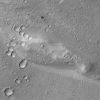
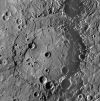
Time to open the thirtieth door in the advent calendar. Until the New Year, I'll be opening a door onto a different landscape from somewhere in the solar system. Where in the solar system is this ridged crater?

Here's how the MESSENGER team describes the Rembrandt impact basin, which was not seen by Mariner 10, so was first observed during MESSENGER's second flyby:
The Rembrandt basin is remarkably well preserved. Most large impact basins on Mercury, the Moon, and other inner planets are flooded by volcanic flows that cover their entire floor. The number per area and size distribution of impact craters superposed on Rembrandt's rim indicates that it is one of the youngest impact basins on Mercury. Exposed in portions of Rembrandt's floor is terrain preserved from when the impact basin formed. In most large impact basins this terrain is completely buried by volcanic flows erupted long after basin formation. Volcanic material does fill the central area of the Rembrandt basin and was deformed by tectonic forces into a complex pattern of ridges and troughs. Ridges formed during subsidence and contraction, and troughs formed during uplift and extension of the basin floor. Both types of deformation occurred after the interior volcanic flows were emplaced.
You may notice a funny faded line running through the right side of this image from top to bottom. That faded line is a mark of some image magic that the MESSENGER team had to do to create a view of the entire crater. You may also notice that the direction of solar illumination changes across the image -- the Sun is coming from the left on the left side of the photo and from the right on the right side of the photo. What gives?
The left part of the image was taken on October 6, 2008, as MESSENGER approached for its second flyby; at the time, the crater was disappearing into the sunset on Mercury's terminator, and the right edge of the crater was in darkness. The right part of the image was filled in with data from the departure view from MESSENGER's first flyby on January 14, 2008, when almost exactly the opposite hemisphere of Mercury was in sunlight. MESSENGER got photos of very nearly all of Mercury during its three flybys, but images like this one provide one example of why the data from the orbital mission will be a major improvement: MESSENGER will map all of the planet at consistent solar illumination angles, which will provide a better base map for scientific analysis. Actually I am quite amazed by how well the two parts of this image match up!
The Planetary Society Blog 2010 Advent Calendar









You Power the Next Great Discovery!
Fund future scientific research that advances space science and exploration with your gift today.
Donate