
Nighttime Sky View of Future Galaxy Merger: 4 Billion Years
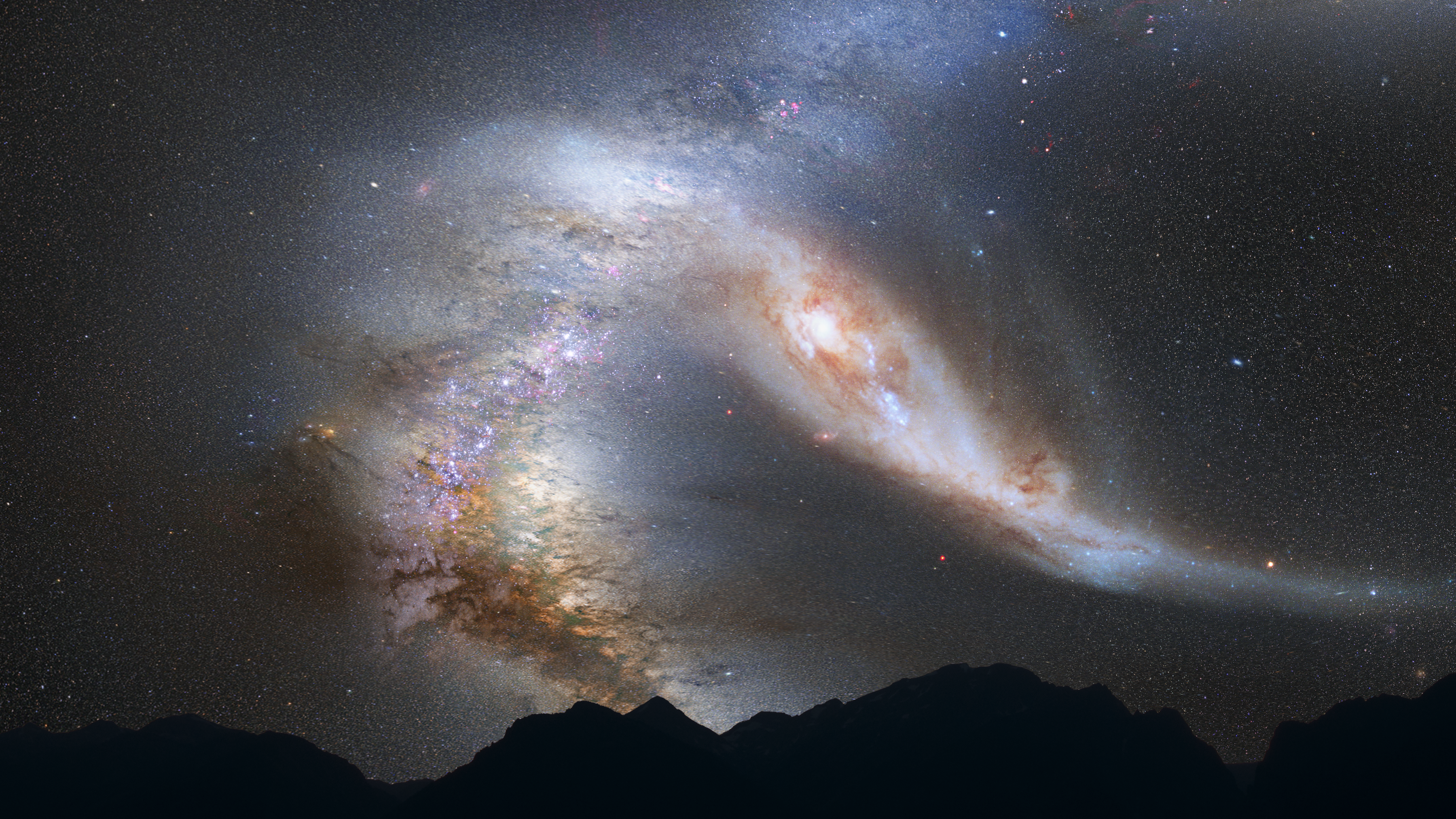
Filed under pretty pictures, art, stars and galaxies, astronomy
NASA, ESA, Z. Levay and R. van der Marel (STScI), T. Hallas, and A. Mellinger
Here is the full 8-image series:
NASA, ESA, Z. Levay and R. van der Marel (STScI), T. Hallas, and A. Mellinger
Nighttime Sky View of Future Galaxy Merger: Present Day
This is a nighttime view of the current sky, with the bright belt of our Milky Way. The Andromeda galaxy lies 2.5 million light-years away and looks like a faint spindle, several times the diameter of the full Moon.
NASA, ESA, Z. Levay and R. van der Marel (STScI), T. Hallas, and A. Mellinger
Nighttime Sky View of Future Galaxy Merger: 3.85-3.9 Billion Years
During the first close approach, the sky is ablaze with new star formation, which is evident in a plethora of emission nebulae and open young star clusters.
NASA, ESA, Z. Levay and R. van der Marel (STScI), T. Hallas, and A. Mellinger
Nighttime Sky View of Future Galaxy Merger: 3.85-3.9 Billion Years
During the first close approach, the sky is ablaze with new star formation, which is evident in a plethora of emission nebulae and open young star clusters.
NASA, ESA, Z. Levay and R. van der Marel (STScI), T. Hallas, and A. Mellinger
Nighttime Sky View of Future Galaxy Merger: 5.1 Billion Years
During the second close passage, the cores of the Milky Way and Andromeda appear as a pair of bright lobes. Star-forming nebulae are much less prominent because the interstellar gas and dust has been significantly decreased by previous bursts of star formation.
NASA, ESA, Z. Levay and R. van der Marel (STScI), T. Hallas, and A. Mellinger


Go Back


Comments:
Leave a Comment:
You must be logged in to submit a comment. Log in now.



