

 Explore Worlds
 Find Life
 Defend Earth


Mars Express animation of Phobos' shadow transiting Mars

Written by
Emily Lakdawalla
February 2, 2010
A cool item was posted to the Mars Express VMC website this morning:
For the first-time ever, VMC has imaged what we believe to be the shadow of Mars' moon Phobos crossing the surface of Mars. The shadow cast by Phobos as it passes between the Sun and Mars was photographed by VMC on 30 January, just as Mars Express approaches an intensive scientific observation campaign of Phobos.
These events (called Phobos Transits) are similar to a solar eclipse on Earth but happen much more frequently. The shadow cast by the tiny moon has been seen by several spacecraft before, including by HRSC on Mars Express, but such a long sequence of images showing the shadow crossing the planet is very rare.
They went on to invite readers to produce an animation from their images. Sure, I'll make an animation! Here's my version, produced from the raw images using the processing technique I discussed in my VMC image processing tutorial:
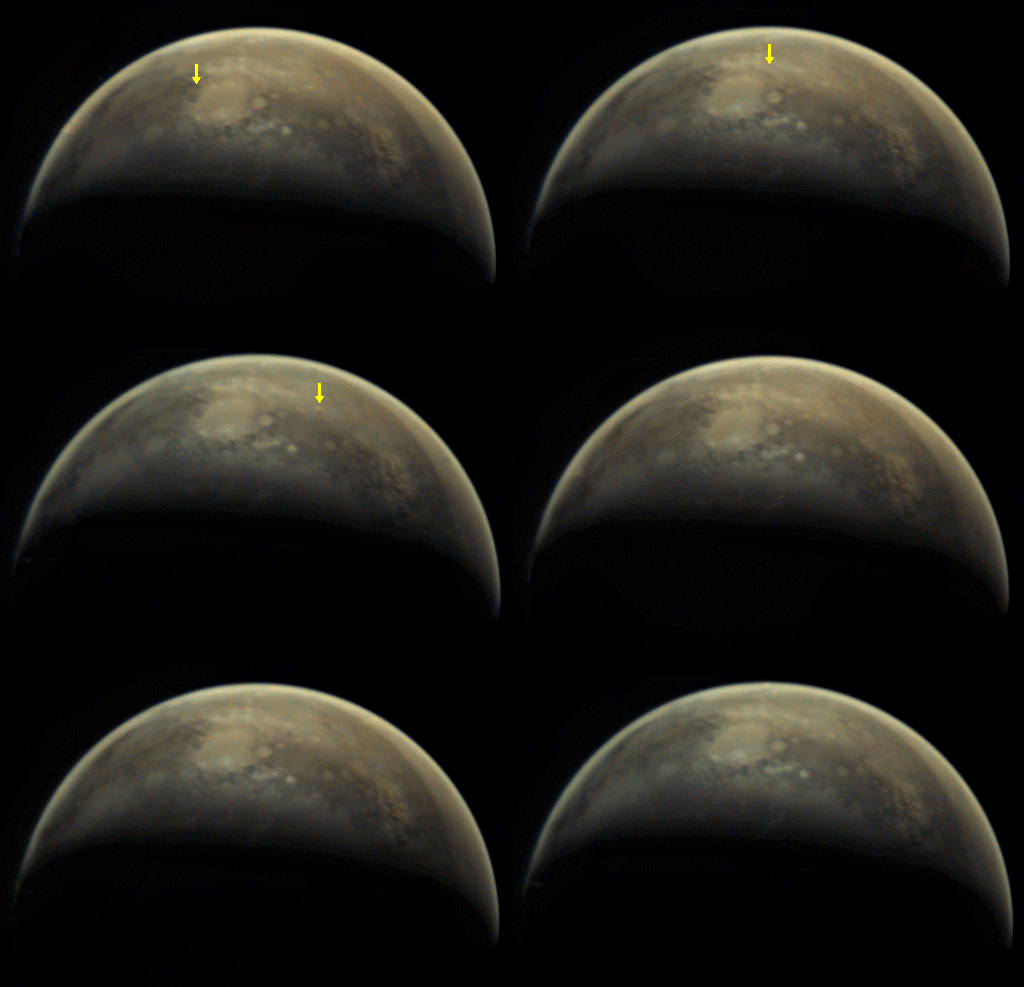
(You may notice a couple of funny artifacts near the limb in the last two frames. The last frame was cut off at the edge as Mars drifted out of VMC's field of view, so I substituted in a bit of the limb from the previous frame. I also painted out some artifacts in those last two frames. But my touch-up job was hurried and not very good and because the human eye is really good at detecting motion those artifacts jump out at you during the animation.)
Undoubtedly, VMC will see this event again. Phobos shadow transits are very common because Phobos orbits so close to Mars (at an altitude of 6,000 kilometers or so, roughly the same as Mars' diameter) that no matter what season it is, the shadow almost always crosses Mars' disk once each 8-hour orbit. Only near the solstices does the shadow miss Mars. In fact, it's quite likely that the event has happened before in VMC observations and just not noticed -- this one was seen by accident by Thomas Ormston at ESA earlier today. Check out the older photos and see if you can find more Phobos transits!
You Power the Next Great Discovery!
Fund future scientific research that advances space science and exploration with your gift today.
Donate