

 Explore Worlds
 Find Life
 Defend Earth

Proof for liquids on Titan

Written by
Emily Lakdawalla
July 30, 2008
There's an article just published in Nature by the Cassini Visual and Infrared Mapping Spectrometer (VIMS) team, led by Robert Brown, titled "The identification of liquid ethane in Titan's Ontario Lacus." The associated press release is titled "NASA Confirms Liquid Lake on Saturn Moon." This may be making some of you ask: but wait, haven't they already proven there's liquid lakes on Titan?
Sort of. In science -- particularly the observational and descriptive end of science (as opposed to the experimental end) -- there's all kinds of shades of proof. For the liquids on Titan story, we had, to begin with, observational evidence of lots of methane in the atmosphere. So much methane would be really, really hard to sustain without a reservoir on the surface, and the surface temperature of Titan is such that methane should be stable as a liquid. So even without sending a spacecraft there we already had good evidence for liquids on Titan.
Then Cassini arrived, and it applied a battery of techniques to try to peep through the haze to see what was going on at the surface. The first piece of stronger "proof" of liquids on Titan came from the cameras, which spotted vaguely river-like features, and south polar clouds. But the rivers could quite well be dry (in fact, they probably are), and the clouds could produce no rain. The Huygens landing made it really obvious that liquids are an important element in the story of what creates Titan's surface features. There were unmistakably fluid-carved channels, and rounded cobbles of ice at the landing site whose shape really had to have been created through tumbling with other cobbles in a running river. Still, that's only evidence for past liquids, not present liquids. If you think that's unimportant, consider the question of water on Mars. There's tons of evidence for past water on Mars, but no chance of any liquid water at present.

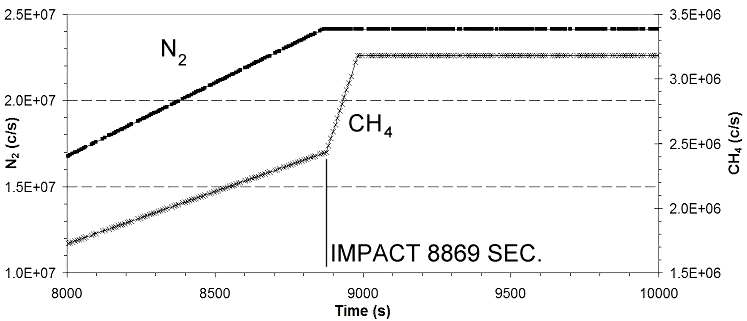
But close analysis of the Huygens data did yield a possible detection of current liquid methane on the surface. The Gas Chromatograph Mass Spectrometer measured the composition of Titan's atmosphere as Huygens descended. Once Huygens had landed, GCMS kept measuring, and it noticed an increase in the amount of methane in the atmosphere over several minutes following the landing. The GCMS team interpreted this to mean that the heated inlet port of GCMS was either close to or in contact with the surface, and that its heat was causing liquid methane that was present in the subsurface (dampening the icy soil) to evaporate. Were damp soils enough to maintain the levels of methane in the atmosphere?
With the Huygens mission over, Cassini kept looking for present liquids. The RADAR team was looking particularly hard, but it was the camera team, ISS, that spotted the first thing that kind of looked like a presently liquid lake, this dark spot near the south pole. It was seen during a nontargeted flyby of Titan, on rev 9, on June 6, 2005.

This thing looks enough like a lake that it's now named Ontario Lacus. But it's so small and unassuming that it is hard to pin the whole atmospheric methane story on one tiny, isolated spot near the south pole. There had to be more lakes. Climatic arguments began to suggest they were probably at the poles. ISS couldn't see the north pole very well -- it was northern winter, so there wasn't enough sunlight. But RADAR carries its own "light source" -- it broadcasts radio waves and listens for the echoes. And when RADAR finally started getting passes that covered the north pole, that's when we finally had images that were very convincing evidence for present liquid lakes on Titan. The images were convincing enough that most people talk about the lakes on Titan as though they were a proven fact.

Here's a RADAR lake that even looks like Ontario Lacus.

Those images are really compelling, but do they constitute proof? Maybe for some. But it's possible to make up explanations for how these features look to the RADAR instrument that do not involve liquids. So it would really be nice if some other instrument could come up with a different line of evidence that provided a different kind of support for the claim that these are lakes.
That's what today's press release is about. The VIMS instrument, like ISS, can only see Titan's surface through spectral "windows," narrow regions of the electromagnetic spectrum where methane gas is transparent. Methane is a great absorber, and it tends to eat up all the incoming sunlight even before it hits Titan's surface; whatever survives to reach the ground mostly doesn't make it through the return trip back to space. But there are a few regions of the spectrum where methane doesn't absorb sunlight very well, and it can make it down from the Sun, to the surface, back up to the spacecraft to be measured. ISS only has one of these "windows" available to it, at about 1 micron, and it's only semi-transparent, a very foggy view to the surface. VIMS reaches to longer wavelengths, out to 5 microns. There are several very good windows for VIMS to see down to the surface of Titan, in particular a broad one centered at 2 microns and another very wide one at around 5 microns.
So VIMS can take pictures of the surface of Titan, and, lo and behold, the "lakes" seen by RADAR and ISS look dark to VIMS too. So far, we're not talking about a different kind of evidence. But what VIMS can do that ISS and RADAR can't is measure spectra -- that is, it can measure how strongly the surface absorbs light of minutely different wavelengths. VIMS is the instrument that tells us what the surfaces of Saturn's icy moons are made of -- ice, crystalline or amorphous, and some carbon dioxide, and other stuff.
The job of the VIMS team is much, much, much harder at Titan because to see the surface they have to look through the atmosphere, and the atmosphere has its own spectrum. So they have to figure out how to correct their spectra for the influence of all the gases in the atmosphere, and even when they've done that they only have tiny bits of spectra to work with, the bits around 2 microns and 5 microns and the couple of other places where the methane windows allow them to see to the ground. Figuring out how to correct for the atmosphere, and figuring out whether any of the features they could see through those narrow little windows were even real, has taken them years. But they're finally beginning to report on the results of all that work.
The paper reports that they got a particularly good look at the Ontario Lacus feature (the foot-shaped one first spotted by ISS) on December 4, 2007, on the "T38" flyby. It goes through a careful analysis of what few spectral details make it through the methane windows, and concludes on the basis of the spectral analysis that it must be a very smooth, quiescent liquid, made of ethane mixed with propane and butane. If methane is there, they can't see it, because they had to correct for the atmospheric methane, and in doing so they would have erased any spectral features that had to do with methane in Ontario Lacus.
So the VIMS team is reporting one set of evidence that's the same as what was cited before by ISS and RADAR -- the putative lakes are dark and smooth, so are probably liquid -- and one new piece of evidence, on the composition of the lakes, that they seem to contain ethane, propane, and butane. Ethane and propane would be liquids at current temperatures and pressures there; butane wouldn't, but would be soluble in the first two.
So, if you were a doubter before, this would be a new line of evidence that should make you more confident in the possibility that there are lakes on Titan. What else could form stronger proof? One thing that would be nice to see is a specular reflection from one of these lakes -- a mirror-like glint. Problem is you can only see specular reflections when you have exactly the right geometry, with the sun behind you. Maybe if Cassini is there long enough, they'll spot one.
Whether or not you "believe" in the lakes, you ought to buy a "Surf Titan" T-shirt. Come on, you know you want one.
You Power the Next Great Discovery!
Fund future scientific research that advances space science and exploration with your gift today.
Donate